Pleased to speak to @guardian about Reform’s energy plans. V much welcome the focus on the cost of living, jobs and growth.
Renewables are the cheapest form of new power we can build, while supporting British industry, local jobs, ports, factories, supply chains and coastal communities.
But energy is still far from affordable and we should all be asking what we can do to take more cost out of the system and accelerate getting off imported gas.
I did highlight one policy would be a mistake - tearing up existing Contracts for Difference. These are legally binding contracts, and undermining them would damage investor confidence far beyond renewables, without cutting bills.
Looking forward to discussing the many areas where we do align - above all on the need to secure affordable, home-grown energy as soon as possible.
https://t.co/GcolRjs2pj
🇬🇧 Britain's electricity is its 'most British' in over 20 years 🇬🇧
Our analysis shows 53% of energy in 2025 was generated in UK
https://t.co/ghAdeAp1wP
NEW ANALYSIS: Record wind and solar generation saved UK from gas imports worth £1bn in March 2026
📈Wind+solar were up 22% year-on-year in March to a record high for the month
⛴️This avoided the need for gas imports worth £1bn at current high prices
https://t.co/E2meLmnPe8
The UK energy price cap was introduced in 2019 as a means to protect billpayers on variable electricity and gas tariffs. It’s designed to both ensure fair pricing and reflect the underlying cost of supplying energy, but what actually goes into it? 🤔
Ahead of the price cap changing tomorrow (1 April), our latest blog explores the costs that go into the price cap, how Ofgem sets it each quarter, what is changing from tomorrow, as well as what 'policy costs' and 'network costs' actually are 💡
👉 https://t.co/NTpp8RQQh3
We have a growing range of resources and articles covering renewables and the energy transition, as well as a library of 'myth-busting' resources to help correct the record and establish the facts with political stakeholders, decision-makers, and the general public.
You can find out more and access them below:
🔗 https://t.co/STfFR3mECN
Around 90% of UK North Sea oil and gas ‘already drained dry’.
New drilling could amount to just 1–2% of total extracted since commercial operations began and through to 2050.
The latest Government survey data for renewables shows 78% support and 5% opposition.
Last week UK's solar and wind fleet produced a record-breaking 34GW on midday, Weds last week.
UKERC says that assertions that drilling the North Sea will provide energy resilience and affordability in the face of current fuel price shocks "actively distracts from the regulatory reforms needed to address the end-game dynamics of North Sea oil and gas"
https://t.co/IXGlzbwac8
Our Chief Executive Tara Singh (@RenewableUKCEO) caught up with @CityAM and @ChristianJMay to discuss the increasing polarisation in how we talk about energy, and the role that all forms of it have to play together.
"Whether you care about net zero, or care about low energy costs, or care about jobs... you have to recognise the role of renewables."
Watch here 📹 https://t.co/KrM2Lzalda
Tara also discussed the UK's energy resilience, following the publication of our new report on energy and national security. The report draws on a literature review, expert interviews and a tabletop exercise run with @RUSI_org to stress-test UK resilience under three plausible winter-time energy crisis scenarios, before providing six recommendations for Government that will help us deploy the new tools we need to meet the threats of this age.
Find out more here 📖https://t.co/rZeVQCO6Sb
'Staying the course on clean energy would not only save households three times as much money but render the UK truly energy secure for generations to come.'
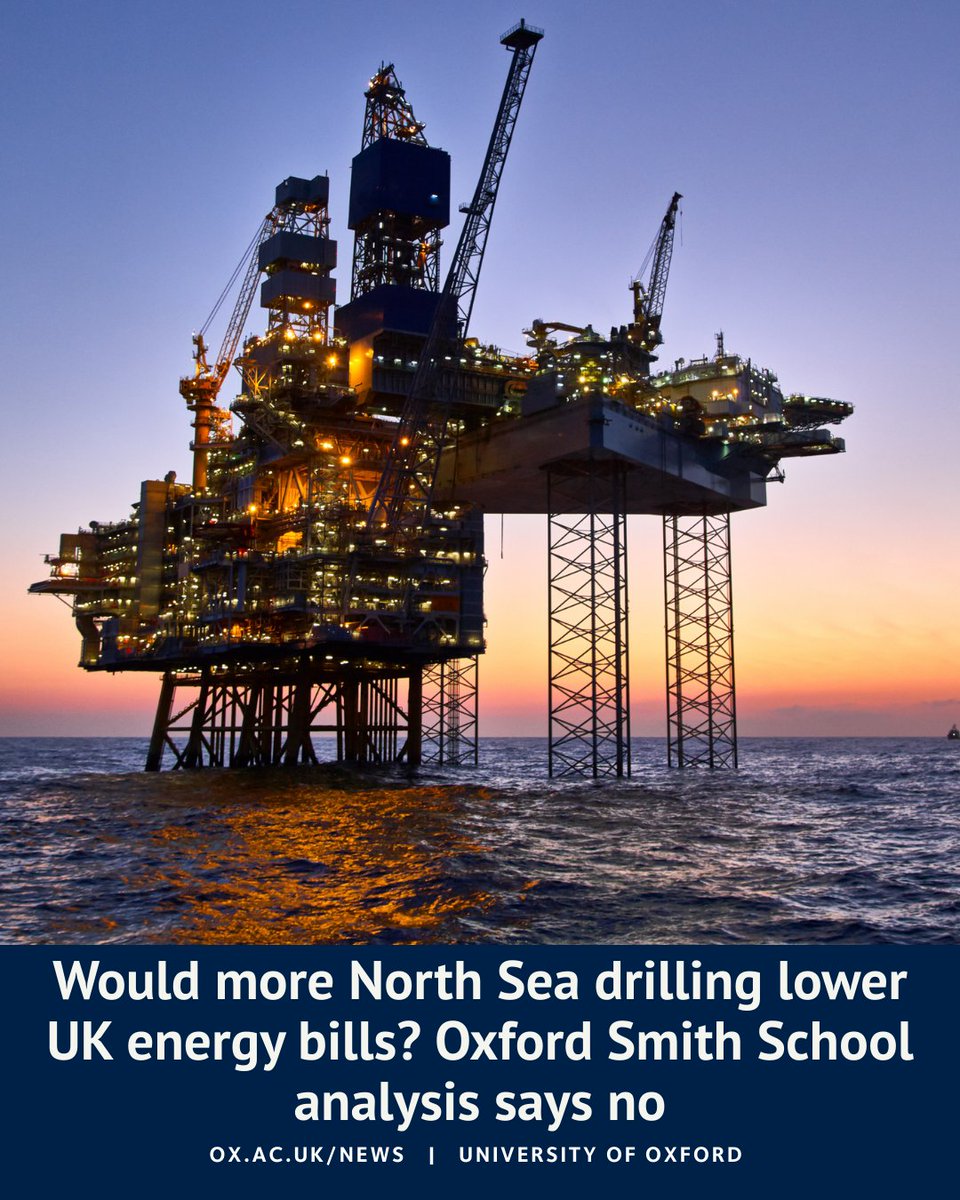
Maximising North Sea production would reduce bills by just £16 to £82 per year, say researchers from the Oxford Smith School ⬇️
https://t.co/PwdbfGrqck
✨ Big Boys – “I didn’t make it, did I?”
The Narrator informs Danny of his fate in the Big Boys finale episode, before Danny asks Jack for an alternate ending. A sliding-doors moment of the two potential routes Danny could take, becomes a powerful reminder of why anyone struggling should always choose to stay.
Vote now 👉 https://t.co/RU4j2xOxv6
#BAFTATVAwards with @pandocruises
Thanks to @Telegraph for running my op-ed today. Before anyone gets too excited: I’m calling for a depoliticised conversation about energy in the UK — not an overhaul of policy to favour oil and gas. https://t.co/TSTcUwhvYe 1/4
@energygovuk has announced the results of the non offshore technologies for the Contracts for Difference (CfD) auction AR7a, with 28 onshore wind projects awarded, totaling a capacity of 1.3 GW at a strike price of £72.24 per megawatt hour (MWh). Alongside the solar and tidal projects which also won contracts, these projects could support up to 10,000 jobs and bring £5 billion in private investment ⚡ 📊
📰 https://t.co/i2bAMDMFCn
Watch our latest video featuring Head of Onshore Wind James Robottom who tells us how this auction builds on the record-breaking offshore wind results announced last month and profiles the private investment, community benefits, and fresh opportunities throughout England, Scotland and Wales, with a total capacity of 1.3 GW, The capacity awarded today is enough to power more than 1.2 million homes 🏠 ⚡
@RUKCymru Director Jessica Hooper also explains how this result will attract much needed investment in Wales and could support up to 3,000 well paid jobs 🛠️
📰 https://t.co/IPqfrZxFZU
Policy Manager, Market Design Nick Hibberd explains how explains how onshore wind is much more cost-effective for billpayers than new generation from gas at £147/MWh and new nuclear power at £124/MWh 📉
Finally, Senior Policy Analyst Shareiss Smith sets out how onshore project give back to communities through community benefit funds, we estimate these new projects will generate more than £6.5 million in community benefits for those living near them. Examples of case studies throughout the country such as Pen y Cymoedd are available in our joint report with @ScottishRenew: 𝐂𝐨𝐦𝐦𝐮𝐧𝐢𝐭𝐲 𝐛𝐞𝐧𝐞𝐟𝐢𝐭 𝐢𝐧 𝐚𝐜𝐭𝐢𝐨𝐧: 𝐜𝐚𝐬𝐞 𝐬𝐭𝐮𝐝𝐢𝐞𝐬 𝐟𝐫𝐨𝐦 𝐭𝐡𝐞 𝐨𝐧𝐬𝐡𝐨𝐫𝐞 𝐰𝐢𝐧𝐝 𝐬𝐞𝐜𝐭𝐨𝐫 🌲
📎 https://t.co/olYjFxl8Ms
Renewables auctions to ⬇️ gas imports from 🇺🇸 by 1/2 in 2030
AR7a
🌬️ 1.3GW onshore wind
☀️ 4.9GW solar
➕
AR7
8.4GW offshore wind
🟰
⬇️ 🇬🇧 gas demand, limit gas imports by over 80 TWh/yr
More than 3️⃣❎ what new drilling licences might produce in 2030
https://t.co/o3CQqJ6hff
I've not posted here for a long time, but like Apollo Creed, I've been provoked back into the ring.
The new GWPF report, saying that renewables secured in the latest CfD auction (AR7) will add £600 to energy bills needs addressing.
A🧵with gifs.
Yes, I know how Rocky IV ends
"There's just a problem in Westminster where men, who are notorious bullies or sex pests, they get defended by their friends"
Ailbhe Rea, Political Editor for the New Statesman, says "women in Westminster" are "absolutely devastated" by the Mandelson revelations.
#Newsnight
Rachel Reeves should be very careful arguing only graduates should pay for their degrees
Would be a lot of cold pensioners without our generation’s taxes. I don’t make much use of the nuclear deterrent either
Education is a public good, not a commodity
Sensationalism of big numbers very misleading by @TimesRadio
£1m in one day on constraints? Big number
Per household? 3p
Annual cost on bills from constraints, 75% of which goes to gas : ~£52
Increase in wholesale costs caused by gas since invasion of Ukraine: £317
Two reasons why today is going to be frustrating for people in the energy sector.
1⃣Misleading/hyperbolic claims like this👇which are largely born from the complexity of our electricity system.
The CfD price is not the same thing as the price consumers pay, because of the way both CfD’s and the ‘pay as clear’ market works. You have to look at:
⚡️The benefits wind farms have in driving down the wholesale price of electricity (this is part often ignored, but saves us all billions)
💵CfD top ups and paybacks, &
🔋All system costs
This is why studies suggest a strike price of under £94 per MWh is net good for billpayers. The UK agreed £91 with wind farm developers today.
If there are any journalists who want someone to talk them through this – call Ofgem – the body set up to protect billpayers. I’m sure they’ll take the time to explain.
2⃣Second, and main, reason I’m frustrated.
We know:
💷That wind energy can be incredibly cheap – we were paying £54 per MWh (current prices) for offshore wind just a few years ago (before the cost increases effecting all infrastructure).
🌍That we are one of the windiest countries in the world.
⚡️That we need more electricity in the years to come. Ideally energy abundance.
🌊That (we can contest how much) there is only a finite amount of gas left in the North Sea - once that goes, we are a full importer of international gas.
So we will definitely, and obviously, need to build new wind farms (as well as nuclear etc) in the decades to come.
If this is the case – we need to focus on getting the costs of wind, and all energy infrastructure, down. As a long term, strategic priority for the UK.
If we had half the number of people coming up with solutions to help lower the costs of wind (e.g. planning and regulation reforms) and helping advocate for them as we do people pretending new gas isn’t very (and transparently, just Google for 2 seconds) expensive to build and price volatile – our country would be in a much better state.
"Offshore wind is still one of the best deals for consumers" Ana Musat of @RenewableUK explains why in 1 minute.
Wholesale prices for new:
🏭 gas: over £100/MWhr
☢️ nuclear: around £128/MWhr
🌬️ wind: around £86/MWhr (below £94/MWhr they save money off bills, above are cost-neutral for billpayers)
Tomorrow morning we’re going to find out the results of the latest Government auction for offshore wind farm contracts.
Here’s why it’s going to be a good news story for billpayers👇and why £94 per MWh, not the wholesale price, is the benchmark to judge if they’ll lower bills.
🏭Electricity demand is growing rapidly, whilst old generators are set to go offline soon – we need more power and renewables remain the lowest cost way to produce it (and yes, that’s including the costs to the system to managing their variability).
🛡️These wind farms offer stable prices for billpayers, and greater energy security - lowering our exposure to international gas markets and the geopolitics of other countries.
💵Only the lowest cost wind farms will be taken forward, after an incredibly competitive auction for contracts.
Warning: contains an attempt to explain wholesale price suppression.