Well, from a practical point of view it still depends on who and what you're asking.
The drone is just an object. It could also be a backpack lying on the back seat. If someone inside the car wanted a drink from a bottle inside the backpack and asked where it is, someone else would answer "it lies on the back seat" and not "it's comoving with the vehicle".
If instead a person at home asked where the backpack is, someone could say "it's in the car on it's way to <destination>".
But if an alien in some other star system asked that question the answer would probably involve the solar system and the Earths orbit. If the alien instead resided in some other galaxy or even cluster, then the respective bigger systems' velocities are also considered.
Here, the question was about the underlying physics. So the answer is that it depends on the frame of reference.
Even in your train example, humans can perfectly well look out the window and recognise that they're moving relative to the ground. That doesn't contradict their perception that they're stationary relative to the train either. The kind of sensory input is irrelevant. Removing the GPS from the drone wouldn't change the physics or the answer to the question of its velocity.
@xfebuse@mersomas And why precisely would that be the "only source of truth"? The reference frame of the operator is also just another comoving frame. If he's standing outside, then that frame is moving with the Earth.
Velocity is relative.
@dr01_d@Nasdorachi@mersomas That's because the air inside the train also moves with the train while that outside the train does not. Thus, the outside air is basically a wind in the opposite direction.
@moreisdifferent I personally don't see why that would be odd and feel that humans too quickly and too often assume that their experience and existence is in some form special.
I'm not agreeing with OP's interpretation here, but this is also not correct. It's word salad that sounds mathematical but isn't.
First of all, the problem doesn't describe a series. It shows two data points and you are asked to deduce the third.
Even if that was the case, n*n*2 is the same as (n+n)*n, neither is a preferred representation of a series, because neither even IS a representation of a series to begin with.
A mathematical series is a sum over a an infinite sequence of terms.
That's just a repetition of the same argument and narrow view shown in the first post.
If you have problems taking part in conversations with a large disparity in IQ, maybe you should work on not being perceived as the low-IQ one.
This post blew up, and the replies perfectly illustrate the exact point I was making.
The most common pushback is some version of:
“Nuh-uh, intelligent people can still communicate with lower-IQ individuals just fine.”
I shouldn’t have to spell this out, but here we go.
Nobody is claiming you can’t have a basic transactional conversation with a grocery store clerk, order food, or make small talk with your neighbor. Surface level communication works across moderate gaps. You point, you smile, you use simple sentences, it gets the job done.
The real breakdown happens when you move beyond scripts and start exchanging actual ideas.
That’s where the 20-point gap becomes a chasm:
- One person is thinking in systems, incentives, second and third order consequences.
- The other is stuck at first order, immediate, concrete terms.
What feels like a crystal clear, logical argument to the higher IQ person sounds like confusing, overly complicated nonsense to the other.
You’re not speaking the same conceptual language anymore.
This is why high IQ people often feel chronically alienated in normal social or professional environments, and why average people can find very bright individuals exhausting, “weird,” or arrogant.
It’s also why throwing together teams, friendships, marriages, or institutions with massive cognitive mismatches creates persistent friction that “just be nice” rhetoric can’t magically dissolve.
Basic communication? Usually possible.
Deep, accurate exchange of complex ideas? Often not.
If you cannot talk to someone of lower IQ, then you simply don't know how to communicate. Your own perspective is the only view that matters to you, and that's your problem.
In reality, you may not be able to talk about the most abstract things in the same way, but not only should you easily be able to talk about a topic from their perspective, you might even learn a thing or two.
Seriously, have you ever talked to a kid or even a mentally disabled person? If you do it right, they're incredibly easy to talk to. Additionally, they will show you a perspective most adults have long lost.
Once you hit about a 20-point IQ gap, communication starts to completely break down.
It's not that the lower IQ person is "stupid" (although that can often be the case) or the higher one is arrogant, it's that you're literally operating on different systems.
A 20 point difference (roughly 1.3 standard deviations) means:
Vocabulary and abstraction levels diverge sharply. What feels like crystal clear logic to one side sounds like vague, pretentious word salad to the other. Jokes land flat. Metaphors get taken literally. Complex cause and effect chains get simplified into "this good, that bad."
Different time horizons and pattern recognition. One person thinks in months or years and sees systems, the other is locked into days or immediate rewards. Trying to explain second order effects feels like speaking another language.
Also, processing speed and working memory gaps. The higher IQ person is already three steps ahead, getting impatient. The lower IQ person feels talked down to or overwhelmed.
Both walk away frustrated.
Both have wasted each others time.
We need to talk about the grief of losing your entire identity to motherhood while the man you married gets to keep his hobbies, his freedom, and his career completely uninterrupted.
Of course it does. Again, deterministic doesn't mean predictable. A chaotic system is fundamentally deterministic, but there exists some time horizon after which the system is no longer precisely predictable. That's because we cannot determine the initial conditions of the system.
There's still no randomness in there. If you knew the exact conditions to absolute precision, you could simulate it without error.
If you try to get at "free will" here, then I think that doesn't exist in either case.
Case 1. The universe is fundamentally deterministic: That means there is no free will, everything is pre-determined by the initial conditions of the system.
All your thoughts, ideas, plans, memories and future actions simply depend on the current state of the particles that your system is made of. You aren't the system, you don't even have access to all parts of the system and you certainly don't know the full state of the system to full precision.
You are a program that runs on the system. A mechanism employed by the brain to understand its input and perceived agency.
You not having all the information is the reason why you cannot predict your own actions far into the future and why you therefore think that you have agency over them.
Case 2. The universe is fundamentally non-deterministic: That means there is no free will, everything is fundamentally random, you cannot influence it. If you could, then there would exist some mechanism that you call "will" that removes the randomness. But that mechanism is part of the very same universe. So it also is either deterministic or random. If not, there exists a mechanism... You see how it goes.
Here, you're the same mechanism, or process, running on the brain. The only difference is now that your actions aren't just unpredictable because of you not having all the information, it's because fundamentally your actions are random.
---
In both cases, the best you can do is try to figure out patterns and probabilities of future actions based on past observations.
So, unless you believe that your "free will" somehow resides outside reality, it doesn't exist.
I personally think that 1. is true and that ultimately we'll find some kind of hidden variables model that explains all observed effects. But that is just my opinion.
So yes, I claim that given the exact same conditions, natural selection would work precisely the same. If it doesn't work the same, it's because the initial conditions aren't idedntical.
Why would you? As you stated yourself, chaos is completely deterministic. Whether - you - can deacribe it accurately is absolutely irrelevant. There is no randomness, the perceived randomness in a chaotic system is purely due to missing information.
Also, for all we know the same may apply to quantum mechanics. Just because the theory is probabilistic and proposes a "function collapse" doesn't mean that this is the actual underlying reality.
For all we know, this universe could also be super deterministic with absolutely zero randomness.
That's not because weather cannot be simulated, it's because weather is chaotic. Meaning, tiny differences in initial conditions will eventually result in large differences in trajectories.
You can still simulate weather, just not yours, because you cannot pin down the initial conditions precisely enough.
I agree in the above example, which is why I said searchability isn't a good argument. I still dislike it, but there's more stuff in the code that I consider bad than the naming.
Yes, we use `i` when it is used in a context where it represents something similar to an index. Just like `j` is used for a nested loop, `x` and `y` are commonly used for mathematical formulas and `e` is used for errors or events.
But these are usually conventions for specific cases. Also, not all one letter variables are created equally.
You would likely be fine with:
for i in range(0,10):
for j in range(0,10):
# do some stuff here
But how about:
for a in range(0,10):
for b in range(0,10):
# do some stuff here
Does this represent the same to you, or do the letters convey meaning already?
How about iterating over tuples:
for a,b,c,d in customer_data:
for e in d:
# do some stuff here
Still the same?
Or do you require at least somewhat "better" naming?
for n,a,ad,p in customer_data:
for i in p:
# do some stuff here
Or would it be better to have:
for name,age,address,products in customer_data:
for product in products:
# do some stuff here
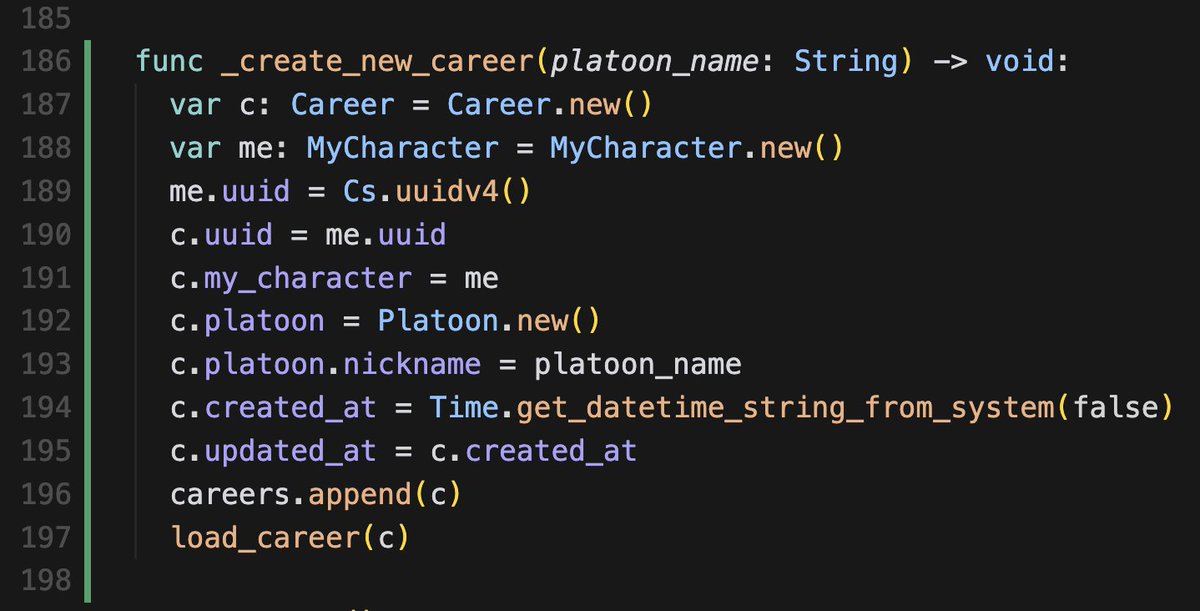
These are obviously no real world examples, they are just to illustrate that lines alone aren't sufficient. It depends on how much information the surrounding code provides. In the original example where you can deduce `Career` from `c`, it doesn't matter whether you have a function that's 5 lines long or 100 lines long, the context remains the same.
If you can deduce the meaning of some variable from the surrounding context, then it's probably fine to keep it less descriptive. If the context is unclear, then descriptive names are better.
the argument is that AI will replace every single job, both all jobs now and all jobs in the future, including any potential job that might be created given such displacement. The real question is "How will humans live without any jobs for anyone".
I would simply go ahead, solve it and then leave.
My capabilities are obvious from my application and provided sources, or from a talk we had previously.
If you're too lazy to look through them, don't believe me or still decide to come at me with unrelated leetcode questions, you're just being disrespectful.
That's entirely different though. In a standard for loop the 'i' is most commonly used as just an index. That means there must already exist a collection you can look for. The 'i' itself is irrelevant to the search process.
However, I think search isn't really a good argument either. In the picture above you can search for 'Career' just the same as you would for 'career' or any other name.
I still don't like the naming and wouldn't accept a PR like that.
Ah yes, two nouns in a row sound completely weird in English, which is why it's absolutely not common at all. In fact, it's so uncommon that thr English language clearly doesn't allow more than two nouns in a row.
Which is why it's very difficult to convey the idea of a simple "flight delay" that left you stuck in the "airport security line", completely ruining your "winter holiday travel plans". Or that before you even reached the broken "airline baggage claim conveyor belt" you had to pay an absurd "passenger luggage weight limit penalty fee", leaving you no choice but to spend the evening on hold with the automated "customer service department complaint resolution phone line".
Thank god the English language doesn't allow for basically an endless number of nouns following each other.
@wells_sl@Anabelvidal13@hell_line0 Speaking of barbaric and unnecessary, how about you go ahead and tell your God to leave babies alone instead of forcing diseases onto them?