🇸🇮 🇪🇺 Macroprudential Policy and Financial Stability Department at @ECB | Econ PhD from @EUI | Views are my own and not those by the ECB or the Eurosystem.
Giannis on Luka: he’s one of the best scorers
Reporter: right now for sure
Giannis: No, the best of all time. Some people are afraid to say it but I’m not. Definitely one of the best scorers of all time.
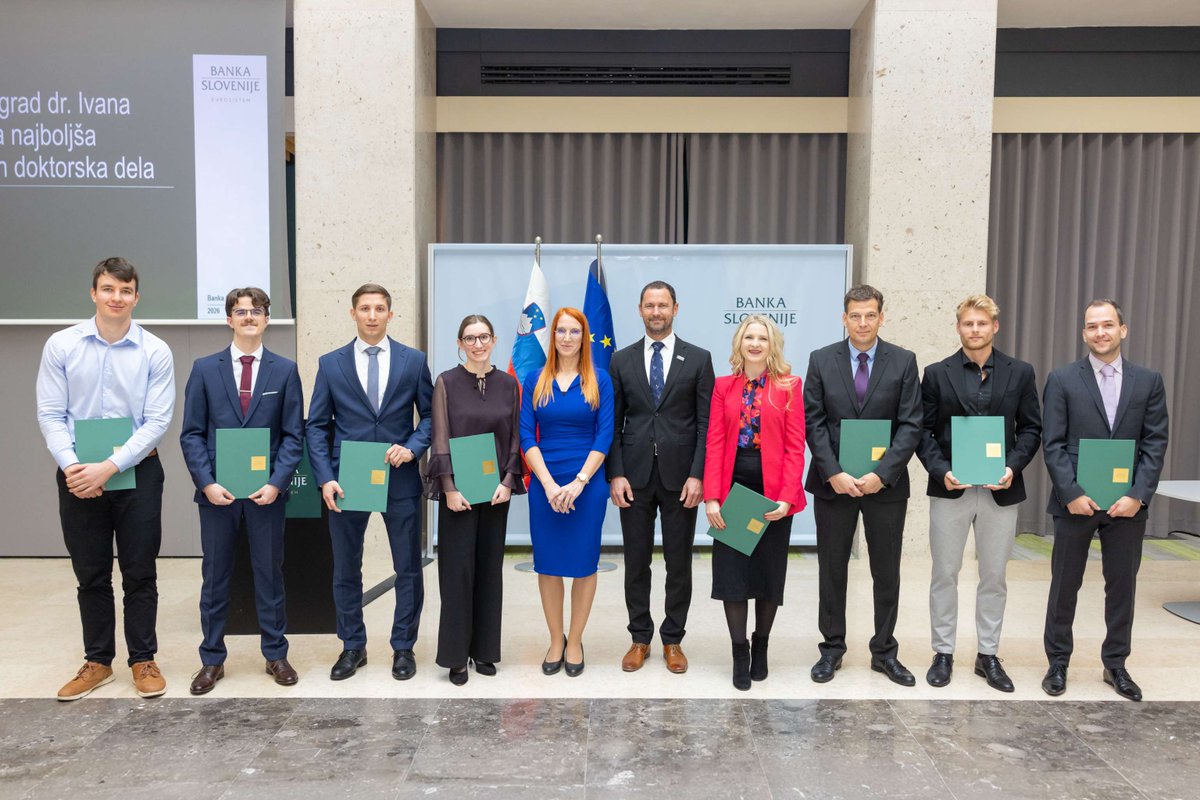
Honoured to receive the Bank of Slovenia PhD dissertation prize from the place where I started my career. Thank you to the committee for recognising my work, and to my supervisors Giancarlo Corsetti and @ChalleEdouard for their guidance throughout!
🎓 V Banki Slovenije smo tudi letos podelili nagrade prof. dr. Ivana Ribnikarja za najboljša magistrska in doktorska dela s finančnega področja.
Čestitke vsem prejemnikom letošnjih nagrad!
👉 https://t.co/Ae05l7MBfW
BREAKING NEWS
The Royal Swedish Academy of Sciences has decided to award the 2026 Sveriges Riksbank Prize in Economic Sciences in Memory of Alfred Nobel to Robert E. Hall and Michael Woodford “for microeconomic foundations of macroeconomic stabilisation.”
#NobelPrize
When Pogacar retires people will miss him. No one will give you a greater show than Pogacar. No rider in yellow gonna go all in risking it all in the last stage #pogacar#tdf2026#mvdp#cycling
Super interesting!
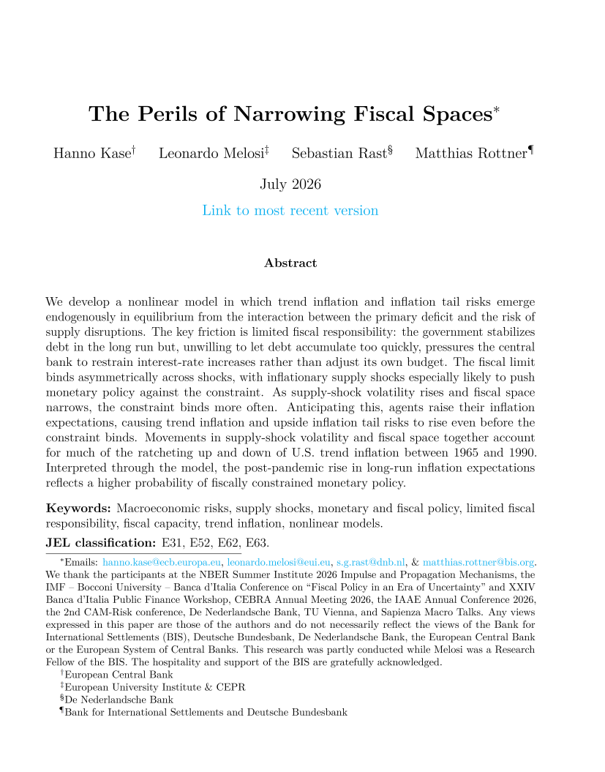
"The Perils of Narrowing Fiscal Spaces" by Hanno Kase, Leonardo Melosi, Sebastian Rast, and Matthias Rottner.
"We develop a nonlinear model in which trend inflation and inflation tail risks emerge endogenously in equilibrium from the interaction between the primary deficit and the risk of supply disruptions. The key friction is limited fiscal responsibility: the government stabilizes debt in the long run but, unwilling to let debt accumulate too quickly, pressures the central bank to restrain interest-rate increases rather than adjust its own budget. The fiscal limit binds asymmetrically across shocks, with inflationary supply shocks especially likely to push monetary policy against the constraint. As supply-shock volatility rises and fiscal space narrows, the constraint binds more often. Anticipating this, agents raise their inflation expectations, causing trend inflation and upside inflation tail risks to rise even before the constraint binds. Movements in supply-shock volatility and fiscal space together account for much of the ratcheting up and down of U.S. trend inflation between 1965 and 1990. Interpreted through the model, the post-pandemic rise in long-run inflation expectations reflects a higher probability of fiscally constrained monetary policy."
https://t.co/Dbk5m1fxGi
I am delighted to welcome Silvana Tenreyro as the next IMF Chief Economist. She brings exceptional academic & policymaking experience that will further strengthen the IMF’s analysis & policy advice to help our membership navigate a complex global economy. https://t.co/qmMLUhqoSa
For ~40 years, we've assumed RBC models imply a tiny welfare cost of business cycles.
In a new paper w/ V. Carvalho & @matias_cova2 we show that it's an artifact of the single‑sector assumption.
Drop it, and the cost is ~100x larger.
A 🧵 (1/n, n= 12)
https://t.co/nsDBi3D1Lr
If you're in an academic seminar, a good question to ask yourself occasionally is: what would this experience be like if everyone behave liked me? Would this be a seminar you would want to keep attending?
Wednesday? One Extra Year story!
This week, Evi Pappa will share her story through “Fragments from the Diary.” It is a story of resilience and success.
https://t.co/CuEwg7ikXj
There is so much discussion about the EU needing to solve Europe's problems. But this article is also a good reminder about what the individual countries can do.
Krugman's "Don't worry, be happy" message to Europe this weekend is damaging to Europe's reform agenda. He uses current-price PPP to wave away the structural productivity gap that @a_bergeaud and others have carefully documented. Europe is not collapsing, but it is stuck in a two-speed trap: Eastern catch-up, Southern stagnation, a chronic innovation gap with the US frontier since the mid-1990s, as I wrote this week in Silicon Continent. (Both posts linked in replies.)
The gap reflects how we lost our tech leadership in the ICT revolution (as PK does recognize) and now risk something more serious with AI. Draghi called it a near-crisis for a reason. Read @a_bergeaud's thread below on why the methodology, and the choice between current and constant-price PPP, matters, and why current PPP is not the right way to think about long term growth.
Thrilled that Biomni-AD won the $1M Alzheimer's Insights AI Prize at the AD/PD Conference in Copenhagen 🏆
Most AI tools answer a single question. Biomni-AD is a co-scientist agent. It explores hypotheses, integrates evidence across genetics, proteomics, neuroimaging & clinical data, and explains its reasoning so scientists can interrogate and build on it.
Alzheimer's will affect 152M people by 2050. No single researcher can synthesize all that data at once. That's exactly where AI agents change the equation.
Proud of the whole team. And it'll be freely available to researchers worldwide 🙏
https://t.co/vN6yWnMi2c
History for Slovenia! 🇸🇮
Klara Lukan with a new European record at the 10K Villa de Laredo!
Lukan took the victory in 29:50 - she becomes the first European in history to break the 30 minute-barrier on the roads! 🤯
#EARunning#10km#Running#EuropeanRecord
🚨 New policy brief 🚨
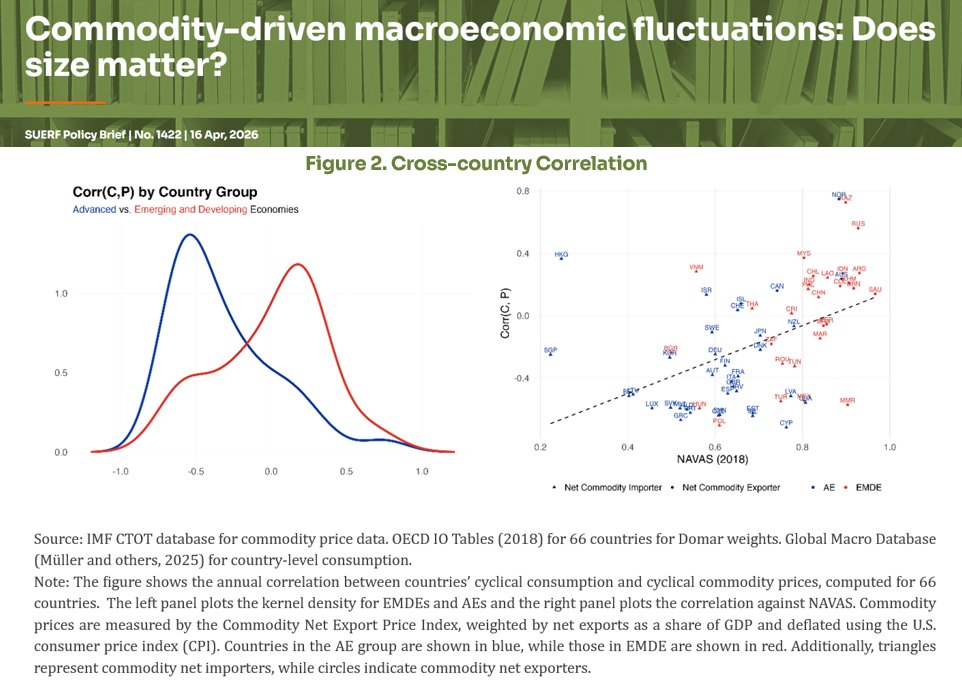
🔎 Key takeaway: Monetary policy frameworks should be adapted to account for domestic production networks when calibrating responses to commodity price shocks.
#SUERFpolicybrief “Commodity-driven macroeconomic fluctuations: Does size matter?" by Patricia Gómez-González, Maximiliano Jerez Osses, @JorgeMirandaPi5, Jean-Marc Natal (International Monetary Fund), and @VidaMaver (@ecb)
📄 https://t.co/Es51B9Vv1k