Dear real person,
If you should find that I've blocked you despite never having interacted with me, the reason is:
99% of you: I've repeatedly told X that I'm not interested in your content but it keeps appearing in my TL anyway
1% of you: I think you're an asshat
Cheers
@bunburyoudoujp So weird , you're the second person I follow (the other on Facebook) that visited this place in the last week, and I follow even less people there than I do here.
The new ATF Forensic Crime Gun Intelligence Laboratory is purpose-built to transform how law enforcement investigates violent firearms crimes. As the first forensic laboratory to specialize in DNA recovery from fired cartridge cases, FCGIL combines advanced DNA collection and analysis with a high-throughput workflow. This enables rapid development of investigative leads from crime scene evidence and felon-in-possession cases, linking suspects through the national DNA database hits and connecting crimes even when different firearms are used.
“This laboratory is a force multiplier for law enforcement,” said ATF Director Robert Cekada. “It brings together DNA, casing acquisitions into NIBIN, firearm examinations, serial number restoration, latent fingerprints, and intelligence support in one place, allowing us to move faster and provide investigators with the leads they need. Every hour matters in a violent crime investigation, and this facility helps close that gap and strengthens our ability to go after those who use firearms to harm our communities.”
Learn more about ATF labs at https://t.co/BC5rkZ3cvf. #CrimeGunIntel
The final paragraph here perhaps explains the tendency of punk fashionistas to affix zippers to their dress; it seems to me the practice may not have begun until after the advent of Velcro fasteners.
Joining two pieces of fabric is a basic physical need. Fastening heavy wool cloaks at the shoulder requires sturdy mechanisms. Before buttons or zippers existed, people fastened their clothes with metal pins. These sharp metal pieces weren't just functional tools. They were objects that clearly showed the wearer's place in society.
Around 2100 BC in Mesopotamia, gold plaques were adorned with lapis lazuli. Mycenaean craftsmen cut gold into octopus shapes. In Egypt, winged scarabs made of faience were placed below the shoulders. Centuries later, workshops in the Roman Empire's provinces took a different path. Artisans forged bronze pins shaped like rabbits, owls, deer, and fish, decorating them with colorful enamel. These animal figures found their way into everyday wear from Britain to Gaul. Moving further north, the climate gets harsher. Thicker clothes demand heavier metals. In the 7th century, Anglo-Saxon and Frankish metalworkers filled gold disks with garnets and colored glass. In Scandinavia, interlocking dragon forms were engraved onto silver surfaces. Scotland's coarse fabrics were fastened with large, ringed brooches like the Hunterston.
Across continents, production techniques adapted to local resources. Chinese masters created phoenix motifs by setting blue kingfisher feathers into metal frames. In India, real tiger claws were set into gold mounts. In 19th-century Algeria, mountain women secured their clothes with large coral and silver fibulae. As industrial production sped up in Europe, jewelers began directly copying forms found in nature. Art Nouveau designers crafted dragonflies, bats, and cicadas with translucent enamel. In England, human hair was woven into lapel pins to honor deceased loved ones. In America, miniature eye portraits were pinned inside gold frames. By the 20th century, Halley's Comet was modeled as a gold brooch in Australia.
The standardization of buttons and zippers on clothing changed everything. The practical need to pin fabric together essentially vanished. Losing its function as a fastener, the brooch transformed into an aesthetic ornament. Craftsmen began adding marcasite-studded automobiles and tin sardine cans to jackets.
@simonsarris Some new distilleries will offer an investment opportunity to buy a barrel. Then over several years, the return is bottles of finished product. A nice alternative way to think about futures.
In theory, you could do something similar with software: Free license to future code?
@DrHughT Iirc, it was bone collectors who first stumbled across the ancient Shang dynasty Oracle bone script.
Presumably, however, the demand for TCM doesn't extend that far across Asia!
@IterIntellectus Despair or hope? These are the only two choices, by which one believes Intelligence may be tested?
It is just one statistic & univariate analyses are virtually useless. Add infant mortality rate, average lifespan, population density, relative affluence, %age below poverty level.
#May long weekend —whether you’re away or tackling DIY, here’s some inspiration:
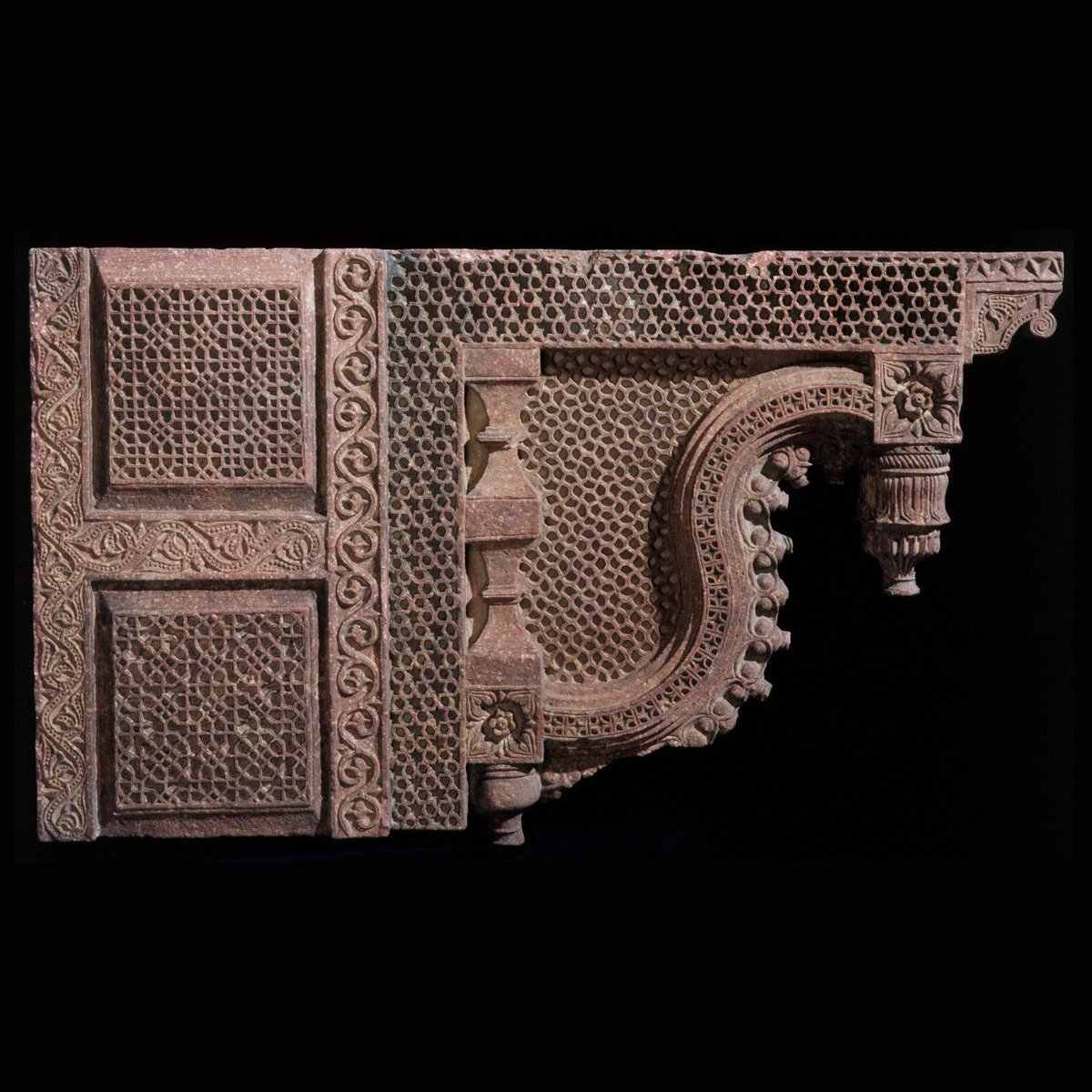
Early 16th-c Sultanate brackets, likely from Agra, carved in mottled pink sandstone with interlacing strapwork and scrolling borders. Look closely—the inner edges form a stylised makara, a mythical water creature.
“Let's fix the problems on Earth before we go to space.”
“We don't need more power. We need to use what we already have more efficiently.”
“We’ve got enough already. We don't need another.”
Fuck these shallow-minded cretins, who claim to speak for everyone but instead see only the short horizons inside their own head. Their lack of vision doesn't justify them freezing the world in aspic.
Instead let's realise that we're not a monkey tribe in an autumn valley, teetering on the edge of wintery oblivion. We're a civilization with billions of brains that's figured out how to create force & energy at will and is on the verge of learning how to infinitely multiply intelligence itself.
And for something that big the best bet is not to procrastinate too much. Instead reach out with hydraulic hands and electric blood and try a million things all at the same time, until you find what works. And then multiply that a million times until it's everywhere.
Do that enough and the lives of our children and grandchildren will be unrecognizable from our troglodyte slouching towards progress.
Ignore the naysayers.
Try Everything!
Let's test your edict with a hypothetical:
An acclaimed anime studio employs only accomplished Japanese anime production specialists.
Their HQ, where all production occurs, is located on an island claimed by Japan.
Their first product is a masterpiece | par excellence |, achieves global success, and goes on to be THE | prima causa | anime by which all others are then judged.
Then, unexpectedly, a nascent rebellion occurs, and the islanders declare themselves a new nation, independent of Japanese hegemony.
Moreover, the leaders of this revolutionary movement declare that this nation has | always | been free and independent of Japan -- never actually Japanese, but merely involuntary subjects of foreign imperialism.
The National Diet officially recognizes the new geopolitical reality, including the retroactive declaration.
So now, the acclaimed studio is no longer in Japan. It no longer employs Japanese anime mavens. The company becomes, both in law and in fact, Gaijin.
The question then becomes, what shall their most sublime, unparalleled, & exquisite creation be now called?
@CDoombeard@lmkwhenurhome In terms of the scale involved with evolutionary psychology, photography is bleeding edge technology. It will take us some time yet before we incorporate these aspects into our collective psyche.
I disagree with the architectural form suggested. I feel as though the Triumphal Arch better represents victory over a specific existential threat rather than temporal perseverance.
A better choice would be a monumental staircase, with each step representing a year, and key moments in US history marked by landings, such spaces perhaps punctuated with public benches, statuary, reliefs, inscriptions, plaques, and the like.