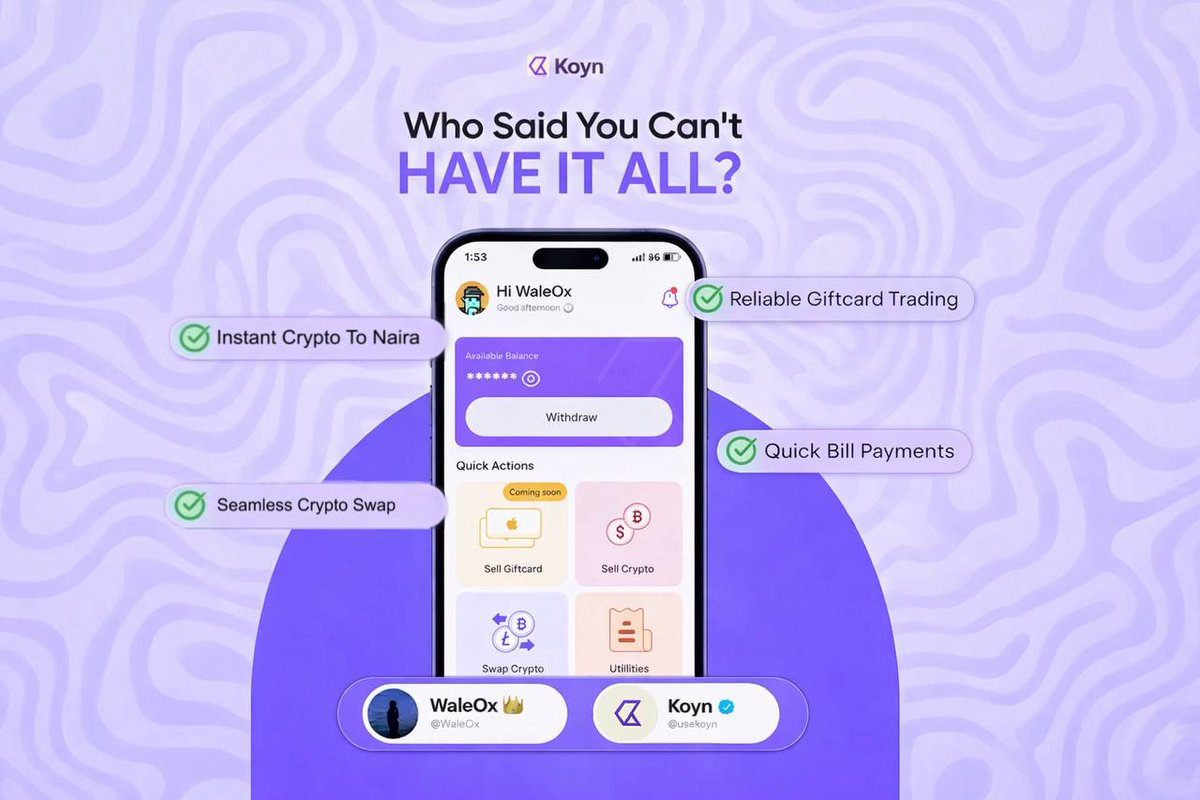
In Africa, Crypto is not the hard part, Access is.
I once watched someone almost lose a real opportunity because his money was “there”… but not really there.
He had Crypto sitting in his wallet, Good value, Solid gains.
But he needed naira urgently.
Stay with Me🧵⬇️
@XRPL_AF@usekoyn
Please I'm begging you people, take an interest in other things that do not necessarily have anything to do with your career. You could be an Engineer, but please read up on literature. You could be a lawyer, but at least be curious who Frank Lloyd Wright was. Be curious man.
Now that you can freely do everything your parents never wanted you to do, hope you’ve found fulfillment ?
Now that you can drink/smoke/have sex with anyone at anytime/stay out late/spend nights out and all..
I repeat, hope you’ve found fulfillment ?
Maybe.. Just maybe, the real fulfillment is in DISCIPLINE.
If you are not careful, that freedom that we really seek could ruin our lives faster than we think. lol
Freedom is a trap! That’s why we pray for wisdom every time to live life.
After five years of work, the team is happy to announce the Zama Confidential Blockchain Protocol and the release of our Public Testnet.
First things first, read the litepaper ⬇️
HOW GENSYN OUTPACES ITS COMPETITORS (Part 3 – The Comparison)
So far we’ve been talking about what @gensynai is and just recently, we broke down the behind the science of Gensyn’s tech, from consistent execution to trustless verification.
Now, let’s put it into context.
Because #Gensyn isn’t the only one trying to decentralize AI training. Imagine a project like DeTrain, which connects GPUs around the world so people can share compute power.
This is a good start, but there are some key differences and I will be explaining this in 4 points.
Let’s dive in 🤿🤿
—-—-—-——-—-—-——-—-—-——-
1. The Goal
Both Gensyn and our hypothetical DeTrain aim to make AI training open to anyone with computing power. But here’s the key difference.
DeTrain mainly focuses on connecting computers so they can share GPU power, allowing people around the world to share their computing resources and contribute to AI training. This here is a solid approach that makes access to compute more open and collaborative.
But Gensyn on the other hand takes it several steps further. It doesn’t just connect computers, it also verifies them as well. Every bit of work done on the network can be proven real and correct, without anyone having to double check it themselves.
This makes shared computing even more open, honest, and dependable for everyone.
2. Verification vs Trust
DeTrain still asks you to trust that the work is done right. This means that when contributors finish tasks, the contributors have no choice than to take the results as they are.
Now this is where Gensyn added more seasonings to the soup. Here, the system can check that the work is correct without redoing it. It’s like the difference between taking a friend’s word for it and checking it yourself.
3. Scalability
DeTrain’s system works very well for community GPU sharing, but it can get messy when scaling large, complex models.
Thanks to the four-layer design we talked about previously🙂↔️ this problem is addressed. These layers address this problem by:
- Keeping every device in sync
- Allowing nodes to drop and rejoin without breaking training
- Automating incentives and payments
this way, the network can scale smoothly, handling more computers and bigger models without breaking a sweat.
4. Fair Rewards
DeTrain rewards contributors after results are manually validated. Whereas Gensyn on the other hand, pay contributors automatically and on-chain once their work is verified by the network itself. No middlemen stress, Just proof-based rewards.
—-—-—-——-—-—-——-—-—-——-
Tabular Comparison:
Bottom Line:
Both aim for decentralized AI, but only @gensynai takes it steps further by making it trustless, scalable, and fully verifiable.
As you were 🙂↔️🫳🏾
Notable mentions:
@austinvirts@diogortega@gab_p_andrade
If you’ve been anywhere near DeFi lately, you’ve probably noticed the rising chatter about @MMTFinance (MMT) a project that’s been making waves across social feeds and crypto communities. But what exactly is driving all this attention? And what’s Momentum really about beneath the buzz?
What is Momentum Finance Exactly?
Momentum Finance is a next-generation liquidity protocol built on the Sui blockchain, designed to make liquidity provision more capital-efficient through a Concentrated Liquidity Market Maker (CLMM) model.
In simple terms, it helps liquidity providers (LPs) earn more with less, optimizing how capital is deployed in DeFi pools, rather than spreading it thin like traditional AMMs.
Momentum Finance has emerged as the flagship liquidity provider within the Sui blockchain ecosystem. through its high‑performance liquidity engine has secured a leadership role, raised a total of $10 million in funding, marking key milestones that underscore its rapid growth and central importance to Sui DeFi.
Key Achievements Include:
-- Leading Liquidity Engine: Recognized as the primary liquidity provider for assets on Sui, enabling seamless trading and deep order‑book depth across the network.
-- Retro‑Drop Campaign: Ran from Jan 2023 through Oct 2025, distributing tokens to early adopters and sustaining community engagement over an extended period.
-- Funding Success: Secured $10 million in capital and $100 million valuation, providing resources for product development, security audits, and broader market outreach.
Also they recently talked about the deed NFT
What the Deed NFT is?
The Deed is described as a VIP pass inside the Momentum ecosystem granting holders special access, benefits, and long-term rewards.
Momentum announced the distribution of 15,000 “Deed” NFTs (often called “Title Deed NFTs”) to contributors in the Sui ecosystem. Of those, 10,000 NFTs are allocated to key contributors (Genesis Deed phase participants, winners of trading competitions, top creators) and 5,000 via a community nomination wave.
Here are the stated mechanics and value propositions of the Deed NFT:
-- Holding a Deed NFT gives you access to priority rights: e.g., guaranteed airdrops of the native token (MMT), governance power (veMMT style), and perhaps preferential access to launch-pad/IDO pools.
-- The Deed is transferable (i.e., it’s an NFT you can hold, trade, or use) in some versions of the description. Controverity
It is also positioned as a contributor‐recognition item: it rewards early or key supporters of the ecosystem (developers, traders, creators) which helps align community incentives.
The “Nomination Wave” mechanism: the community can nominate eligible people (max 3 nominations each) for some of the Deeds.
The recent buzz "community offering with Buidlpad" what is it about?
Momentum Finance has launched a Community Offering via the platform Buidlpad. This is a token-sale event aimed at giving the community early access to MMT tokens, under a “fair launch” model rather than the typical VC-only rounds.
Key facts:
Target raise: US$ 4.5 million.
Two tiers of valuation:
--- Tier 1: FDV (Fully Diluted Valuation) ≈ US$ 250 million, for users who meet certain eligibility criteria (e.g., staking, prior participation).
--- Tier 2: FDV ≈ US$ 350 million, open to the broader verified community.
-- All tokens purchased in this offering will be 100% unlocked at Token Generation Event (TGE) meaning no lock-ups for participants.
-- Accepted contribution assets: SUI (on Sui network), USDC (Sui), BNB (on BNB chain) depending on region.
-- Anti-Sybil / fairness measures: To prevent multiple accounts, bots, etc.
Momentum finance is definitely worth positioning for
gMMT
HTTPS revolutionized the Internet. @zama_fhe is doing the same for Blockchain.
Before HTTPS, everything on the web was plain text.
Anyone could intercept your messages, steal your passwords, or read your credit card info as it traveled between you and a website.
Then HTTPS came, encrypting communication and making sure browsing, banking, and online commerce were secure.
It didn’t change the Internet. It made it safe to use.
Now, blockchain stands at the same crossroads.
Today, every wallet balance, trade, and DAO vote is public.
Transparency built trust, but it also exposed privacy.
DeFi strategies can be copied, users can be profiled, and sensitive logic can’t stay secret.
That’s where @zama_fhe steps in.
Zama’s FHEVM (Fully Homomorphic Encryption Virtual Machine) is doing for blockchain what HTTPS did for the Internet, enabling privacy without breaking trust.
It allows smart contracts to:
1. Compute directly on encrypted data
2. Keep logic, balances, and inputs private
3. Stay fully on-chain and verifiable. No off-chain workarounds
In simple terms:
HTTPS = Secure Communication 🌐
@zama_fhe FHE = Secure Computation 🔒
With Zama, data stays encrypted not just while stored or transmitted but even while being processed.
That’s true end-to-end confidentiality, embedded right into the EVM.
Just as HTTPS unlocked the modern Internet,
Zama is unlocking the next era of blockchain
where apps are transparent enough to trust and private enough to protect.
The future of crypto isn’t just open.
It’s confidential, verifiable, and unstoppable.
@alwsfrosty@Zun2025
#ZamaCreatorProgram
Rightly said by @Zun2025
For developers, I will be providing a quick guide to setting up your environment using the official @zama_fhe Hardhat template.
If you already know Hardhat, you’re already halfway there.
Step 1: Clone the Hardhat Template
Zama provides a fully pre-configured project that has all FHE dependencies, Solidity extensions, and Hardhat tooling baked in — no manual setup required.
Repo: zama-ai/fhevm-hardhat-template
git clone https://t.co/UpxuBzvKB0
cd fhevm-hardhat-template
npm install
That’s your foundation. Everything you need to build confidential smart contracts is in place now.
Step 2: Configure for the Real World
To deploy on a live testnet (like Ethereum Sepolia, where Zama’s FHEVM is active), add a few environment variables.
In a .env file:
MNEMONIC="your 12-word wallet seed"
API_KEY="your Infura or Alchemy key"
These credentials let Hardhat connect securely to Sepolia while the FHE plugin manages encryption/decryption behind the scenes.
The flow feels just like normal Solidity dev except everything happens under full encryption.
Step 3: Test Locally First
The template ships with an example contract — FHECounter.sol — which performs encrypted addition.
Before spending any gas, test it locally:
npx hardhat node
npx hardhat test --network localhost
This spins up a local FHE-ready node and runs your test suite.
If all checks pass, your encrypted logic is working correctly in a private, local environment.
Step 4: Deploy Confidentially
Now the fun part — deploying your encrypted smart contract to Sepolia.
Zama’s FHEVM operates as a confidentiality layer over existing EVM networks.
When you deploy, your contract automatically connects to Zama’s FHE coprocessors.
npx hardhat deploy --network sepolia
Once deployed, your contract’s state (like the euint counter) remains fully private.
Only the authorized party can view or decrypt the plaintext value even during computation.
That’s end-to-end privacy on-chain.
And You’re Done
In just four steps, you’ve launched a confidential smart contract where data remains encrypted from storage to execution.
No special setup. No obscure tooling.
Just Hardhat, Zama, and modern cryptography at work
If you want a deeper look at the tech under the hood, check out the video guide on the core compiler https://t.co/aXU8NHTAQX
The video provides a developer tutorial on how to get started with the Concrete FHE compiler.
#ZamaCreatorProgram
@Coderkkk @gl0rious_e @wannabemorris@Leumas_Agba@VigorWeb3