De la programmation à la traduction ou encore la création de contenu, #ChatGPT est votre allié ultime.
Mais en quoi d'autre peut-il exceller ?🤔
Découvrez comment il améliore clarté des documents et la prise de décision en tant que #DataScientist
👉https://t.co/yPY0BgBjH6
#IA
I just spoke to myself, and it was weird.
You can now clone your voice using a few seconds of audio, give the robot personality, and deploy a clone of yourself.
Here is a step-by-step process on how to do this in less than two minutes:
Segment Anything in High Quality
paper page: https://t.co/acknyb7GAy
propose HQ-SAM, equipping SAM with the ability to accurately segment any object, while maintaining SAM's original promptable design, efficiency, and zero-shot generalizability. Our careful design reuses and preserves the pre-trained model weights of SAM, while only introducing minimal additional parameters and computation. We design a learnable High-Quality Output Token, which is injected into SAM's mask decoder and is responsible for predicting the high-quality mask. Instead of only applying it on mask-decoder features, we first fuse them with early and final ViT features for improved mask details. To train our introduced learnable parameters, we compose a dataset of 44K fine-grained masks from several sources. HQ-SAM is only trained on the introduced detaset of 44k masks, which takes only 4 hours on 8 GPUs. We show the efficacy of HQ-SAM in a suite of 9 diverse segmentation datasets across different downstream tasks, where 7 out of them are evaluated in a zero-shot transfer protocol.
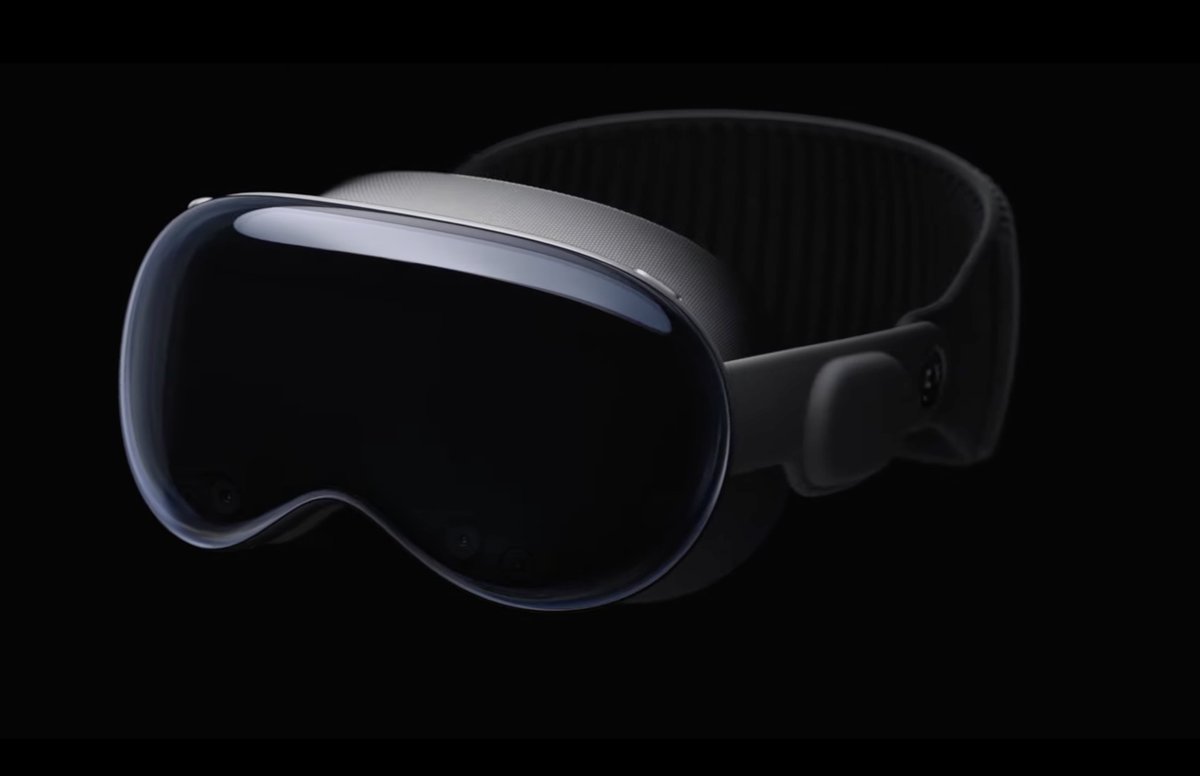
I spent 10% of my life contributing to the development of the #VisionPro while I worked at Apple as a Neurotechnology Prototyping Researcher in the Technology Development Group. It’s the longest I’ve ever worked on a single effort. I’m proud and relieved that it’s finally announced. I’ve been working on AR and VR for ten years, and in many ways, this is a culmination of the whole industry into a single product. I’m thankful I helped make it real, and I’m open to consulting and taking calls if you’re looking to enter the space or refine your strategy.
The work I did supported the foundational development of Vision Pro, the mindfulness experiences, ▇▇▇▇▇▇ products, and also more ambitious moonshot research with neurotechnology. Like, predicting you’ll click on something before you do, basically mind reading. I was there for 3.5 years and left at the end of 2021, so I’m excited to experience how the last two years brought everything together. I’m really curious what made the cut and what will be released later on.
Specifically, I’m proud of contributing to the initial vision, strategy and direction of the ▇▇▇▇▇▇ program for Vision Pro. The work I did on a small team helped green light that product category, and I think it could have significant global impact one day.
The large majority of work I did at Apple is under NDA, and was spread across a wide range of topics and approaches. But a few things have become public through patents which I can cite and paraphrase below.
Generally as a whole, a lot of the work I did involved detecting the mental state of users based on data from their body and brain when they were in immersive experiences.
So, a user is in a mixed reality or virtual reality experience, and AI models are trying to predict if you are feeling curious, mind wandering, scared, paying attention, remembering a past experience, or some other cognitive state. And these may be inferred through measurements like eye tracking, electrical activity in the brain, heart beats and rhythms, muscle activity, blood density in the brain, blood pressure, skin conductance etc.
There were a lot of tricks involved to make specific predictions possible, which the handful of patents I’m named on go into detail about. One of the coolest results involved predicting a user was going to click on something before they actually did. That was a ton of work and something I’m proud of. Your pupil reacts before you click in part because you expect something will happen after you click. So you can create biofeedback with a user's brain by monitoring their eye behavior, and redesigning the UI in real time to create more of this anticipatory pupil response. It’s a crude brain computer interface via the eyes, but very cool. And I’d take that over invasive brain surgery any day.
Other tricks to infer cognitive state involved quickly flashing visuals or sounds to a user in ways they may not perceive, and then measuring their reaction to it.
Another patent goes into details about using machine learning and signals from the body and brain to predict how focused, or relaxed you are, or how well you are learning. And then updating virtual environments to enhance those states. So, imagine an adaptive immersive environment that helps you learn, or work, or relax by changing what you’re seeing and hearing in the background.
All of these details are publicly available in patents, and were carefully written to not leak anything. There was a ton of other stuff I was involved with, and hopefully more of it will see the light of day eventually.
A lot of people have waited a long time for this product. But it’s still one step forward on the road to VR. And it’s going to take until the end of this decade for the industry to fully catch up to the grand vision for this tech.
Again, I’m open to consulting work and taking calls if your business is looking to enter the space or refine your strategy. Mostly, I’m proud and relieved this has finally been announced. It’s been over five years since I started working on this, and I spent a significant portion of my life on it, as did an army of other designers and engineers. I hope the whole is greater than the sum of the parts and Vision Pro blows your mind.
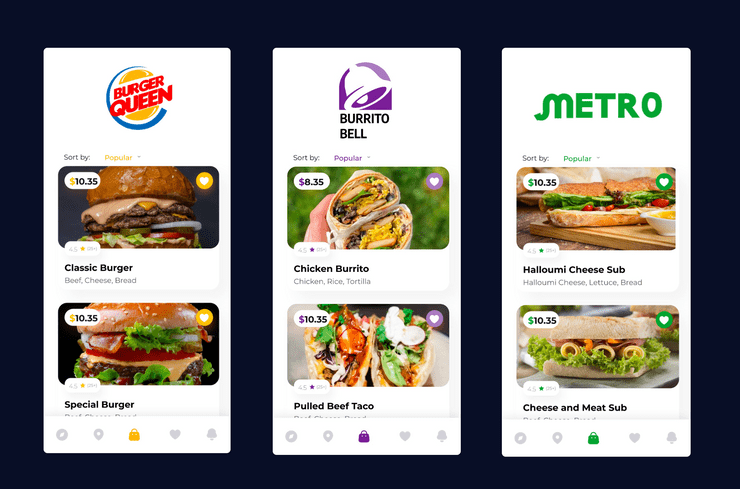
I recently did a talk about building whitelabel mobile apps at DevDaysEurope. We took this approach on a project last year that needed multiple apps for dozens of brands built from the same base. 🏷️📱
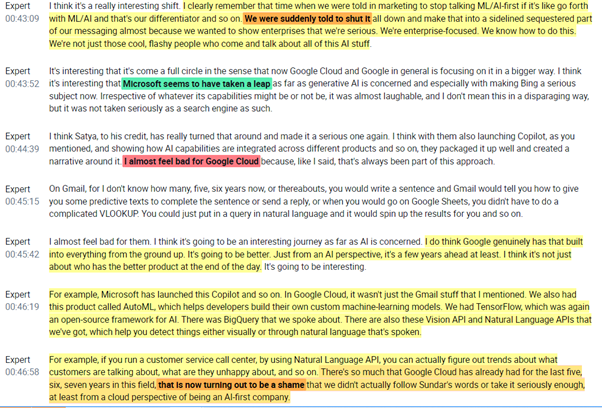
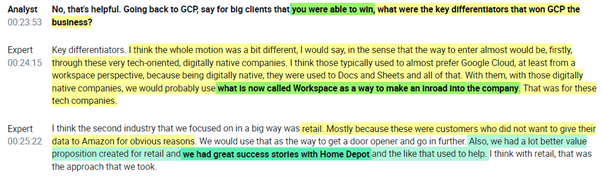
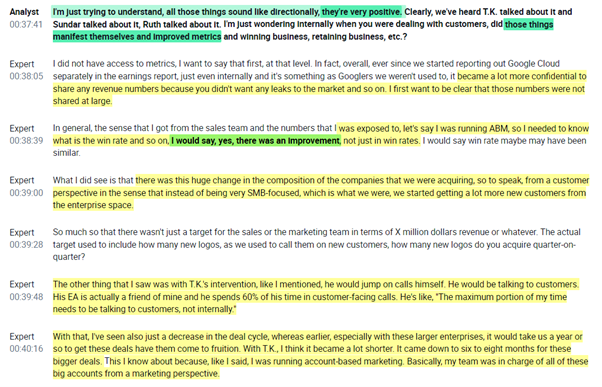
One of the best interviews I read.
Former Global Head at $GOOGL /GCP who worked there for 7 years:
- $GOOGL's edge on AI
- Talks about CEO of GCP: T.K - 60% of the time on customer-facing calls
- Transition from SMB clients to enterprises
- Thinks $MSFT Azure will be num. 1
Some papers that Falcon is based upon:
- Multi-Query Attention: https://t.co/onSUhpPwGL
- Flash Attention: https://t.co/rNy75blIDD
These ideas are the key to making Falcon super fast at doing inference. Could be a game changer for applications with latency requirements!
🎉 The most powerful Open-Source LLM is out!
Yes! Smaller than LLaMA 🦙, but Stronger than LLaMA (65B)
hands down! 💪
***
The Institute of Technological Innovation of the Arab Emirates released today the most powerful base model ever: FalconLM 🚀
The model is currently ranked first on the Huggingface leaderboard!🥇
The leaderboard: https://t.co/ocmJHUhvgl 📊
In addition to a series of models that are growing in size, they have also released a dataset on which the models were trained. The dataset contains one and a half trillion tokens (~1.5B) and is exceptionally clean. That's why the model performs so well! 👌
More details:
The FalconLM model currently outperforms all other open models (Redpajama, MPT, LLaMA...). 🔝
The model is trained with RoPE Embeddings, Flash Attention and Multi Query Attention - which makes it optimized for inference. 🧠
It is available in both 7B and 40B versions. 💻
In addition, the model is also available in Instruct version which is optimized for instruction execution. 💡 but not for fine-tuning, so remember it.
Also, they have introduced a very cool and creative license. It allows for commercial use, but they require a 10% royalty for any use-cases that generate over $1M in revenue using it. 💼💰
📚 Download links:
7-billion model: https://t.co/tXMHZoALtp
7-billion model - Instruction execution: https://t.co/1U96t4c9V9
40-billion model: https://t.co/mf0MbgNUuf
40-billion model - Instruction execution: https://t.co/nAsvZj4LF0
Dataset: https://t.co/AZ4AQeUmZc
This is the current state of models as ranked by folks from Berkley based on ranking.
Interestingly here, @karpathy here says that GPT-4 is the best "by far", but on the chart its 1274 to Claude's 1224 ELO rating that doesn't seem "by far"
https://t.co/ysirTZo9Us
15/
How do Snowflake and Databricks stack up?
Wolfe Research dove into the numbers and uncovered some interesting data points.
- How enterprises spend on $SNOW compared to Databricks
- Use cases for Databricks vs $SNOW
- Other data platforms like $MDB, $AWS
Here's what they found:
It’s easy to succeed in data/AI. All you need is to put data into a DWH for OLAP using ETL, or ELT with DBT. Spot any issues on your DAG, run SQL for some BI, reverse ETL into SaaS or use a CDP, then leverage for ML/AI with CNNs, RNNs, RLs, GANs, and maybe LLMs or LDMs for GenAI.
There are plenty of recourses in the financial & business side.
The context is they are putting a “task force” in eng together to prep and be in good shape for sale explorations. “I wish I could give some directional prep resources for managers/engineers who never did this.”
Merci à @theodo sponsor de WLS 2023 ! Expert en développement d'app #web et mobile sur-mesure pour aider ses clients à gagner des parts de marché
@theodo accompagne les entreprises de toutes tailles à gagner des parts de marché avec des apps performantes 👉https://t.co/8szMNyakSy
Découvrez comment obtenir la certification SnowPro Core de @SnowflakeDB grâce au guide complet de @VincentFraillon
📌Les prérequis et détails de l’examen ;
📌Les ressources pour vous préparer efficacement
👉 https://t.co/l3wknflooP
#certification#data#technology