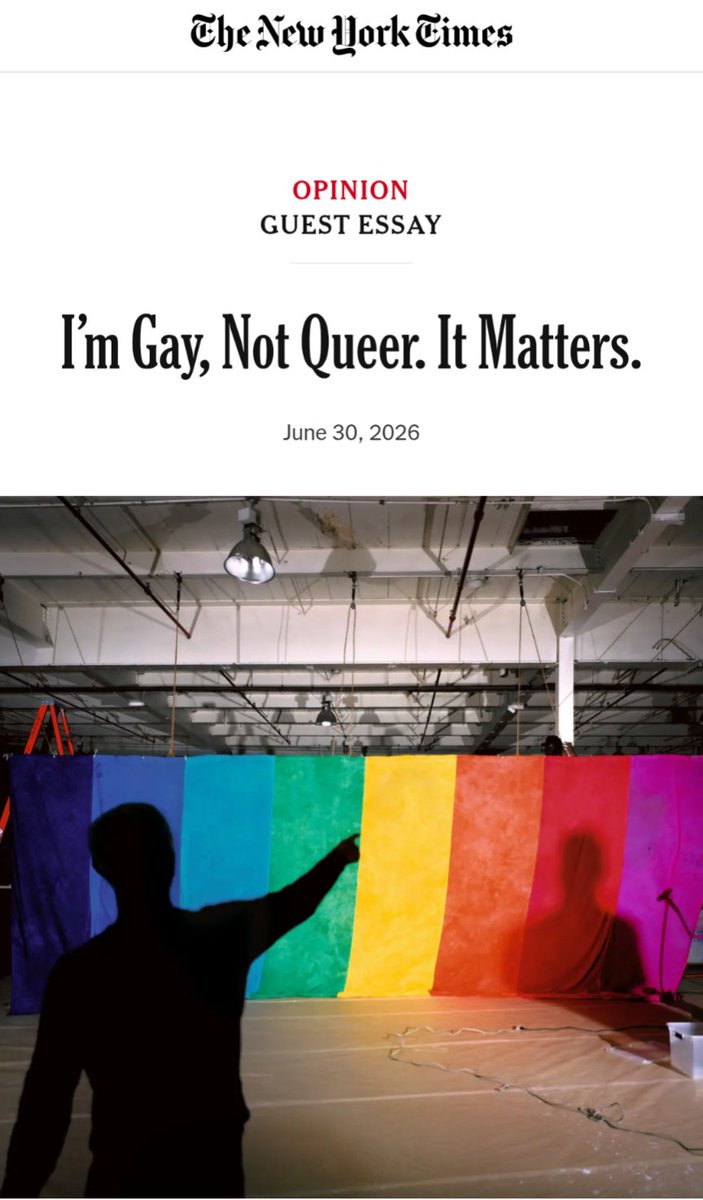
"Gay" and "queer" are increasingly used interchangeably in progressive discourse. But the two words don't mean the same thing. And in that difference lies a danger for our hard-fought equality.
My essay in today's New York Times: https://t.co/FavZpILNVE
@BMcGrewvy@MWellertXc Stephen accidentally cut a few minutes from part of the video when he first posted it, so he removed and reposted it. Unfortunately, YouTube doesn't allow for edits to videos after they're posted, so it has new link now.
Not to be pedantic, but there is a difference between "intractable" and "permanent and exclusive." Plenty of non-affirming Christians are willing to acknowledge the former in some form; fewer are willing to acknowledge the latter without hedging. Some are, and my understanding (correct me if I'm wrong) is that you are among that group, but that is a distinct minority among Christians who believe that same-sex relationships are categorically sinful.
There is a reason that ex-gay ministries have been so popular and why they persist despite their demonstrable ineffectiveness. Acknowledging the reality of same-sex orientation plainly is uncomfortable for a lot of Christians, whether you think it should be or not.
@BMcGrewvy@stephengadubato I thought about this afterwards because Rich was indeed the best. I know he technically was CCM but in my mind he transcended the category, so for some reason, I don't think of him as CCM. But yes, incredible music, and an even better man.
To the extent it could be helpful to celebrate gay men (and I share your skepticism of this sort of identity-based celebration), it would be about celebrating the actual accomplishments of particular men who happen to be gay—not celebrating the banal fact that some men are attracted to other men. There is, of course, nothing wrong with being gay, but it isn't an accomplishment either.
It's also quite tiresome to frame gay identity in this hypersexualized way.
If you are gay and criticize any aspect of LGBTQ activism as too extreme, you will inevitably be called a "pick me."
This is, of course, a cheap ad hominem, but it's also profoundly manipulative. It's similar to a romantic partner telling you that, if you break up with them, no one else will ever love you. From my conversation with @GayMenTherapy:
This is just the conservative version of queer theory, and it is no more compelling than the leftist one. Being seen as normal only robs you of your sense of purpose if you have an unhealthy obsession with being seen as different and special.
Also, if both same-sex promiscuity and same-sex committed relationships represent the "repression" of "homoerotic longing," then I'm not sure what could qualify as the actual expression of such longing. If making art qualifies (which plenty of gay people still do, btw) but being in a same-sex relationship doesn't, then all you've done is redefine your terms to the point of meaninglessness.
Well, to be fair, I also got a lot of positive feedback from Times readers on the article (see the reader comments on it). And since the piece was more controversial than most, I don't think it's unreasonable for the Times to curate a selection of critical responses to make sure those views get their due as well.
I'm in favor of an open, civil debate. And while I certainly have my critics on the left (as well as on the right, as you can attest), I would note that my views weren't too conservative for the Times to publish in the first place. And I am grateful for that!
@holybullies Not sure what you mean. I don't have a problem with criticism. My point here is that I think this particular critique is overly pessimistic and embraces a victim mentality to an unhealthy degree.
This is among the more common critical responses I've received since last week: the people who are committed to hating you no matter what will still hate you regardless of what language you use or whether you advocate for integration into society or subversion of it.
That is true, but trivially so, because fortunately, the great majority of people are not committed to hating gay people no matter what. The world cannot be neatly divided into people who seek our destruction and people who will applaud no matter what we say or do—and in fact, almost everyone exists somewhere in between those extremes.
So no, I have no illusions that reclaiming a message focused on shared values and common humanity will magically eliminate all ill will toward gay people in the world. But I do think it will make a significant difference for the large number of people who do not want to persecute gay people but who also are understandably alienated by radical, us-vs.-them approaches to LGBTQ activism that have become far too common in recent years.
Inclusive orthodoxy only makes sense if it retains a clear norm of monogamy. People are free to make whatever arguments they want or write whatever books they like, but the case for polyamory is ultimately quite weak and short-sighted, and that will remain true no matter how many books people write in its defense. And those of us who disagree with it can write our own books and arguments as well, which I fully expect will persuade many more people in the long run.
This feels significant: @WNYC (the main NPR member station in New York City) ran a 12-minute segment today about the word "queer." The title was "Why Do You Identify As Queer?", but @BrianLehrer spent the first half of the segment reading excerpts from my NYT essay to give listeners my perspective (without framing it as problematic): https://t.co/RDkA7Xkjdq.
He then invited calls from listeners who do embrace "queer" for themselves to share why they like the word. Which is fine by me! I have no interest in shutting anyone else down or preventing anyone from using their term of choice. I just want the 52% of gay, bisexual, and transgender people who do not identify with "queer" to have a voice, too.
A week ago, it would've been hard to imagine a major NPR member station giving equal time to both views on this topic. I hope this is a sign of where things are headed.
@RolandDunbrack A striking number of the negative responses to my essay have been from people saying that being gay inherently makes me queer, and therefore they will call me queer despite me saying I don't want that label for myself. That is the imposition, and it is remarkably widespread.
Why imposing the "queer" label on all gay people limits our freedom rather than expands it (from the comments section on my New York Times essay):
https://t.co/FavZpILNVE
Thanks for sharing. I think that's an uncharitable reading. The essay focused on the difference between gay and queer because that is my own experience and orientation, and because I know I can't speak for everyone. But that doesn't mean I'm not for people who are different from me. I support bisexual people. I support trans people. I support people who identify as queer as a synonym for non-straight, even though I don't. And I certainly support LGBTQ people regardless of their race, class, geographic location, etc.
Where I do think it is important to clarify—and yes, narrow—what we are fighting for is the question of whether we are fighting for equal rights and acceptance for LGBTQ people, or whether that fight is also inherently connected to a myriad of political ideologies that, in my opinion, have nothing to do with it. Do gay people—or bi or trans people—need to be on board with abolishing prisons and the police? Do we need to see the United States as an evil country that should be loathed for its flaws rather than loved for its virtues, while still working to improve it? Do we need to view normative monogamy as an oppressive force to be dismantled rather than a cornerstone of a stable, equal, and just society?
I am not against any people. I am against radical ideas that are being imposed on LGBTQ people through the subversive, deconstructive worldview of queer theory. What exactly do I want to exclude that you think deserves to be included, and why do you think it should be included?