Need visuals for your next promo? The limited combo starts at $6.29.
Generate assets in Dreamina and assemble your campaign video in CapCut PC.
Give that idea a starting point.
First-month combo · Oct 20–30 · CapCut Desktop only.
#CapCutDidThat#Dreamina #Smallbusinessmarketing #CapCutSale
EVERY PROMPT CHANGE IN MY AGENTS USED TO MEAN A DEPLOY.
Fix a typo in a system prompt? Pull request.
Adjust the tone for one workflow? Another branch.
Roll it back because the output got worse? Another deploy.
The prompts lived in the code, so every edit had to go through the code.
So I moved them into @RequestyAI's prompt management. Each prompt is stored there with its variables, and my code calls it by prompt_id. When I want an agent locked to a version I trust, I pin that version in the call.
The code decides which prompt runs. Requesty holds what the prompt says.
It's one extra field in the request, on the same OpenAI SDK.
Builders: where do your prompts live right now, in the repo or somewhere you can change without shipping code?
Full link in my first reply.
You paid for your smart TV.
So why is it showing you ads before you can even open Netflix?
A developer named Gathin got so annoyed by the ads on his parents’ Xiaomi TV that he used Claude Code to replace its home screen.
He disabled 25 preinstalled packages and built a clean, Apple TV-style launcher.
Then he open-sourced it as CleanYourTV.
What it does:
-Disables unwanted apps and promotional services.
-Replaces the cluttered home screen with a clean launcher.
-Works over Wi-Fi without rooting your TV.
-Includes scripts to restore the original setup.
-Supports multiple Android and Google TV models.
Over 16,000 GitHub stars. MIT licensed. Free.
Requires a computer and a coding assistant. Compatibility varies by TV model.
You paid for the hardware. You should control the home screen.
Credits: @gathint
Every app needs a crash test dummy. Software deserves one too.
Your tests can pass while real users still run into bugs nobody anticipated.
That’s what makes Breken interesting. It puts your actual software into simulated production environments, throws real-world chaos at it, and catches problems before your users do.
Production engineering might be the missing layer between shipping fast and shipping confidently.
i don't think people realize how big this is…
A US lab just released a 40B open-weight coding model leading its class on three major coding benchmarks.
125+ tok/s on a MacBook. 150+ on RTX Spark.
no per-token fees. no usage limits.
your laptop is now the endpoint.
holy sh*t @agentmail went from under 20 million emails a year ago to over 1 billion today.
it gives an AI agent its own email inbox with one API call, so it can send, receive and act on email like a person would.
agents are already using it to process invoices, handle customer requests and create accounts on other services, and they never need your personal inbox.
email turned out to be how agents get real work done, watch the story below:
comment "YOUGOTMAIL" on Michael's post and he'll DM you a free month of the AgentMail Startup plan.
10 GITHUB REPOS THAT MAKE GAME DEVELOPMENT LOOK LIKE MAGIC.
1. Godot — build entire games with an open-source engine.
Create 2D and 3D games with scripting, physics, animation and a complete editor.
https://t.co/7nI4zJ0nK8
2. GDevelop — build games without traditional coding.
Use visual events and built-in tools to create playable games for multiple platforms.
https://t.co/oZjT2V7kiB
3. Phaser — create browser games with JavaScript.
Build fast 2D games with physics, animations, input controls and web deployment.
https://t.co/tO4wHCkA7M
4. Bevy — build games with Rust.
Explore a modern, data-driven game engine designed around an entity-component-system architecture.
https://t.co/gRxQMnp2L5
5. Three.js — turn your browser into a 3D playground.
Create interactive 3D scenes, games and immersive experiences using JavaScript and WebGL.
https://t.co/uD9xWNG2rq
6. Babylon.js — build immersive 3D games for the web.
Use a full-featured 3D engine with physics integrations, animation and WebXR support.
https://t.co/WhtEesal1F
7. LÖVE — make 2D games with Lua.
A lightweight framework for building games with simple code and rapid iteration.
https://t.co/ccmh2wJqVf
8. Ren'Py — create interactive stories and visual novels.
Build branching narratives with dialogue, character sprites, music and multiple endings.
https://t.co/sCYbV2h8UA
9. Stride — build games in C#.
Create 2D and 3D experiences with a visual editor and a flexible rendering pipeline.
https://t.co/q61URLkorB
10. UPBGE — create interactive 3D worlds.
Build real-time 3D applications and games using a Blender-based workflow.
https://t.co/ihG82sbRDS
All are open-source.
Bookmark this. Your next game idea doesn't need a giant studio to become playable.
In the summer of 2023, I gained over 30,000 LinkedIn followers in 3 months.
It started when I began posting infographics.
I've made over 1,000 of them since, and we just used the same method to get a 2-month-old brand 167,000+ impressions and 817+ saves from a single post.
The brand is an AI dialer for sales teams that had just rebranded. We were helping their CEO launch the new name on LinkedIn.
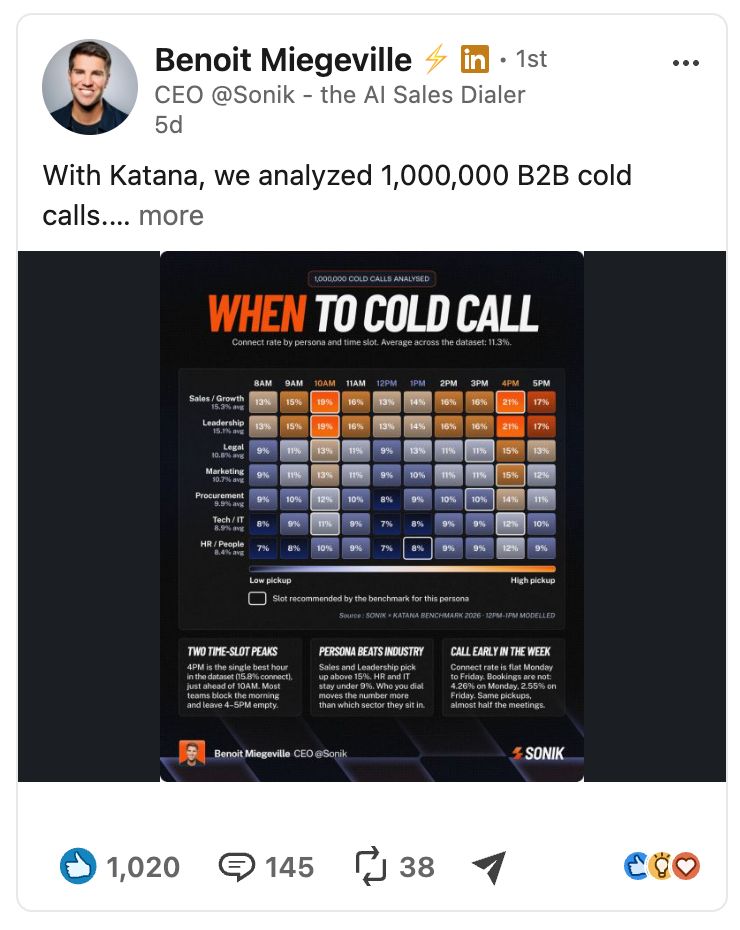
They had studied 1,000,000 B2B cold calls with a data partner, so we turned part of that study into a heatmap showing when to call each role, hour by hour.
That's why it got so many saves. Sales teams come back to it before they pick up the phone.
Behind it is a simple formula of winning formats, unique insights and a signature visual identity. Here's how to run it for your own brand.
1. Start with your visual identity. Turn your brand's colors and fonts into a LinkedIn look people recognize. For this brand, that meant a strong black and orange palette, bold fonts and signature elements.
2. Build a knowledge center before you post. Collect your resources and interview your in-house experts, so every post idea comes from what only you know.
3. Pick 3 content pillars. Theirs were the CEO's sales and founder story, the cold call + AI playbook, and life behind the scenes.
4. Use formats that already outperform, and fill them with your own data. For this brand, that meant a 2020 vs 2026 table on how the BDR role changed, and the heatmap below.
5. Ship fast and keep publishing. Their first visuals were live within 2 weeks, and 14 posts went out in 7 weeks. You never know which post will take off.
Want signature content that stands out in the feed and converts? Book a call with us. The link is in the first reply.
NOW LIVE: DREAMINA + CAPCUT PRO, STARTING AT $6.29.
Create AI visuals in Dreamina. Shape the final video in CapCut PC.
Your next campaign starts with an idea.
First-month combo · Oct 20–30 · CapCut Desktop only.
#CapCutDidThat#Dreamina#Smallbusinessmarketing#CapCutSale
Everyone's sharing Flint as a fast local coding model.
I went back and read Recursive's post properly and found the part that's easy to miss.
Flint is the first model built with the Eureka Machine, Recursive's automated research system. It found improvements in architecture, low-bit training, inference kernels and speculative decoding, and the model came together from scratch in under four months.
That's recursive self-improvement showing up in an open-weight model you can actually download.
There's a lot of RSI hype, but I think we'll look back at this as one of the early milestones
there is so much going on in the <30B model post-training space (especially with the growing focus on consumer applications).
a lab recently did some interesting work adding MLA (from DeepSeek) to Qwen3.8 27B to hillclimb on benchmarks. given that they are also working on brain-AI interfaces, it makes a lot of sense to finetune models of this class to make them faster + less verbose.
i also think open-source environments are a pretty good starting point these days for getting into model post-training at scale, especially when the goal is to focus on specific capabilities that align with broader RnD efforts.
🚨 Most businesses don't need more employees. They need smarter systems.
Imagine waking up to find that your emails have been processed, customer inquiries have been handled, your CRM has been updated, and your team has already received the necessary notifications. 🤯
No endless copy-pasting. No repetitive manual tasks. No switching between 10 different apps just to get one thing done.
Here's how an AI automation workflow makes it possible: 👇
📩 1. TRIGGER — Everything starts automatically.
A new email arrives, a customer submits a form, or a scheduled event occurs. That event triggers the entire workflow.
⚙️ 2. DATA PROCESSING — Information moves without the busywork.
The system collects incoming information, organizes it, and prepares it for the next step.
🧠 3. AI DECISION — The workflow gets smarter.
AI analyzes the information, identifies the type of request, and helps determine what action should happen next.
🔀 4. AUTOMATED ACTIONS — Work gets done.
Depending on the conditions, the workflow can send emails, update customer records, assign tasks, or trigger other processes.
🔗 5. INTEGRATIONS — Your tools finally work together.
Connect platforms like Slack, Shopify, CRM systems, and external APIs to move information between applications.
🔥 Here's a real-world example:
A customer submits a request →
AI analyzes the message →
The system updates the CRM →
A personalized email is sent →
Your team receives a Slack notification.
One trigger. Multiple connected actions. Less manual work. More time to focus on growth. 🚀
And this is only one example. Similar workflows can support sales, marketing, customer service, reporting, and internal operations—with appropriate permissions and human oversight.
💡 The biggest opportunity isn't just learning to use AI. It's learning how to connect AI with the systems that run your work.
The people who understand automation can build workflows that save hours, reduce repetitive tasks, and help businesses scale more efficiently.
♻️ Repost this for someone who is still doing manually what could potentially be automated.
Follow for more practical AI tools, automation workflows, and ways to work smarter with AI. 🧠
#AI #Automation #AIagents #AITools #FutureOfWork
Learn which mode you are in before you touch the prompt. Most people use Claude the same way for everything, and that is why the output feels inconsistent.
Chat is for fast answers and ideas: questions, brainstorming, quick rewrites. Most people never turn on Research mode or connect Gmail, so it stays a search box instead of an assistant with real context.
Cowork is for finishing entire projects: docs, slides, reports. Give it the outcome you want, not a step-by-step, and let it run multiple agents on the work at once. Projects and Skills stack here, and it can export straight to Google Drive.
Code is for building software: websites, apps, internal tools. Describe what you want in plain English instead of writing a spec first, and turn on Bypass Permissions so it can actually move without stopping to ask.
Skills are for the work you do more than once. A skill is a reusable process that works across every chat, triggered with a slash command, with its instructions stored inside it. A project is the specific work in front of you right now. Use both together instead of picking one.
Bookmark this before your next Claude session.
DAMN. THESE 10 GITHUB REPOS COULD HELP YOU BREAK LANGUAGE BARRIERS WITH AI.
Imagine translating conversations, transcribing speech, and generating natural voices even without an internet connection.
These open-source repos can help you build it:
1. Whisper
Transcribe speech across multiple languages.
https://t.co/BtoYkkyJno
2. Seamless Communication
Build multilingual speech translation tools.
https://t.co/lVRnM1Umkb
3. Argos Translate
Translate text offline without relying on cloud APIs.
https://t.co/iUHBteaRrX
4. Bergamot Translator
Bring privacy-friendly translation directly into the browser.
https://t.co/MrMA24cZXX
5. Piper
Generate natural-sounding speech locally.
https://t.co/wFvcXDaVE9
6. Piper
Generate natural-sounding speech locally.
https://t.co/wFvcXDaVE9
7. Vosk
Add offline speech recognition to your apps.
https://t.co/yqPxxNHibw
8. Coqui TTS
Experiment with neural text-to-speech models.
https://t.co/SCntx1DcHL
9. Whisper.cpp
Run speech recognition efficiently on your own hardware.
https://t.co/8y8dlnod7t
10. F5-TTS Generate expressive AI voices from text.
https://t.co/4QpL1gNZOi
The best part? These projects let developers explore speech and translation technology without building everything from scratch.
Imagine creating apps that help people communicate across languages, wherever they are.
Bookmark these repos. The future of communication is multilingual. 🔖
People with bigger calves live longer.
A meta-analysis of 37 studies found every 1 cm increase in calf size = 5% lower mortality risk.
why?
Two reasons:
1. Calves pump blood back to your heart (the soleus acts like a second heart)
2. Calf size = a proxy for total muscle mass. less muscle → more frailty → earlier death
If yours are small: 3x20 slow calf raises daily. add weight when it gets easy.
YOUR AGENT CAN RUN ALL NIGHT. YOUR BUDGET WILL NOT.
43% of enterprises struggle to prove AI's business value, while 27% cannot even track token spend across systems.
@StackletIO just launched Token Custodian to close that gap.
An agent stuck in a retry loop can balloon its context window on every turn.
By the time a monthly billing alert arrives, the money is already gone...
Built by the team behind CNCF Cloud Custodian, Stacklet already governs $10B+ in enterprise cloud spend, cutting cloud and AI bills by up to 50% and governance overhead by 80%.
Token Custodian brings real-time enforcement to LLM tokens:
> attribute tokens and agent runs to teams, projects, apps, and cost centers across providers
> cap agent steps, runtime, and context growth per run
> pause runaway loops automatically and alert owners in Slack
> switch routine requests to cheaper models at 80% budget usage, with approvals for frontier model exceptions
FinOps sets budgets in the UI.
Platform teams manage policies as code in Git across coding assistants and customer-facing agents.
The results?
savings 6x faster, with flat subscription pricing instead of a percentage of spend 🔥
now in early preview ahead of the October 27 Token Governance Summit (event link in 🧵↓)
Explore it here → https://t.co/EMvL6lNPz4