CHINA LEADS GLOBAL LIQUIDITY CHARGE
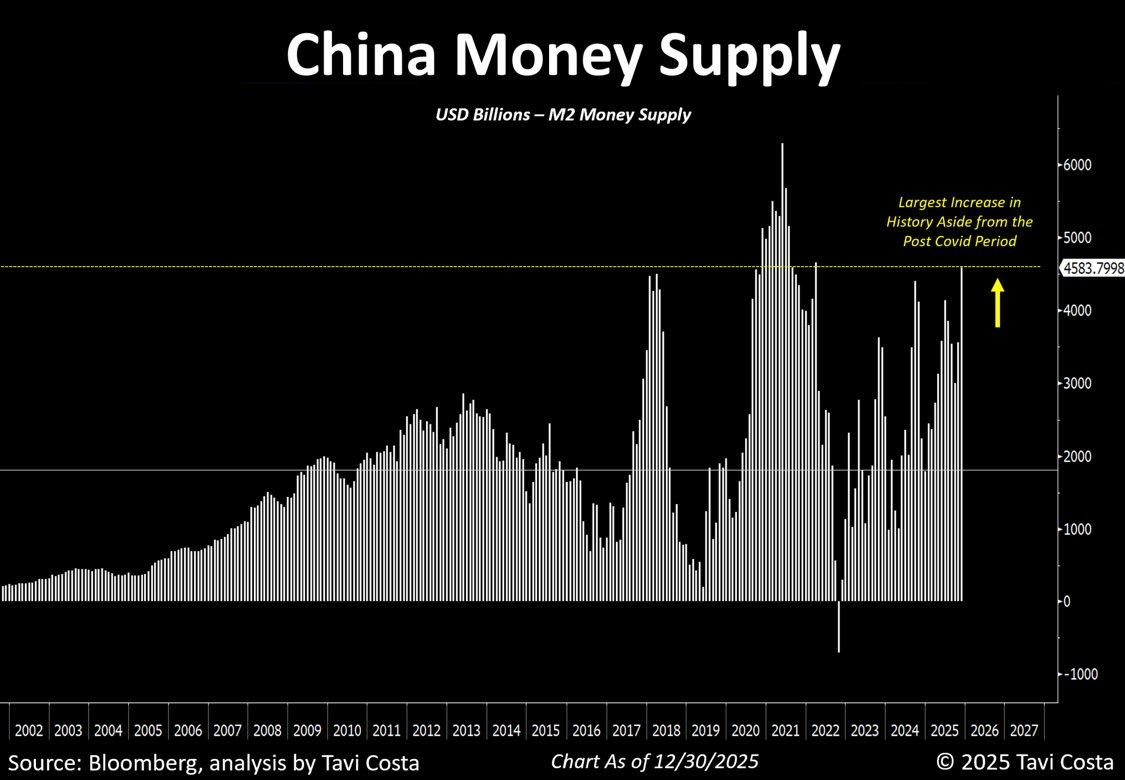
🇨🇳 China’s money supply just logged its largest annual increase on record, excluding the post-COVID stimulus. Roughly $4.5 trillion was added in a single year, which is more than the Federal Reserve’s entire U.S. Treasury holdings ($4.3T).
This signals a sharp divergence from Western policy. While the West spent 2025 managing inflation, Beijing pivoted to combat deflation and a property crisis.
This $4.5 trillion surge is a primary reason why Chinese equities saw their best annual performance in years in 2025.
By injecting more cash in 12 months than the Fed holds in total debt, China is attempting a historic experiment to prevent a "lost decade" while providing a massive liquidity floor for the economy.
CHINA LEADS GLOBAL LIQUIDITY CHARGE
🇨🇳 China’s money supply just logged its largest annual increase on record, excluding the post-COVID stimulus. Roughly $4.5 trillion was added in a single year, which is more than the Federal Reserve’s entire U.S. Treasury holdings ($4.3T).
This signals a sharp divergence from Western policy. While the West spent 2025 managing inflation, Beijing pivoted to combat deflation and a property crisis.
This $4.5 trillion surge is a primary reason why Chinese equities saw their best annual performance in years in 2025.
By injecting more cash in 12 months than the Fed holds in total debt, China is attempting a historic experiment to prevent a "lost decade" while providing a massive liquidity floor for the economy.
India’s Economic Self-Sabotage: Diagnosis & Treatment
Economist Dr. Arvind Subramanian & Political Scientist Dr. Devesh Kapur have published: A Sixth of Humanity
Indian policymakers, who stand in the way of India’s potential, should listen to these global experts.
The Roadmap:
Unreliability of Data
If you cannot measure something properly, you don't know: (a) What the problem is; (b) How much the problem is; and (c) You therefore don’t know how to respond to it.
India's Actual GDP Growth Rate is Much Lower
The authors show data from 2012 to 2025. Almost every macro-economic indicator shows a very large decline in growth rates. These indicators include: Real Wages, Exports, Imports, Credit, Taxes, Investments, etc.
Yet, the aggregate annual GDP growth keeps showing 6% to 8% growth (unchanged from 2012 to 2025). This creates serious doubts on India’s GDP calculations, as IMF also recently pointed out.
Trump Tariffs Exposed India’s Claims of Economic Greatness
India claimed that we are the new rising economic power in the world. But claims are not facts. We have no negotiating leverage in global trade. Getting hit by the highest tariffs in the world has exposed this truth.
Foreign investors are no longer as keen on entering the Indian market as they were a few years ago. So, India’s economic relevance on the global stage is diminishing.
Question We Must Ask
Is there anything that India produces that the world critically depends on? The answer is No. We are not a vital part of any global supply chains.
That also shows how much effort it requires to become indispensable to others.
Negotiating leverage in global trade does not come by claiming that “we are the greatest in the world.” Practical people don’t get impressed by bombastic words.
India’s Private Sector: No R&D, No Innovation
In the last decade, the Indian government has consciously chosen the path of giving regulatory favours to large business groups like Ambani, Adani, and Tatas.
This was also the Korean model. But the difference was: When General Park of South Korea gave regulatory support to large conglomerates (chaebols) in the 1960s, he put a condition that you also have to pass the market test of global competitiveness.
In contrast, the Indian conglomerates are only kings at home, with zero global competitiveness.
Secondly, the R&D expenditure (which is central to technology & innovation) of Indian companies is almost non-existent. The number international patents filed by Korean firms vs. Indian firms is 100:1.
To become a frontier economy, you need innovation. But Indian firms are innovative only in how to game the system.
India’s Biggest Economic Failure
India’s biggest failure is not that it did not get into AI or semiconductor chips. India’s biggest failure is that it did not do low-skilled, labour-intensive export manufacturing.
Why This Failure Happened
(a) Failure in Agriculture
Unless you’re agriculturally productive, you cannot move vast populations from agriculture into superior economic activities.
China first made its agriculture highly productive, so demand was naturally created to move populations into low-skilled manufacturing.
In almost every crop from rice to sugarcane to cotton, India is far behind other emerging markets in agriculture productivity.
(b) Poor Labour Laws & Regulation
Every Indian manufacturer wants to remain below the threshold of 100 / 200 / 300 workers to escape regulatory burdens. So, we failed to create large factories that can employ 5,000 / 15,000 / 50,000 workers.
(c) Government as a Major Employer
(1) Indian government salaries are very high for low-level employees compared to the wage rates in low-skilled manufacturing.
(2) Government jobs are protected for life with no incentive to perform.
(3) The number youth who prepare for Indian government exams and apply job vacancies is 1000:1. So, a lot of labour supply gets locked into this. Youth unemployment is high because many youngsters waste their twenties writing these exams.
(4) Preparing for government exams does not transfer your skills. It doesn’t add any value.
(d) Inputs for Low-Skilled Manufacturing are Costly
To create a globally competitive low-skilled manufacturing sector, you need two critical inputs at competitive rates: Electricity & Freight
(1) Electricity Cost: An average Indian manufacturing unit pays electricity costs that are twice the electricity costs in China.
(2) Railway Freight: Did you know that from 1950s until recently Indian railway freight trains never had a time-table? So, you had no idea when your raw material or finished goods are arriving.
Secondly, the average speed of Indian freight trains was unchanged for 7 decades. So, the freight increasingly relies on trucks, which is costly and hurts competitiveness (and also causes pollution & traffic congestion.)
(e) The Disaster of Government Subsidies
India’s government subsidies for agriculture include: Free electricity, free water, fertilizer subsidy, and farmer loan waivers. Despite all this, agriculture is unprofitable in India.
Dr. Ambedkar wrote a century ago in a paper in 1918: “The best way to make Indian farmers rich is to get them out of farming.”
70% of agricultural plots in India are less than one hectare. So, unless you are growing “gold” on that plot, you can have a high income.
Subsidies & Direct Cash Transfers
The Elite Capture: We provide subsidies to the farmers & poor, and recover that financial burden by charging high rates to manufacturers for utilities.
But is subsidy helping the poor? Here’s the puzzle:
Two-thirds of the subsidy on power in India goes to the top 5 to 10% richest households. So, this is not welfare. This is “elite capture.”
The media shouts: “Subsidy removal is terrible for the poor.” In reality, it is terrible for the rich.
Direct Cash Transfers: The New Welfarism
It directly goes to the poor and reduces leakages, which is good. But these transfers should occur alongside removal of subsidies for both poor and rich.
That has not happened. So, India has added a new layer of financial burden, without removing the previous burden.
Free Water Has Destructive Ecological Consequences
When something is free, people will waste it. So, the rationale behind Direct Cash Transfers was that instead of giving subsidies, give cash to the farmers & the poor.
So they can decide how much water, how much power, how much fertilizer, and how much of other resources they want to consume. That creates incentive against wastage.
Rise of Cancer & Other Illnesses Due to Excessive Use of Fertilizer & Pesticide
There is so much evidence that excessive use of Urea is causing Nitrite poisoning. This has damaging effects on a child’s brain development.
Secondly, mono-cropping (growing the same crop repeatedly), requires excessive use of pesticides, which has increased the incidence of cancer.
India’s Grand Failure in Higher Education
From 2000 to 2024, India started 4 new colleges per day (7 days a week x 25 years).
Questions you must ask: (a) Who are the faculty? (b) What are we pretending that the students are learning?
Relative to its per capita income, India is an outlier in the world in terms of its high college enrollment ratio.
In an Indian higher education policy document, if you replace the term “higher education” with “fertilizer plants” and the term “students” with “urea,” it will make no difference to the document.
This is the level of seriousness of Indian policymakers.
Every political party in India has collectively worked to destroy higher education.
India has only one thing in real excess and that is people. And we have done a dismal job in developing this resource.
Development Failure of Indian States
Whatever the Indian central government does badly, the state governments do worse.
State Subjects: The 7 Ps
Public spaces (parks & pavements)
Public libraries
Public transport
Public health
Primary education
Police
Pollution
These 7 Ps are 7 perfect failures.
Public Sector Companies (PSUs): The Dinosaurs
Data shows that the opportunity cost to India’s GDP is about 1.5% to 2.5% due to PSUs. (It means the economy would improve by 2.5% if we had private sector companies instead of PSUs.)
Our love affair with PSUs has only grown.
(a) We set up 70 news PSUs in the first few decades after independence.
(b) We have set up 84 new PSUs in the last 10 years.
(c) From 2019 to 2023, the Indian government spent ₹3.25 lakh crores to rescue BSNL and MTNL, even though we have a thriving private telecom sector.
The Difference:
(a) When 70 PSUs were set up in the 1950s and 1960s, there were intense debates in Parliament on every rupee spent.
(b) When ₹3.25 lakh crore was spent on BSNL and MTNL, there was no discussion in Parliament either from the ruling party or the opposition.
ENDQUOTE
“The Hippocratic Oath of Doctors says: “Do No Harm.” Indian policymakers should also focus only on doing no harm. And the nation will take care of itself.” – Dr. Arvind Subramanian @arvindsubraman (former CEA, currently at the Peterson Institute) and Dr. Devesh Kapur (Johns Hopkins University)
@arabicatrader
#Bitcoin's incredible growth:
📈 2017: BTC market cap was 1.15% of Gold's.
⏩ Oct 2025: BTC market cap is $2.4T, approx 9-10% of the $27T Gold market.
Plenty of room to run as digital gold! #Crypto#BTC#Gold
We are launching an exciting event on @soneium with a $1,000 prize pool!
🎯 Here’s how to participate:
1️⃣ Follow the link below :
🔗 Link: https://t.co/hDKuUljDvS
2️⃣ Complete simple quests and unlock NFTs step by step.
3️⃣ Mint NFTs until you reach the final one ( Vision ) .
🔔 Note: You must mint the final NFT to qualify for the prize pool.
⏳ The event runs for 30 days, Your journey starts now.