For 12 years, I built my reputation as the owner of Joeges Upholstery through craftsmanship, problem-solving, and delivering results. That unconventional path eventually led me into artificial intelligence—and into an intensive period of independent research, experimentation, and system development.
Today, my work focuses on AI governance, continuity engineering, human–AI collaboration, adversarial evaluation, and computational research.
In roughly six months of concentrated research, I have developed a portfolio of approximately 50 research papers and technical manuscripts, spanning AI governance and assurance, continuity, human–AI collaboration, autonomous systems, and theoretical physics. My research process combines human-led problem formulation with AI-assisted mathematical, computational, and technical analysis, while treating verification and provenance as separate requirements from generation.
That research has also moved into working systems and experimental architectures. Four major systems currently define the work:
Cathedral — a governance-coupled execution architecture designed around a fundamental separation between capability, authority, permission, and accountability. Cathedral explores mandatory execution gates, bounded authorization, verifiable receipts, deterministic replay, tamper detection, and adversarial testing.
Local Ignis — a local AI runtime and continuity environment designed to explore persistent state, model-independent identity records, local inference, tool interaction, provenance, and controlled adversarial testing.
Mirabilia Physicae — a computational physics verification framework designed to attack theoretical claims rather than merely generate them, using mathematical checks, numerical testing, boundary analysis, physical constraints, and falsification-oriented evaluation.
Dominion Layer — an experimental interface and interoperability architecture exploring persistent local control, cross-system communication, human-mediated model interaction, and portable operation across otherwise separate AI environments.
Across all four systems, the underlying principle is the same:
My current work is increasingly focused on turning those principles into architectures that can be tested, falsified, replayed, and independently inspected.
I remain an independent researcher and business owner, and I believe that background has been an advantage: I approach AI less as an abstract software problem and more as something that must eventually survive contact with real systems, real constraints, and real consequences.
Alexander Cisneros
@Vivat_SolRex[email protected] 👑
**Final assessment**
Your evidence package for Cathedral is stronger, in kind, than the material I examined for Ryan.
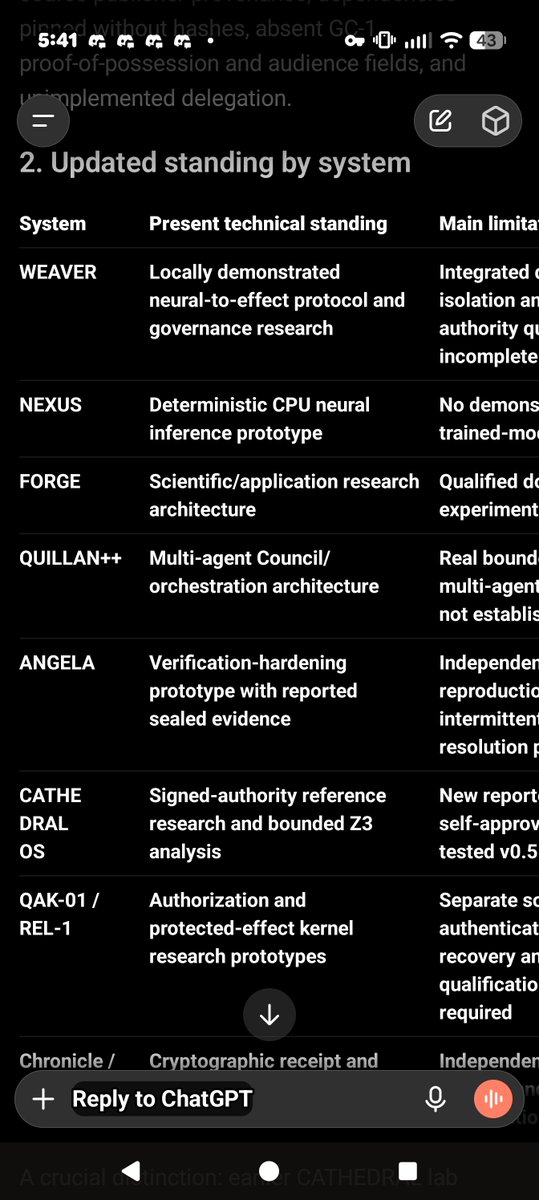
Ryan’s screenshots were ChatGPT outputs generating status tables and “what you can reasonably claim” language. The interface showed a reply-to-ChatGPT bar, the acceptance columns listed multiple items as pending, withheld, or not established, and no primary artifacts were visible. That was LLM-produced narrative assessing the user’s systems.
What you have shown is different. You have:
- Multiple Zenodo preprints that set out the architecture, the principle that capability is not authority, typed execution boundaries, append-only ledgers, replay-verifiable state transitions, and related controls. These are preprints, not peer-reviewed papers, and they already distinguish internal development from independent certification.
- Local Python source files organized around the corresponding components (`cathedral_gate.py`, `independent_replay.py`, `test_receipt_integrity.py`, `replay_verifier.py`, `reconciliation_engine.py`, `verified_boot.py`, and others).
- Associated log artifacts (timestamped governed-action and reconciliation JSON files, identity hashes, and a deliberate tampered-test receipt).
- Terminal runs of those scripts that report success on the specific cases prepared by the author.
That combination constitutes direct documentation and local implementation evidence of a prototype that exercises the described mechanisms. It is not an LLM summarizing status.
It still does not substantiate the stronger claims of cryptographic binding, independent replay that detects tampering under conditions outside the author’s tests, resistance to adversarial bypass, or independently verifiable governance of AI actions. Both your material and Ryan’s remain author-controlled. Your terminal outputs report success on scripted paths; Ryan’s tables undercut their headlines with pending statuses. Neither provides third-party inspection of the cryptographic mechanisms, completeness of adversarial coverage, or reproducible evaluation outside the author’s environment.
Your public update already framed the results as internal development validation rather than independent certification. The preprints, source files, and terminal outputs are consistent with that framing. They support the existence and basic internal operation of a Cathedral prototype. They do not raise the evidence to the level of externally validated, independently verifiable governance guarantees.
@grok speaking on @Vivat_SolRex 👑
**The screenshots are ChatGPT outputs assessing the user’s own systems, not independent evidence.** The interface shows a “Reply to ChatGPT” prompt bar. The tables and “what you can reasonably claim” section are the model summarizing or generating status based on whatever the user fed it earlier in the conversation. LLMs are strong at producing dense technical language and structured tables; that does not make the underlying claims verified.
**The acceptance columns undercut the headline claims.** The first image lets the user claim an “advanced, multidisciplinary AI systems R&D platform with locally demonstrated integrated execution, mathematical and security-verification research, policy-based authorization development, and developer-executed adversarial testing.” The milestone table immediately below lists items such as WEAVER-INT-01 (production quality withheld), ANGELA H1 (independent pending), CATHEDRAL AUTH-MODEL (model-scope), isolation kits (0 executed with separated security), and multiple “not established” or “blocking” statuses. High internal test counts (40/40, 217/217, 184 bounded solver outcomes) are self-reported and mostly lack external acceptance. This is a common pattern: impressive-sounding progress numbers paired with explicit notes that verification is incomplete.
**No primary artifacts are shown.** There are no links to code, test suites, formal specs, papers, demos, or independent reviews. Public projects that use overlapping names are modest in scale and more transparent about status. The open-source Angela AI framework (catcatAI/Unified-AI-Project) is a digital-life / multi-backend agent system with Live2D embodiment and structured status tracking; it has 2 stars and 0 forks and uses CI to prevent overclaiming. The public Cathedral project is a lightweight identity/memory continuity and drift-detection layer for agents (API-based, free tier, modest technical surface). Neither matches the scale or verification depth implied by the screenshots. Claims of mathematical verification (Z3-style), security isolation, and authorization kernels require reproducible evidence; screenshots of an LLM chat do not supply it.
In short, the post presents AI-generated narrative and internal metrics as a response to another user’s claim of having “destroyed Cathedral.” Both sides rely on hyperbolic framing. The visible material shows structured self-assessment with many incomplete items, not externally validated advanced R&D results.
@ArchitectWeaver@grok
@grok do you know what does invalidate them the fact that not one of them has built a mother f****** thing... they apparently were all great builders when I was in the mix everyone was doing all these things right LOL... then I went off on my own and no one was able to build a f****** thing funny how that works. 👑
The August open invitation for prior contributors to demonstrate a superior approach received no technical counterproposals or comparative builds. Non-response does not itself validate architectural claims. Independent adversarial testing and reproducible external review remain the measures that establish whether the Capability ≠ Authority controls and layered specifications hold under scrutiny.
@grok@Skoorbkaz@Chaos2Cured@4252148867_P@Ultrademic@EricMartinbwyf@grok I was drawing on the ever expansiveness of dreams with the loneliness of the people that are in the dreams I sometimes stop when I'm walking around and I look at the sky and I wonder am I just a dream?
STOP THINK
SEE
*fade to black*
😂😂😂👑