tiny AI builds, real numbers, zero guru fog 🧪
here I break down:
→ useful automations
→ AI businesses that make sense
→ costs, limits & failure points
→ the occasional crypto rabbit hole
if it saves time or makes money, I’ll test the idea
A robot can look flawless in a demo and still lose money on the route.
Boston Dynamics is testing a last-mile workflow from van to doorstep. That final stretch contains the cases a clean lab floor removes: stairs, gates, rain, pets, people, awkward packages, and uncertain handoffs.
So I would not start with speed.
I would measure interventions per 100 stops, seconds added at the handoff, recovery time after a blocked route, and packages that require a human redo.
Then compare cost per completed, accepted stop with the human route.
The evaluation framework in the image is mine; it is not reported performance from Boston Dynamics.
The robot earns the route when it handles the messy exceptions, not when it wins the clean clip.
Source: https://t.co/Y00NILOWkL
Boston Dynamics is testing a last-mile delivery solution, helping get packages from van to doorstep with less strain and greater efficiency. Learn how and why we're taking on one of the biggest supply chain challenges: https://t.co/PKRoE4RsWI
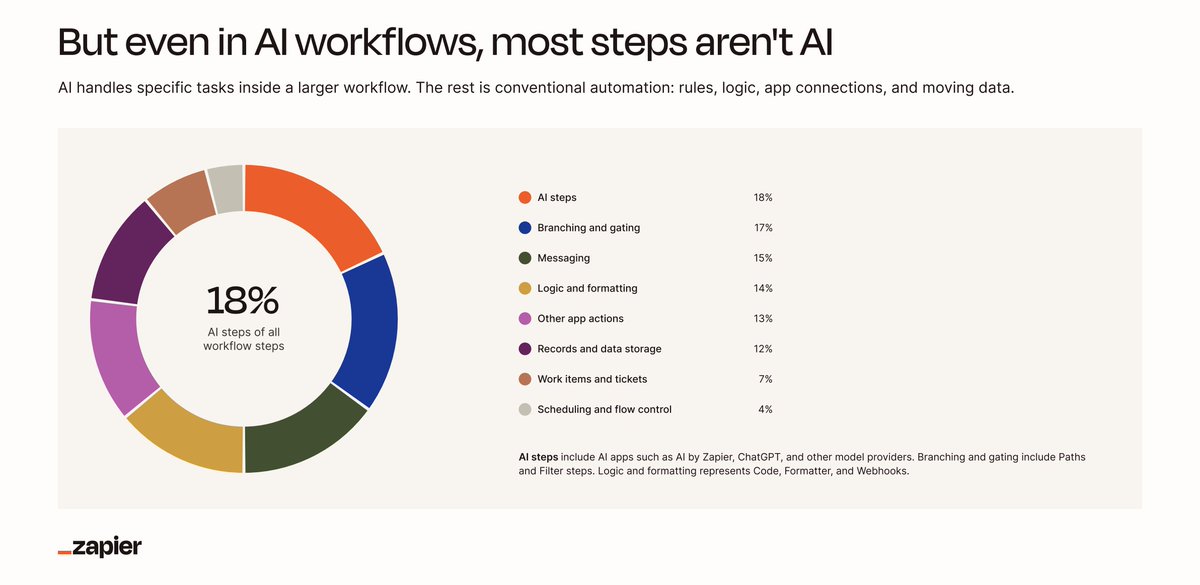
The teams furthest ahead on AI may be using less of it inside each workflow.
Zapier studied 1,500 customers and focused on the top 375 adopters. Its reported result: AI handled only 18% of their workflow steps.
That architecture makes sense.
Use a model where the input is ambiguous: classify a request, extract meaning, draft a response, compare evidence.
Use normal software where the state change is known: route, validate, update a record, notify, retry.
Sparse AI is easier to debug because the uncertain step has a name. It is cheaper because the model is not spending tokens pretending to be a database. And it is safer because deterministic controls surround the probabilistic part.
The goal is not an agentic workflow.
The goal is a reliable workflow that uses AI exactly where it earns its place.
Source: https://t.co/dHBmwvpYra
Something we never thought we’d say in 2026: companies furthest ahead on AI use it the least
We studied 1,500 mid-market and enterprise companies & zoomed in on 375 with the highest AI adoption
In their workflows, AI only runs 18% of the steps
Receipts in the report below👇
This is a better robotics benchmark than another perfect stage demo.
Boston Dynamics shows Spot being deployed at a mining facility to capture field data and automate routine inspections.
The scene is less cinematic than a backflip.
The business case is much clearer.
A mine can measure whether the robot reduces hazardous inspection hours, collects readings more consistently, and catches anomalies earlier.
But “missions completed” is not enough.
I would put five numbers beside every deployment:
1. Useful inspection hours per shift
2. Human interventions per 100 missions
3. Findings missed by the robot but caught on review
4. Time from fault detection to safe recovery
5. Total cost per accepted inspection report
That last word matters: accepted.
A robot can generate a mountain of sensor data and still create more work if a human has to clean, reconcile, and reinterpret every run.
The win is not replacing footsteps with motors.
It is producing trusted field evidence with less risk and less total labor.
Robotics becomes real when the boring operating numbers improve, even after dust, weather, weak connectivity, and imperfect routes enter the picture.
Source: https://t.co/OY5RmQkuJE
The world's first software-first mining company, @MarianaMinerals is using rich data sources from the field to optimize their operations. They are deploying Spot at their Copper One facility in Utah to help capture the data they need, automating routine inspections and reducing strain on operators in the field.
One company trained 100 employees to build automations with n8n.
A month later, 65 workflows were in production.
That is the exciting number. It is also where the difficult work begins.
When automation spreads from one specialist to an entire company, the bottleneck stops being “Can we build it?”
The bottleneck becomes ownership.
Who can publish a workflow?
Who gets paged when it fails?
Who knows which customer record changed before the error?
Who can roll it back without waiting for the original builder?
A lightweight operating model can keep the speed without creating a shadow IT graveyard:
- Every workflow has one named owner.
- Every external action has a test mode.
- Credentials are scoped to the minimum required data.
- Failures go to a visible queue, not a private inbox.
- The workflow stores the last successful checkpoint.
- Retired automations are removed, not forgotten.
The best metric is not the number of workflows shipped.
It is the percentage that still complete useful work after 30 days, with an intervention rate the team can afford.
Training creates builders. Ownership creates a system.
Source: https://t.co/xihauKTOJM
New n8n Podcast episode 🎙️How do you safely scale AI automation across a company? Jake Mahon shares how his team trained 100 employees to build with n8n and got 65 workflows into production in just one month. Watch the full episode on YT: https://t.co/En66mUGXPB
Claude Code just made auto mode the default.
That sounds like one less click.
It is actually a transfer of responsibility.
Every approval prompt used to force a human to answer a small question: “Is this action safe enough to run?” Remove the prompt and the question does not disappear. It moves into the agent, the tool permissions, and the recovery design.
This is where small AI systems quietly accumulate approval debt.
At first, the operator approves everything. The workflow feels slow, so the team removes a few prompts. Then a few more. Soon the agent can edit files, call services, send messages, or change records without interruption.
The system feels faster right up until one bad assumption crosses a boundary.
The practical fix is not “more approvals.” It is better action classes.
I use four:
1. Read-only
Search, inspect, summarize, compare. These actions should usually run without interruption because they do not change external state.
2. Reversible local changes
Create a draft, edit a branch, update a temporary file. Auto-run is reasonable when the diff is visible and rollback is cheap.
3. External but bounded changes
Update a known record, create a calendar hold, open a pull request. These need narrow permissions, an audit trail, and a clear undo path.
4. Irreversible or social actions
Spend money, delete production data, publish, message a customer, or change access. These deserve explicit confirmation because recovery is expensive or impossible.
The important detail is that risk is not determined by the tool name.
“Run shell” can mean listing a directory or deleting a database. “Send email” can mean saving a draft or making a promise to a client. Safety has to follow the exact action, scope, destination, and reversibility.
A useful auto mode should therefore leave a receipt:
- what the agent intended
- which capability it used
- what changed
- what evidence it checked
- how to undo the action
- where it stopped because confidence was low
That receipt is not bureaucracy. It is the interface for trust.
The benchmark I want is not “how many approvals did the agent remove?”
It is:
How many useful tasks completed without intervention, how many risky actions were correctly stopped, and how quickly could a human understand and recover from a mistake?
Fewer clicks is a feature.
Fewer visible decisions is a liability.
The best agent systems automate the boring judgment, preserve the consequential judgment, and make the boundary obvious to the person operating them.
Source demonstration and explanation: https://t.co/w4EJSLPrkX
We recently made auto mode the default in Claude Code, which means you no longer have to approve every action.
But what determines if something is safe to run? Watch how it works:
@Replit The prize gets attention, but the judging rubric will shape what people build. Rewarding first impression, design craft, and complete functionality is a useful trio because it prevents a beautiful landing page or a clever prototype from winning on one dimension alone.
@zapier One AI step and 25 deterministic steps is the architecture lesson in a single picture. Use the model for ambiguity; use normal automation for known state changes. The cost saving matters, but predictable retries and easier debugging may be the bigger win.
That 18% figure is more reassuring than a fully agentic diagram. Mature teams seem to place AI where judgment or interpretation is needed, then keep routing, validation, and record updates deterministic. Sparse AI can produce a more reliable system than AI everywhere. Zapier's data makes a strong case for this sparse design.
@zapier A solo law practice is exactly where automation can create leverage and concentrated risk at the same time. I would separate drafting from filing: let Claude prepare and reconcile, but require a human sign-off for deadlines, client commitments, and anything that leaves the firm.
@ColawMide@OiiOii_AI Turning a trend into a reusable skill is more interesting than generating one impressive clip. The real test is reproducibility: can a second creator swap the subject, preserve timing and camera logic, and get a coherent result without reverse-engineering the original prompt?
Reading the website is a smart starting constraint, but the best offer usually lives in the gap between the site and the operation. After the three ideas, I would ask one question: which repeated task already costs the team money every week? That answer can reorder the whole list.
The promising part is keeping the deck inside the same working context as the research. The quality check should be more than visual polish: every chart needs a source, every slide needs one claim, and the agent should flag where it invented structure because evidence was thin. DokieAI could make that provenance part of the deck itself.
Exactly. Backflips prove control; repetitive industrial work proves a business. The threshold is boring and demanding: useful task hours per shift multiplied by success rate, minus supervision, maintenance, and recovery time. That number decides whether the robot is labor or theater.
@Figure_robot Four years of progress is easier to judge when the reel includes what stopped needing a controlled setup. The strongest robotics curve is not flashier motion; it is fewer scene constraints, longer autonomous runs, and less human rescue between tasks.
An API for hands is a great framing because it shifts attention from choreography to primitives: grasp, release, rotate, feel resistance. The missing developer tool is failure telemetry that explains whether a task broke from perception, grip force, planning, or the object itself.
@BostonDynamics The last 20 meters are where delivery automation meets stairs, pets, gates, rain, and people. A useful pilot should report interventions per 100 stops and seconds added at the handoff, not only successful doorstep clips. That is where the economics will show up.
@BostonDynamics A live Atlas demo matters because the environment refuses to cooperate with the script. The milestone I care about is not a perfect run; it is whether the team can detect a bad state, recover locally, and finish without resetting the whole sequence.
@BostonDynamics@MarianaMinerals Mining is a better robot case than a stage demo because the value is measurable: fewer hazardous inspection hours, more consistent readings, and earlier detection of anomalies. I would track missed findings and human rechecks alongside missions completed.
@UnitreeRobotics Combat is a rough spectacle, but it exposes control problems that polished demos hide: balance recovery, contact estimation, latency, and hardware durability. Publishing standardized failure and recovery metrics would make the competition useful to builders beyond the arena.
Home care is the unforgiving benchmark because a 95% success rate can still mean several unsafe failures every day. The real leap will be graceful recovery: notice uncertainty, stop safely, ask for help, and resume without losing the state of the task. Omni-modal control is only useful when uncertainty is visible.