Dirty tanker spot freight rates increased in 2025 across several major routes. Middle East to Far East averaged 73 percent of Worldscale ($17.2 per tonne), up from 57 percent in 2024. West Africa to US Gulf Coast increased to 98 percent, and Indonesia to Far East eased to 131 percent.
#OPECASB2026
World proven crude oil reserves stood at 1,572 billion barrels (bn b) at the end of 2025, slightly higher by 7.3 bn b, y-o-y. Proven crude oil reserves in OPEC Member Countries increased by 2.19 bn to reach 1,243 bn b at the end of 2025.
#OPECASB2026
Chevron CEO says shortages in oil supply will begin appearing
Chevron Chairman and CEO Mike Wirth said on Monday that physical shortages in oil supply would begin appearing around the world because of the closure of the Strait of Hormuz, through which 20% of global crude supply passes.
Economies will begin shrinking, first in Asia, as demand adjusts to reduced supply with the strait still closed because of the U.S.-Israeli war with Iran, Wirth said during a discussion sponsored by the Milken Institute.
"We will start to see physical shortages," Wirth said, noting that surplus supply in commercial markets, tankers in so-called shadow fleets avoiding sanctions, and national strategic reserves were being absorbed.
Asia is most heavily dependent on the Gulf's oil production and refineries, with Europe likely to be affected next, Wirth said.
The overall effect of the Hormuz closure is "potentially as big as in the 1970s," Wirth said. Two major supply disruptions in that decade shook economies around the world, leading to fuel rationing and long lines at retail pumps. (Reuters)
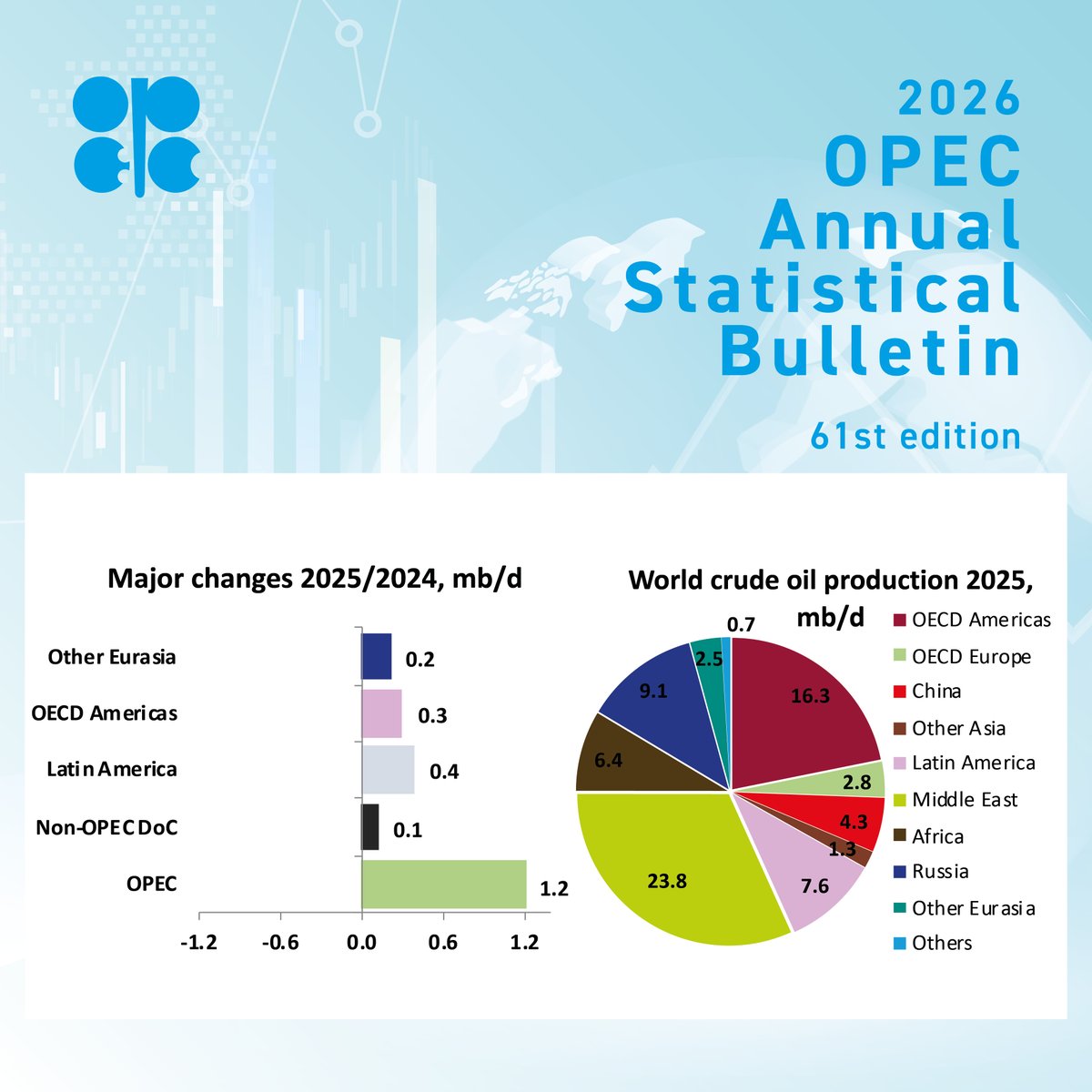
World crude oil production averaged 74.85 mb/d in 2025, an increase of 2.24 mb/d, year-on-year (y-o-y). Crude oil production from OPEC Member Countries and non-OPEC oil-producing countries participating in the Declaration of Cooperation (DoC) increased, y-o-y, by 1.22 mb/d and 0.12 mb/d respectively, while crude production from non-DoC countries rose by 0.90 mb/d.
#OPECASB2026
The only source of energy that has ever gone to ZERO is whale oil.
As global demand increases, so does all energy sources. We need all the inputs that we can. There is no substitution, there are only additions, as this chart clealy shows.
Saudi Arabia, Russia, Iraq, Kuwait, Kazakhstan, Algeria, and Oman adjust production and reaffirm commitment to market stability
Read Press Release ➡️https://t.co/FX9u07426n
I recently had the pleasure of being a guest for the DHABA podcast run by the great Joel Gill.
We discussed about HyperVolatility, energy and shipping volatility and why volatility intelligence is so important.
https://t.co/OYHXNBonhy
#volatility#energy#shipping
Saudi Arabia has increased its official selling price (OSP) to a record high.
The state-owned Saudi oil giant told refineries in Asian it would charge a premium of $19.5 a barrel over the regional benchmark for sales of its flagship Arab Light.
https://t.co/sheew7I4Mu
Iranian Oil Prices Fetch a Premium for First Time Since 2022
The price for the nation’s main export grade swung to a premium of $1 a barrel to Brent on March 26, just days after the US temporarily rolled back some sanctions on the country’s oil, according to data from Argus Media.
That contrasts with a roughly $10-a-barrel discount in early 2026 when all of the country’s supply was under sanctions. (BBG)
Governments have responded to energy crisis with wide range of emergency measures aimed at shielding consumers and securing domestic supply, ranging from financial support to rationing as fuel crisis deepens; based in part on @IEA and @Reuters information, @StatistaCharts infographic shows that one of most common responses has been introduction of emergency subsidies and direct financial support
Ship Fuel Shortages Emerging Due to Mideast War, Supplier Says
Shortages of shipping fuel are starting to emerge in Asia and West Africa as vessels seek supply outside the Middle East, according to marine fuel trader Monjasa Group.
The UAE port of Fujairah just outside the Strait of Hormuz — normally a key hub for shipping fuel — has suffered disruption from drone attacks. The uncertainty there is creating new and unexpected demand, according to Casper Borgen, general manager for Middle East and Africa at the firm.
“From the epicenter in Hormuz, we are seeing how the rings spread to Asia and West Africa, where markets are also starting to experience a shortage of products due to the increasing demand without the supply being able to keep up,” he said by email. “There is a bottleneck in one of the world’s most important energy trade lanes, and this means many new and major challenges for all suppliers.” (Bloomberg)
BREAKING: Qatar says that its Ras Laffan industrial city, home to a massive LNG plan, was hit by Iranian missiles.
"Emergency response teams were deployed immediately to contain the resulting fires, as extensive damage has been caused."
Note the wording: "extensive damage"