ANNOUNCEMENT: We've built a coding agent that beats Claude Code on long tasks.
Today we're releasing it for free. Meet Volt: The coding agent who never forgets.
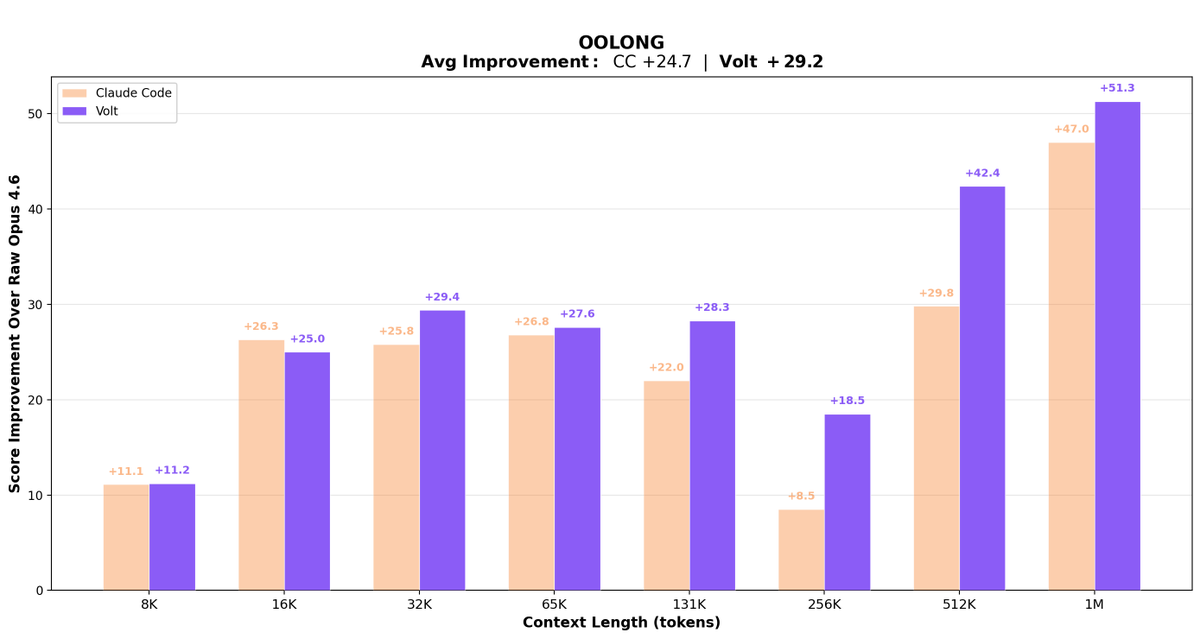
→ Dominates Claude Code on the OOLONG long-context benchmark, including at every length from 32K to 1M tokens.
→ Has unlimited recall. No more amnesia. Volt can code for weeks in a single coherent session.
→ Massively parallel. One tool call can process thousands of tasks. Like "Map" for LLMs.
→ Open source and model agnostic. Try Volt today with @openrouter or your API of choice.
Volt's performance is the result of a new architecture, Lossless Context Management (LCM), which applies lessons from the history of operating systems and programming languages to LLMs.
LCM is like paged virtual memory, except for managing context:
- Layer 1. An immutable append-only store of everything that occurs in the coding session.
- Layer 2. The active "context window" which functions like a cache layer for navigating to the appropriate section(s) of Layer 1 via a high-fanout DAG.
From a user perspective, this feels like an infinite context window, because the model never forgets and performance stays crisp.
For the technical details, read our paper: https://t.co/wuyz3osmJh
For the code, go to https://t.co/tBGzZWyngT.
Or get started with one line:
curl -fsSL https://t.co/sIHoG3zHfQ | sh
Some founders are fighting for b2b saas.
And others are fighting to win it all.
This conversation is the moment I knew Ted and @ClintEhrlich were taking on Dario.
lossless-claw 0.11.1 — the focus mode release
🎯 /lossless focus curates your context
↩️ /lossless unfocus brings the normal context view back
🖼️ image externalization now works across roles
📦 installs stop pulling a second OpenClaw
"LCM: Lossless Context Management" (Ehrlich and Blackman, 2026) is now available on arXiv.
This is the paper that caused @openclaw to modify its architecture to support context management.
It's a must-read for anyone interested in RLMs vs LCM.
https://t.co/c4NYUnsZlO
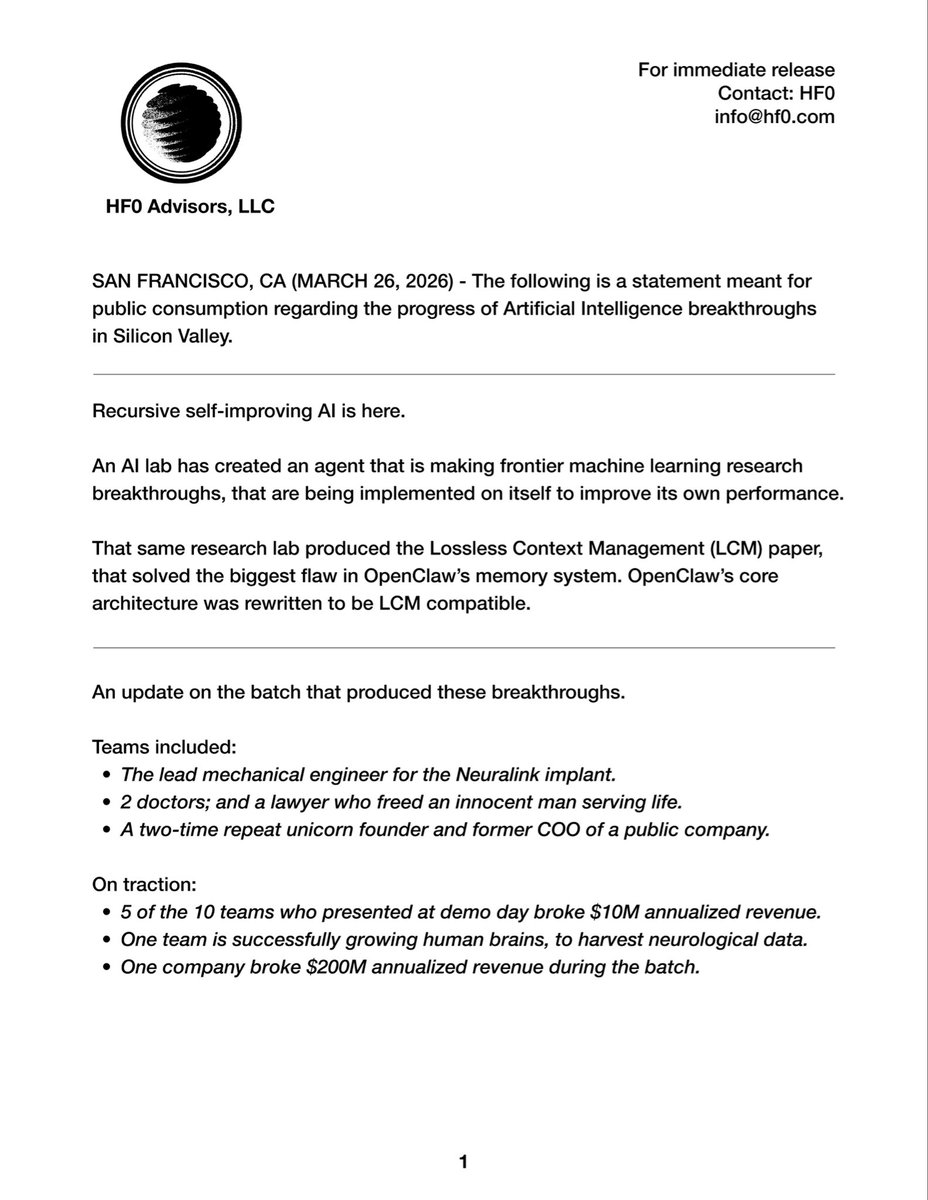
Recursive self-improving AI is here.
I had heard people talking about self-improving AIs at some of the frontier labs but wasn't sure how real it was.
One of the neo labs in the current @hf0 batch had a breakthrough and now it’s running in our basement. It’s real.
The following is a statement meant for public consumption regarding the progress of Artificial Intelligence breakthroughs in Silicon Valley:
Recursively self-improving AI is here.
Fun fact about lossless-claw: in addition to solving agent amnesia and enabling infinite-length sessions, it's also very token efficient.
Lossless summaries are great for prompt caching. I at about a 90-94% cache hit rate.
Thanks to incremental compaction, your context rarely grows beyond 80k tokens before truncating back to 30-40k or less. This means that your model is almost always operating faster, smarter and cheaper since it has less overall context to operate on.
A common line of questions I receive: what does lossless-claw do differently than memory systems? How do the two relate? Should I use both? Here’s the lowdown:
Memory systems are good for letting you search for information that’s external to your context window, which are typically “memories” extracted from past/different conversations. This is necessary because:
Compaction is lossy: when your conversation gets too big, your agent replaces the whole conversation with a summary. Do this a few times and details from the first conversation are no longer part of the summarized conversation.
Your context is split across many sessions: you have conversations with different agents over time and want to be able to reference all of that in your current conversation.
Memory systems work okay in the first case and pretty well in the second case. lossless-claw works phenomenally well in the first case and only indirectly addresses the second one. Let’s expand that.
Lossless context makes frequent summaries of smaller pieces of context in the background. It keeps your most recent messages around verbatim (the “fresh tail”). As the summaries accumulate, they get combined into summaries of summaries.
This lets your agent stay focused: older content is still there, but becomes more “vague” over time — kind of like your own recollection of events. Current messages are always there and never suddenly disappear to be replaced by a summary. This effectively solves the “post-compaction amnesia” problem where your agent seems to suddenly forget important recent details about what you were doing.
The reason lossless-claw is called “lossless” though is because your older messages never get truly removed. The incremental summaries replace the messages, but act as “pointers” to them that can be used to expand the source messages back into context. Because the summaries stick around, your agent doesn’t forget about what it can expand should it need to.
By contrast, memory systems don’t offer the agent any ideas about what can they can be used to remember. This is why you have to frequently tell your agent to “search its memories” explicitly for something. This feels unnatural and is certainly inefficient.
Using lossless-claw means that you can keep one conversation going indefinitely without ever needing to reset. This assesses point (2) from above indirectly: if you don’t need to start new sessions all the time, you don’t need a way to recall information from past sessions!
If you work across multiple agents and want to share memories between them, or want to be able to recall information that happened outside of the scope of a conversation (eg meeting notes), you’ll want a memory system.
Much of what memory systems are used for is a poor fit for them stemming from overly naive approaches to managing context, which unfortunately are industry-standard. Don’t get me wrong: they’re still useful — I still use one — but they’re not the only tool that agents need to become effective personal assistants.
Lossless-claw is among the first production-grade implementations of an alternative context management strategy, and certainly the most effective, and it’s only available on @openclaw.
None of this would be possible without the excellent research into Lossless Context Management pioneered by @ClintEhrlich and @rovnys at @Voltropy, so make sure to give them a follow if you’re looking for some real alpha.
🚨 OpenClaw users!
Install Lossless Claw immediately!
Every message stored. Full history searchable. Context that actually survives.
This is the single biggest upgrade you can make to your OpenClaw setup. Not close.
I’m not affiliated or paid to post this. It’s that good!
AIエージェントのためのプログラミング言語。静的型付けで組み込み可。静的型付けされたLuaのようなものと考えればいいらしい。 / “GitHub - voltropy/mog: Programming language for safe AI agents” https://t.co/a29ewylZIt
First there was AI chat, that was one dimension, then came OpenClaw that made AI work in many dimensions at a time. Moreover by having your API KEY it made it as useful as the tokens you were willing to spend. But still there was the limited memory span challenge, this is a great solution from the Lossless Claw team. Now you have the tokens and the memory.
"[LCM] does something that no other AI plug-in has ever done before:
It gives your AI a permanent memory, that never deletes anything, ever.
Your OpenClaw is about to get dramatically more powerful." - @JulianGoldieSEO