James Cameron has written & directed 3 of the top 4 highest-grossing movies of all time (Avatar, Avatar: The Way of Water, and Titanic).
Before he made movies, Cameron was a truck driver.
He didn't go to film school.
Instead, on the weekends, he would go to the library and..
"I'd pull any thesis that [University of Southern California] graduate students had written [on] anything that related to film technology," Cameron explained.
"And for the cost of xeroxing (photocopying), I [got] all these doctoral dissertations [and] build up these big binders on how everything was done."
"So I literally gave myself a full graduate course on film technology for about $120.
I didn’t have to enroll in school because it was all there in the library. I’d set it up to go in like I was on a tactical mission, find out what I needed to know, and take it all home."
Takeaway 1:
When asked what motivated him to read those big binders full of information on filmmaking, Cameron said he was just following what excited him.
"People seek out the information and knowledge they need," he said. "It's like a divining rod."
The mythologist Joseph Campbell similarly talked about how reading is like "a divining rod," a way to find what you are uniquely attracted to and meant to do.
"You’ve got to read," Campbell said. "Find [what] excites you. And if it doesn’t excite you…It’s not yours.”
Takeaway 2:
Of course, at some point, Cameron had to put the binders down and pick up a camera.
When he eventually attempted to make his first movie, Cameron said, “It was a bit like a doctor doing his first appendectomy after having only read about it."
The bestselling author and learning expert, Scott Young, has a great article with a great title, "Do The Real Thing."
"When you examine case studies of people who have had major accomplishments," Scott writes, "you expect there to be some trick or shortcut...More often, however, the strategy used is dead simple: doing the real thing."
Takeaway 3:
Leonardo da Vinci used to sign off his letters, “Leonardo da Vinci, disscepolo della sperientia” ("disciple of experience").
He used to believe that one learns best by solely "doing the real thing."
Over time, however, he evolved out of this belief and, biographer Walter Isaacson writes, "became a disciple of both experience and received wisdom."
When you examine case studies of people who have mastered their craft, you usually find they are "disciples of both experience and received wisdom."
Like Cameron, they read the library and they do the real thing.
- - -
“Those who are in love with practice without theoretical knowledge are like the sailor who goes onto a ship without rudder or compass and who never can be certain whither he is going.” — Leonardo da Vinci
Follow @bpoppenheimer for more content like this!
For this famous scene in The Shining, Stanley Kubrick took a bit of inspiration from the silent era.
(The Phantom Carriage 1921 and Broken Blossoms 1919)
It begins with the words.
Nothing happens without them. Sometimes, the writing achieves transcendence, but, in every case, it’s seminal. I got to a give a brilliant speech recently, which not only explicated my and my brother’s characters, it illuminated an entire narrative. 1/3
@devincf This transition shot gives me goosebumps every time. I get even bigger goosebumps when I tell people about it. It blows my mind's goosebumps, actually.
@EricRogersHere I’d always assumed that the secret to not-looking was within the pages of the large locked book he refers to at the beginning during the intelligence briefing. As for how they got off the island, maybe he had a book about how to do that too.
@SethAbramovitch It will stay. It’s so that more Discovery content can be shoved onto the platform. HBO, DC, Cinemax, TCM, etc then become pillars under the Max umbrella. It makes sense to marketers and brand teams but feels like it’s diminishing their strongest asset in the TV land-the HBO brand
𝗦𝗮𝘆 𝘀𝗼𝗺𝗲𝘁𝗵𝗶𝗻𝗴 𝗳𝗶𝗿𝘀𝘁 𝗮𝗻𝗱 𝘆𝗼𝘂 𝗼𝘄𝗻 𝗶𝘁:
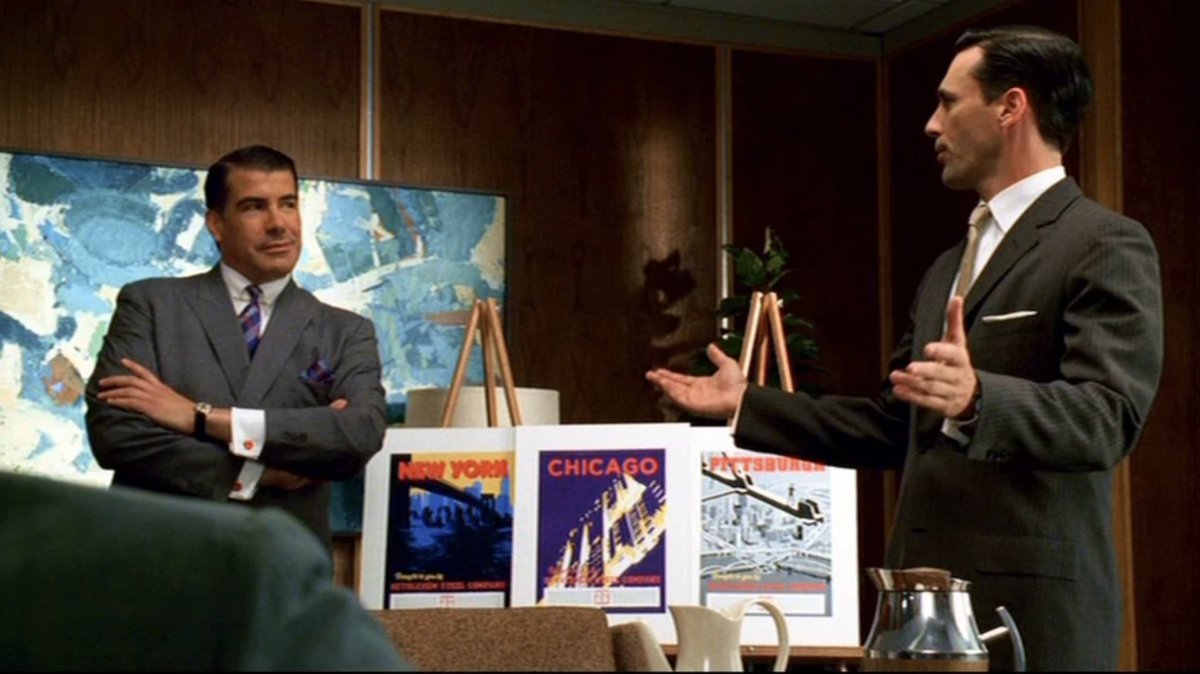
This 𝘔𝘢𝘥 𝘔𝘦𝘯 scene stayed with me:
“So,” says Walter Veith, “what do you fellas have for me?”
Walter’s the Vice President at Bethlehem Steel, a manufacturer.
“Well,” says Don Draper, “we take for granted the things we need the most: water, oil, electricity,” he takes a beat, “steel.”
Don’s the Creative Director at Sterling Cooper, an ad agency.
Both men are in a boardroom in Midtown Manhattan. It’s 1960. Everyone’s wearing a suit. There’s a bar cart in the corner. Don is vying for Bethlehem’s advertising business:
“I was thinking about the last time you were here,” Don says, turning towards the view, “looking out this window at this incredible city and saying: ‘It’s all steel.”
𝗗𝗼𝗻’𝘀 𝗮𝗯𝗼𝘂𝘁 𝘁𝗼 𝗽𝗶𝘁𝗰𝗵 𝗮 𝗰𝗮𝗺𝗽𝗮𝗶𝗴𝗻:
He turns back towards the room, towards three canvases resting on easels:
“New York,” Don says, turning a canvas, “Brought To You By Bethlehem Steel.”
Walter shifts in his chair.
“City of Pittsburgh,” Don says, turning another, “Brought To You By Bethlehem Steel.” He turns another: “City of Chicago, Detroit, St. Louis,” he says, “full-page ads in targeted markets: newspapers, trade publications.”
Walter shifts back. “They’re kind of plain, aren’t they?” he says. “Reminds me of those WPA ads before the war.”
“Walter,” Don says, “you know we can throw this artwork away in a minute. But the sentiment, the idea — it’s so basic, you feel like you already know it. You just haven’t thought of it lately.”
And therein lies a proven way to advertise, especially (if you’re selling a commodity):
𝗨𝘀𝗲 “𝗽𝗿𝗲𝗲𝗺𝗽𝘁𝗶𝘃𝗲 𝗰𝗹𝗮𝗶𝗺𝘀” 𝘁𝗼 𝗰𝗿𝗲𝗮𝘁𝗲 𝗮𝗻 𝗮𝘀𝘀𝗼𝗰𝗶𝗮𝘁𝗶𝗼𝗻 𝘄𝗶𝘁𝗵 𝘆𝗼𝘂𝗿 𝗯𝗿𝗮𝗻𝗱:
In other words, say something first and you own it.
For example, marketing genius Claude Hopkins used preemptive claims over a century ago when advertising Schlitz beer. After visiting the factory and seeing the manufacturing process, he wrote ads with headlines such as “Every Bottle Sterilized” and “Bottled Purity.”
Was Schlitz the only beer maker to sterilize its bottles or filter its product? Of course not. Every beer company did these things. But Schlitz was the first to advertise it, which simultaneously created:
𝟭/ a positive association with the brand
𝟮/ uncertainty about the competition’s product
Similarly, was every building in New York City built specifically with Bethlehem Steel? Of course not. But preemptively claiming this creates an association with — and preference for — a commodity brand that has no functional advantages over the competition.
“𝗖𝗶𝘁𝗶𝗲𝘀 𝗮𝗿𝗲 𝗺𝗮𝗱𝗲 𝗼𝗳 𝘀𝘁𝗲𝗲𝗹,” 𝗪𝗮𝗹𝘁𝗲𝗿 𝘀𝗮𝘆𝘀.
“Bethlehem Steel,” Don says.
Republicans have banned:
- CRT
- Books
- Abortions
- Saying GAY
- Black History
- Contraceptives
- Voting drop boxes
- Drag queen readings
- Michelangelo's David
- Tampons for students (Idaho)
US: What about assault weapons?
THEM: Nah, bans don't work.
My heart breaks for the people of Nashville, for all those that were lost, for their families and loved ones, for the community that I know feels shattered. How someone can be so casual about these weapons, especially this week, is beyond me.
@MuseZack It also has one of, if not, the best title song with Nobody Does It Better. If you add up all the reasons you cited it makes a case for it being the best Bond movie ever. Which I happen to think. Best opening/best song/best car/best villain/best sets/best script (?). Yes.
Many of my startup friends see that I used to be an investment banker and have consequently asked me to explain to them what's going on with SVB as I would explain it to a 7 year old, so here goes:
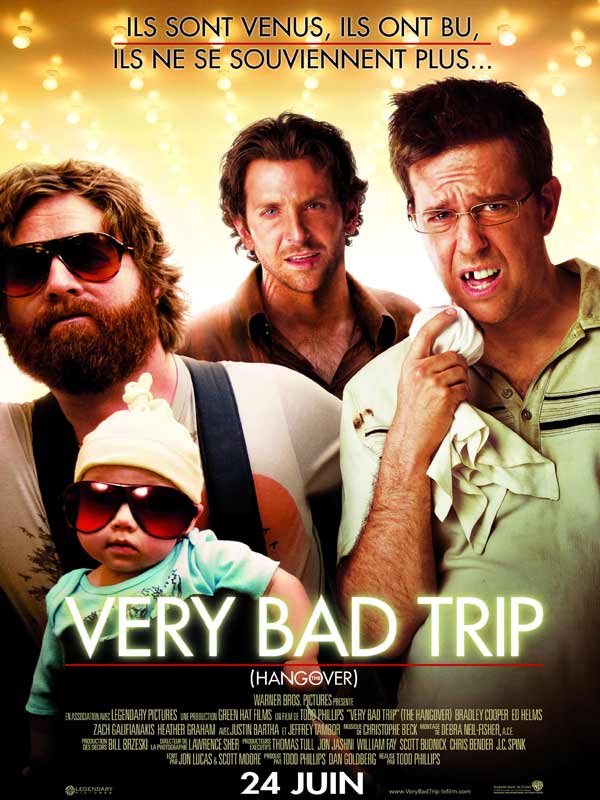
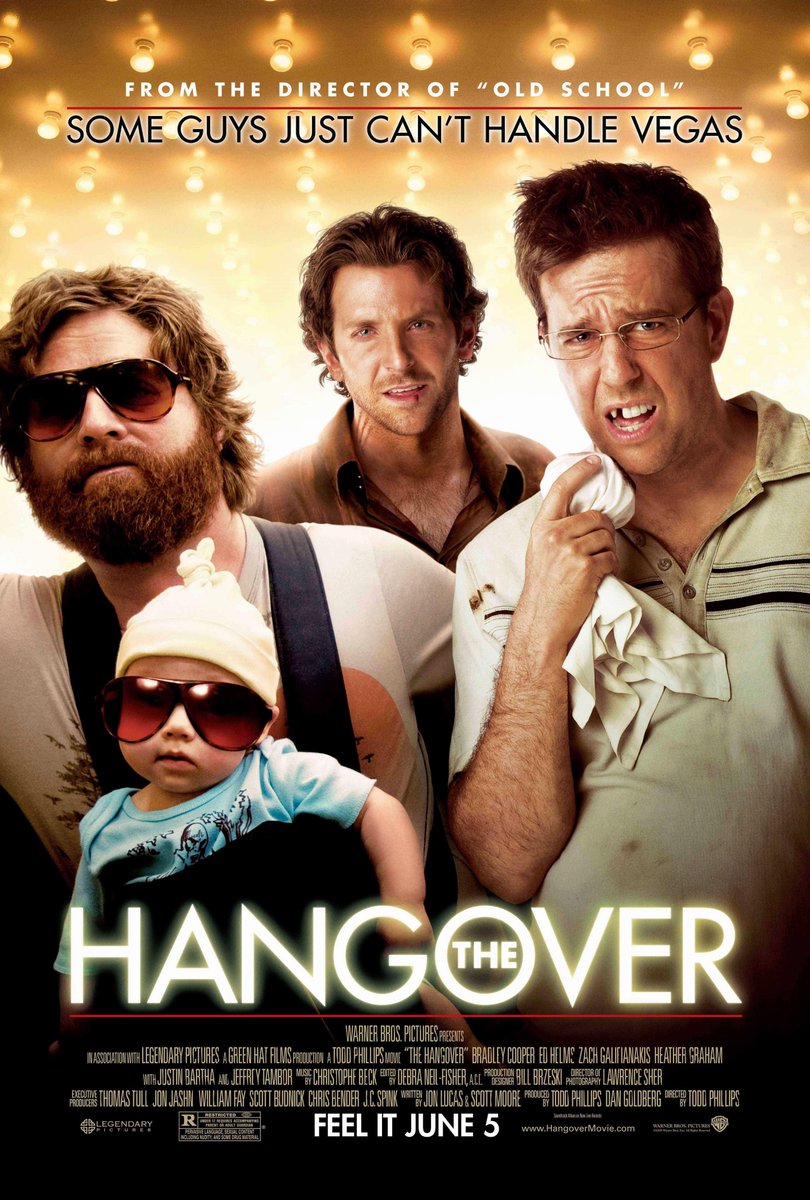
for some *ridiculous* reason the french love to translate movie titles from english to... english
here's a thread with my all-time favorites, starting with "the hangover"
...i mean VERY BAD TRIP






![bpoppenheimer's tweet photo. James Cameron has written & directed 3 of the top 4 highest-grossing movies of all time (Avatar, Avatar: The Way of Water, and Titanic).
Before he made movies, Cameron was a truck driver.
He didn't go to film school.
Instead, on the weekends, he would go to the library and..
"I'd pull any thesis that [University of Southern California] graduate students had written [on] anything that related to film technology," Cameron explained.
"And for the cost of xeroxing (photocopying), I [got] all these doctoral dissertations [and] build up these big binders on how everything was done."
"So I literally gave myself a full graduate course on film technology for about $120.
I didn’t have to enroll in school because it was all there in the library. I’d set it up to go in like I was on a tactical mission, find out what I needed to know, and take it all home."
Takeaway 1:
When asked what motivated him to read those big binders full of information on filmmaking, Cameron said he was just following what excited him.
"People seek out the information and knowledge they need," he said. "It's like a divining rod."
The mythologist Joseph Campbell similarly talked about how reading is like "a divining rod," a way to find what you are uniquely attracted to and meant to do.
"You’ve got to read," Campbell said. "Find [what] excites you. And if it doesn’t excite you…It’s not yours.”
Takeaway 2:
Of course, at some point, Cameron had to put the binders down and pick up a camera.
When he eventually attempted to make his first movie, Cameron said, “It was a bit like a doctor doing his first appendectomy after having only read about it."
The bestselling author and learning expert, Scott Young, has a great article with a great title, "Do The Real Thing."
"When you examine case studies of people who have had major accomplishments," Scott writes, "you expect there to be some trick or shortcut...More often, however, the strategy used is dead simple: doing the real thing."
Takeaway 3:
Leonardo da Vinci used to sign off his letters, “Leonardo da Vinci, disscepolo della sperientia” ("disciple of experience").
He used to believe that one learns best by solely "doing the real thing."
Over time, however, he evolved out of this belief and, biographer Walter Isaacson writes, "became a disciple of both experience and received wisdom."
When you examine case studies of people who have mastered their craft, you usually find they are "disciples of both experience and received wisdom."
Like Cameron, they read the library and they do the real thing.
- - -
“Those who are in love with practice without theoretical knowledge are like the sailor who goes onto a ship without rudder or compass and who never can be certain whither he is going.” — Leonardo da Vinci
Follow @bpoppenheimer for more content like this!](https://pbs.twimg.com/media/FyDsJLPXsAIX5UE.jpg)