1/
~60 people in the world work full time on proving what happens inside AI datacentres. The whole field would fit on one office floor.
We fund you for 8 weeks in Cambridge to join them. Mentors incl. an Oxford professor and ex-Arm, ex-Intel, ex-RAND engineers. Apply by 2 Aug: https://t.co/8d8w83nkYa
Open for Application: UNU Macau Visiting Research Fellowship Program
🕙 Apply by 24 July 2026
📤 Apply: https://t.co/1CavO3Dezt
We invite researchers and practitioners to join our short-term, in-residence fellowship (1–3 months) focused on Digital Emerging Technologies for Sustainable Development.
Based in Macau SAR, this fellowship offers a unique opportunity to conduct policy-oriented research bridging technology and the UN’s Sustainable Development Goals, collaborate with UNU experts and global partners, and contribute to solutions that advance inclusive and sustainable futures.
Call for papers Special Issue of Frontiers in Political Science, a Q1 journal indexed in @Scopus@ScimagoJR & @webofscience (WoS) Journal Citation Reports (JCR). Submit your manuscript now! Deadline: 16 January 2027
CSEP is looking for an Associate Fellow / Research Associate – Southeast Asian Studies. If you're interested in international relations, geopolitics, and policy research, apply now or share this opportunity with your network. https://t.co/HzkX5UUH9i
#JobSearch#ForeignPolicy
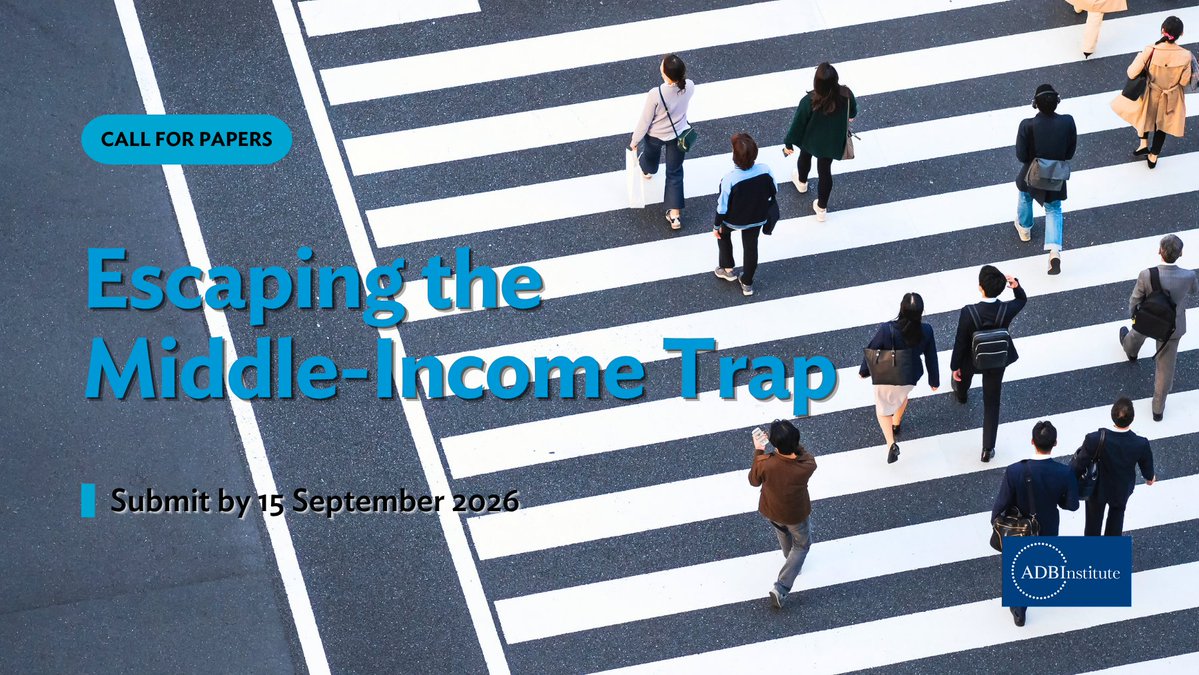
📢 ADBI and the Journal of Development Economics (JDE) invite researchers to submit studies on the drivers of sustained growth in middle-income economies. Selected papers will be presented at a conference and considered for publication in a special issue exploring how developing economies can boost productivity, sustain growth, and advance toward high-income status.
𝐑𝐞𝐚𝐝 𝐭𝐡𝐞 𝐟𝐮𝐥𝐥 𝐝𝐞𝐭𝐚𝐢𝐥𝐬 𝐡𝐞𝐫𝐞: https://t.co/0uP4kkwt6M
🚀 Call for Panelists: UNU Macau AI Conference 2026 https://t.co/SAPru4riFy
We are excited to announce that the UNU Macau AI Conference 2026 will convene on 25–26 November in Macau SAR, China.
Under the theme “AI × Education”, this year’s conference will explore how artificial intelligence can transform learning systems, elevate human capacity, and expand inclusive access to quality education worldwide.
We invite global visionaries, researchers, and practitioners to shape the dialogue across 5 featured panels:
1. Generative AI & Learning — How education should respond as AI reshapes learning and employability skills
2. Agentic AI in the Loop — From autonomous tools to shared capacity
3. The UN–AI Corridor — Enhancing Macau’s role as a multilateral tech bridge
4. Human Agency in AI-mediated Communication — Integrity, trust, and ethical practice
5. AI Education in Low-Resource Regions — Reimagining education in underserved contexts
👉 Submit now: https://t.co/SAPru4riFy
🔗 More on the conference: https://t.co/Db7YfQQ6y2
AI × Education: AI for Learning, Learning for AI
Nov. 25-26, 2026 | Macau SAR, China
Interested in working with us? 💼
Remote and on-site positions in Macau and Helsinki are available this July.
Visit https://t.co/JWiDZH0mMC to learn more and apply now!
#Vacancies#NowHiring#JobOpportunities#UNCareers
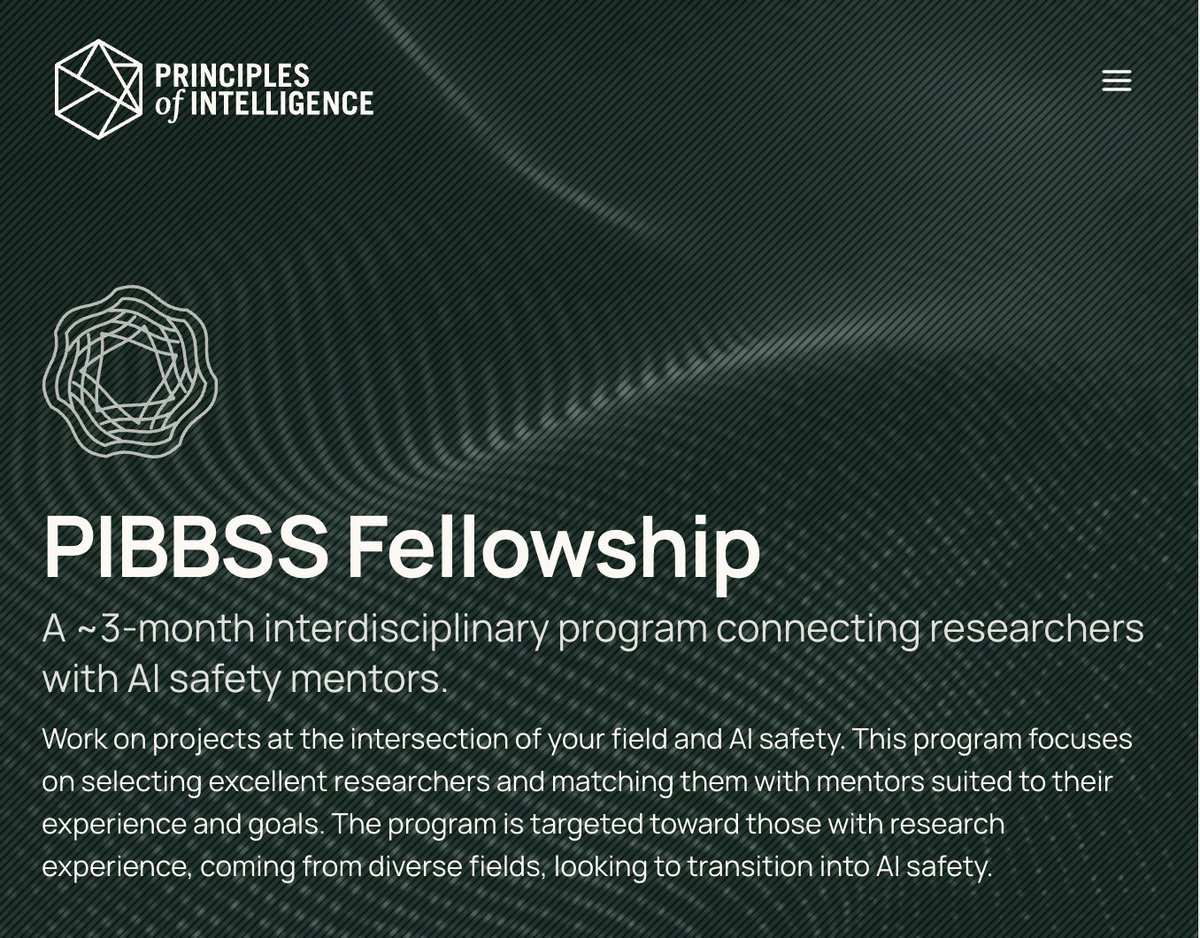
A fully funded 3-month program designed for researchers looking to work on AI alignment with world-class mentors.
The @pibbssai Fellowship is now accepting applications.
What you get:
• $3,000/month stipend
• Free accommodation, meals and return flights
• 1:1 mentorship from AI safety researchers
• A chance to work on your own research project
• Alumni network across Anthropic, Google, Oxford, Harvard, Epoch, FAR AI and more
Deadline: July 20, 2026
apply: https://t.co/B3pgcW43w8
3-Month Fully Funded AI Program in Singapore 🇸🇬 (No Application Fee)
📅 Program Dates: 21 September – 4 December 2026
🤖 Program: Singapore AI Safety Fellowship 2026
🔗 Apply Here: https://t.co/reIsctZ58z
Benefits: SGD 5,000 Monthly Stipend, Free Accommodation, Travel Support, Visa Support, Up to USD 30,000 Compute Funding, Mentorship by Leading AI Researchers, Research & Career Support, Office Workspace, Workshops, Networking & Community Events.
⏰ Application Deadline: 10 July 2026
Credit: Singapore AI Safety Hub (SASH)
Disclaimer: Scholarships Corner shares opportunity information for educational and informational purposes only. Applicants are encouraged to verify all eligibility requirements, funding details, and deadlines through the official Singapore AI Safety Fellowship website before applying.
#ScholarshipsCorner #artificialintelligence #fellowship #singapore #AIprogram #AIJobs
Stanford professor Judy Fan went on stage at MIT and broke down why humans are so good at making the invisible visible...
And why AI hasn't actually learned to "see" the way we do.
It completely changes how you think about Human Intelligence v/s Artificial Intelligence:
1. Nature never gave us straight lines or sharp corners. The number line, the coordinate plane, even basic geometry are all human inventions. We created tools that do not exist in nature simply because we needed a way to think more clearly.
2. The coordinate system Descartes invented solved a problem that had stumped mathematicians for centuries, doubling the volume of a cube. Once invented, this tool became so indispensable that virtually every math curriculum on Earth still depends on it.
3. Humans have been doing this for at least 30,000 to 80,000 years. The story of human progress is inseparable from the story of marking up our environment, from cave walls to Galileo's telescope to Feynman diagrams of particles we will never see with our own eyes.
4. Every major scientific breakthrough relied on a visual tool that made something invisible visible. Darwin needed side-by-side illustrations of finches to see variation that was otherwise too subtle to notice. Cajal needed detailed drawings of neurons under a microscope to map how the nervous system was wired.
5. Fan's research group studies something deceptively simple: how people decide what to put into a drawing and what to leave out. When two people played a drawing game, sketchers used far more detail when the target object had close competitors than when it stood alone, all the way down to using fewer strokes and less time when more detail was not necessary.
6. People are not just copying what they see. They are making constant judgment calls about what level of detail actually serves the goal of communication, and they do this naturally without ever being taught the theory behind it.
7. There is a real difference between drawing something so someone can identify it and drawing something so someone can understand how it works. In one study, participants drew explanatory diagrams that emphasized moving, causal parts of a machine while depictive drawings emphasized background and overall appearance, even though both were drawing the exact same object.
8. Explanatory drawings were genuinely better at helping someone figure out how to operate a machine, but worse at helping someone identify which machine it actually was. You cannot optimize a single drawing for both goals at once. Communication always involves tradeoffs.
9. AI vision models trained on photographs generalize surprisingly well to simple, sparse sketches, suggesting that resemblance based recognition is not just a story we tell ourselves. It is something modern neural networks can replicate with real accuracy.
10. But there remains a large, measurable gap between how confidently AI models recognize sketches and how confidently humans do, even when both groups answer the same questions about the same images. Humans are simply far more reliable and far more consistent in their judgments.
11. When researchers compared human-made sketches to AI-generated sketches under tight stroke budgets, both were similarly recognizable at higher budgets, but diverged sharply as the budget shrank. Humans and AI systems simplify drawings in fundamentally different ways once resources get scarce.
12. Reading a graph is not one single skill. It involves perception, knowing where to look, mapping that visual information onto the actual question being asked, and then translating that mapping into an answer. Each of these steps can independently break down, and people fail for very different underlying reasons even when they land on the same wrong answer.
13. When tested directly against humans on graph reading tasks, leading multimodal AI models, including GPT-4V, showed a meaningful performance gap. Even when a model's overall accuracy approached human levels, its pattern of mistakes looked nothing like how humans actually get things wrong.
14. People choose entirely different types of charts depending on what specific question they are trying to answer, not out of a generic preference for bar charts or scatter plots. Their chart choices closely tracked which visualization would genuinely help someone answer that specific question correctly.
15. Two of the most widely used graph literacy tests in education research turned out to correlate strongly with each other, suggesting they measure overlapping skills. But when researchers dug into the actual error patterns, the standard categories used in textbooks, like "find the maximum" or "identify a cluster," failed to explain why people got things wrong nearly as well as a more basic, underlying four-factor model did.
16. The deepest goal behind all of this research is not just academic curiosity. It is to eventually help students and everyday people develop genuine literacy with the visual tools that science and modern decision-making increasingly depend on, because every generation should be able to see further than the last by standing on the visual tools the previous generation built.
Follow @yasminekho for more ideas on thinking better, becoming clearer & building a more intentional life.
Applications are still open for our inaugural Emerging Voices in AI & Society Fellows Program!
The cohort will research and help shape public discourse across multiple potential areas, including: AI and Cognition, AI and Relationships, AI and Surveillance, AI and Spirituality, and Inside the Machine: a technologist's view of what drives decisions at leading AI companies.
Submit your application by July 12, 2026. The fellowship begins September 14.
Learn more and apply here: https://t.co/tpUUQi3pAN
Applications are now open via the online application system for the FY2027 Bilateral Program. This program supports joint research projects and seminars to develop bilateral research networks.
📅Deadline: 5.p.m. Sep 3, 2026
🔗https://t.co/291kACMcKy
#BilateralPrograms
How can governments turn AI principles into effective regulation?
@UNESCO’s new issue brief presents nine emerging approaches to #AIGovernance, with legislative examples from around the world to support national policymaking.
📄 Read more:
https://t.co/rFgyca30hL
#AIDialogue