Did you know?
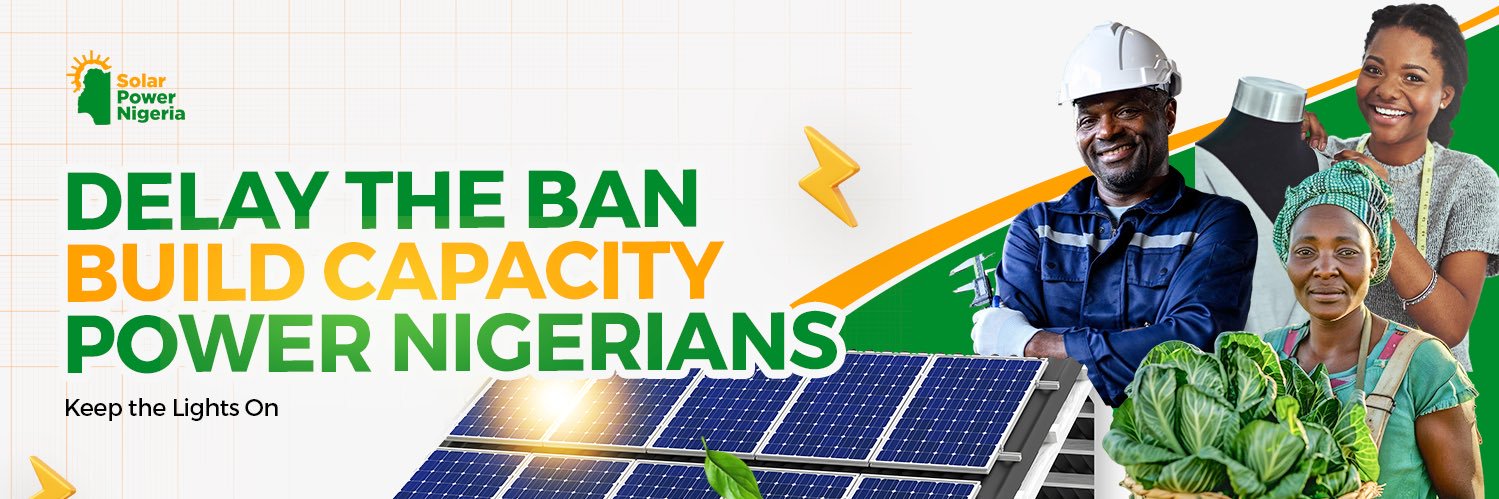
The Federal Government of Nigeria has proposed to ban the importation of solar panels. Good or Bad Policy? Join the conversation #SolarPowerNigeria
A heartfelt thank you to everyone who attended the Solar Power Nigeria Media Story Grant Award Ceremony.
Together, we are amplifying stories that inform, inspire, and drive action toward a future where clean, reliable, and affordable energy is accessible to all Nigerians.
Your support and participation helped make the event a success and reinforced the importance of storytelling in shaping Nigeria's energy future.
Thank you for being part of the movement.
@miketerungwa@gifsep4climate
#SolarPowerNigeria
"Don't put the cart before the horse."
Solar manufacturing in Nigeria is the goal, but if we rush an import ban, solar becomes a luxury instead of a solution. Timing and capacity building are everything. 💯 #SolarPowerNigeria
Nigeria's journey toward local solar manufacturing must be strategic this was the message from the executive director of GIFSEP at the media story grant award ceremony. He clarified that the call is not against local production or a future import ban on solar panels. Rather, it is about getting the timing right.
"We are not saying the government should not ban imports, but timing is important. We must develop our local manufacturing capacity and adopt a phased approach so that solar energy does not become too expensive for the common man."
As Nigeria works toward energy security and industrial growth, policies must protect both local industry and the millions of Nigerians who depend on affordable solar solutions for power access.
#SolarPowerNigeria
@gifsep4climate
Inspired by nature. For climate. For our future.
Every day, solar energy transforms sunlight into opportunities for learning, growth, and progress.
This World Environment Day, we celebrate solutions inspired by nature and built for our future.
#SolarPowerNigeria #WorldEnvironmentDay
No outages. No interruptions. Just power.
The sound of reliable power isn't loud.
It's the quiet hum of an air conditioner on a hot afternoon.
The rhythm of fingers on a keyboard.
The peace of working, studying, and living without interruption.
For millions of Nigerians, constant electricity remains out of reach. But it doesn't have to be.
Solar power is helping homes, businesses, and students create their own reliable source of energy every day.
You deserve to work in peace whenever you decide.
Lend your voice. Improve energy access.
#SolarPowerNigeria
Both matter: ending power poverty AND building local capacity. Places that got renewables right (UAE's long-term strategy, for example) did it with predictable policy. Consistency attracts investment. 🌞
Spot on!!! For millions of Nigerians, reliable electricity is directly tied to income, education and daily life. As we grow local solar manufacturing, we also have to keep solar affordable and accessible. Ending energy poverty must stay at the center. #SolarPowerNigeria
According to AFDB as reported by Amaka Okoro of AIT, over 70% of Nigerian businesses rely on generators for electricity.
That statistic tells a bigger story: millions of entrepreneurs are spending money every day just to keep the lights on.
Nigeria's goal of building local solar manufacturing is important and necessary. But any policy changes affecting solar access should be implemented gradually, allowing local production to grow while businesses and households continue accessing affordable energy solutions.
The challenge is not simply replacing imports.
The challenge is ending power poverty.
A phased transition can help Nigeria achieve both.
#SolarPowerNigeria
At first glance, solar may seem more expensive… but let’s break it down
If you buy just 3 litres of fuel daily at about ₦3,900 per day, you would spend roughly ₦1,404,000 in one year powering your home with a generator.
Meanwhile, with solar:
You still own your panels, batteries, and inverter after the first year
You enjoy quieter and more reliable power
You reduce daily fuel spending and generator stress
So which option is truly more expensive long-term?
Generator or Solar Power?
Drop your answer below
#SolarPowerNigeria
As we celebrate Eid Al-Adha, may sacrifice bring blessings, peace, and renewed hope to every home.
Wishing you and your loved ones joy, gratitude, and uninterrupted moments that truly matter.
Eid Mubarak from Solar Power Nigeria.
#SolarPowerNigeria#EidMubarak
Africa is moving to solar and fast.
In 2025 alone, the continent recorded a 54% increase in solar installations, adding a record 4.5GW of solar capacity, according to the Global Solar Council.
As more African countries embrace solar as a solution to unreliable electricity, Nigeria should be creating conditions that support the growth of solar not the opposite.
Reliable power is no longer a luxury.
And for millions around Africa solar is the answer.
#SolarPowerNigeria
Source: Reuters
Education needs power.
Dreams need power.
Nigeria’s future needs power.
Waiting for “NEPA to bring light” before life can continue.
For many Nigerian students, unstable electricity isn’t just frustrating, it directly affects learning, productivity, and opportunity.
The experiences of students reflect a bigger national reality.
Watch. Share. Be part of the conversation.
#SolarPowerNigeria
How are students supposed to learn without stable power?
We asked Nigerian university students about the current light situation on their campus and their answers say it all.
Reliable electricity is not a luxury, it’s a necessity.
Watch, share, and join the conversation.
#SolarPowerNigeria
24.5 watts.
That’s the estimated share of electricity available per Nigerian.
Not enough to power a fan.
Not enough for a refrigerator.
Not enough for businesses to thrive.
Not enough for students to study comfortably at night.
Yet this is the reality millions live with every day.
The good news?
The sun gives us more energy every single day than we choose to use.
#SolarPowerNigeria
For years, unreliable power has made Nigerians believe solar is complicated, weak, or only for a few people.
The truth?
Most of what we hear about solar are myths.
Be honest which of these solar myths have you believed before?
Swipe through to see the facts Nigerians need to know about solar power.
#SolarPowerNigeria
Every blackout tells a story.
A student struggling to read for exams.
A phone dying in the middle of an online class.
A dream delayed because there’s no power to keep going.
But it doesn’t have to be this way.
The sun rises every single day.
Maybe it’s time Nigeria started using it.
#SolarPowerNigeria
Every blackout tells a story.
A student struggling to read for exams.
A phone dying in the middle of an online class.
A dream delayed because there’s no power to keep going.
But it doesn’t have to be this way.
The sun rises every single day.
Maybe it’s time Nigeria started using it.
#SolarPowerNigeria
Nigeria has one of the highest solar potentials in Africa, yet solar contributes less than 1% to our energy mix. With abundant sunlight across the country, the potential for renewable energy growth is enormous.
The conversation around energy isn’t just about today, it’s about building a more reliable and sustainable future for everyone.
#SolarPowerNigeria
Source: Source: International Energy Agency (IEA)
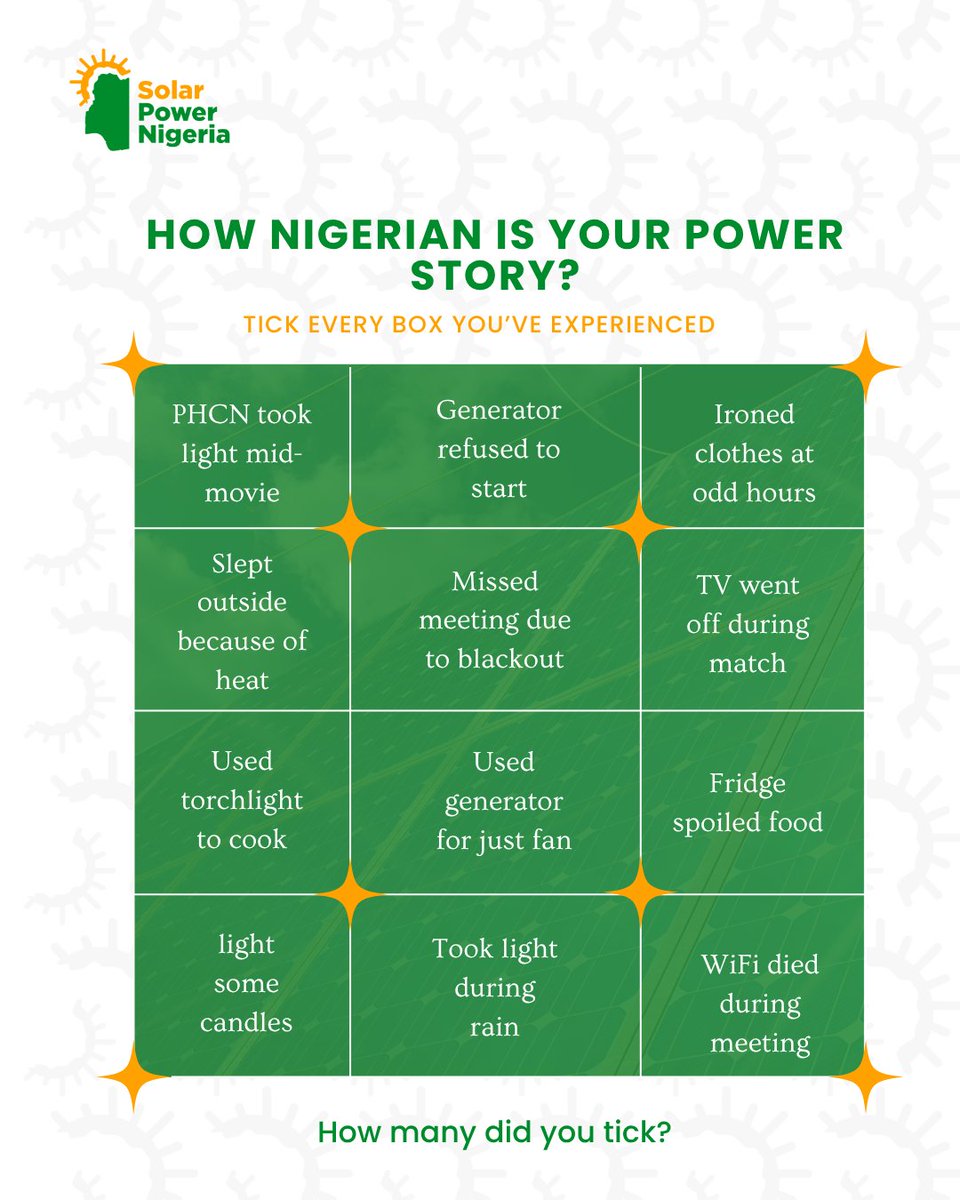
If you live in Nigeria, chances are you’ve experienced at least 5 of these
How many boxes did you tick on the #SolarPowerNigeria Bingo Card?
Drop your score in the comments
Tag someone who’ll complete the whole board
#SolarPowerNigeria