Today we’re launching VoxNexus 🎙
An audio intelligence SDK that hears, understands, and speaks — entirely on device, optimized for @MediaTek 's new Dimensity 9600 Pro. Grateful for the partnership that made this possible!
🌍 Translation in 103 languages · ASR in 59 · TTS in 29
⚡ 12h of always-on listening at just 162 mAh
🔒 Fully local processing – privacy by design
See it in action 👇
#MediaTekDimensity #OnDeviceAI #Dimensity9600Pro #VoxNexus
A TTS model can synthesize speech 2.8× faster than real time and still leave listeners waiting mid-sentence.
While benchmarking our on-device TTS models, we encountered a limitation of real-time factor (RTF): it measures average synthesis speed, not playback continuity. In one case, the first chunk held just 50 ms of audio, and the next arrived about a second later.
For streaming TTS, we recommend tracking five metrics with a consistent start buffer:
• Time to first audio (TTFA)
• Real-time factor (RTF)
• Startup delay
• Stall frequency
• Stall time ratio
With steady audio chunking, two of our other on-device models achieved median startup delays of 19 ms and 50 ms, with zero stalls in our tests.
If you’re building streaming TTS systems, we share our full methodology and on-device vs. cloud comparison:
https://t.co/NTeKPtByrc
#OnDeviceAI #TTS #VoiceAI
A 70 MB speech recognition model shouldn’t need nearly 900 MB to transcribe 30 seconds of audio. Yet that’s exactly what we found.
Short audio clips looked perfectly fine, hiding the problem until longer recordings came along.
The culprit was quadratic memory growth: once exported as a compute graph, attention generated multiple full-sized intermediate tables. By fusing these operations, we cut peak memory by 62.6% and made decoding 15.5% faster.
Read the full story in our first engineering blog:
https://t.co/ckE2JLBEbN
#OnDeviceAI #SpeechRecognition
Audio Intelligence, Built into Dimensity.
At our launch event in Spain, we showcased our collaboration with strategic AI partner VoxNexus, bringing advanced audio intelligence directly to devices powered by MediaTek Dimensity.
VoxNexus demonstrated on-device AI capabilities, including speech recognition, text-to-speech and translation across 103 languages, all without relying on a cloud connection.
Together, we're making advanced on-device AI experiences more accessible.
@VoxNexusAI4All
A memorable day in Spain. VoxNexus was proud to showcase our on-device audio intelligence alongside the new Dimensity 9600 Pro at @MediaTek 's launch event.
We’re grateful to the MediaTek team for an exceptional partnership, and to everyone who joined us at the booth to experience the technology firsthand. Your questions, feedback, and curiosity made the day what it was.
On-device audio AI is here. The journey begins now.🚀
#MediaTekDimensity #Dimensity9600Pro #OnDeviceAI
@Noticias3Dcom@MediaTek Thank you @Noticias3Dcom for the thoughtful coverage from the event! We’re building toward private, local, and highly efficient on-device audio AI.
¡Muchas gracias por el apoyo!
Today we’re launching VoxNexus 🎙
An audio intelligence SDK that hears, understands, and speaks — entirely on device, optimized for @MediaTek 's new Dimensity 9600 Pro. Grateful for the partnership that made this possible!
🌍 Translation in 103 languages · ASR in 59 · TTS in 29
⚡ 12h of always-on listening at just 162 mAh
🔒 Fully local processing – privacy by design
See it in action 👇
#MediaTekDimensity #OnDeviceAI #Dimensity9600Pro #VoxNexus
AI is becoming part of everyday life. But whose everyday life are we talking about?
Some markets still lack products that fit their needs. Low adoption gets mistaken for low demand. Investment then flows toward markets already gaining traction, while underserved markets stay overlooked. And the cycle continues...
Frontier research matters. So does expanding who benefits from it.
Markets we call "small" or "not ready" may simply need the right products. They could hold some of the biggest opportunities in AI.
Which markets do you think the AI industry is underestimating?
AI does need data to work.
The real question is where that data gets processed. With on-device AI, processing happens locally, so your data doesn't need to leave your device.
That's what we're building at VoxNexus. An affordable, efficient, and private on-device AI solution.
@ehdande Totally agree! "Powerful" isn't the same as "useful." A good model should reflect what local communities actually need, which is why local stewardship matters more than porting mainstream solutions into a very different market.
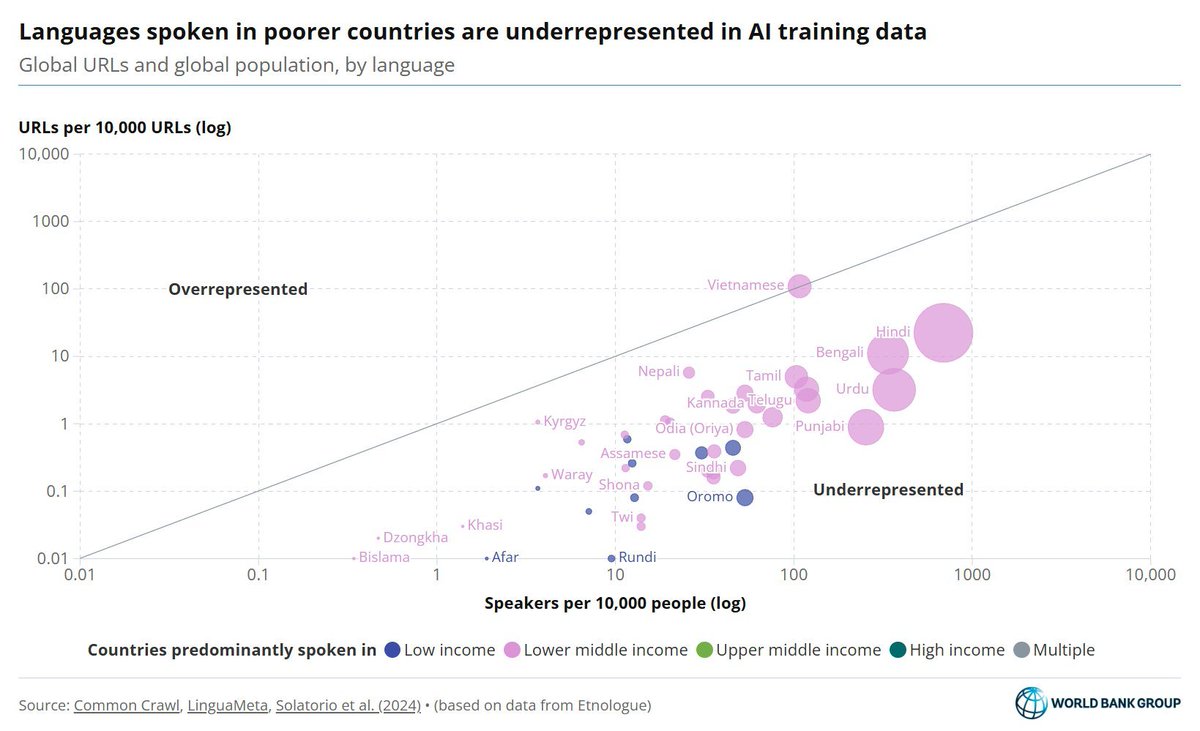
8,800 to 1.
For every 8,800 English pages on the open web, there's just one in Assamese, a language spoken by 15 million people in Northeast India. It shows exactly why AI struggles with low-resource languages. Not because the languages are complex. Because the training data barely exists.
Three months in, our team ranked #1 across all six evaluation metrics in four of WMT26's most data-scarce language translation tracks. A look at the problem we're solving: https://t.co/4yaWdG0yNw
#NLProc #LowResourceNLP #WMT26
This chart says it clearly. Assamese, Odia, Kannada, Telugu all have tens of millions of speakers and still sit far below the line. Population isn't the bottleneck. Digital presence is.
AI may be a general-purpose technology. But does it work equally well in every language?
Languages spoken in poorer countries are often vastly underrepresented online—even when they have hundreds of millions of speakers.
See what the data say: https://t.co/gtlVGDu0aP