VoxEU is a policy portal run by @cepr_org. It posts research based policy analysis from leading economists.
Visit our development economics branch @vox_dev
This week's #VoxTalks Economics features @MonnetEric (@PSEinfo) in conversation with Tim Phillips, recorded at the PSE-CEPR Policy Forum 2026.
The discussion revisits one of international macroeconomics' best-known ideas: the monetary policy trilemma. Drawing on a newly digitised dataset of central bank balance sheets spanning 1891–2019, Monnet explains how historical evidence suggests central banks have long used their balance sheets to respond to international financial shocks, not only through interest rates, but also through liquidity provision and financial market operations.
The conversation also explores how these historical records were assembled, why they matter for understanding monetary policy, and what they imply for the way economists think about central bank autonomy today.
🎧 Listen to the episode now: https://t.co/EpzqHTm9hq
#Economics #CentralBanks #MonetaryPolicy #EconomicHistory #Macroeconomics #CEPR #PSE
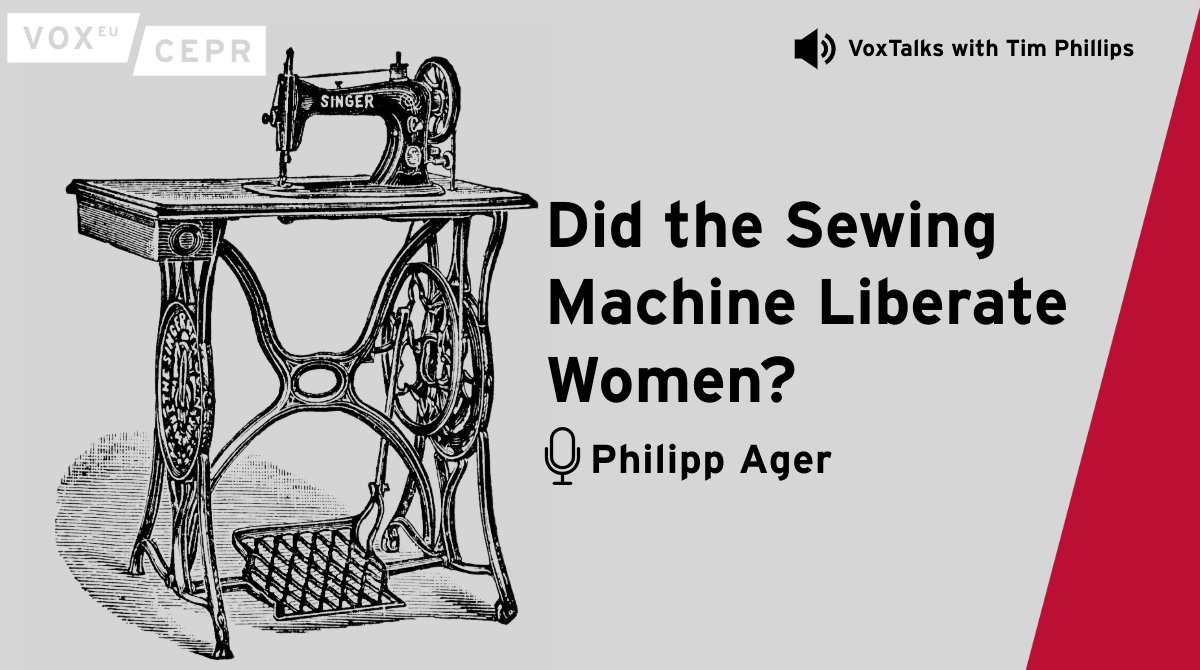
In 1860, the New York Times declared that "no one invention has brought with it so great a relief for our mothers and daughters as these iron needle-women." They were, of course, referring to the sewing machine. But how much did it really change the lives of women in the 19th century?
In the latest VoxTalks Economics Podcast, Tim Phillips speaks with Philipp Ager (@EconUniMannheim) about his research with Davide Coluccia (@BristolUni), which traces the spread of the sewing machine across Massachusetts between 1850 and 1900. Their findings reveal a striking divide across social classes.
🎧 Listen now: https://t.co/GXeh35VS5o
#VoxTalks #Economics #EconHistory #Gender #Labour
Defence spending is rising across Europe and beyond. But what does society get back from that investment?
Tim Phillips spoke with John Van Reenen (@LSEnews) about whether defence spending can also support economic growth through innovation.
History offers some striking examples: nuclear power, GPS, and the internet all originated in military projects. But innovation spillovers don't have to be left to chance.
🎧 Don't miss the episode: https://t.co/HNIrEUsJrm
#VoxTalks #Economics
If you export to the United States, how do you know what tariff you actually have to pay?
In 2025, that became an increasingly difficult question. Between February and December, 53 separate US tariff announcements introduced, delayed, reinstated or changed tariffs, with different countries and products affected each time.
In the latest episode of #VoxTalks Economics, recorded at the PSE-CEPR Policy Forum, Tim Phillips speaks with Kalina Manova (@EconUCL, CEPR) about new research on the economic effects of tariff confusion.
Manova and her co-authors assembled a database of every tariff announcement in 2025 and developed new measures of the confusion firms faced in identifying the statutory tariff actually in place. They find that tariff confusion had a substantial effect on trade alongside the tariffs themselves: on average, it doubled the reduction in imports associated with tariff increases, and for some countries the effect was even larger.
The conversation explores why rapidly changing trade policy can impose additional costs on firms, even without further tariff increases, and what this implies for the design of trade policy.
🎧 Listen to the episode now: https://t.co/YGnqLJNujw
#Economics #Trade
What happens to money when it goes digital?
Redefining the Monetary Standard, explores whether the fiat money system, having survived the Great Inflation, the global financial crisis, and a pandemic, can also survive the rise of digital currencies.
Livio Stracca (@ecb) joins Tim Phillips to discuss how today’s digital innovations could change everything. While Bitcoin introduced blockchain technology and solved the “double-spending” problem, stablecoins built on this innovation by pegging their value to assets backed by central bank money.
What comes next? What if the unit of account itself were indexed to consumer prices? Digitalisation might finally make that approach viable at scale: price stability, by design.
Listen now: https://t.co/Vhra0HdsjT
#Economics #VoxTalks
When we think about what shapes trade, tariffs and trade deals often come first. But what role does economic power play?
In the latest #VoxTalks Economics episode, recorded at the PSE-CEPR Policy Forum in Paris, Alberto Martín (@bse_barcelona, CEPR) joins Tim Phillips to discuss new research on how hegemons, large dominant economies, influence trade by fostering political alignment between countries.
Drawing on a new database of around 77,000 international treaties signed between 1800 and 2020, the research uses treaty signing as a proxy for alignment between countries. The findings show that hegemonic powers sign a disproportionate share of treaties. They also show that countries which are more closely aligned tend to trade more with one another, even when economic treaties are excluded from the analysis.
The conversation also explores a striking recent trend. Treaty signing has fallen sharply over the past 15 years, following a long historical rise. What this means for global trade in an increasingly multipolar world remains an open question.
🎧 Listen to the episode: https://t.co/NJrJnwCNE9
📖 Read the paper: https://t.co/j0Bgxj5Xm4
#Trade #InternationalTrade #PoliticalEconomy #GlobalGovernance #Economics
Beyond the snapshot: How poverty really unfolds over time in the EU
Alina Șandor, Shaun Da Costa, Argyrios K. Pisiotis @EU_Commission
https://t.co/ZuB3N2LxbQ
After the fire: How Ukrainian strikes disrupt local economies around Russian refineries
Štěpán Mikula @muni_cz, Fabio Sabatini @FabbioSabatini@SapienzaRoma
https://t.co/kAEKAmzH7N
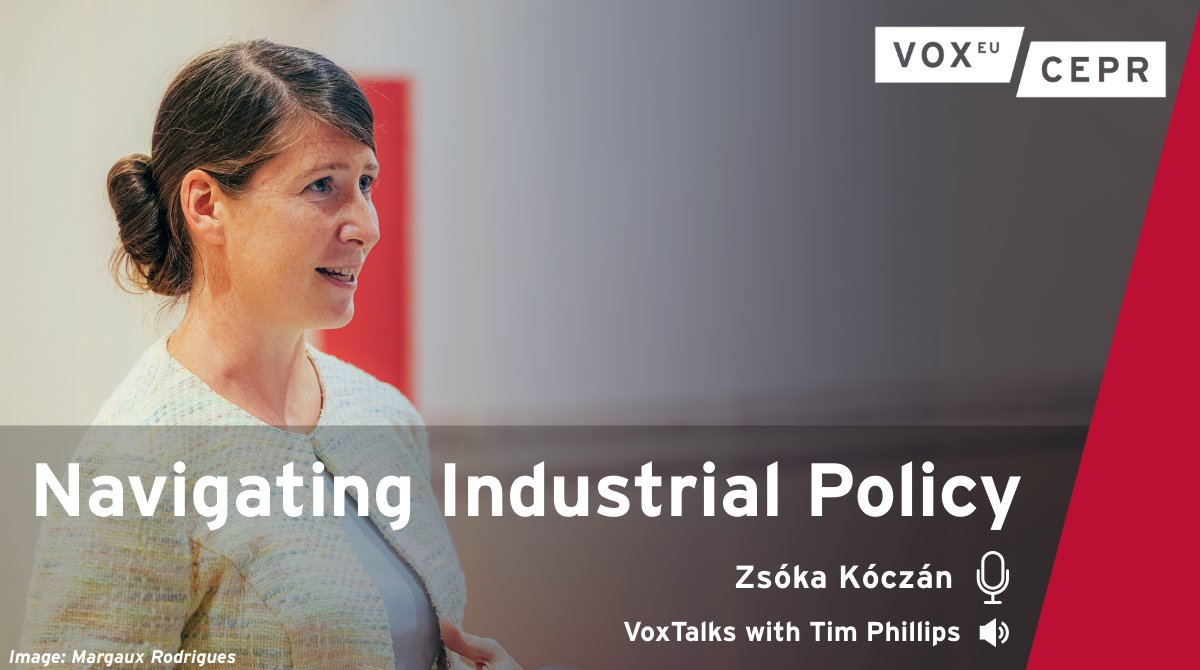
Industrial policy is back on the policy agenda. Governments across advanced and emerging economies are increasingly using it to shape what their economies produce. But what makes these policies effective, and what are the risks when they are not well designed?
In the latest episode of #VoxTalks Economics, recorded at the PSE-CEPR Policy Forum in Paris, Tim Phillips spoke to @ZsokaKoczan (@EBRD) about the growing use of industrial policy around the world.
Drawing on the EBRD's Transition Report 2024–25 and a database of more than 31,000 industrial policies across 150 economies, they discuss why governments are increasingly using industrial policy, how these policies are designed, and the challenges of evaluating them and deciding when they should be phased out.
The conversation also explores the role of administrative capacity, the challenge of balancing multiple policy objectives, and why clear evaluation and exit mechanisms matter.
🎧 Listen now: https://t.co/Ss4hpPyxP8
#Economics #IndustrialPolicy
Why Europe's banks stay home: Regulatory fragmentation and the cost of an incomplete banking union
Damien Capelle @IMFNews, Adriano Fernandes @IMFNews, Jan Jakob Krüger @ImperialBiz, Peter McAdam @ecb
https://t.co/8TdK8E1njG
In 1941, the United States banned oil exports to Japan, hoping to deter aggression without fighting a war. Historians now argue the embargo may have had the opposite effect.
In the latest episode of VoxTalks Economics, recorded at the PSE-CEPR Policy Forum, @IsabelleMejean (@sciencespo) sat down with @timsvengali to discuss what she and her co-authors call 'The Safety Paradox'. While reducing trade with geopolitical rivals might appear to strengthen security, it can also reduce the economic interdependence that makes conflict more costly.
The conversation explores the growing use of economic coercion, trade fragmentation, and US–China decoupling, alongside new research examining the trade-offs between economic security and the likelihood of conflict. Looking to the future, Europe may need to think differently about trade agreements, not only as a route to market access, but also as a form of insurance in an increasingly uncertain geopolitical environment.
🎧 Listen to the latest episode here: https://t.co/6PxFYMaMdG
#VoxTalks #Trade #PoliticalEconomy #Geoeconomics #EconomicsPodcast
Lifelong learning is becoming increasingly important in response to labour market transformations
Isaure Delaporte, Verónica Escudero, Hannah Liepmann @ilo
https://t.co/qxWX9D8Bsf
Who kept the courts sitting and the streetlights lit when the state had almost no money to pay anyone?
In early 19th-century Britain, around two-thirds of people carrying out local government roles were unpaid. Yet the system worked.
James Robinson (@HarrisPolicy) explains the idea of the 'embedded state' in the Success of the Embedded State, a #VoxTalks Economics Episode. Elite members of society took on unpaid public roles because they brought prestige and could lead to Parliament, promotion, or paid office. Positions without those incentives, such as jailer, had to be paid. Even more striking, the unpaid officials were often more productive than the paid ones.
Robinson argues this isn't just a historical curiosity. He points to modern Rwanda as another example of a high-capacity state built on similar principles. The lesson for anyone trying to make government work: start with the society, not the tax code.
🎧 Listen now: https://t.co/utd5pe0IfQ
#PoliticalEconomy #Development #Economics #Incentives