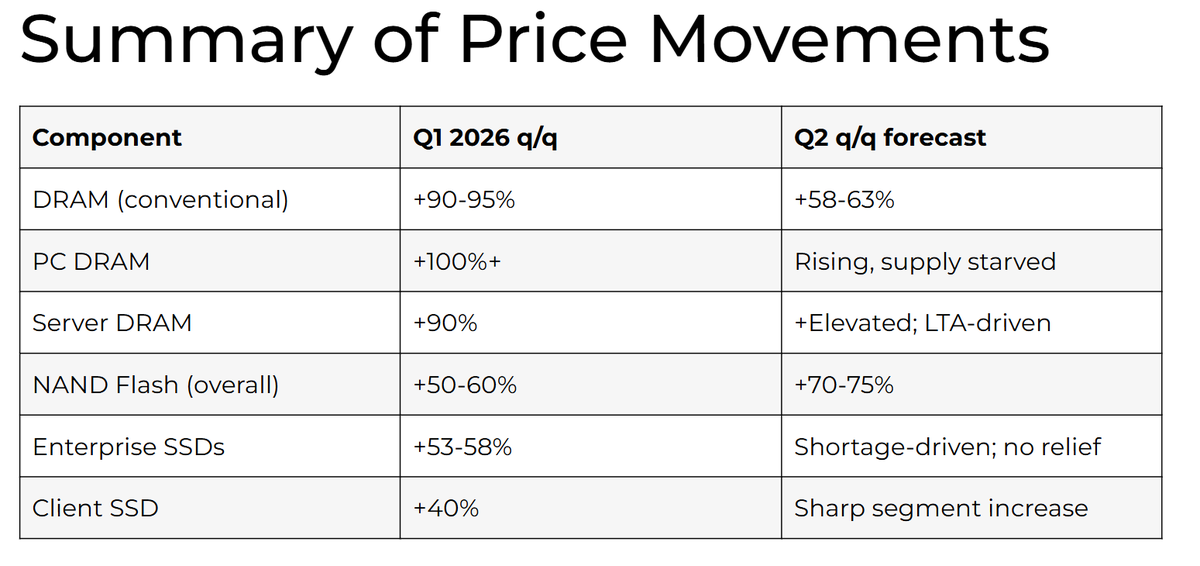
Intel CEO Lip-Bu Tan: “Everyone knows memory is the biggest shortage. Everybody try to scramble for memory. Even though you build the fab, capacity increase, it takes a couple of years to do that. Same thing for CPU, GPU” $INTC via @NoPriorsPod
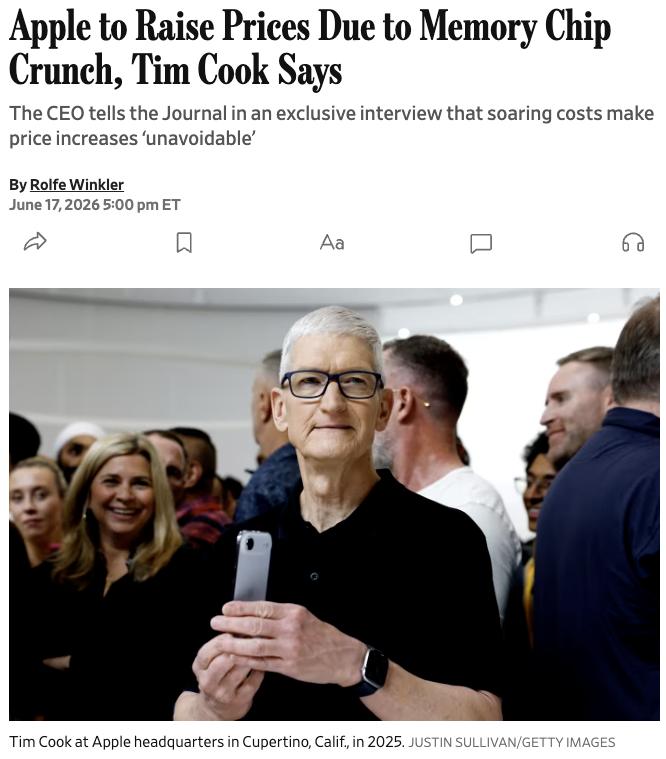
Apple $AAPL is reportedly preparing to RAISE PRICES as the AI-driven memory crunch starts hitting consumer hardware.
DRAM and NAND costs are moving higher as AI servers absorb more supply, and Tim Cook says the pressure is becoming unsustainable.
AI Infrastructure Roadmap
What you need to research to outperform over the next few years
Now → memory + optical transceivers
2027 → 800V + early CPO
2028 → PLP + scale-up optical
2029 → glass substrates + HBM5
2030 → optical I/O chiplets + embedded cooling
2031 → 3D DRAM + microfluidic cooling
Chinese models will increasingly be optimized for Chinese hardware and will run poorly on Nvidia, and vice versa.
Right now, when Chinese labs (DeepSeek etc.) run on Nvidia hardware, the US has leverage.A fully Chinese HW +SW ecosystem matures, that leverage disappears.
The AI world is splitting into hardware ecosystems the way mobile split into iOS vs Android except the stakes are geopolitical, and the switching costs are becoming enormous.
The 2026 Investing Blueprint
Research the NVIDIA, Google, AWS, and SpaceX ecosystems
↓
Map the entire supply chain
↓
Buy the suppliers with the biggest disparity between importance, moat, and valuation
Today's DC have massive transformers that take electricity from the grid and step it down.
Solid State Transformers (SSTs) replace these and are 40x lighter and 14x smaller and 98%+ efficient.
Infineon: Supplies the SiC chips that go inside SSTs.
ABB: The Swiss industrial giant. They co-announced an 800VDC distribution partnership with Nvidia in October 2025. They make the switchgear, circuit breakers, and busway that will carry 800V through the building.
Right now, hyperscaler DCs don't necessarily have to adopt the 800VDC archi. and change their DC Wiring.
When Nvidia's next-next chip, the Kyber rack, runs at 660,000 Watts per cabinet, they have to.
Till then, they need a power converter. Delta Electronics makes this rn.
The 800VDC transition doesn't just change wires and cabinets.
It creates a massive new demand curve for SiC (Silicon Carbide) and GaN (Gallium Nitride).
STMicro, Infineon, Wolfspeed, and Navitas.
A simple division puts HBM at about 47% of one GPU’s cost. Add advanced packaging, and estimates put HBM plus packaging at roughly 66 to 70% of the GPU BOM.
Gavin Baker is one of the best tech investors alive and he explains why the AI cycle might actually avoid a bubble.
Every major technology in history ended in a bubble. Railroads, canals, the internet and even the PC. Every single one.
The pattern is always the same:
1. Investors get excited about a genuine breakthrough
2. Diversity of opinion breaks down
3. Everyone converges on the same thesis
4. Valuations disconnect from reality and then it collapses.
But Baker thinks AI is different this time and that's because of a physical constraint that no past technology ever had:
Watts and wafers.
TSMC is run by what he calls "flinty old men and women" who view themselves as the guardians of the most important institution in Taiwan. Jensen Huang flies to Taipei every three months and pushes them to double or triple capacity. They expand about 5%.
Here's Baker's math:
If TSMC actually gave Jensen what he wanted, Nvidia could probably sell $1.5 to $2 trillion worth of chips next year. He really believes that. The demand is there.
But a boom that size would almost certainly end in a bust. And a bust is catastrophic for TSMC. So TSMC's conservatism isn't a bottleneck. It's a release valve. A real-world physical constraint that enforces discipline on the whole cycle and prevents the kind of overbuilding that turned the internet boom into the dot-com crash.
Baker believes TSMC is the key reason why we won't have an AI bubble.
NVIDIA’s Vera Rubin will let GPUs fetch their own data
1/ Today the GPU has to ask the CPU to fetch data from storage. CPU is the bottleneck
2/ This makes HBF viable for the first time. Flash was too slow under CPU control.
16x more memory capacity at a fraction of HBM cost