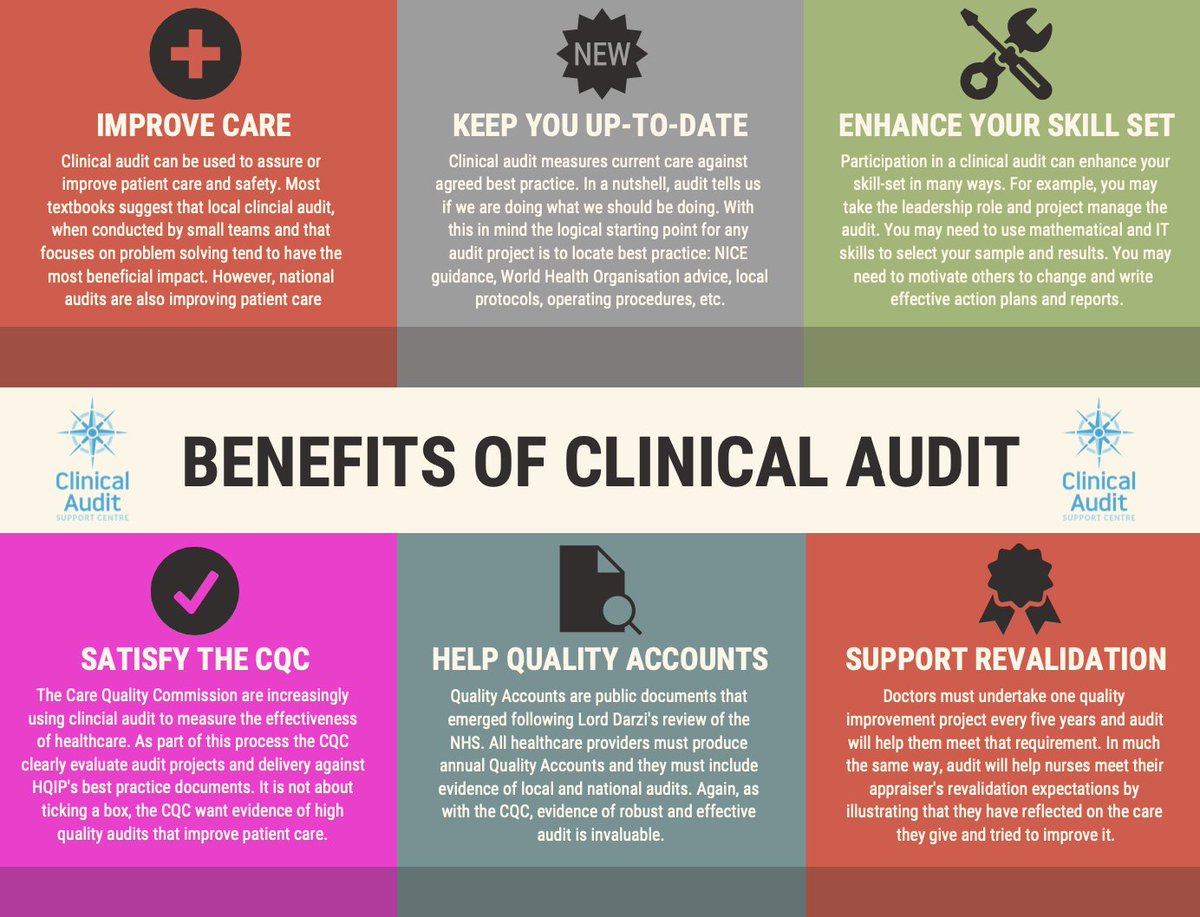
Clinical audit is a quality improvement process that seeks to improve patient care and outcomes through systematic review of care against explicit criteria
Clinical audit data should be analysed to measure compliance with standards.
The results will then provide the clearest possible picture of performance allowing you to make appropriate changes in the right areas.
What's the difference between Prospective and Retrospective data collection?
Prospective looks at data that’s current (present) e.g. patients notes on the ward at the time of audit
Retrospective looks back at data (past) e.g. looking back at patients notes to a time in the past
Do not Jump straight to developing your action plan!
* Share the results with the rest of your team including your stakeholders
* With your stakeholders, establish the underlying causes of poor or non compliance
* Develop some small changes to test and implement
Let's turn a negative…
Quality Improvement Tools is just another pointless step to the process
Into a positive...
Using scientifically proven QI tools will increase the likelihood of your project delivering sustainable improvements for patients
National Audits!!
Don't get distracted by solely looking at the National Recommendations!!
Look at local results and create actions off the back of the appropriate recommendations for your Trust/Organisation
The National Clinical Audit Module (NCAM) has been live for a few months!
NCAM enables the National Audits the Trust participates in to be transparent to staff whilst enabling the Trust to track and monitor their progress.
Drop your thoughts on the system below! 👇👇
If, after implementing some changes, and another PDSA cycle demonstrates no improvement, your initial changes may not be the right ones you need to make.
Go back to the drawing board with your stakeholders and agree on another small set of different changes.
The Clinical Effectiveness Team will be at the enterance to the Rivercourt Restaurant today between 12-2pm.
Come and say hi and find out more about how we can support you and what we do. Bring along any of your Clinical Audit, Nice and Key Document queries
#CAAW23#DropInDay
We've seen so many of our infographics and resources as part of local #CAAW23 stands and displays today! Huge thanks to all of you who have felt they warranted displaying. Such a nice feeling knowing people like the stuff we created to promote #clinicalaudit and #QI ❤️
To all the local #clinicalaudit professionals out there celebrating #CAAW23 this week. Don't undersell yourselves! You do amazing work and make a real difference to patient care and safety!
Just because you may have completed your Clinical Audit - don’t forget to continue to monitor the improvements implemented to ensure they are being sustained by undertaking a re-audit at a suitable time
#TopTipTuesday
The Clinical Effectiveness Team are hosting a Happy Café today at the George Marshall Medical Museum at CHEC.
Come along and relax whilst taking some time to focus on your wellbeing!
Here we are kicking off #CAAW23 with our first stand of the week on the ground floor of the main corridor at the Alexandra Hospital.
Come and see us to see who we are and what we do and how we can help you! @WorcsAcuteNHS
Clinical Audit Awareness Week is here!
The Clinical Effectiveness Team will be in the main corridor of the Alexandra Hospital between 12-2pm.
Come and find out how we can support you,what we do and bring your Clinical Audit,NICE and Key Document queries
#CAAW23#DropInDay
Why should you use QI Methodology in you Clinical Audit projects?
“Quality improvement” is an agreed,systematic approach with specific tools and techniques to improve quality
Incorporating QI methodology increases the likelihood of a successful project and changes sustainable