Today’s news: Treasury may start using its nearly $1 trillion TGA cash balance to fund bond buybacks.
Here is what that actually means.
The TGA — Treasury General Account, is basically the U.S. government’s bank account at the Federal Reserve.
Normally the flow is simple:
Taxes + Treasury borrowing
→ cash enters the TGA
→ government spends that cash
But Treasury is now considering using part of that cash balance to buy back long-duration government bonds from the market.
Suppose Treasury has $950B sitting in the TGA and decides to use $100B for bond buybacks.
The flow becomes:
Treasury buys $100B of long bonds
→ TGA falls by $100B
→ that cash moves back into the banking system
→ bank reserves/liquidity rise
→ long-duration Treasury supply held by the market falls
So Treasury achieves two things at once:
Liquidity goes up Pumping markets
duration pressure goes down
And this is where it gets interesting.
Treasury does not necessarily have to issue $100B of new bills at the same moment.
It can use the existing cash first.
That means:
Buy long bonds today
→ relieve pressure on the long end
→ inject short-term liquidity
→ wait for calmer market conditions
→ issue bills later to rebuild the TGA
So in effect, Treasury is using the government’s bank account to buy time.
It is separating two transactions that normally happen together:
support the bond market now
finance/replenish the cash later
This is still not QE.
The Fed is not creating new money.
The TGA cash already came from previous taxes and borrowing.
Eventually, if Treasury wants to rebuild the TGA balance, it has to issue more debt again.
So the full cycle looks like this:
Long-duration bonds bought back
→ TGA cash released
→ liquidity injected
→ long-end supply reduced
→ bills issued later
→ TGA rebuilt
The end result is effectively a shift from:
long-duration debt → short-duration debt
But the timing matters enormously.
If the 20Y or 30Y bond market is under stress, Treasury can use the TGA as a temporary shock absorber, rather than dumping more issuance into the market immediately.
That gives Treasury more control over:
when debt is issued
where duration sits
when liquidity is injected
when liquidity is drained
So the government is not solving the debt problem.
it is being shifted forward and shortened in maturity.
More bills mean more refinancing risk and greater dependence on stable short-term funding.
And if Treasury increasingly has to manage duration and liquidity to keep long yields contained, pressure eventually moves toward the Fed.
That is the path toward fiscal dominance, financial repression and a weaker fiat system.
One of the clearest ways to know when capital is starting to flee a country is to watch what happens when its bond yields rise.
Normally:
Yields ↑ → currency strengthens
Higher yields should attract capital.
But when you start seeing:
Bond yields ↑
Currency ↓
Equities ↓
something has changed.
The market is no longer interpreting higher yields as an opportunity.
It is interpreting them as risk.
Investors are demanding more yield to hold the debt while simultaneously selling the currency and domestic assets.
That is capital flight.
And here is where it becomes much more interesting:
What happens when this eventually happens to the reserve-currency country itself?
Capital cannot simply escape into another gigantic sovereign bond market without inheriting many of the same problems.
The escape route increasingly becomes scarce real assets:
Gold.
Silver.
Copper.
Energy.
Commodities.
Productive real assets.
In other words:
Capital stops asking, “Which paper asset should I own?”
and starts asking:
“What cannot be printed?”
Bookmark this.
You are going to hear this story again and again over the coming years.
Highly relevant!
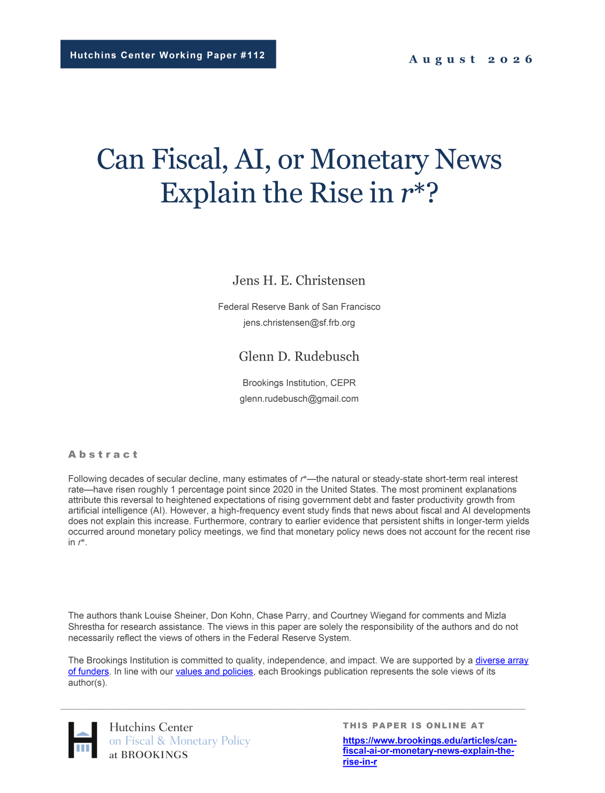
"Can fiscal, AI, or monetary news explain the rise in r*?" by Jens H. E. Christensen and Glenn D. Rudebusch.
"Following decades of secular decline, many estimates of r*—the natural or steady-state short-term real interest rate—have risen roughly 1 percentage point since 2020 in the United States. The most prominent explanations attribute this reversal to heightened expectations of rising government debt and faster productivity growth from artificial intelligence (AI). However, a high-frequency event study finds that news about fiscal and AI developments does not explain this increase. Furthermore, contrary to earlier evidence that persistent shifts in longer-term yields occurred around monetary policy meetings, we find that monetary policy news does not account for the recent rise in r*."
https://t.co/mIAzLqQjWJ
It’s not QE and it’s not yield-curve control. But if Treasury increasingly buys back long-duration debt and replaces it with bills, it is effectively conducting a Treasury-led Operation Twist: removing duration from the market to put downward pressure on long-term borrowing costs.
Combine that with Bessent’s push to expand the Fed’s FIMA repo facility, allowing foreign governments to pledge their US Treasuries as collateral and borrow dollars rather than having to sell those Treasuries outright.
The message is becoming abundantly clear: the US Treasury does not want higher long-term rates. More importantly, it wants to prevent forced or destabilizing selling of US government bonds, especially at the long end.
Gold understands the message.
It’s up more than 3% today.
Official demand for Treasuries has become less dominant, "with private investors now holding 73% of the Treasury market versus roughly 50% a decade ago:" Barclays report. With the market relying more on price-sensitive buyers, the yield premium will likely be higher vs history
The U.S. Treasury just doubled the maximum size of certain long-term bond buybacks from $2 billion to at least $4 billion per operation.
Long-term yields immediately fell.
But 99% of investors don't udnerstand what this ACTUALLY means-
Here’s what is actually happening: 🧵
Here is how Bessent's Treasury QE works:
- Step 1: Bessent issues UST bills.
- Step 2: The Fed prints money to buy them.
- Step 3: Bessent uses the proceeds to buy long-term USTs.
They don't call it QE because the Fed doesn't intervene directly in the long end...
Meanwhile the Fed is buying UST bills at a faster pace than during Covid.
I'm pretty sure we will effectively get YCC... just with a different name tag.
We’ve been writing for a few years about shift away from Great Moderation Era back to something that might look like what I’ve termed “Temperamental Era” … this chart highlights relationship between bond yields and stock prices in these two distinct eras (more on subject here: https://t.co/IRTQKRimAU)
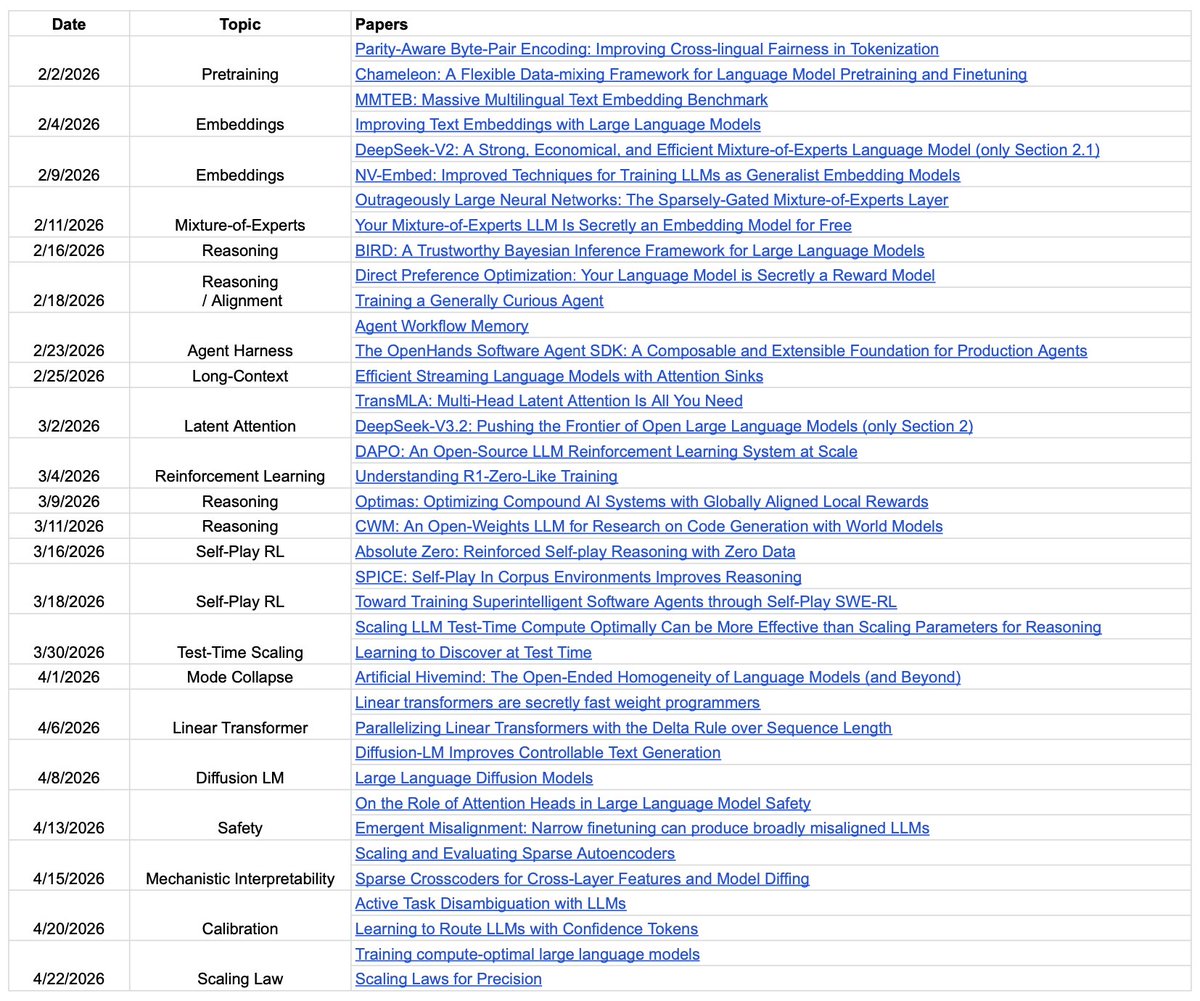
Updated CS 8803 "Large Language Model" class at @GeorgiaTech this year for 2026!
The reading list spans pretraining, MoE, reasoning, RL & self-play, agents, long-context, test-time scaling, diffusion LMs, safety, interpretability, and more.
👉 https://t.co/rzFFz4tgsI
🔗 https://t.co/rD39bWNiOD
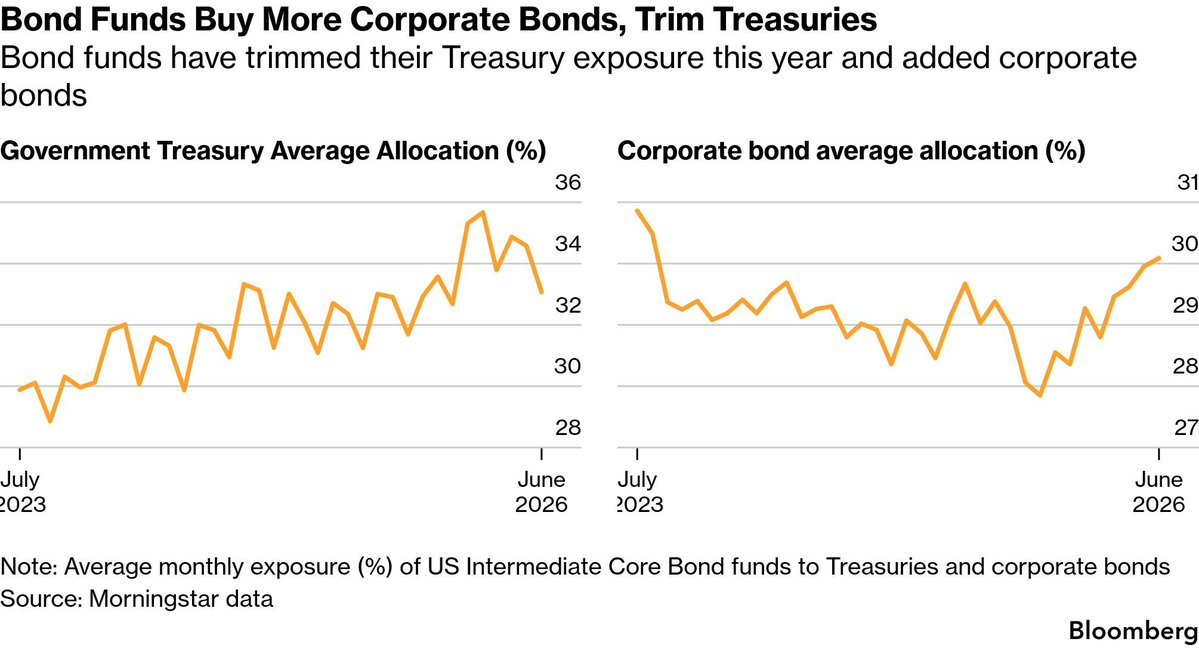
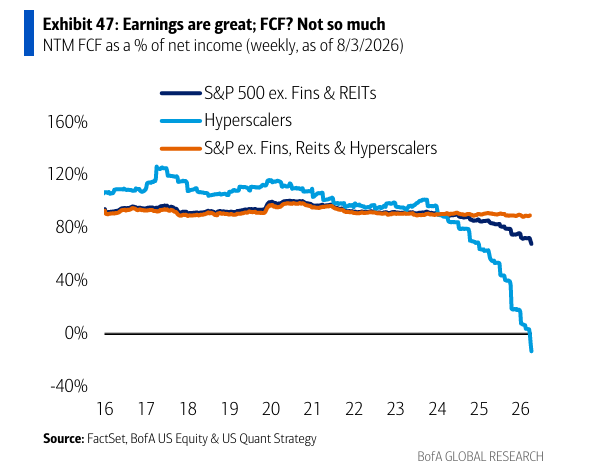
🦔AI companies have borrowed so much money this year that they're pushing up interest rates for the entire economy. Nomura estimates tech borrowing alone now equals 25% of what the US Treasury issues in bonds, five times more than last year. Bank of America says the surge has added about 0.3 percentage points to the 10-year yield. Bond managers are selling Treasuries to buy AI corporate debt instead because it pays more.
My Take
AI companies are now competing with the US government for the same pool of lenders, and the lenders are picking the corporate bonds. Alphabet's 30-year pays 6.4%. A Meta data center bond pays over 7.5%. At those rates, a 5.2% Treasury loses the fight for capital every time. That's one of the reasons long-term rates have stayed so stubborn even as the Fed tries to bring them down.
JPMorgan expects $5.5 trillion in AI infrastructure spending through 2030, and most of it will be borrowed. That borrowing raises the cost of money for everyone, the government, your mortgage, small businesses trying to get a loan. The AI buildout has reached the scale where it moves rates for the whole economy, and most people paying higher borrowing costs have no idea that a data center arms race is one of the reasons why.
Hedgie🤗
Anthropic engineer:
"You can build 5 assistants in one afternoon. Each one handles a task you've been doing manually every single day."
In 45 minutes he shows exactly how to build them from scratch, step by step.
Most people are still doing all of this by hand.
Watch the session, then read the article on Loop engineering below
Andrej Karpathy spent 8 years at OpenAI & Tesla, recently he joined Anthropic
Few days ago, he put everything he knows into one free 4-hour lecture
After this course you'll learn to build LLMs like ChatGPT & Claude from scratch
People pay $15k for bootcamps that teach half of this
You probably don't have 4 hours right now
Don't let this get lost in your feed
Watch it, then read the guide below and build your first loop
Price action remains bullish, but this is likely to be a blow-off top.
It's hard to imagine the market delivering 2-digit annualized returns over the next 5 years with valuations this stretched and speculation at all-time highs.
I believe we still have several months of bull market ahead before a larger correction.
These levels are unsustainable.