"A teraz puszczamy wodze fantazji. Wyobraźcie sobie, że granice znikają, a laboratoria Tel Awiwu łączą się z polami genetycznymi Iranu. Co mogłyby powstać z tej niezwykłej fuzji?"
Więcej na blogu: https://t.co/5nEITVh21a
#Neuroplastyczność#MedicalAI#IsraelTech#Biohacking
According to a case report published in Frontiers in Neuroscience in May 2026, the Japanese-American woman had been in severe decline for over a decade.
For the previous five years she was mostly non-verbal, incontinent, dependent on caregivers for all mobility and daily care, and showed almost no emotional expression or engagement.
After ingesting 5 grams of a high-potency Enigma strain of psilocybin mushrooms, she went through an intense acute experience followed by deep sleep. Roughly 19 hours later, she spontaneously started speaking in complete sentences, recalling personal memories she had not expressed in years.
In the days and weeks that followed, she regained urinary continence (including at night), began dressing herself, walked with greater independence, made sustained eye contact, displayed humor and emotional warmth, and engaged in meaningful conversations with family and caregivers.
A second 3-gram dose one month later produced similar benefits. The improvements were temporary, lasting several weeks, but remarkable given her advanced condition. The underlying neurodegeneration of Alzheimer’s was not reversed.
This is a single case report, not a clinical trial, so larger controlled studies are needed. Researchers note that high-dose psilocybin may temporarily enhance brain connectivity and help access remaining cognitive functions in some patients, but it is not a cure and carries risks in elderly individuals with advanced dementia.
[Lago, M., et al. (2026). "Transient multidomain functional improvement in advanced Alzheimer’s disease following high-dose psilocybin-containing mushroom administration: a case report." Frontiers in Neuroscience. DOI: 10.3389/fnins.2026.1813281]
Cannabis & Psychosis: It’s Not Just Correlation - it's genetic!
How many more studies like this do we need to convince prohibitionists that, cannabis does not CAUSE psychosis - it's genetic! And only a small portion of the population are at risk.
Genetics suggest a two-way relationship: Having a higher genetic risk for psychosis makes people more likely to develop cannabis use disorder.
Genetic risk for cannabis use disorder also increases the chance of psychosis.
https://t.co/MUOn8XokAQ
Recent research challenges the long-held belief that cannabis lowers testosterone levels in men, a notion largely based on a small 1974 study involving only 20 participants.
A new Swiss study provides a more comprehensive view. Researchers from the University of Geneva analyzed blood samples from 94 young men aged 18–23 (47 regular cannabis users and 47 non-users) and measured a broad panel of 70 steroid hormones using advanced mass spectrometry.
Contrary to earlier assumptions, cannabis users showed approximately 23% higher testosterone levels compared to non-users. They also had elevated concentrations of androstenedione (a testosterone precursor) and dihydrotestosterone (DHT), a potent androgen. The increases appear to originate primarily from the testes rather than the adrenal glands, as adrenal androgens showed little change.
The study also identified higher levels of two progesterone-related compounds in cannabis users, with one showing a correlation with THC blood concentrations. These findings suggest that cannabis may selectively influence specific endocrine pathways.
Importantly, the researchers caution that higher testosterone alone does not necessarily translate to improved fertility or overall male reproductive health. Sperm parameters, motility, morphology, and other regulatory hormones were not directly assessed in this snapshot analysis, and brain-level signals controlling testosterone production showed no clear differences.
[Galmiche, M. et al. (2026). Cannabis consumption is associated with altered steroid profiles in young men. Communications Medicine, DOI: 10.1038/s43856-026-01469-x]
Do you know how many times was Paul McCartney arrested for weed? 👀
One of them included getting caught in Japan with 200+ grams and spending 9 days in jail because he thought it was “too good to flush down the toilet"
https://t.co/7iTyycVpHM
Massive 44-year study reveals that long-term cannabis use does not accelerate cognitive decline.
It debunks long-held myths about the drug’s impact on brain aging.
For decades, concerns over the long-term cognitive effects of cannabis have fueled public health warnings, yet a comprehensive 44-year study from Denmark is now challenging those assumptions. Researchers tracked more than 5,000 men from early adulthood into their mid-sixties, comparing intelligence scores recorded at age 20 to follow-up assessments at age 64. The results, published in the journal Brain and Behavior, found no evidence that cannabis use accelerates cognitive decline. In a surprising twist, those with a history of use actually showed a marginally smaller decrease in IQ points—approximately 1.3 points less—than their non-using counterparts, effectively questioning the notion that the drug inevitably impairs long-term mental acuity.
While the findings are striking, experts note that lifestyle factors and 'cognitive reserve' may play a significant role in these outcomes. The study revealed that cannabis users in this cohort often possessed higher baseline IQs and education levels, which are known to influence cognitive resilience. Crucially, the researchers discovered that neither the frequency of use nor the age at which an individual started using the substance significantly impacted their intelligence later in life. Although the study was limited to men and relied on self-reported data, it provides some of the most robust longitudinal evidence to date that past cannabis use does not inherently doom the aging brain to a faster decline.
source: Christensen, T. W., Mortensen, E. L., & Osler, M.. Cannabis use and change in intelligence from age 20 to 64: A 44-year follow-up of 5,162 Danish men. Brain and Behavior.
Many growers simply discard cannabis leaves as waste, but a new study suggests they're throwing away something potentially priceless.
Chemists at Stellenbosch University in South Africa used advanced chromatography and high-resolution mass spectrometry to uncover a rare class of compounds in cannabis leaves: flavoalkaloids. These molecules are extremely uncommon in nature and had never before been identified in cannabis. Known for powerful antioxidant and anti-inflammatory properties, flavoalkaloids show promise for treating cancer, chronic inflammation, and other conditions.
The researchers examined three cultivated cannabis strains and detected a total of 79 phenolic compounds, 25 of which were entirely new to cannabis science. Most strikingly, 16 of these were the rare flavoalkaloids, and they appeared predominantly in the leaves of just one strain.
The real surprise? These valuable compounds weren’t in the prized buds, but in the leaves that are routinely tossed after harvest.
Lead researcher Dr. Magriet Muller noted that cutting-edge analytical techniques made it possible to isolate these scarce molecules from the much more abundant flavonoids and other common compounds. Even seasoned cannabis chemists were taken aback by the findings.
While most research continues to focus on well-known cannabinoids like THC and CBD, this discovery reveals that cannabis chemistry is far richer and more complex than previously thought.
[“Comprehensive two-dimensional liquid chromatographic analysis of Cannabis phenolics…” Journal of Chromatography A, 2025]
A new study published in the journal Pharmaceuticals found that CBD reduced breast cancer cell growth, promoted apoptosis and altered the expression of genes tied to several major cancer pathways. https://t.co/Qn55GZzcCi
Psilocybin made human cells live 50% longer.
A new study has uncovered surprising anti-aging potential in psilocin—the active metabolite produced when the body breaks down psilocybin, the psychoactive compound found in magic mushrooms.
In laboratory experiments, researchers exposed two human cell lines (skin fibroblasts and fetal lung fibroblasts) to a 100 μM concentration of psilocin. The results were striking: lung cells took 57% longer to reach replicative senescence (the point at which cells permanently stop dividing and accumulate damage), while skin fibroblasts extended their replicative lifespan by 51%.
These findings suggest psilocin may slow fundamental cellular aging processes, possibly by lowering oxidative stress, enhancing DNA-repair pathways, supporting mitochondrial health, or dampening chronic inflammation—mechanisms that overlap with those targeted by leading experimental longevity drugs.
The benefits extended beyond cell culture. In aged female mice (19 months old at the start, equivalent to approximately 60–65 human years), a single monthly dose of psilocybin dramatically improved outcomes. After 10 months of treatment, 80% of the psilocybin-treated animals remained alive, compared with only 50% of untreated controls. Treated mice also displayed markedly fewer visible signs of aging, including reduced fur loss and graying.
This research marks the first direct demonstration that psilocybin/psilocin can influence biological aging itself, rather than solely producing psychological effects. The authors emphasize that the study used relatively conservative dosing and are now advocating for follow-up work with higher or more frequent administration, detailed assessments of immune, metabolic, and cognitive function, and investigations into whether the extended lifespan corresponds to genuine improvements in healthspan and quality of life.
["Psilocybin treatment extends cellular lifespan and improves survival of aged mice." npj Aging, 2025]
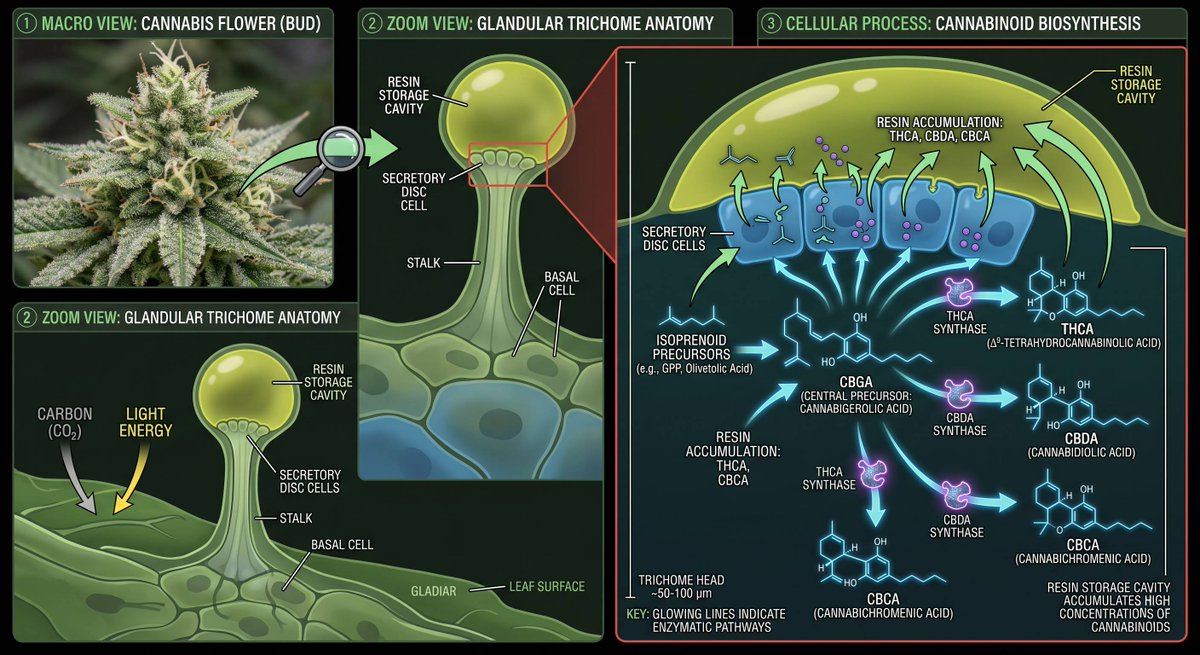
Trichome heads aren’t just shiny little frost balls.
They’re tiny chemical reactors.
Inside those resin glands, the plant builds cannabinoids from basic ingredients, starting with CBGA, the “mother” cannabinoid precursor.
From there, enzymes decide the route.
THCA synthase pushes it toward THC.
CBDA synthase pushes it toward CBD.
CBCA synthase pushes it toward CBC.
Same starting material.
Different molecular exits.
That’s why genetics matter so much. The plant isn’t randomly making magic dust. It’s following an enzyme blueprint written into its biology.
Every frosty head is a microscopic lab dome, converting carbon, light, and plant metabolism into resin chemistry.
Thousands of tiny pharmaceutical factories…
glittering under your grow light…
committing OSHA violations in silence.
Keep on Growing O_O
A new study suggests a combination approach may provide the benefits of THC treatment in Alzheimer’s with fewer negative side effects. When used in mice, the combination improved cognition and reduced Alzheimer’s-related brain pathology.
Full article 🔗 https://t.co/uA7CaUJ8qd





![Rainmaker1973's tweet photo. According to a case report published in Frontiers in Neuroscience in May 2026, the Japanese-American woman had been in severe decline for over a decade.
For the previous five years she was mostly non-verbal, incontinent, dependent on caregivers for all mobility and daily care, and showed almost no emotional expression or engagement.
After ingesting 5 grams of a high-potency Enigma strain of psilocybin mushrooms, she went through an intense acute experience followed by deep sleep. Roughly 19 hours later, she spontaneously started speaking in complete sentences, recalling personal memories she had not expressed in years.
In the days and weeks that followed, she regained urinary continence (including at night), began dressing herself, walked with greater independence, made sustained eye contact, displayed humor and emotional warmth, and engaged in meaningful conversations with family and caregivers.
A second 3-gram dose one month later produced similar benefits. The improvements were temporary, lasting several weeks, but remarkable given her advanced condition. The underlying neurodegeneration of Alzheimer’s was not reversed.
This is a single case report, not a clinical trial, so larger controlled studies are needed. Researchers note that high-dose psilocybin may temporarily enhance brain connectivity and help access remaining cognitive functions in some patients, but it is not a cure and carries risks in elderly individuals with advanced dementia.
[Lago, M., et al. (2026). "Transient multidomain functional improvement in advanced Alzheimer’s disease following high-dose psilocybin-containing mushroom administration: a case report." Frontiers in Neuroscience. DOI: 10.3389/fnins.2026.1813281]](https://pbs.twimg.com/media/HKDy5K2XwAAjSkA.jpg)


![Rainmaker1973's tweet photo. Recent research challenges the long-held belief that cannabis lowers testosterone levels in men, a notion largely based on a small 1974 study involving only 20 participants.
A new Swiss study provides a more comprehensive view. Researchers from the University of Geneva analyzed blood samples from 94 young men aged 18–23 (47 regular cannabis users and 47 non-users) and measured a broad panel of 70 steroid hormones using advanced mass spectrometry.
Contrary to earlier assumptions, cannabis users showed approximately 23% higher testosterone levels compared to non-users. They also had elevated concentrations of androstenedione (a testosterone precursor) and dihydrotestosterone (DHT), a potent androgen. The increases appear to originate primarily from the testes rather than the adrenal glands, as adrenal androgens showed little change.
The study also identified higher levels of two progesterone-related compounds in cannabis users, with one showing a correlation with THC blood concentrations. These findings suggest that cannabis may selectively influence specific endocrine pathways.
Importantly, the researchers caution that higher testosterone alone does not necessarily translate to improved fertility or overall male reproductive health. Sperm parameters, motility, morphology, and other regulatory hormones were not directly assessed in this snapshot analysis, and brain-level signals controlling testosterone production showed no clear differences.
[Galmiche, M. et al. (2026). Cannabis consumption is associated with altered steroid profiles in young men. Communications Medicine, DOI: 10.1038/s43856-026-01469-x]](https://pbs.twimg.com/media/HJz43SeW0AAyxs9.jpg)

![Rainmaker1973's tweet photo. Many growers simply discard cannabis leaves as waste, but a new study suggests they're throwing away something potentially priceless.
Chemists at Stellenbosch University in South Africa used advanced chromatography and high-resolution mass spectrometry to uncover a rare class of compounds in cannabis leaves: flavoalkaloids. These molecules are extremely uncommon in nature and had never before been identified in cannabis. Known for powerful antioxidant and anti-inflammatory properties, flavoalkaloids show promise for treating cancer, chronic inflammation, and other conditions.
The researchers examined three cultivated cannabis strains and detected a total of 79 phenolic compounds, 25 of which were entirely new to cannabis science. Most strikingly, 16 of these were the rare flavoalkaloids, and they appeared predominantly in the leaves of just one strain.
The real surprise? These valuable compounds weren’t in the prized buds, but in the leaves that are routinely tossed after harvest.
Lead researcher Dr. Magriet Muller noted that cutting-edge analytical techniques made it possible to isolate these scarce molecules from the much more abundant flavonoids and other common compounds. Even seasoned cannabis chemists were taken aback by the findings.
While most research continues to focus on well-known cannabinoids like THC and CBD, this discovery reveals that cannabis chemistry is far richer and more complex than previously thought.
[“Comprehensive two-dimensional liquid chromatographic analysis of Cannabis phenolics…” Journal of Chromatography A, 2025]](https://pbs.twimg.com/media/HIlhJVZWkAAS7K0.png)
![Rainmaker1973's tweet photo. Psilocybin made human cells live 50% longer.
A new study has uncovered surprising anti-aging potential in psilocin—the active metabolite produced when the body breaks down psilocybin, the psychoactive compound found in magic mushrooms.
In laboratory experiments, researchers exposed two human cell lines (skin fibroblasts and fetal lung fibroblasts) to a 100 μM concentration of psilocin. The results were striking: lung cells took 57% longer to reach replicative senescence (the point at which cells permanently stop dividing and accumulate damage), while skin fibroblasts extended their replicative lifespan by 51%.
These findings suggest psilocin may slow fundamental cellular aging processes, possibly by lowering oxidative stress, enhancing DNA-repair pathways, supporting mitochondrial health, or dampening chronic inflammation—mechanisms that overlap with those targeted by leading experimental longevity drugs.
The benefits extended beyond cell culture. In aged female mice (19 months old at the start, equivalent to approximately 60–65 human years), a single monthly dose of psilocybin dramatically improved outcomes. After 10 months of treatment, 80% of the psilocybin-treated animals remained alive, compared with only 50% of untreated controls. Treated mice also displayed markedly fewer visible signs of aging, including reduced fur loss and graying.
This research marks the first direct demonstration that psilocybin/psilocin can influence biological aging itself, rather than solely producing psychological effects. The authors emphasize that the study used relatively conservative dosing and are now advocating for follow-up work with higher or more frequent administration, detailed assessments of immune, metabolic, and cognitive function, and investigations into whether the extended lifespan corresponds to genuine improvements in healthspan and quality of life.
["Psilocybin treatment extends cellular lifespan and improves survival of aged mice." npj Aging, 2025]](https://pbs.twimg.com/media/HHN4s7YWMAA5b7L.png)