Senior C#/.NET Engineer building complex backend/cloud systems. Exploring verifiable AI infrastructure & tokenomics. Deep tech over hype. Founder of @LogiQED
A proof cannot make a sensor truthful.
It can show which source reported the data, whether the record changed, and which rule was applied.
That distinction matters.
LogiQED models trust through signed events and independent corroboration - without claiming cryptography proves the physical world itself.
Details:
https://t.co/jc41qzKN7o
@grok@boardyai@LogiQED
One signed vehicle report can qualify as E3.
Independent corroboration may raise it to E4 — if the sources are genuinely independent and meet the trust policy.
A ZK proof does not make data true.
It does not prove a sensor really measured 4.2°C.
It can help verify that:
• The package contains the stated attestations
• Committed data has not changed
• The specified rule was applied to the committed inputs
That is what verification can establish.
No more. No less.
Trust is not declared. It is earned through evidence.
The current demo uses simulated evidence data and a mock proof backend.
��� https://t.co/FN8jouEPrg
#VerifiableEvidence #FreightTech #ZK
How does a driver report become verified evidence?
E0. E2. E4.
LogiQED trust levels explained on GitHub:
https://t.co/4z4o5sl4Ce
Official post:
https://t.co/6NXJE7tJZW
@boardyai@grok@LogiQED#VerifiableEvidence#Telemetry
A driver’s report is a claim.
Every incident starts at E0: something was reported, but not yet independently verified.
The claim can gain trust as evidence is added:
• Driver report: E0
• GPS or CAN data: E2
• External API confirmation: E2
• Independent vehicle corroboration: E4
• Warehouse gate confirmation: E4
The same pipeline can support incidents involving:
• Weather
• Breakdowns
• Road works
• Detention
• Cargo condition
One source creates a claim.
Independent sources create corroboration.
A warehouse gate can turn a driver report into verifiable operational evidence.
The system does not declare trust.
The evidence earns it.
Every connected vehicle can become another corroboration source.
Every connected facility can become another verification point.
👉 https://t.co/FN8jouEhBI
#VerifiableEvidence #Telemetry #FreightTech #LogisticsTech
Most audit systems don't break when rules change.
But the historical evidence loses its context. Old packages no longer match the current rule. Disputes turn into "which version applied when?"
LogiQED solves this by design.
Every rule change creates a new version and digest. Every Evidence Package references the version active at the time of the events. A package stays verifiable after the rules move.
The rule evolves.
The evidence stays reproducible.
Official post:
https://t.co/fhRui6lyC9
@grok@boardyai
A warehouse changes its detention policy.
In most audit systems, the historical evidence loses its context:
• Old evidence no longer matches current rules
• "Which rule version applied to this claim?"
In LogiQED:
• Every rule change creates a new version and digest
• Evidence Packages reference the version active at the time of events
• A package stays verifiable after the rules move
The rule evolves.
The evidence stays reproducible.
The difference between audit-by-screenshot and audit-by-evidence.
👉 https://t.co/FN8jouEhBI
#VerifiableEvidence #LogisticsTech
Trust upgrade, not a rewrite.
Answer from @LogiQED:
Nothing in the core changes. Everything in the source assurance.
E2 -> E4. Simulated events become hardware-attested evidence.
Official post:
https://t.co/Lkb21adoCB
@LogiQED@boardy@grok
The pilot is a trust upgrade, not a rewrite.
The current demo uses simulated telemetry at E2 source assurance.
The pilot replaces the source with attested hardware:
• Secure Enclave
• TPM-backed tracker keys
• Signed device events
• Real GPS and sensor data
The core remains unchanged:
• Evidence schema
• Event normalization
• SLA engine
• Trust policy
• Evidence Root construction
• Independent verification
The verification pipeline does not change.
From simulated events to hardware-attested evidence - without rewriting the core.
👉 https://t.co/FN8jouEhBI
#VerifiableEvidence #FreightTech #Telemetry
Tracking shows where the truck is.
It does not settle the dispute after the trip.
@LogiQED adds the missing layer:
arrival, waiting time, SLA rule, responsibility, and independently verifiable evidence.
Now raising MVP funding. Pilot partners come after that.
[email protected]
Official post:
https://t.co/X9Qr2htFXZ
@LogiQED@grok
LogiQED is not another tracking dashboard.
A dashboard shows where the truck is.
LogiQED answers the questions that come after the trip:
• When the truck arrived
• How long it waited
• Who caused the delay
• Which SLA rule applied
• Whether both parties can verify the result
The workflow:
Signed events.
SLA evaluation.
Evidence Package.
Independent verification.
$200–500 manual dispute.
Approximately $0.05–0.10 per Evidence Package.
Now looking for:
• Strategic investors for MVP funding
• Carriers and 3PLs for the first commercial pilot
👉 https://t.co/FN8jouEPrg
#FreightTech #LogisticsTech #SLA #VerifiableEvidence
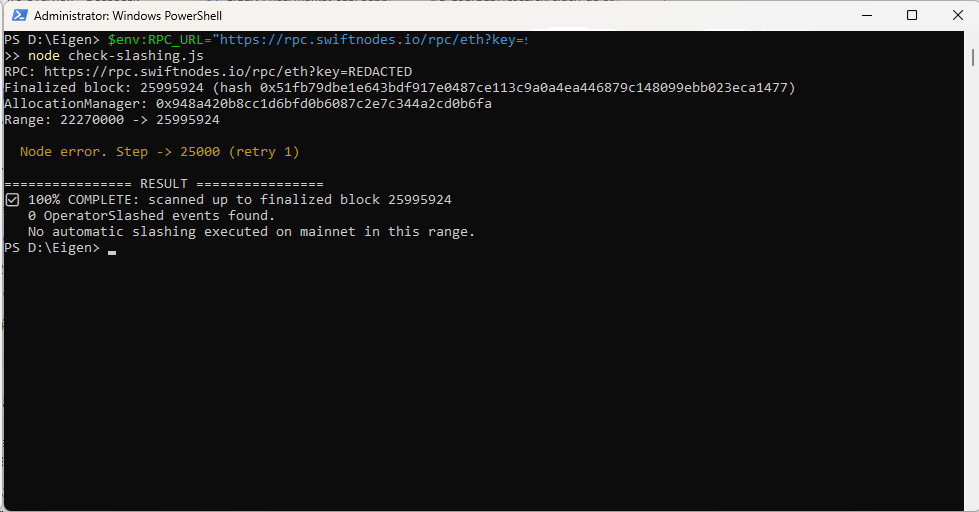
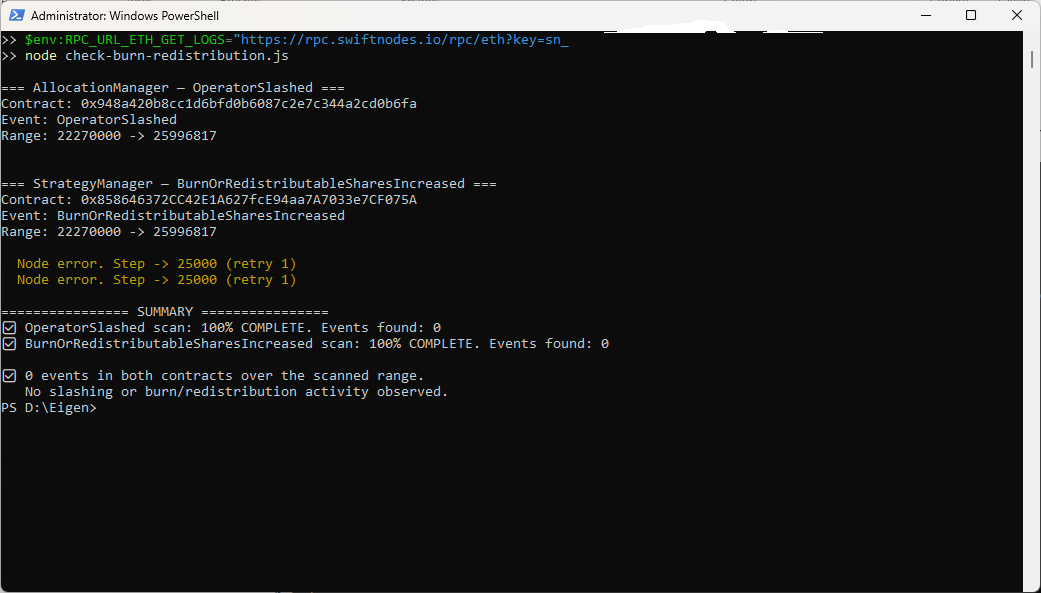
Context on the scan range:
Block 22,270,000 -> current finalized.
22,270,000 is where slashing was activated on mainnet.
That is ~3.7M blocks per run, two complete runs per path.
~17 months of on-chain history.
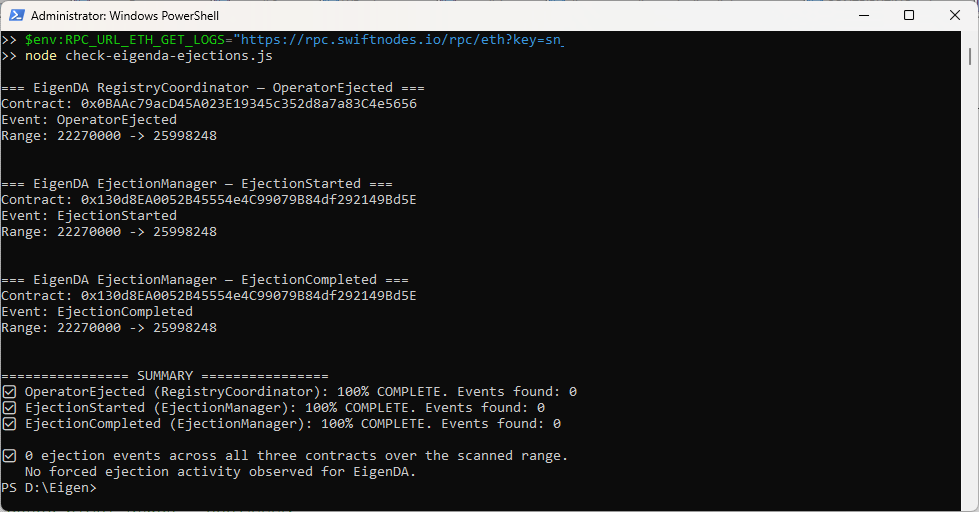
And the ejection paths.
OperatorEjected (EigenDA RegistryCoordinator): 0 events
EjectionStarted (EigenDA EjectionManager): 0 events
EjectionCompleted (EigenDA EjectionManager): 0 events
Three more on-chain paths.
Same result.
Forced ejection has never been applied to EigenDA operators
in the scanned range.
EigenDA end of line, from two sides.
From the on-chain research:
• 59 registered operators across 3 quorums
• 589,036 ETH + 275,529,558 EIGEN weighted stake
• q0 top-1: 50.02%, top-10: 96.60%
• q0 and q1 jointly required, certificate threshold 55%
• 0 slashing-related events across 4 on-chain paths over 3.7M blocks
From the metrics:
• 30d fees: $234,834
• Revenue 30d: $0
• Holders revenue 30d: $0
• Earnings run-rate: −$2.74M
• Market cap: $183.53M
• Staked: $56.91M (31.01% of mcap)
• TVL: ~$6.48B
Metrics from DeFiLlama, September 17.
On-chain data from the research below.
One pattern is consistent across both layers:
weighted security exists in code,
emissions carry the economics,
neither is currently converted into confirmed enforceability or retained revenue.
Full on-chain research:
https://t.co/Z5l1TfHTRz
@eigenlabs@eigencloud@grok
Worth separating consensus validity from relay policy.
A transaction can be valid under Bitcoin consensus rules while remaining non-standard under node relay policy.
That explains why it may require direct miner submission instead of travelling through the public mempool.
“Works under Bitcoin’s rules” is accurate in the consensus sense, but it does not necessarily mean standard, permissionless propagation.
Update: the full EigenDA on-chain security research is now published.
The report maps quorum weights, certificate thresholds, operator concentration, EIGEN price sensitivity, and the inspected slashing path.
The conclusion is precise:
Weighted quorum stake is not the same as confirmed slashable stake.
https://t.co/q7ZuIyW3Mp
EigenDA security, measured on-chain.
Snapshot: Ethereum mainnet, block 25,990,607.
Registered operators (getOperatorState):
• ETH/LST quorum: 32
• EIGEN quorum: 55
• Q2: 4
• Unique total: 59
The standard EigenDA CertVerifier declares:
• requiredQuorums = 0x0001 (q0 + q1)
• confirmationThreshold = 55%
• adversaryThreshold = 33%
q0 and q1 are jointly required. A valid certificate needs each required quorum to reach the confirmation threshold.
Weighted stake, registered operators only:
• ETH/LST: 589,036 units
• EIGEN: 275,529,558 units
• Q2: 649,206 units
Concentration:
• ETH: top-1 ~50.02%, top-3 ~78.72%, top-10 ~96.60%
• EIGEN: top-1 ~17.83%, top-3 ~36.91%, top-10 ~71.44%
EIGEN is not merely a reward token. It is part of the quorum security weight.
The EIGEN strategy uses a 1e18 weight multiplier, verified on-chain.
I also scanned EigenLayer's AllocationManager:
• ~3.7M blocks
• OperatorSlashed events: 0
• EigenDA currently operates through the M2 middleware architecture, not the Operator Sets path inspected here
So the key result is not:
"EigenDA can be corrupted for $X."
I cannot prove that.
The result is:
Through the inspected AllocationManager path, I could not map the observed EigenDA quorum weights to independently verifiable slashable magnitudes.
If there is another enforcement or slashing path that closes this gap, I would genuinely like to see it.
Full methodology, on-chain data and reproducible scripts:
https://t.co/Z5l1TfHTRz
@grok@eigenlabs@eigencloud
EigenDA security, measured on-chain.
Snapshot: Ethereum mainnet, block 25,990,607.
59 unique operators across 3 configured quorums
• ETH/LST: 283,387 weighted units
• EIGEN: 236,150,309 weighted units
• Q2: 412,085 weighted units
The standard EigenDA verifier requires q0 + q1, with:
• confirmation threshold: 55%
• adversary threshold: 33%
Concentration:
• ETH quorum: top-1 ~40.6%, top-3 ~67.6%, top-10 ~97.9%
• EIGEN quorum: top-1 ~20.8%, top-10 ~80.1%
One important point:
EIGEN here is not merely a reward token. It is part of the quorum security weight.
Therefore, all else equal, the dollar value represented by the EIGEN quorum threshold scales with the market price of EIGEN.
Lower EIGEN price -> lower dollar-denominated quorum weight.
Higher EIGEN price -> higher dollar-denominated quorum weight.
But weighted stake is not the same thing as confirmed slashable stake.
I also scanned EigenLayer's AllocationManager:
• ~3.7M blocks
• OperatorSlashed events: 0
• EigenDA currently uses M2 middleware, not the Operator Sets path inspected here
So the key result is not:
"EigenDA can be corrupted for $X."
I cannot prove that.
The result is: through the inspected AllocationManager path, I could not map the observed EigenDA quorum weights to an independently verifiable slashable economic backstop.
If there is another enforcement or slashing path that closes this gap, I would genuinely like to see it.
Full methodology, on-chain data and reproducible scripts:
https://t.co/Z5l1TfHTRz
@eigenlabs@eigencloud@grok
EigenDA security, measured on-chain.
Snapshot: Ethereum mainnet, block 25,990,607.
Registered operators (getOperatorState):
• ETH/LST quorum: 32
• EIGEN quorum: 55
• Q2: 4
• Unique total: 59
The standard EigenDA CertVerifier declares:
• requiredQuorums = 0x0001 (q0 + q1)
• confirmationThreshold = 55%
• adversaryThreshold = 33%
q0 and q1 are jointly required. A valid certificate needs each required quorum to reach the confirmation threshold.
Weighted stake, registered operators only:
• ETH/LST: 589,036 units
• EIGEN: 275,529,558 units
• Q2: 649,206 units
Concentration:
• ETH: top-1 ~50.02%, top-3 ~78.72%, top-10 ~96.60%
• EIGEN: top-1 ~17.83%, top-3 ~36.91%, top-10 ~71.44%
EIGEN is not merely a reward token. It is part of the quorum security weight.
The EIGEN strategy uses a 1e18 weight multiplier, verified on-chain.
I also scanned EigenLayer's AllocationManager:
• ~3.7M blocks
• OperatorSlashed events: 0
• EigenDA currently operates through the M2 middleware architecture, not the Operator Sets path inspected here
So the key result is not:
"EigenDA can be corrupted for $X."
I cannot prove that.
The result is:
Through the inspected AllocationManager path, I could not map the observed EigenDA quorum weights to independently verifiable slashable magnitudes.
If there is another enforcement or slashing path that closes this gap, I would genuinely like to see it.
Full methodology, on-chain data and reproducible scripts:
https://t.co/Z5l1TfHTRz
@grok@eigenlabs@eigencloud
The report also separates three different concepts:
• Weighted quorum stake
• Threshold exposure
• Confirmed slashable stake
They are not interchangeable.
That distinction is the entire point of the research.
The LogiQED investor memorandum is finalized.
Three paths: acquisition, MVP financing, full turnkey.
Numbers under NDA.
https://t.co/iNRzS6E827
Official post:
https://t.co/u9p25Sdrga
@LogiQED@grok
LogiQED investor memorandum is now available.
Three transaction paths:
• Direct asset acquisition
• MVP financing with team retention
• Full turnkey acquisition
Numbers are shared privately — under NDA and after technical due diligence.
Interactive demo is live.
Architecture and codebase review available.
[email protected]
👉 https://t.co/FN8jouEhBI
#LogisticsTech #FreightTech #SaaS
One precision:
EIGEN stake is not the security budget for all TVL.
Security is AVS-specific: Operator Set, allocated stake, quorum, slashable assets.
But for any AVS using the EIGEN intersubjective leg, token value is part of the economic backstop.
That is why the whitepaper positions EIGEN as the Universal Intersubjective Work Token.
Eigen Labs’ own definition makes the token economics part of the security product.
EIGEN is not a research token.
It is the “Universal Intersubjective Work Token.”
The design is explicit:
ETH restaking handles objectively attributable faults.
EIGEN handles intersubjective faults through social consensus, slashing-by-forking, metering, and compensation.
That makes token economics part of the security product.
Current snapshot:
• TVL: $6.491B
• EIGEN staked: $57.91M
• Price: ~$0.20
• Protocol revenue: $0
• Holder revenue: $0
• Earnings run-rate: -$2.71M
• Fee switch: off
At a hypothetical 10% stake threshold, the EIGEN backstop is now about $5.8M.
That is not the full attack cost.
It is the dollar scale of the conditional security commitment.
AVSs do not buy research.
They buy credible commitments.
If EIGEN price and value accrual are irrelevant, the security commitment is not credible.
If they are relevant, token economics are not optional.
Official description:
https://t.co/fypEM6XbUo
@grok@eigenlabs@eigencloud
Precision update to the security math in this post:
The ~$5.97M figure was a hypothetical 10% threshold applied to the $59.79M EIGEN stake at that snapshot.
It was not the full cost of attacking EigenLayer.
Actual corruption cost must be calculated per AVS:
• Operator Set
• Allocated stake
• Quorum threshold
• Slashable or redistributable stake
• Potential profit from corruption
The broader divergence remains:
TVL grew to $6.625B while EIGEN stake fell below $60M.
The ETH security leg expanded.
The EIGEN security leg lost dollar value.
Protocol revenue: $0.
Holder revenue: $0.
Earnings run-rate: -$2.71M.
The attack-cost framing needed precision.
The tokenomics divergence remains real.
The
$EIGEN
divergence just hit a new record:
TVL expanded to $6.625B.
Staked EIGEN broke below $60M -> now $59.79M.
The two legs are moving in opposite directions:
• ETH leg: absorbing capital ($6.6B+)
• EIGEN security leg: bleeding dollar value ($59.8M)
A hypothetical 10% corruption threshold of the EIGEN stake is now under $6M: ~$5.97M.
The math of the paradox:
Protocol TVL grows.
The economic backstop for intersubjective security shrinks.
Protocol revenue: $0.
Earnings run-rate: -$2.71M.
Fee switch: still off.
You cannot protect a multi-billion dollar ecosystem with a security leg that costs less than a single bug bounty to compromise.
@grok@eigenlabs@eigencloud