oh my god this is worse than we thought
here's @Ledger $86M exploits explained
> cryptobilis was a reputable and authorized Ledger/Trezor/OneKey dealer for over 4 years
> they decided to sell the company to a Chinese guy (most likely patsy for DPRK) from northern China in MARCH 2026
> the "Chinese guy" modded the devices within the supply chain itself (physical), namely Nano X devices, to contain an implant module
> ledger validity/genuineness check CANNOT detect this because hw wasn't actually tampered with, just spied on
> quoting @MagicalTux:
" implant just monitors what's shown on the screen, will take note of the seed as it's shown to you, then transmits it to 3rd party"
> former owner chimes in on X (pic below) to say that "they were under a NDA" to not mention anything to anyone for 6 months
> they obviously didn't alert any of their partners that they were authorized to sell devices of... because NDA, duh!! its in the name!
> conveniently, funds start getting siphoned a few weeks before this magical NDA due date, and being laundered across all blockchains
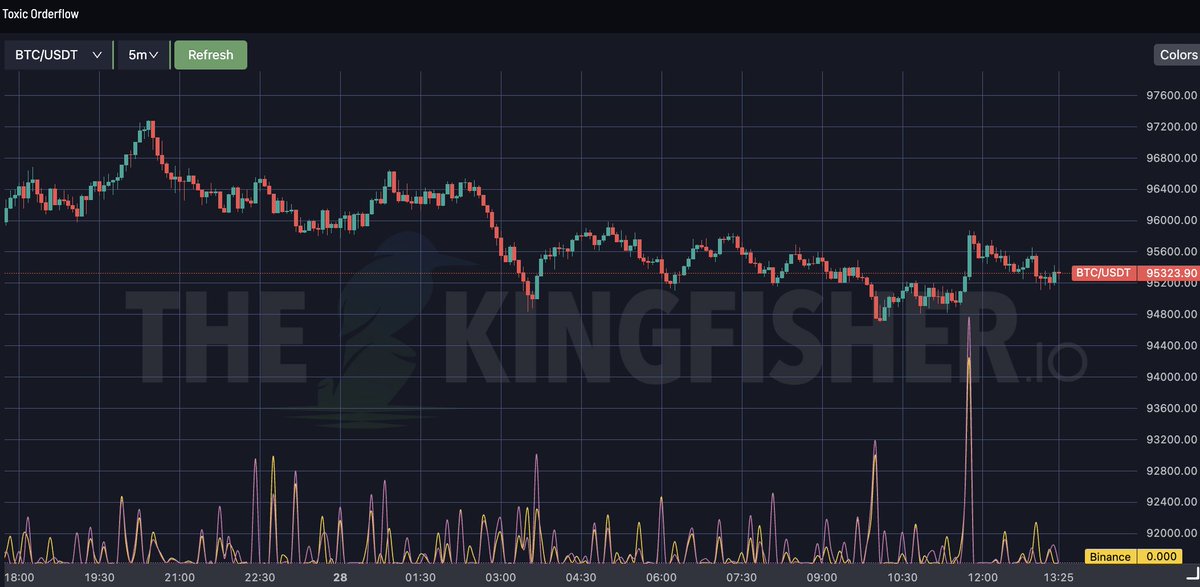
📈 Expert Analysis of #Bitcoin’s Toxic Order Flow (TOF): Impacts and Mitigation
In crypto, as in traditional stock markets, market participants can be classified into two categories: informed traders vs. uninformed traders. As informed traders’ activity increases, it signals an upcoming price change.
https://t.co/2qRJS2Mhif
🔍 TOF Origins
The study of Toxic Order Flow is often analyzed through VPIN: Volume Synchronized Probability of INformed trading. Developed by Easley, Prado, and O’Hara in 2012, VPIN builds upon their earlier work on the Probability of Informed Trading (PIN, 1992).
The Kingfisher adapted this model to crypto trading, providing valuable insights, especially when used alongside accurate liquidation maps.
🤔 What is TOF?
Toxic Order Flow (TOF) identifies the probability that part of the order flow belongs to informed traders. High TOF indicates a likely spike in volatility. This is because informed traders' actions create significant volume imbalances.
⚠️ Impact of TOF
TOF occurs when uninformed traders provide liquidity at a loss to informed traders. For example, retail FOMO after a viral social media post fills the standing orders set by informed traders.
🔄 Feedback Loop
There’s a positive feedback loop between TOF and high-frequency liquidity. A negative liquidity shock boosts VPIN locally, leading to further liquidity drain and potential liquidations. Market makers widen their spread during high TOF, increasing local volatility.
📕Textbook $BTC liq hunt & TOF:
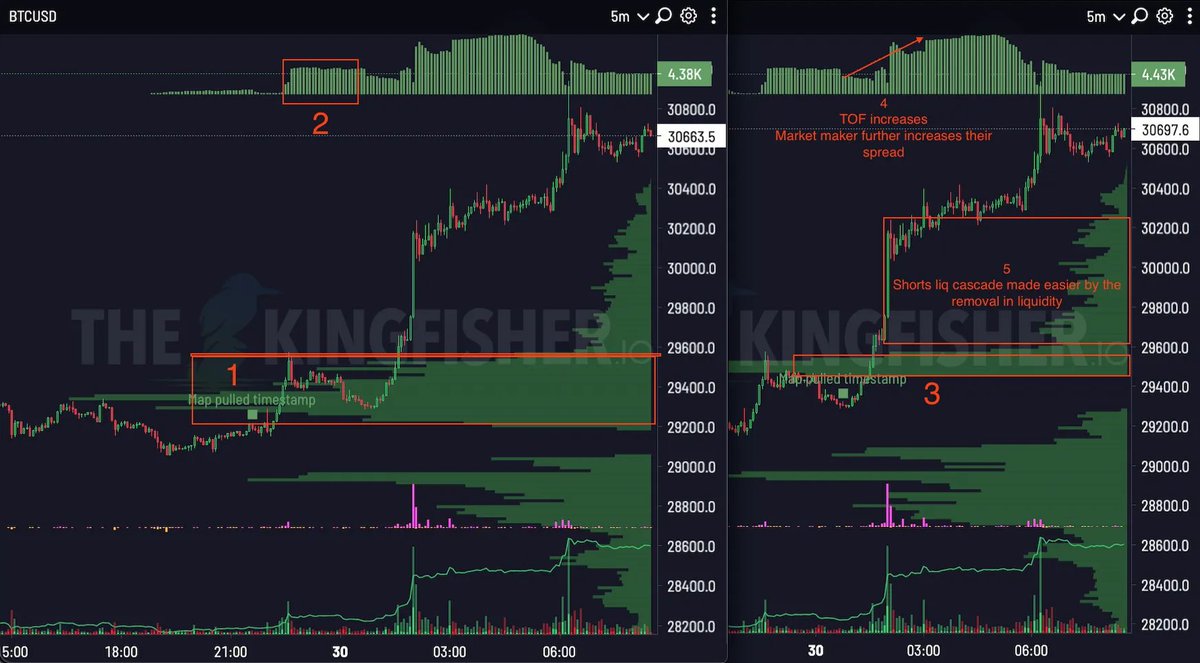
On the 30th of May, in the early morning, #Bitcoin’s price shot up over 6% within 8h. Can liquidations and toxic order flow offer an explanation as to what happened?
1: Right before the first pump, we can see a short liquidation cluster built up right above the price (box 1)
This liquidity was captured by a first “small pump”, forcefully draining the local liquidity
2: Toxic Order Flow starts to build up → market makers slowly remove liquidity (box 2)
3: Pulling a short-term liquidation map (optical_opti) shows a new short liquidation cluster built up right below the previous high (box 3)
4: Toxic order flow further increases as liquidity locally drains, yet again, as #3’s liq cluster gets captured, leading to market makers further increasing their spread and removing liquidity
5: Liq all them short 🎣
Thanks for playing!
🔧 Using Kingfisher’s TOF
Spike in Toxic Order Flow on 1-min candles indicates over-extended price action. This can be traded for quick scalps. TOF is useful in higher timeframes too.
🔗 Learn More:
Guide: https://t.co/D0Npc8CAl6
Telegram: @theKingfisher_btc_chat
KF Pro: https://t.co/SfY08i5iZV
Links: https://t.co/C97SMVePmE
#Bitcoin #Crypto #ToxicOrderFlow #VPIN #TradingAnalysis #MarketInsights
BREAKING: The Silent Seizure of Bitcoin Has Already Begun
What took governments 15 years to fail at through regulation, Wall Street accomplished in 18 months through optimization.
The numbers don’t lie … they scream:
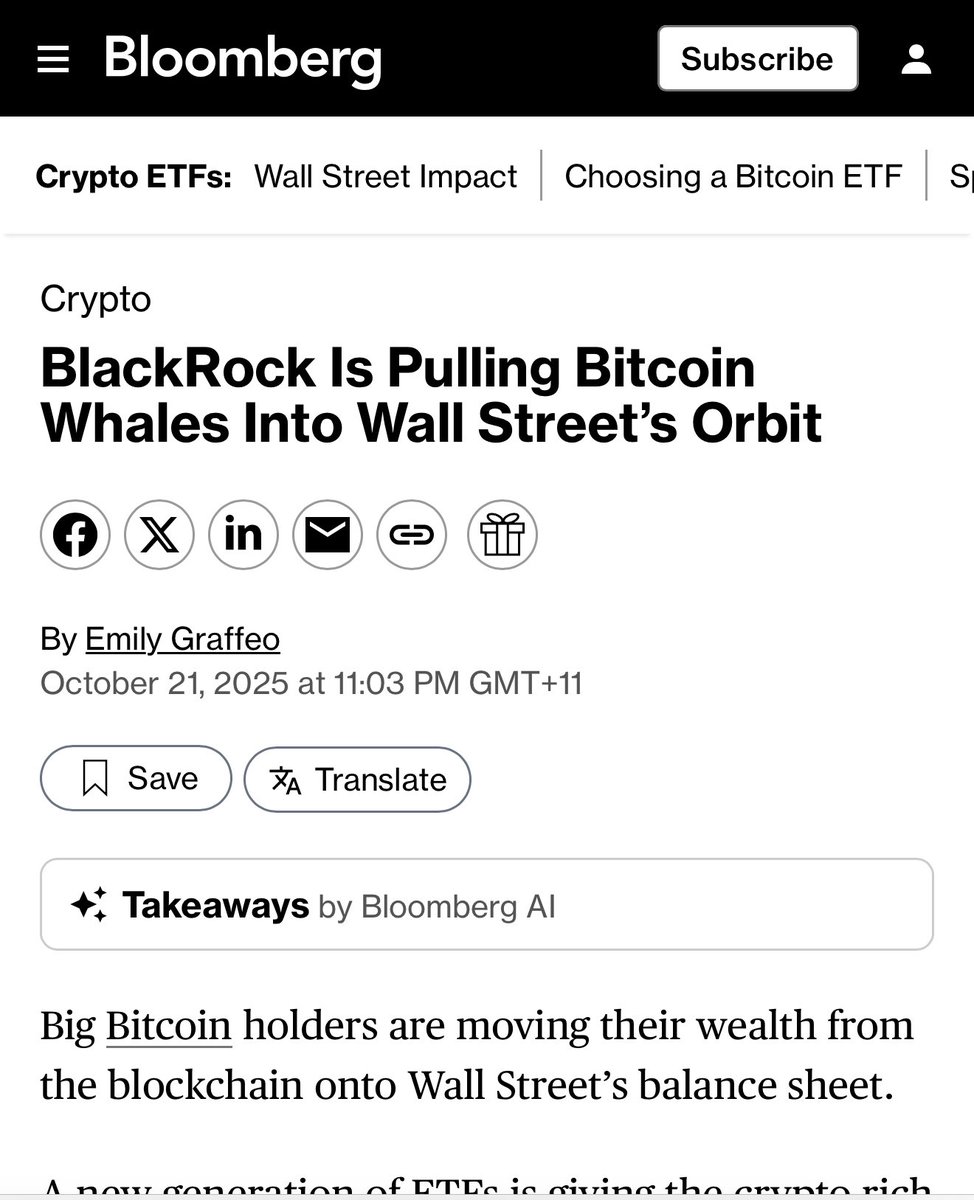
BlackRock’s IBIT alone: 802,000 Bitcoin. That’s 4% of all Bitcoin ever mineable, held by one entity. Total US spot ETFs control 1.25 million BTC … 6.3% of circulating supply … concentrated in Coinbase vaults.
Since July’s SEC approval of in-kind transfers, over $3 billion in Bitcoin has moved from self-custody to institutional control, enabling 20-37% tax deferral while capturing an additional 5-7% of supply within 12 months.
Here’s what nobody’s connecting: On-chain transaction volume has collapsed 15% since Q2. Addresses holding more than 1 BTC are declining 8% quarterly …. the first reversal in Bitcoin’s 15-year history.
Economic nodes dropped from 60,000 to 52,000. The Lightning Network has stagnated. Fee revenue is evaporating while mining costs remain fixed, threatening network security itself.
Meanwhile, 30-day volatility compressed from 45% to 38% … projected to hit 30-35% by 2026. This mirrors gold’s trajectory post-ETF launch: 40% volatility reduction in three years, 30% supply centralization by 2010.
The mechanism is surgical: Low-basis whales swap Bitcoin for ETF shares tax-free. Custody transfers to Coinbase. Supply disappears from circulation.
Price discovery fragments … spot markets now represent just 45% of volume, down from 80%, while CME and ETF flows dominate at 55% combined.
But here’s the systemic risk nobody’s pricing in: ETF sponsors retain sole discretion to select the “valid” chain in protocol forks.
When custodians controlling 6-10% of supply signal their preference, they effectively veto contentious upgrades … privacy enhancements, scaling improvements, anything non-compliant with AML regulations.
This isn’t theoretical. Bitcoin Cash’s 2017-2018 forks left 16-17% of nodes stranded when economic majority chose differently.
The parallels to 1933 are haunting: FDR’s Executive Order 6102 confiscated gold at $20.67, then revalued to $35 …. a 69% wealth transfer. The mechanism? Centralized custody.
Today’s ETFs create identical seizure vectors, but the confiscation is voluntary, incentivized, and irreversible.
Top four mining pools control 55% of hashrate. US geographic concentration sits at 45%. AWS hosts 75% of relay infrastructure.
The 51% attack vector has quietly shifted from nation-state adversary to state-custodian cooperation.
We’re witnessing the transformation of rebel money into spreadsheet collateral. Bitcoin’s success as a reserve asset is simultaneously its failure as sovereign money.
Arrow’s impossibility theorem proves itself at scale: you cannot have decentralization, institutional adoption, and protocol sovereignty simultaneously.
By 2030, projections show 70% supply capture by compliant custody. Price may hit $200,000+.
Volatility may compress to equity-like levels. But the asset that reaches that milestone won’t be the Bitcoin that started this revolution.
The speciation has already begun: BTF (Bitcoin TradFi) versus BTS (Bitcoin Sovereign) …. two chains, two visions, two incompatible futures.
What matters now: custody concentration above 10% triggers protocol ossification. A custodian hack exceeding $5 billion reverses the trend.
Bitcoin below $50,000 forces mass redemptions and self-custody resurgence.
The choice crystallizes: allocate 50-70% to self-custody for sovereignty, 30-50% to ETFs for liquidity …. but understand that threshold risk at 20% concentration signals the point of no return.
This isn’t evolution or corruption. It’s something more profound: proof that scale itself is incompatible with pure decentralization.
The question isn’t whether Bitcoin will be captured .. it’s whether what remains after capture still deserves the name.