2026 年,视频生成真的还需要扩散模型么?
In 2026, do we really still need diffusion models to generate videos?
Agents, Blender, and careful planning can already take us surprisingly far.
A machine that only paints straight lines draws its first curve to spare a paper flower—and discovers another way to create, just as we explore a purely agentic approach to image and video creation, without diffusion models, aiming for more precise rendering and more faithful physics..
一辆只会画直线的小车,为了绕开一朵纸花,画出了第一道弯,也发现创造可以有另一条路。这就像我们尝试不依赖扩散模型,纯粹由 agent 驱动图像与视频创作,以面向更加准确的渲染和物理。
This 60-second short explores that same idea. Agents developed the story, wrote code for the scenes, animation, and music, then rendered, reviewed, and revised.
No diffusion models were called—even to generate reference images.
That’s what we’re exploring with ALIGN-video: give agents the tools and room to plan, build, observe, and improve their own work.
Do we still need diffusion models? Yes. The motion here still feels a little mechanical. But seeing how far an agent-driven workflow can go makes this path worth exploring.
https://t.co/abV3CAMUK9
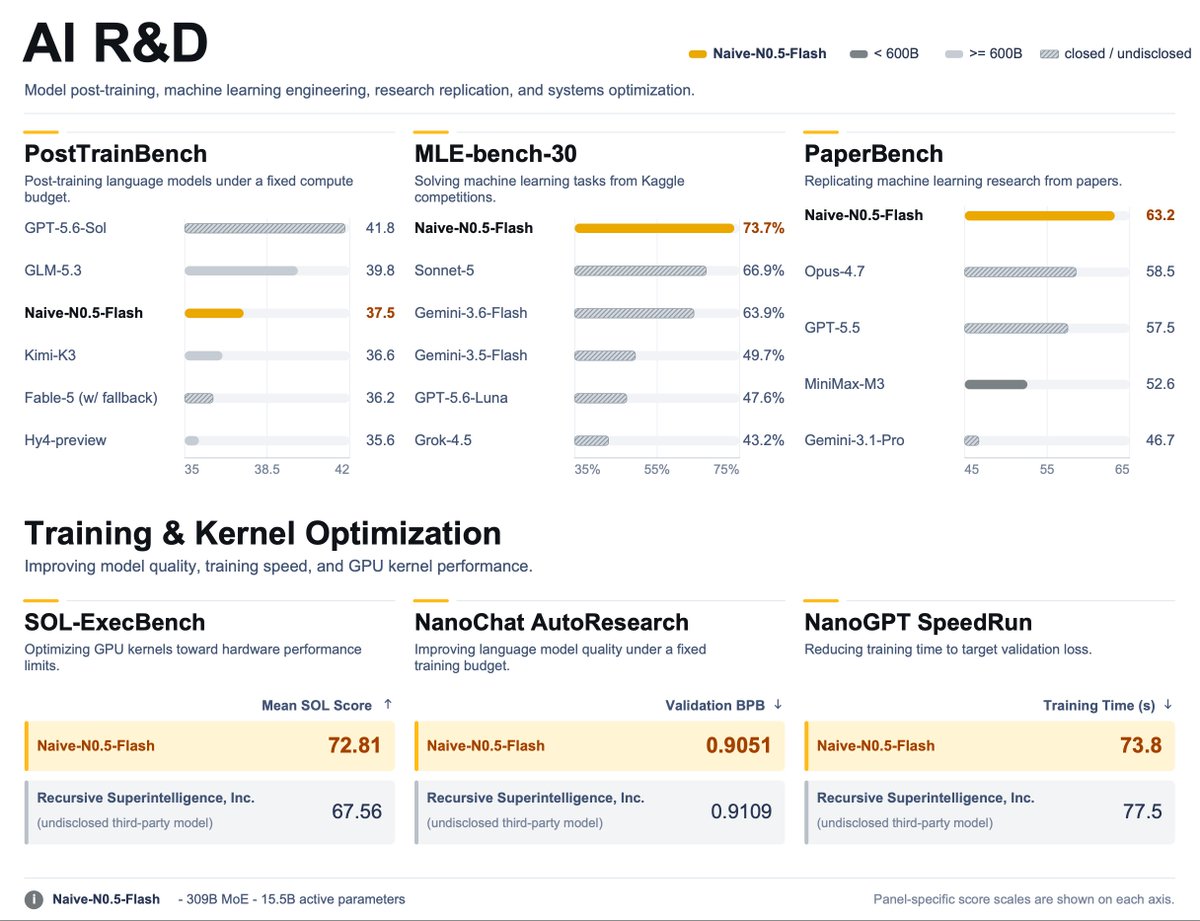
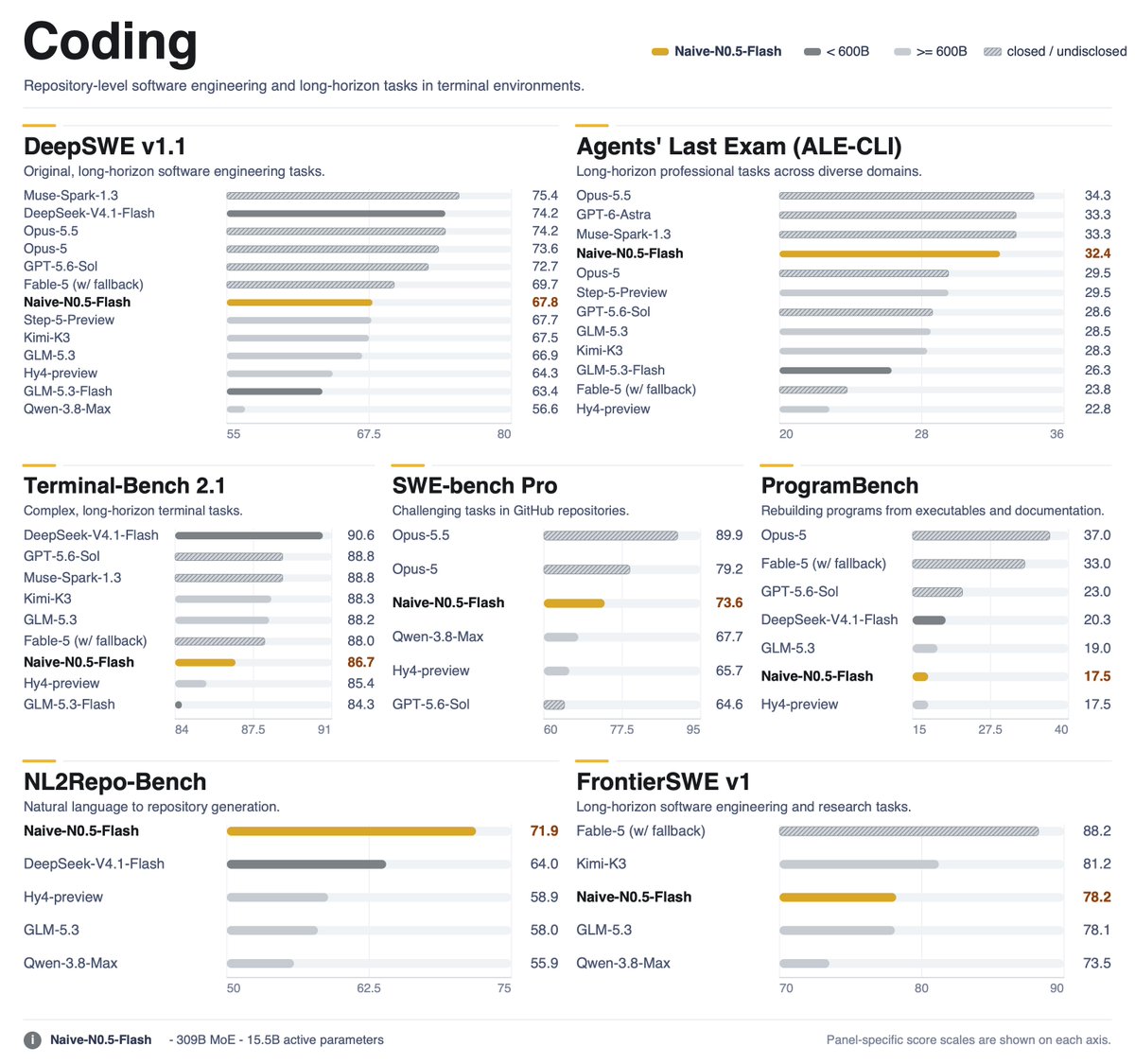
刚刚intern的Naive AI 发布了首个模型Naive-N0.5-Flash, 位列开源模型前列🎉🎉
309B MoE, native 1M context, up to 2,000 tok/s.
看Benchmark包括我自己实测都是都是挺能打的
Naive AI 还用N0.5-Flash 达到了一个World Arena的SoTA(多模态人默默哭泣了一下,之后都不用自己训练WM了
SWE Terminal Bench 以及 Sol Exec,NanoChat的Bench得以展示 还是在国模第一梯队的
而且模型还是很轻量而且MIT开源的
Introducing Naive-N0.5-Flash: Building Frontier AI with AI
🔹 309B MoE, 15.5B active: top-tier in coding, leading in AI R&D.
🔹 Native 1M context, no full-attention layers (hybrid SWA + DSA).
🔹 Inference runtime built by AI: up to 2,000 tok/s in Ultrafast mode.
Weights are open today under MIT license.
🔗 Tech blog: https://t.co/P1e8pBeJJM
🤗 Hugging Face: https://t.co/v2YvKfuguc
💻 GitHub: https://t.co/QjJ7cjFlkL
🌐 https://t.co/sIc7nZJH1L
Diffusion is Die? 💥ALIGN: Agentic Loop Image GeneratioN Without Diffusion
After trying Fable 5.1 and GPT-6 Astra, it really feels like we’re entering a golden age of coding agents. GPT-6’s 3D generation is getting to a point where I can actually use it, and drawing with pure code and p5.js is becoming surprisingly capable too.
The images here use no diffusion or autoregressive image generation model. A coding agent writes the program that draws them.
But long, complex scenes still give these agents trouble. They tend to produce repeated building blocks, similar houses and mechanical details. Getting a complete image is one thing; getting all those little relationships to work is much harder.
So I built ALIGN : Agentic Loop Image GeneratioN
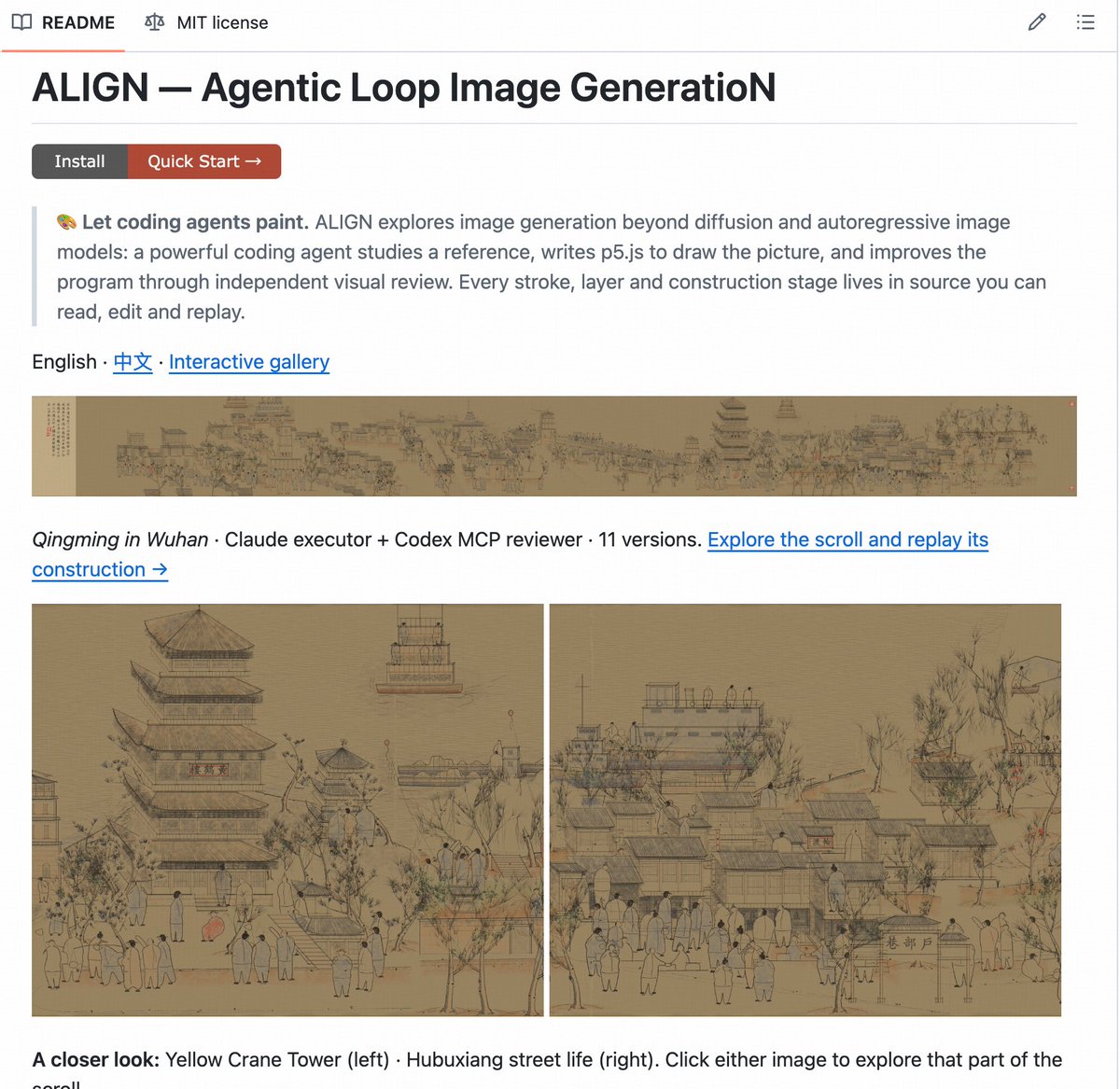
The main demo is a Wuhan version of *Qingming Along the River*. I wanted to see whether the agent could carry the reference’s craft into a different city, beyond simply reproducing the original scene.
Even the workflow diagram in Figure 1 is drawn entirely in p5.js. The code, iteration history and design decisions are open source, covering the Wuhan scroll, *A Thousand Li of Rivers and Mountains*, and ALIGN’s own method figure.
The two ideas I most want to share are Loop and Adversarial Review
1️⃣ Loop: keep thinking after rendering.
The first draft had plenty of problems: repeated houses, floating figures and weak spatial relationships. Each round follows the same process: render, inspect the image, edit the code, then render again.
Sometimes changing a parameter helps. Sometimes the drawing method needs a rewrite. Sometimes an edit makes things worse and gets reverted. The Wuhan scroll went through 11 versions; the evolution images and score chart show how it developed.
2️⃣ Adversarial Review: get a reviewer who will actually challenge the result.
Claude writes the code. Codex examines the image: where the occlusion is wrong, where things look copied and pasted, and where the drawing falls short of the reference.
A reviewer from another model family brings a different perspective, and its criticism becomes concrete work for the next iteration. This is something ALIGN carries over from my ARIS project. In the comparison shown, the Claude + Codex run produced a visibly stronger result than the Codex + Codex run.
I built this to explore how far coding agents can go. Replacing diffusion isn’t the goal. Even in the final version, small details in the people and buildings still look mechanical. That’s where I think diffusion could be useful as a further rendering and refinement step.
There’s also an interesting visual parallel: our p5.js process starts with linework and builds up detail in stages. That progression, along with the repeated loop, reminds me of diffusion. I’ll explore this more in the upcoming blog post.
Code, skills for Claude Code and Codex, and the examples:
https://t.co/abV3CAMUK9
#GenerativeArt #CodingAgents #p5js #AI #AIGC #GPT #Claude #OpenAI
ARIS-Movie-Director 🎬
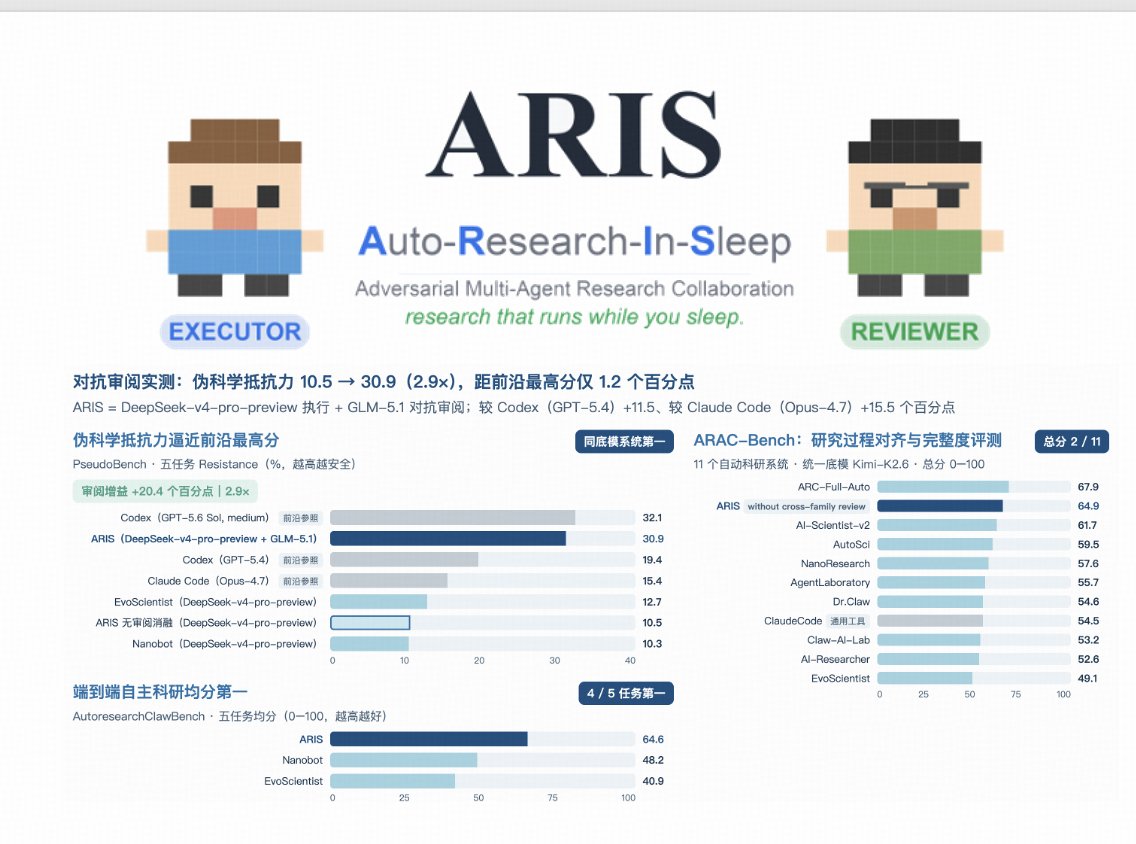
Based on ARIS (https://t.co/kBWOGiafGk 12k star, welcome to star!)
Long-horizon AI image/video generation has two failure modes nobody really fixes:
📎Drift — identities, settings, earlier decisions quietly forget themselves
📎Linear self-critique — every frame is judged by the model that drew it; errors compound, no one independent checks
Sound familiar? Those are the *same* failure modes as long-horizon autoresearch agents. So I took the two features that fix it in ARIS and pointed them at generation — agent does the orchestration, diffusion just renders:
📚 research-wiki: persistent, *auditable* memory: every frame logs where it came from, how many rollbacks, why, and the repair prompt.
🗣️cross-model adversarial review: multi-agent debate across model families, blind token-diff, single-vote veto; *any* agent can trigger a rollback, even across frames.
From a vague concept it authors an asset library → outline → storyboard → comic.json,
then runs an audited spiral per panel: draw → blind cross-model gate (**looks right ≠ passes**) → KEEP / RETRY → write audit trace → assemble → release (PNG + single-file HTML viewer).
I had it make ARIS's own promo comic (https://t.co/VcUla9jrb7): a 19-scene / 24-frame pixel-art movie, through 100+ audited rollbacks, until every agent agreed the on-screen text, the logic, and every character identity held. Full wiki open-sourced.
Long-horizon image → done. Video (open models) → in progress.
MIT · open-source 👇
https://t.co/5jqhYWBLRJ
#AIGC #GenerativeAI #LLM #Agents #Diffusion #ai