Few-Step Generation via Data-Space Iteration
Paper: https://t.co/jbEfue5t8j
We rethink the iterative process behind few-step generation. Instead of iterating in flow space, we propose data-space iteration as a new paradigm for better few-step generation.
Details in the thread!
Introducing Seedream 5.5.
More realistic images. More stable editing across 100 rounds.
1. Keep refining, with pixel-level preservation of unedited regions and reduced detail loss across successive edits.
2. Generate transparent and semi-transparent assets with native RGBA output, ready for compositing and reuse.
3. More natural lighting, materials, and skin textures, with significantly improved small-text rendering.
Seedream 5.5 is coming to Dreamina, CapCut, and BytePlus. We can't wait for you to try it!
Explore what's new: https://t.co/FP12BwViCD
@shumpeiMaxwell Adversarial Flow Models (ICML26) is not cited (https://t.co/1DRlQi9rOv) This is a prior GAN SOTA under the same architecture and dataset setting. Should be included?
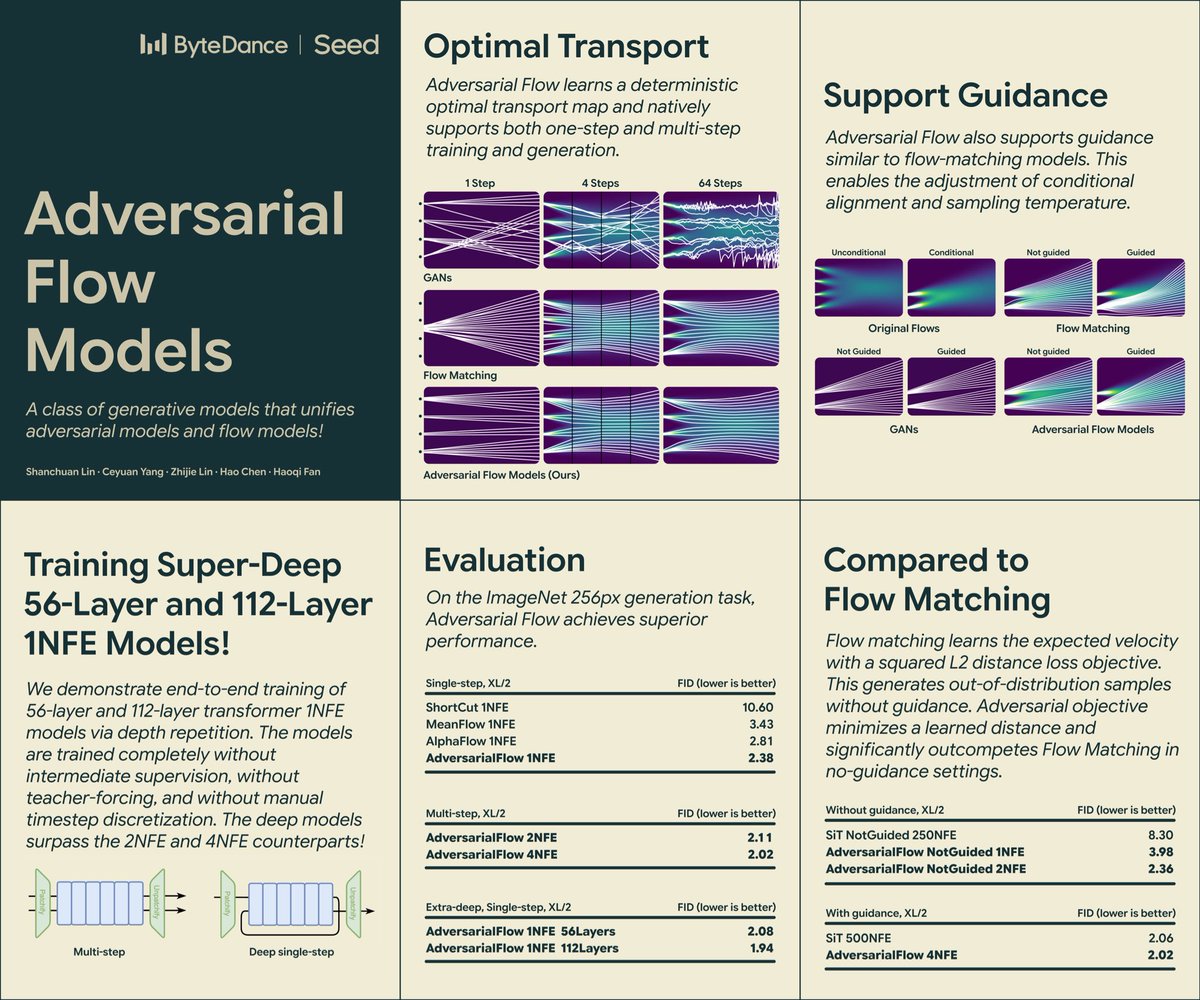
Our research: Adversarial Flow Models (AF)
https://t.co/v9cfjLIPlO
AF unifies Adversarial and Flow Models.
Unlike GANs, AF learns optimal transport (stable). Unlike CMs, AF only trains on needed timesteps (save capacity). We can train super-deep 112-layer 1NFE model! SOTA FIDs!
@AlexiGlad Hum, why does Table 1 deliberately ignore latest SOTA. Consistency family of models are completely excluded. Even for GANs, our Adversarial Flow Models (https://t.co/1DRlQi9ZE3) is not included either.
Our research: Adversarial Flow Models (AF)
https://t.co/v9cfjLIPlO
AF unifies Adversarial and Flow Models.
Unlike GANs, AF learns optimal transport (stable). Unlike CMs, AF only trains on needed timesteps (save capacity). We can train super-deep 112-layer 1NFE model! SOTA FIDs!
Few-Step Generation via Data-Space Iteration
Paper: https://t.co/jbEfue5t8j
We rethink the iterative process behind few-step generation. Instead of iterating in flow space, we propose data-space iteration as a new paradigm for better few-step generation.
Details in the thread!
Few-Step Generation via Data-Space Iteration
Paper: https://t.co/jbEfue5t8j
We rethink the iterative process behind few-step generation. Instead of iterating in flow space, we propose data-space iteration as a new paradigm for better few-step generation.
Details in the thread!
The model G(x, z, r) is conditioned on r (the refinement step index). The paper shows that G(x, z, r) is better than G(x, z).
So it won't be right to inference beyond the training max R. But I suppose you could fix r to the max and just keep reapply the model in a hacky way. The paper didn't experiment with that.
Few-Step Generation via Data-Space Iteration
Paper: https://t.co/jbEfue5t8j
We rethink the iterative process behind few-step generation. Instead of iterating in flow space, we propose data-space iteration as a new paradigm for better few-step generation.
Details in the thread!
@1rreverant Not sure if there is a pretraining way to directly obtain a data-space iteration model. But I personally think flow matching is very scalable and hard to beat, and performing quick distillation afterward is a solid paradigm.
@donghoon_ahn Very interesting. My previous work Continuous Adversarial Flow Models (https://t.co/qwxEjbET3Q) was trying to address it from a very different perspective. Would have been nice if included as related work. I need to spend more time to wrap my head around this new perspective.
Not quite the same.
JiT's data prediction is designed to avoid the Transformer bottleneck, but it still operates within the probability-flow framework.
Our data-space iteration refers to the iterative sampling procedure, which completely eliminates the concept of probability flow during sampling.
Interestingly, JiT predicts (x_0) and converts it back to (v) for ODE sampling. In contrast, our model still predicts (v) (the residual) to minimize changes to the distillation pipeline, and converts it back to (x_0) via (z-v) during sampling.
@AlexiGlad I remember previous paper has explored this under the context of optimal transport (making the trajectory straighter). But this method doesn't scale for text to image generation, where the text condition is free-form and cannot easily be searched and paired exactly.