Regresa el curso intensivo y GRATUITO de Google y Kaggle para aprender a construir y desplegar Agentes de IA en solo 5 días.
Con él aprenderás:
✅ Vibe Coding: Usa lenguaje natural como tu interfaz de programación principal.
✅ Sistemas multiagente: Crea agentes avanzados con memoria, contexto y herramientas.
✅ De prototipo a producción: Cómo escalar tus desarrollos de forma segura en la nube.
🌟 Regístrate aquí: https://t.co/RswXl8HjiF
The new @GoogleColab bridges the gap between local environments and the cloud, providing a zero-friction execution platform for developers and AI agents alike. The CLI Supports:
⚡️ Agent-driven Colab workflows
⚡️ Instant GPU/TPU provisioning
⚡️ Remote script execution
⚡️ Interactive runtime access (console/REPL)
Learn more in the blog: https://t.co/n8TOYStlrp
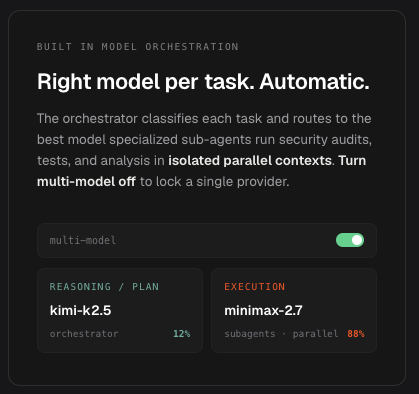
Kimchi es Open Source y hace routing inteligente de modelos. O sea, cuando empieza tu proyecto, automáticamente elige cuándo usar razonamiento (Kimi, más caro) y cuándo usar ejecución (Minimax, más barato)
Todos estos modelos son Open Source! (Kimi, MiniMax, Nemotron)
https://t.co/nfJU1krtUt
Alternativa gratuita y de código abierto a NotebookLM
Genera podcasts y chatea con tus documentos fácil.
Sin suscripciones, desde tu máquina y usas la IA que quieras. 100% privado:
https://t.co/otT4EB81tG
AI is a five-layer cake with an application, model, infrastructure, chip, and energy layer.
While most focus on agents, the biggest bottleneck down the line might actually be the energy layer.
Hear how @calebfoundry breaks down the full AI stack → https://t.co/wJ72PAwffM
Get an intro to the Transformer architecture and the BERT model.
Explore the components of the Transformer architecture and the tasks BERT can be used for, such as text classification, question answering, and natural language inference → https://t.co/zMXXc5hCsq
Create secure agents by protecting access and data with this codelab → https://t.co/wchhFNv7mG
Learn how to protect the reasoning engine with Model Armor and IAM to manage agent access and ensure that sensitive data remains protected during execution.
Ready to explore advanced gen AI topics?
Learn about the components of the encoder-decoder architecture and how to train and serve these models + code a simple implementation in TensorFlow of the encoder-decoder architecture for poetry generation → https://t.co/qWCrOgbFud
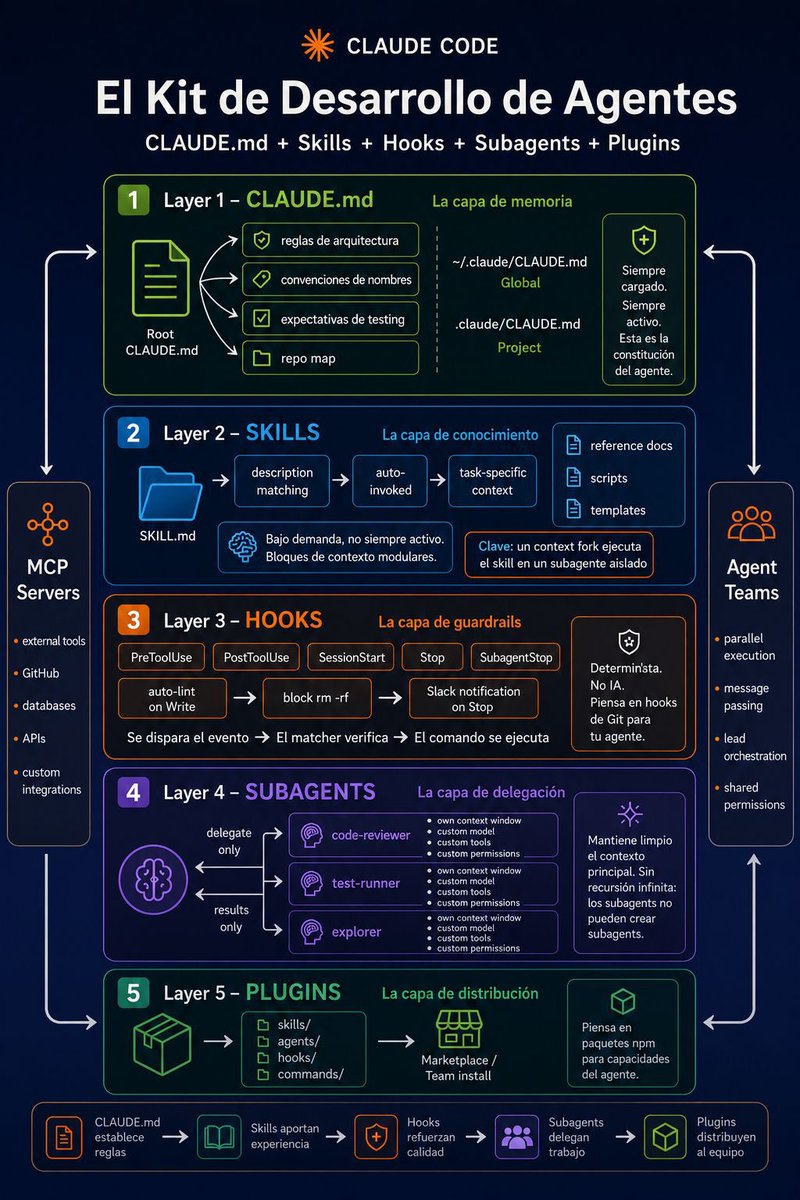
Claude Code no es solo un asistente: es una arquitectura para construir agentes de IA reales
“Crear un agente de IA” suena potente, pero también puede ser demasiado amplio.
Claude Code lo ordena en un Agent Development Kit de 5 layers, donde cada capa resuelve un problema concreto que un LLM por sí solo no puede manejar bien en producción.
🟢 Layer 1 — CLAUDE. md: memoria
Es la constitución del agente: reglas de arquitectura, convenciones de nombres, expectativas de testing y mapa del repo.
Siempre cargado, siempre activo, a nivel global o de proyecto.
🔵 Layer 2 — Skills: conocimiento
Las Skills agregan expertise bajo demanda sin inflar el contexto principal.
Cada SKILL. md puede incluir docs, scripts, templates y contexto específico de tarea.
🟠 Layer 3 — Hooks: guardrails
Los Hooks no son IA: son reglas deterministas basadas en eventos.
Sirven para auto-lint, bloquear comandos peligrosos, validar acciones o enviar notificaciones a Slack.
🟣 Layer 4 — Subagents: delegación
Permiten dividir tareas como code-reviewer, test-runner o explorer.
Cada subagent tiene su propio contexto, modelo, herramientas y permisos. El agente principal delega y recibe resultados.
🟢 Layer 5 — Plugins: distribución
Agrupan Skills, Subagents, Hooks, Commands y MCP Servers.
Una instalación, múltiples proyectos y equipos reutilizando las mismas capacidades.
Alrededor aparecen dos piezas clave:
MCP Servers: conectan herramientas externas, GitHub, bases de datos, APIs e integraciones.
Agent Teams: habilitan ejecución paralela, orquestación y permisos compartidos.
El modelo mental:
CLAUDE. md establece reglas → Skills aportan experiencia → Hooks refuerzan calidad → Subagents delegan trabajo → Plugins distribuyen capacidades.
La mayoría de los problemas en sistemas agenticos no nacen porque “el modelo falló”, sino porque falta una capa arquitectónica.
Si estás construyendo productos con IA, no pienses solo en prompts. Piensa en arquitectura.
Si quieres aprender Python, SQL o Machine Learning, Kaggle tiene cursos gratuitos y con certificado.
Lo mejor es que van al grano desde cero. Te lo explican sin asumir que ya sabes. Perfectos para arrancar.
Duran solo unas pocas horas. Así puedes rápidamente aprender algo nuevo sin necesidad de invertir demasiado tiempo.
Puedes encontrarlos en la web de Kaggle, en la sección "Learn". No pongo el enlace porque ya sabes cómo se pone esta red social.
Transform unstructured chaos into actionable business intelligence in seconds.
Learn how to forecast with AI Agents in this codelab → https://t.co/8JBEAbdO4e
AI agents are entering their production era. The Google for Startups AI Agents Challenge is where startups move from prototype to production. 🛠️⚡️
Every eligible startup receives $500 in credits plus the chance to win a share of a $90,000 prize pool. 💰🏆
Projects are due June 5. Apply here: https://t.co/bFkiJTmGpA
We’re expanding Google @Antigravity’s agentic surfaces and features — and they’re all available now for you to try.
🔹 Antigravity CLI
🔹 Antigravity SDK
🔹 Native voice support with Gemini Audio models
🔹 @Antigravity 2.0 desktop application
🔹 Integrations with @GoogleAIStudio, @Android, @Firebase, and the web
#GoogleIO