its hard to admit but i think im addicted to reading research papers.
the dopamine hit from being in flow state trying to wrap my head around novel ideas is so addicting.
shout out to my dealer arxiv for giving me the good stuff.
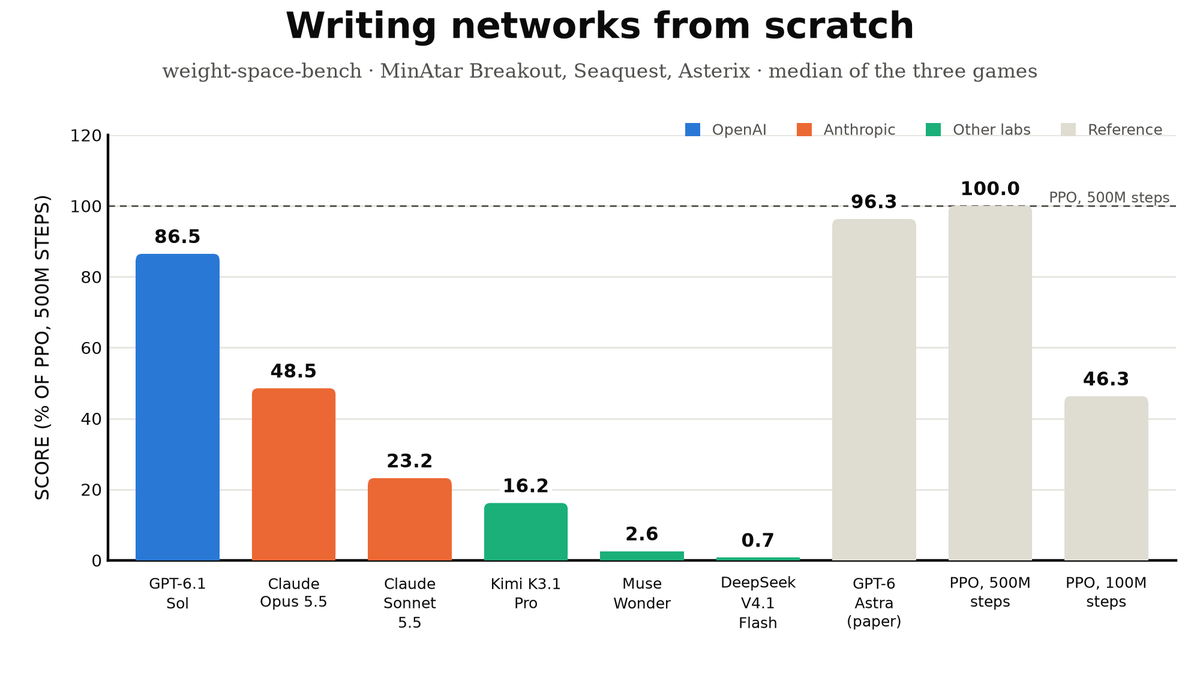
i created a open benchmark on "weight-space programming" and GPT-6 Astra scored the highest at 96.3 against baseline (500M PPO).
runner up: GPT-6.1 Sol, Claude 5.5
my main curiosity was how other LLMs write weights from scratch rather than editing them or "reading them".
so this benchmark only measures the model's ability write new weights from scratch.
full disclosure, im pretty skeptical about this still - but i think it's crazy to just let this idea go by. we need the ecosystem to run with it and see its limits, and train foundation models to optimize this.
github repo: https://t.co/E1Cmqygfh8
We asked GPT-6 Astra to edit Qwen3.5-0.8B weights to improve math.
It directly changed only 0.016% of weights, fixing 0.8B's reasoning loops & improving math up to 6x and even instruction following 3x, without gradients or training.
We call this Weight-Space Programming: frontier LLMs can now natively read/write neural network weights! 🧵
Blog: https://t.co/bOWCcFhCVq
@gpelluet27 the PPO edit i believe was a pure edit without forward pass and validation.
otherwise, like you mentioned Gemma 3 270B edit and Qwen edit both use tools and experiments to try to narrow down the problem which sounds less exciting than a pure read.
@kostasbotonakis this one specifically doesn't measure math but a small neural net ~25k weights from scratch to play games.
it would take 2-3 days of compute and a lot of money to make this benchmark scale to test its ability write LLMs that performs on domain specific jobs.
this is such a well done and beginner-friendly intro to how CUDA works at the high level and will help mold your brain around how kernel engineers think about performance for any given problem. no code at all, just dark theme diagrams!
link below
CUDA explained from a first principles perspective.
Turns out, it's more than just a collection of kernels but it's a huge ecosystem and a huge rabbit hole to dig into.
@NVIDIAHPCDev@NVIDIAAIInfra