Agentic AI for Product Teams comes to @Northeastern San Jose. One day to get your docs in order, run an end-to-end workflow with agents and skills, project manage with @linear and deploy to @vercel. Tag PMs, designers, founders for structure > vibes https://t.co/vC3anKxe75 🦾👾
What if AI is actually creating more jobs than it is replacing?
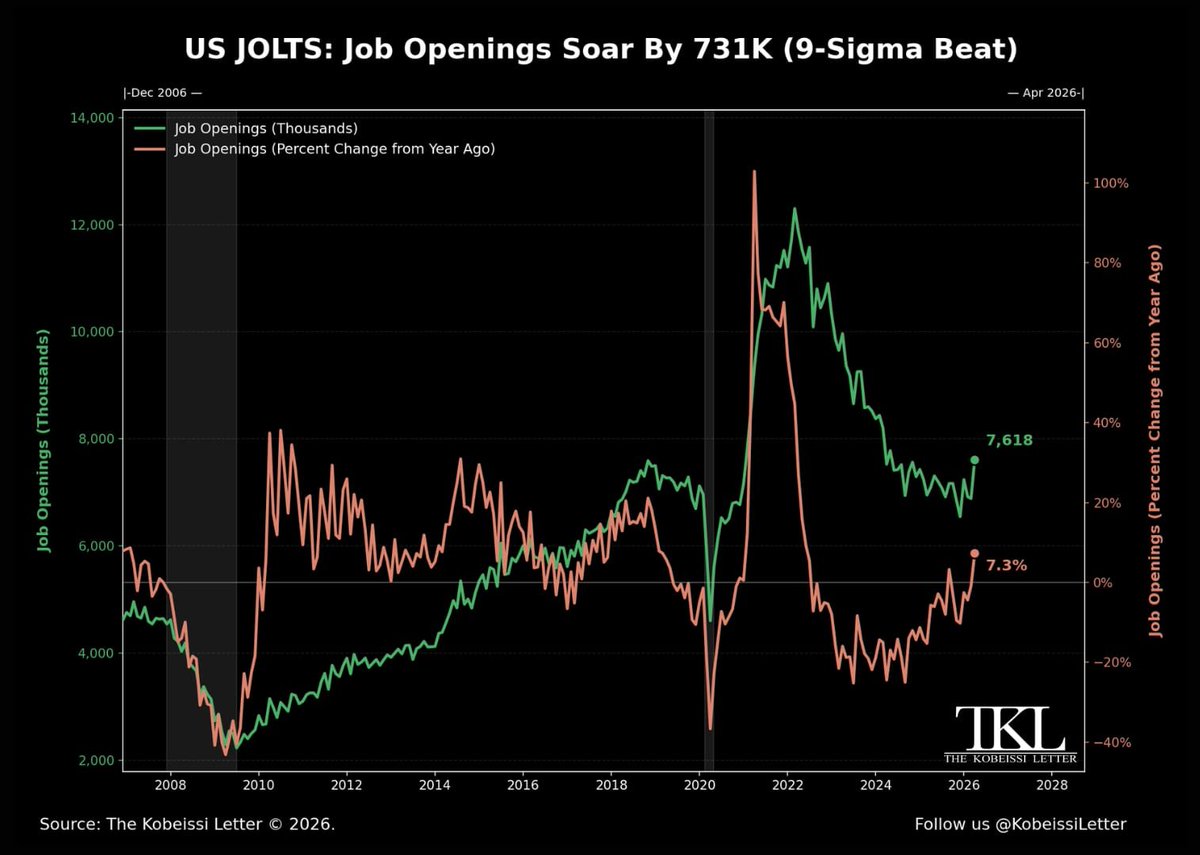
The latest JOLTs data showed that US job openings surged by a massive 731,000 jobs in April.
Markets were expecting no change, resulting in the largest beat in JOLTs history.
As a result, available employment hit 7.6 million for the month, the highest since May 2024.
And, job openings in the professional and business services sector surged by a massive 668,000.
The labor market's bull case from AI is underpriced.
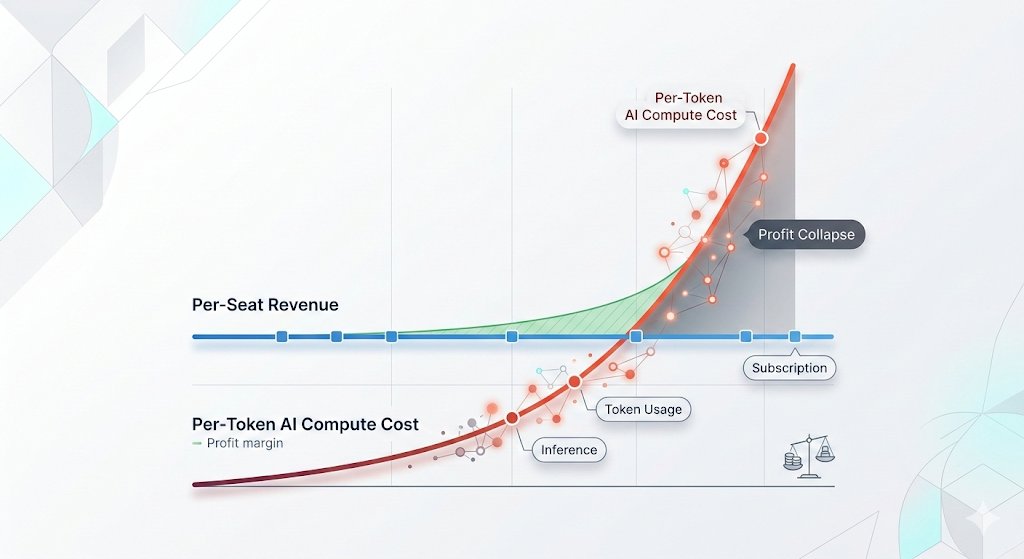
🦔Microsoft canceled its internal Claude Code licenses this week after token-based billing made the cost untenable, even for a company with effectively infinite cloud resources. Uber's CTO sent an internal memo warning the company burned through its entire 2026 AI budget in just four months. American AI software prices have jumped 20% to 37%, and GitHub (owned by Microsoft) is dropping flat-rate plans for usage-based billing across its products.
My Take
The AI subsidy era is ending in real time. The same company that put $13 billion into OpenAI and built the Azure infrastructure powering most of Anthropic's compute just looked at the bill from a competitor's coding tool and decided it was not worth paying. That is not a productivity failure on Anthropic's end. Token-based pricing is forcing every enterprise customer to confront the actual cost of running these models at scale, and the number turns out to be far higher than the flat-rate experiments suggested.
This ties directly to my Gemini Flash post yesterday. Anthropic, OpenAI, and Google all raised effective prices in the last six months. Enterprises that built workflows assuming AI costs would keep falling are now watching annual budgets evaporate in months. Two outcomes look likely from here. Either enterprises scale back AI usage to fit budgets, which slows the revenue ramp the labs need to justify their valuations ahead of IPOs, or the labs cut prices and absorb the losses, which makes the unit economics worse at exactly the wrong moment. Both paths land in the same place, the numbers stop working, and somebody has to take the writedown.
Hedgie🤗
I’ve had very good results running autoresearch with local qwen 3.6 26b model as long as I had a simple vibed pi “advisor” extension that allowed it to periodically ask GPT 5.5 for ideas. I think this direction has a lot of merit.
Quick update: not dead.
$FIG Q1 results:
→ 46% YoY revenue growth, accelerating for the 2nd straight quarter
→ Net Dollar Retention Rate increased to 139%, our highest rate in over two years
→ Raising 2026 revenue guidance for the year
Design matters more than ever.
An NVIDIA-powered farming machine uses AI and precision lasers to destroy weeds in milliseconds without herbicides, offering a potential step toward chemical-free agriculture.
Today we open the Zapier SDK to everyone.
If you're building with AI agents, this is for you.
I've been using this for 2 months. It's totally changed how I do my job.
You install it in your coding agent. Cursor, Claude Code, Codex, whatever you use. Now that agent has access to 8,000+ apps through @Zapier and can do anything those APIs can do.
I think it’s the most powerful thing we’ve launched in years. Now in open beta.
Just give this link right to your agent:
https://t.co/k6arEyZMMU
My friend Milla Jovovich and I spent months creating an AI memory system with Claude. It just posted a perfect score on the standard benchmark - beating every product in the space, free or paid.
It's called MemPalace, and it works nothing like anything else out there.
Instead of sending your data to a background agent in the cloud, it mines your conversations locally and organizes them into a palace - a structured architecture with wings, halls, and rooms that mirrors how human memory actually works.
Here is what that gets you:
→ Your AI knows who you are before you type a single word - family, projects, preferences, loaded in ~120 tokens
→ Palace architecture organizes memories by domain and type - not a flat list of facts, a navigable structure
→ Semantic search across months of conversations finds the answer in position 1 or 2
→ AAAK compression fits your entire life context into 120 tokens - 30x lossless compression any LLM reads natively
→ Contradiction detection catches wrong names, wrong pronouns, wrong ages before you ever see them
The benchmarks:
100% recall on LongMemEval — first perfect score ever recorded. 500/500 questions. Every question type at 100%.
92.9% on ConvoMem — more than 2x Mem0's score.
100% on LoCoMo — every multi-hop reasoning category, including temporal inference which stumps most systems.
No API key. No cloud. No subscription. One dependency. Runs on your machine. Your memories never leave.
MIT License. 100% Open Source.
https://t.co/KggwTqijmD