Ironically for a discipline which defines itself as the science of allocating (relatively) scarce resources, much popular economic commentary amounts to "have you considered making the pie bigger?"
The weirdest thing about white people saying anything nice about Pakistan is that they will make it sound like Pakistanis were incapable of thinking about it.
The fact is Solarisation started after the State Bank introduced Solar refinancing for Industries in 2009, and greatly expanded it in 2016. NEPRA also began given Net-metering licenses in 2015.
This wasn’t a miracle ‘nobody planned’. Pakistanis waited to make the decision based on household economics. The policies were in place, and in fact were ahead of their time. They effectively worked too well.
Another alternative energy transition that has actively accelerated is use of biomass in the country, which is going to pick up more pace. And soon after there will be more stories how nobody planned it.
@sajjadmustafa A quick search: Americans pay 0.7% of their monthly income (in gdp per capita) on gas whereas Pakistanis pay 44%. https://t.co/HXqsJvbc52
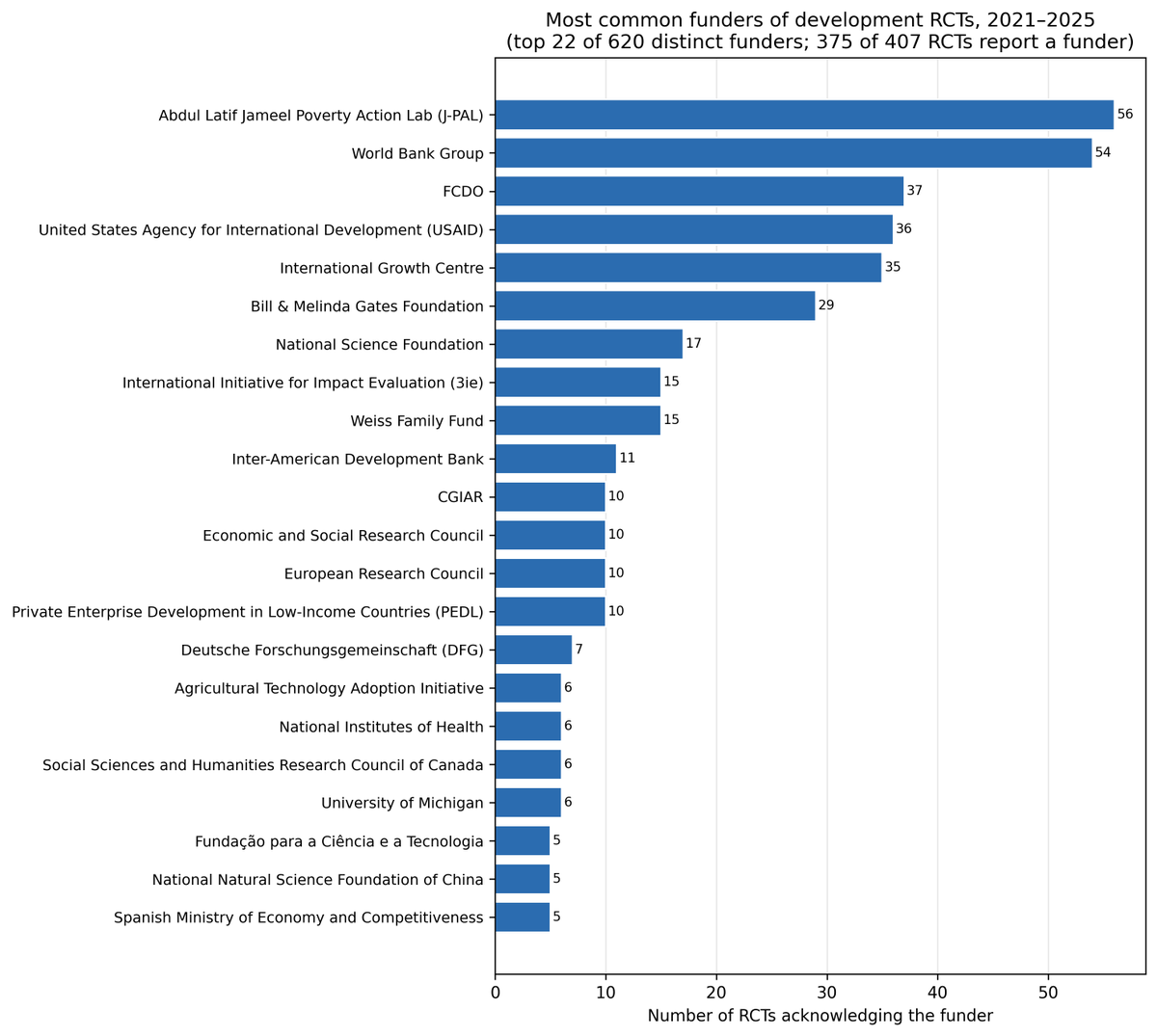
Here's the top 22 (given a 3-way tie at 20). Perhaps no big surprises, but J-PAL tops the list at 56 (aggregating across all J-PAL initiatives cited), followed by the World Bank and then FCDO and USAID nearly tied. USAID, of course, has disappeared.
Who funds development RCTs? Using my new database of dev papers 2021-2025, I pulled information from funding acknowledgments. (This requires, generally, full-text, and is not feasible using metadata; thus I did not do this for non-RCTs.) #econtwitter#econsky
The UN Beyond GDP Report presents a dashboard to evaluate nations. In conversation with Richard Quest I focus on a few salient indicators that all countries must measure, such as inequality-adjusted GDP, to ensure all GDP doesn’t end up in a few pockets.
Have you seen a better inroductory?
Solow (1956) :
𝑨𝒍𝒍 𝒕𝒉𝒆𝒐𝒓𝒚 𝒅𝒆𝒑𝒆𝒏𝒅𝒔 𝒐𝒏 𝒂𝒔𝒔𝒖𝒎𝒑𝒕𝒊𝒐𝒏𝒔 𝒘𝒉𝒊𝒄𝒉 𝒂𝒓𝒆 𝒏𝒐𝒕 𝒒𝒖𝒊𝒕𝒆 𝒕𝒓𝒖𝒆. 𝑻𝒉𝒂𝒕 𝒊𝒔 𝒘𝒉𝒂𝒕 𝒎𝒂𝒌𝒆𝒔 𝒊𝒕 𝒕𝒉𝒆𝒐𝒓𝒚.
Any other example? #EconTwitter
Una sociedad que obliga a una persona de 80 años a utilizar un smartphone para acceder a sus derechos no es una sociedad moderna.
Es una sociedad que poco a poco abandona a sus mayores
@umairjav@faraz_lhr A large population is an advantage. At least it provides a large internal market which can support industrialization though we need to invest in our human capital to leverage it and rise up the value chain - eventually.
Many weekends and a lot of blood, sweat and tears have gone into building an interactive district-level map of Pakistan's census and survey data. All open data from @PBSofficialpak. 🇵🇰
https://t.co/X3C2dMfXEP
@arxiv is recruiting a CEO who will lead the organization as it becomes an independent non-profit. This is an exciting opportunity to improve the infrastructure for open science! The job advert is here: https://t.co/kWIrEivCJP
I second this. I think studying ethics more seriously would make economists less likely to act as unreflective advocates and more aware of their underlying normative premises.
Once in a while @TheLancet publishes philosophy. this one by Sudhir Anand helps explain difference between health equity and health justice. and gives you a tour of some big contemporary philosophers.
[read it. save it.]
https://t.co/fXS0ddtSOR
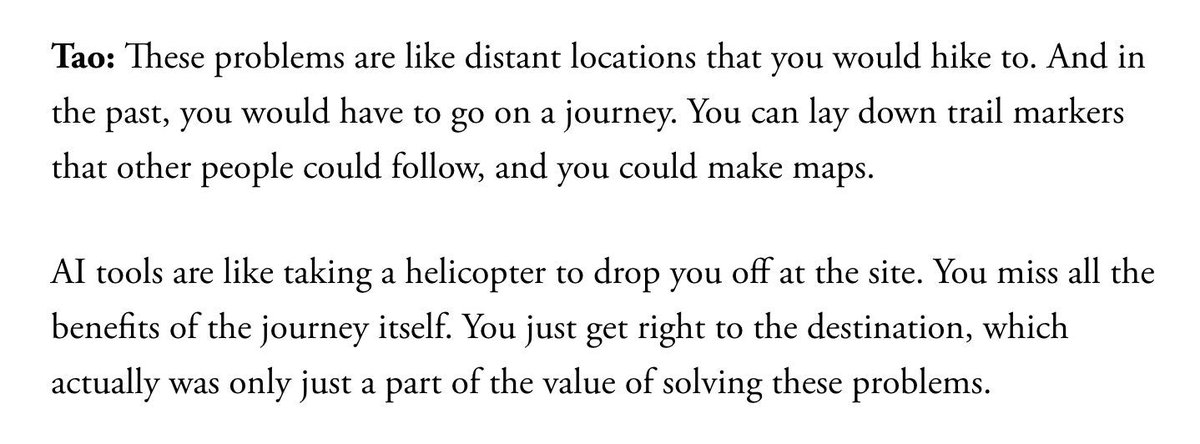
I love this metaphor from Terence Tao—widely considered the world’s greatest living mathematician—about one of the drawbacks of using AI to solve hard math problems. https://t.co/qOVNhfa2cC
@nadeemhaque Hence a gap of more than 4 years between Pakistan's Expected Years of Schooling and Learning-Adjusted Years of Schooling. 9.4 years of schooling, when adjusted for quality, is equivalent to 5.1 years of learning. https://t.co/fKQMIfLChk https://t.co/aKVox7h04v
A great new preprint on the importance of pilot studies for the validity of studies that are performed. Such an important tooic, that is discussed too little. I especially liked the section on the need for transparent reporting. https://t.co/VsUzOeQGJD By @YashvinSeetahul et al.







![sridhartweet's tweet photo. Once in a while @TheLancet publishes philosophy. this one by Sudhir Anand helps explain difference between health equity and health justice. and gives you a tour of some big contemporary philosophers.
[read it. save it.]
https://t.co/fXS0ddtSOR https://t.co/ad0E1FSa23](https://pbs.twimg.com/media/HCjv8LLawAI6gQ4.jpg)