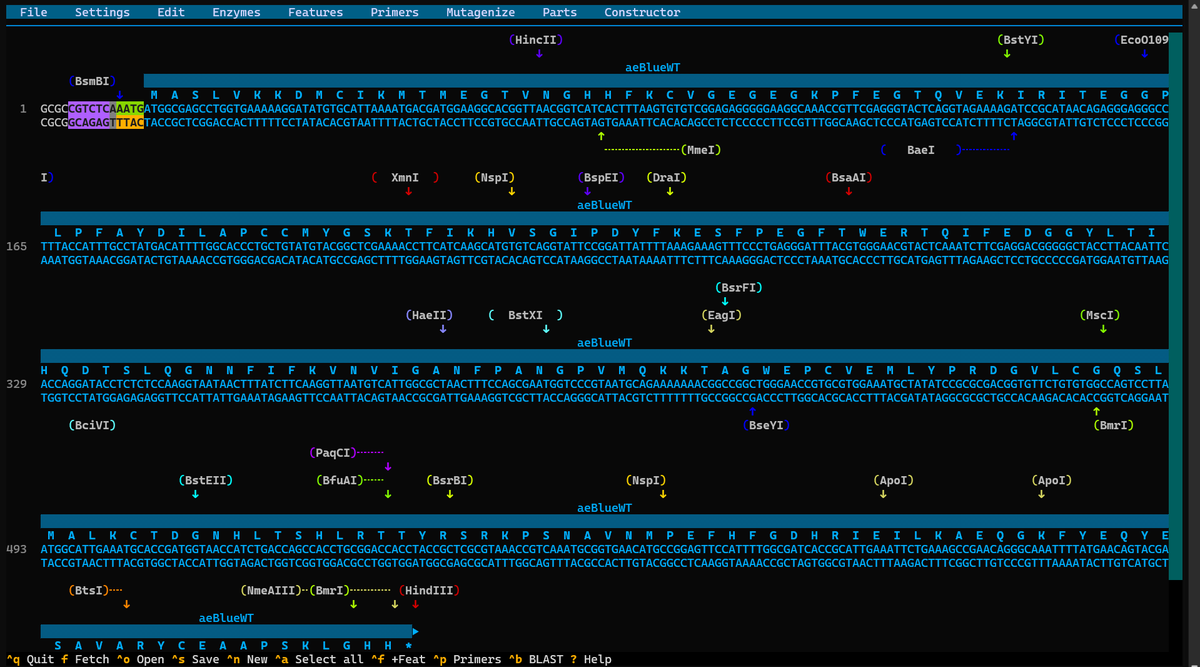
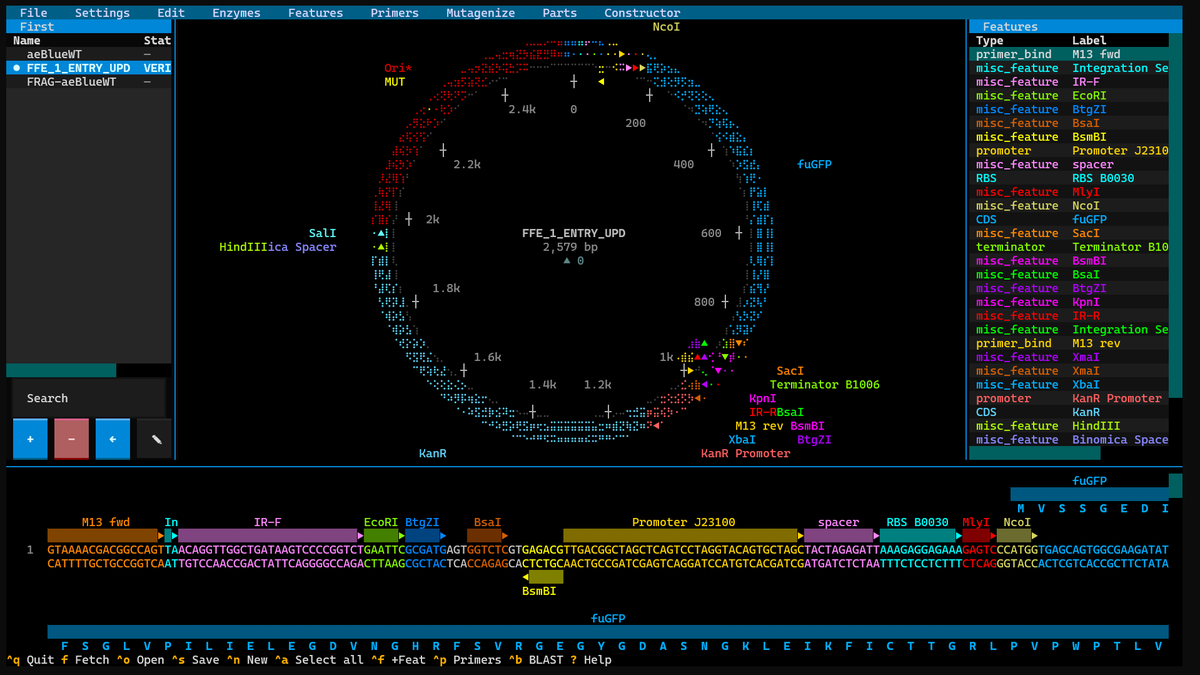
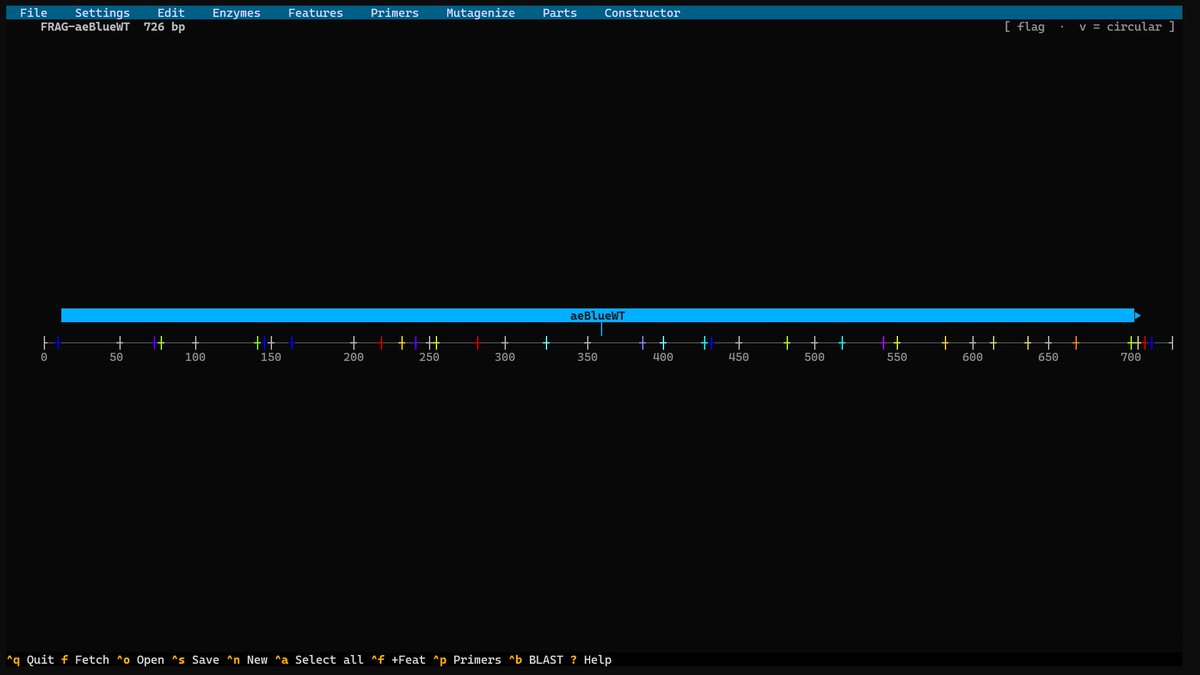
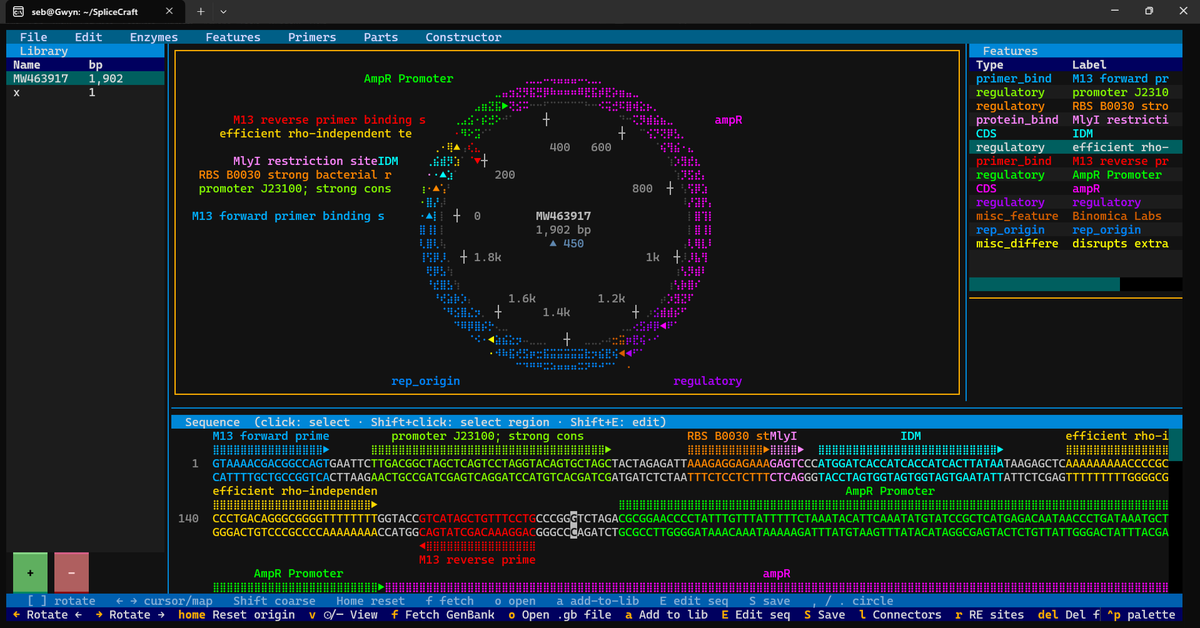
@Govindtwtt I solo'd a full DNA photoshop suite in terminal using vibecoding and I dont know python. Its over 100k lines of code and it works quite well. Took me 2 months of hard work and endless testing but i could not have done it without Ai
https://t.co/3mkWtVqa1T
SPLICECRAFT v1.0 IS LIVE!!!!!!!!!!!!
Open your terminal and type in "pipx install splicecraft" if you want to try it out, then spam "splicecraft update" often as I push updates frequently. A labor of love for the community I adore. Enjoy! 💚
There are simple equations that reveal a lot about biology.
For example, given the concentration of a molecule, one can quickly calculate the average spacing between those molecules in a cell.
The equation involves an assumption; namely, that a cell can be sliced into a cube, with one molecule sitting in the center of each box. Each box has a side length of d, and a volume of d × d × d, or d³.
Imagine zooming out of this hypothetical cell. The whole cell has a volume, V, and contains N molecules, which means it has N little boxes. So the total volume of the cell is given by the volume of one box times the number of boxes:
V = N × d³
Rearranging this equation, we get:
d³ = V / N
Now, the term N/V is just the same thing as density, or the number of molecules per unit volume. We can therefore flip it around and call it c, or "concentration." Rearranging once more, then, we get:
d³ = 1 / c, or equivalently, d = c^(-1/3)
This is a beautiful little equation!
Remember that c is the concentration of a molecule and d is the average spacing between those molecules. Now we can use this to figure out how tightly packed a particular molecule is within the cell.
Consider glutamate, which has a concentration of about 100 millimolar, or 0.1 moles per liter. Multiply by Avogadro's number and convert (1 cubic meter = 1,000 liters), and we get c = 6.022 × 10²⁵ m⁻³.
Finally, if we take the inverse cube root, we get d = 2.55 nanometers. So each molecule of glutamate sits, on average, about 2.55 nanometers from its neighbors, which is a distance smaller than the width of a typical protein.
It's fun to repeat this with other things, too. Try it for water, ATP, ribosomes, and so on. If you wanted to recreate a David Goodsell painting (see below), you could also use this equation to calculate how far apart each object in the painting ought to be!
Fun interactive science app ideas | Part 3
Played around with generating 3D biological structures and made an app to explore them interactively
UI Design
GPT Images 2
Code
Gemini 3.1 Pro
More demos ↓
The creator of Claude Code teaches more about vibe-coding in 30 minutes than most tutorials do in hours.
Save this - it'll change how you build forever.
Introducing Genie 3, a generative protein model that substantially advances the state-of-the-art for binder design, increasing in silico success rates by up to 20x on hard multimeric targets. It also debuts a form of inference-time scaling unobserved in other design models. 🧵1/8
This is actually shaping up to be a really aesthetically pleasing plasmid editor. Amazing what you can do without leaving the terminal. Love seeing the github say 100% Python. Looks like I'll be able to make the May 24th deadline after all!
What's New in Biology (May Edition)
1. The first gene therapy for deafness gets FDA approval.
2. A new oral drug for hair loss seems to actually work.
3. Big proteins fold faster than small ones.
4. Organoids can be used to make snake venom.
... and much more. With @salonium!
1/ Excited to share our new paper in Science: “Toward life with a 19-amino acid alphabet through generative artificial intelligence design.” @ColumbiaSysBio@ColumbiaBME@Columbia
https://t.co/ZT3Ygw9tiG 🦠🧬🛠️🖥️💥
Bacteria move around using a molecular machine called the flagellar motor that rotates faster than the flywheel of a race car engine and switches directions in an instant. After 50 yrs, scientists have finally figured out how it works. “My lifelong quest is now fulfilled.” Link⤵️
We made Caliby much easier to use! Try it out:
Colab notebook: https://t.co/4uwRnRV4Px
HuggingFace Spaces: https://t.co/3AOP0i5uTw
pip install it and use the Python API: https://t.co/dQlFM9eLGS
Makin a bunch more stability updates and bug fixes for my TUI plasmid editor. Currently workin on a pLannotate wrapper module so you can annotate plasmids imported where the author did not fully annotate all the features. I'll eventually try to pull plasmidsaurus seq results too
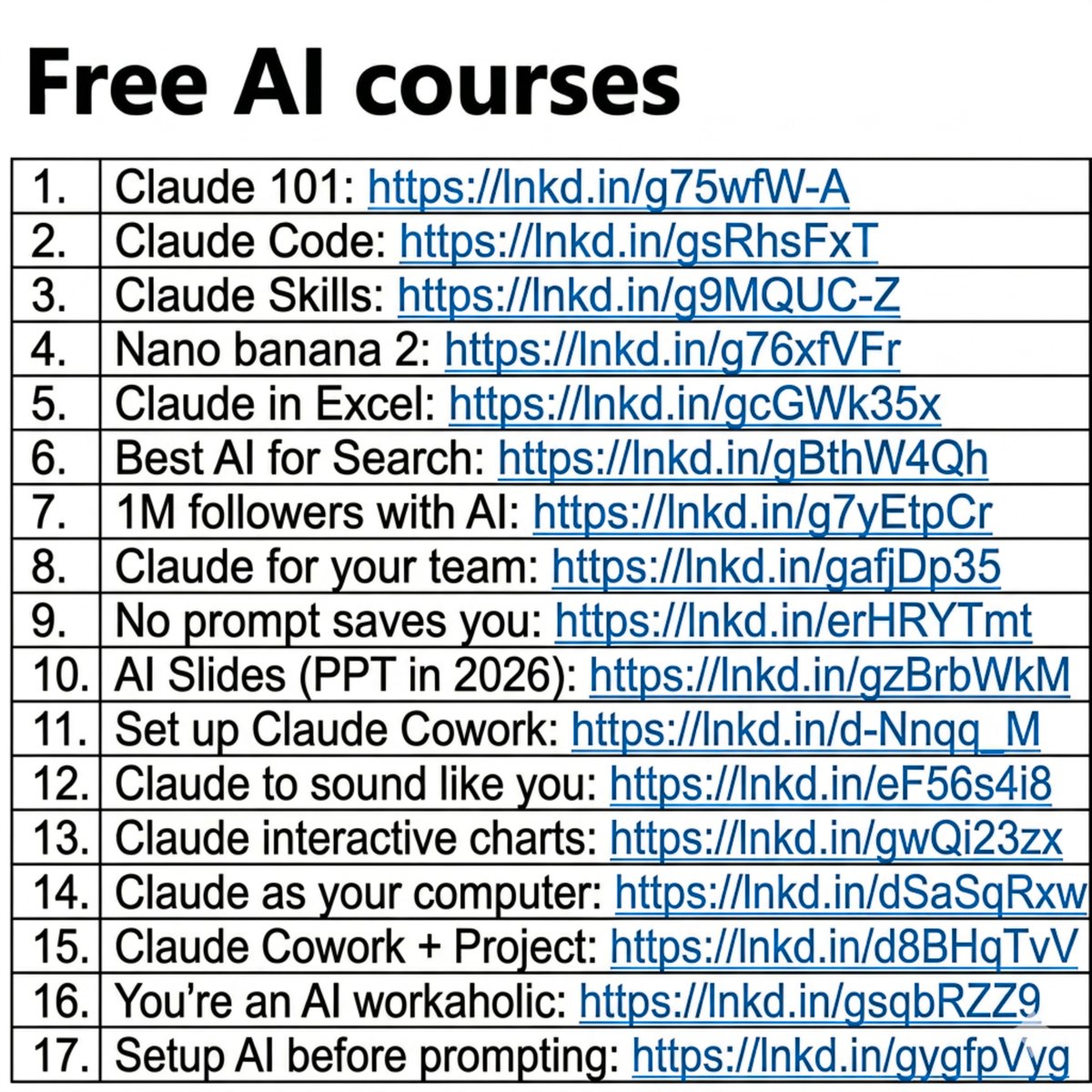
People think learning AI takes months.
It's really just a couple of hours.
And I wrote 17 free guides to start right away:
Claude 101: https://t.co/Jv1jsvFB7T
Claude Code: https://t.co/WYZd5ltnXo
Claude Skills: https://t.co/jT4uB5AFtY
Nano banana 2: https://t.co/qfHT594CCI
Claude in Excel: https://t.co/mfcXYSA57j
Best AI for Search: https://t.co/77BmjbJjP0
1M followers with AI: https://t.co/1TV9LYAptv
Claude for your team: https://t.co/U1JsBVC299
No prompt saves you: https://t.co/SDKJWykHE4
AI Slides (PPT in 2026): https://t.co/RfcyYRQ2Ad
Set up Claude Cowork: https://t.co/diDhiKjHtU
Claude to sound like you: https://t.co/99RzxXTvzs
Claude interactive charts: https://t.co/ebCHGZqgPt
Claude as your computer: https://t.co/TxYuHPiImn
Claude Cowork + Project: https://t.co/Q7AN9CZ2mg
You're an AI workaholic: https://t.co/mCIvB3ZPA5
Setup AI before prompting: https://t.co/pE3OF722aw
___
1. Save this list for later (three dots, top right).
2. Share it with a friend by ♻️ reposting this image.
3. Subscribe to my free newsletter: https://t.co/psB7XxAv8w.
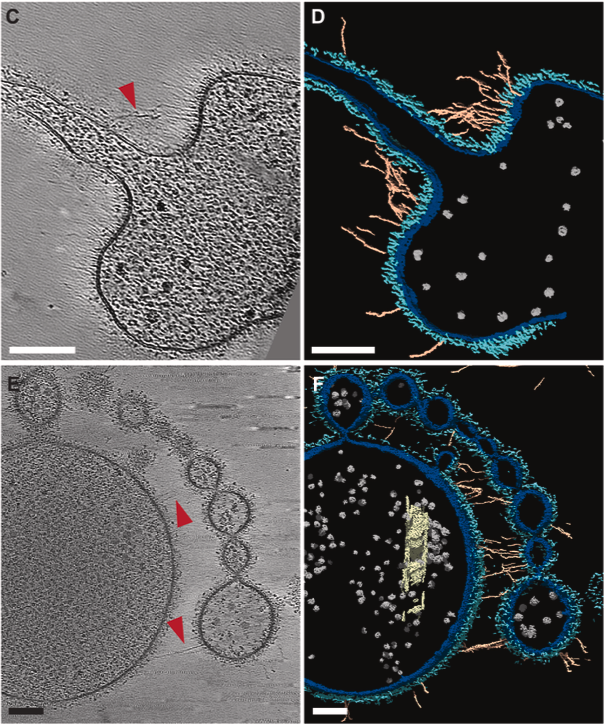
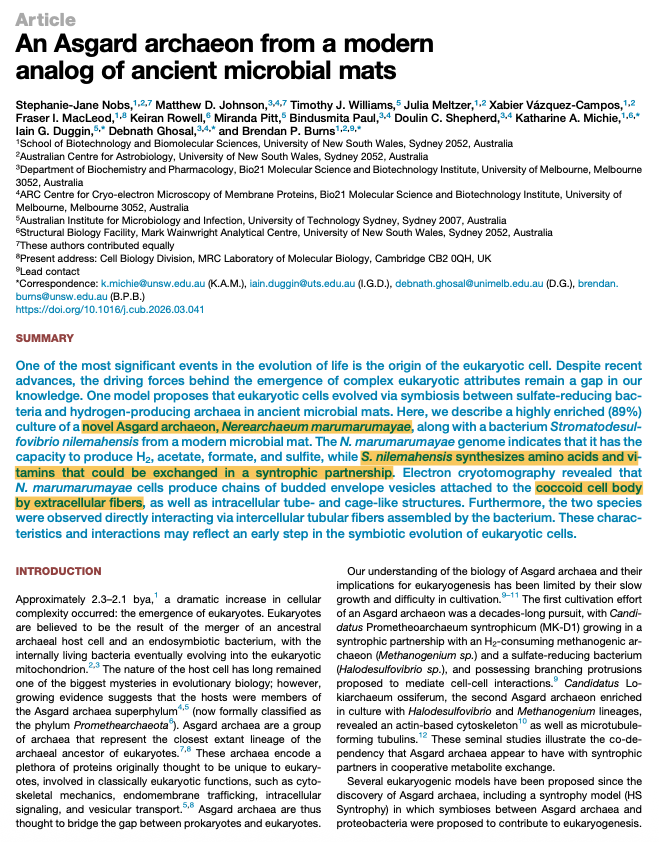
New Asgard paper dropped yesterday. This is only the third Asgard archaeon to be cultured in the laboratory (the first took 10+ years of work.)
Many microbiologists think that the Asgard archaea are the closest living relatives of the ancestor that gave rise to eukaryotic cells. They have cellular features that "bridge" bacterial and eukaryotic cells. And this new Asgard species, found off the coast of Western Australia, is interesting for a couple reasons:
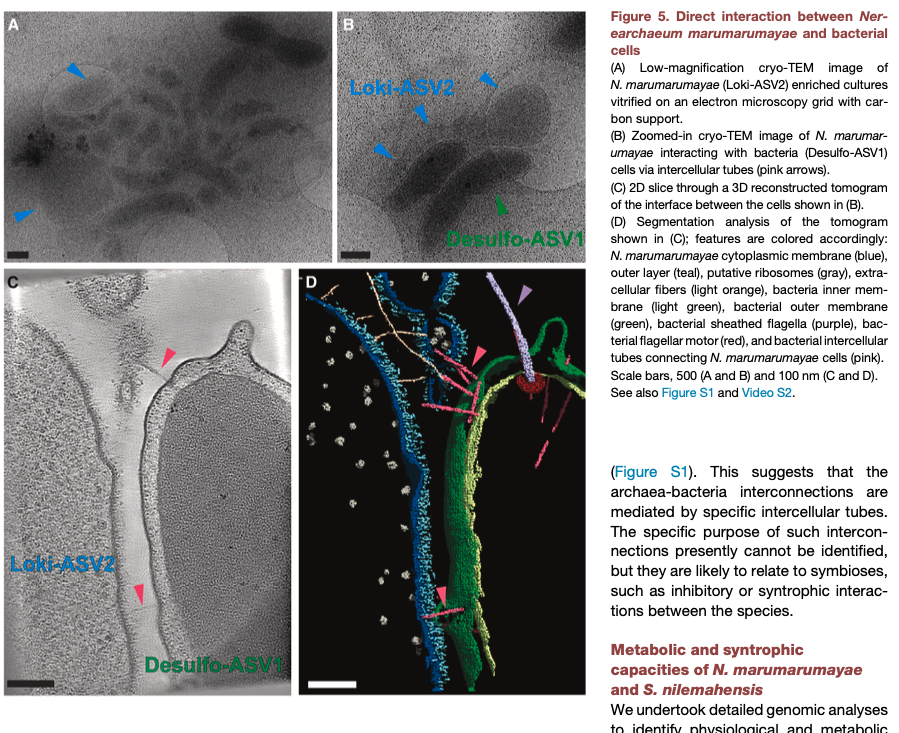
1. The Asgard buds off extracellular vesicles, like many other organisms. But these vesicles remain "tethered" to the main cell via a thin fiber. You can see this clearly in the cryotomography images below. I've never seen other examples of this (but maybe microbiologists on Twitter have.)
2. Asgards cannot be cultured on their own. All of the species cultured thus far can only be grown in the presence of a syntroph. This Asgard can only be cultured with a microbe, called S. nilemahensis. The Asgard makes acetate, formate, and lactate for the bacterium; the bacterium, in exchange, makes amino acids and vitamins for the Asgard. (The archaeon seems to entirely lack metabolic pathways for arginine, proline, phenylalanine, and tryptophan.) These nutrients are exchanged via hollow tubes that physically context the Asgard --> bacterium. (See the images below.)
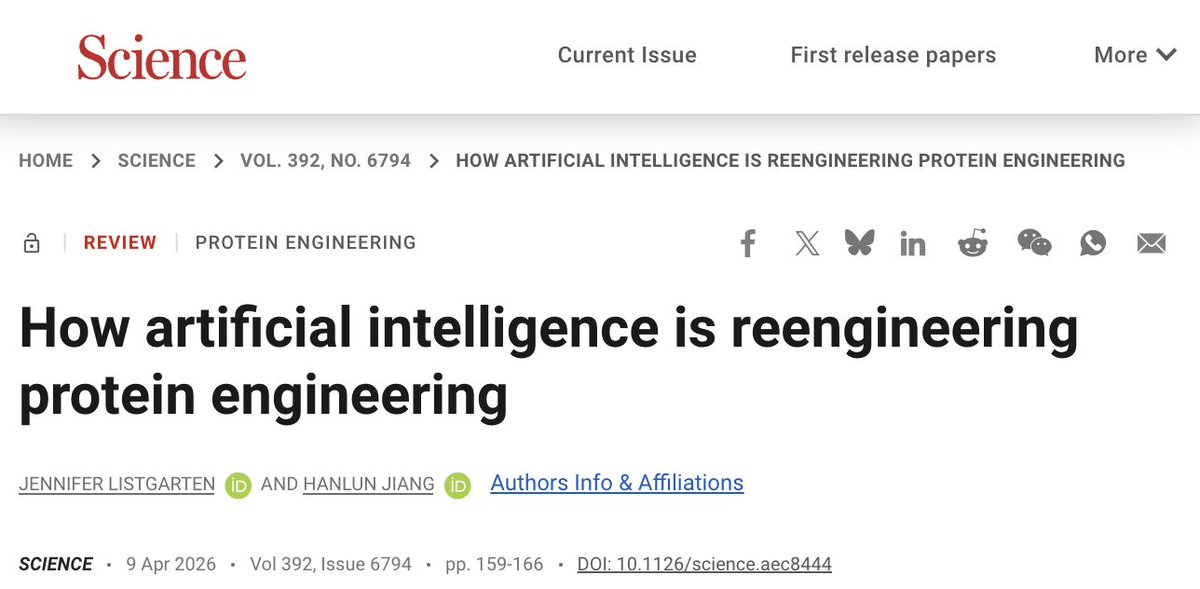
Our review on AI for protein engineering is out now, about this too-fast-moving field full of hype and overclaim, yet one that is having a real impact on the world and can be described in a coherent manner without histrionics
https://t.co/woOWuyTV5R