Four cities, four hidden details: Barcelona's Roman Wall; Paris's Arago medallions tracing the old meridian; Grand Central's tiled Whispering Gallery; and Florence's centuries-old wine windows. Explore the stories around you with Waonder—now on iOS and Android.
This house in Washington's Chinatown was once home to Mary Surratt, the first woman the US federal government ever executed.
Today 604 H Street is a narrow white rowhouse with a restaurant downstairs, a few doors from the Friendship Archway; a marker by the door says who lived upstairs.
Mary, a widow, ran it as a boarding house from 1864. Her son, John Surratt Jr., carried messages for the Confederacy, and through him John Wilkes Booth began visiting the house. In early 1865 Booth's men met here, Lewis Powell, David Herold and George Atzerodt among them, and their first plan was to kidnap President Lincoln.
On 14 April 1865, Booth shot Lincoln at Ford's Theatre instead, and that same night Lewis Powell forced his way into the home of Secretary of State William Seward and stabbed him. Seward survived. Earlier that day Mary had driven to her tavern in Maryland, and its tenant later testified that she told him to have the "shooting irons" ready.
Three nights later, on 17 April, while soldiers were in the house to arrest her, Powell knocked at the door. Asked if she knew him, Mary raised her right hand and said: "Before God, sir, I do not know this man." He had stayed in her house only weeks before. Both were arrested.
A military commission of army officers, not a jury, found her guilty. Five of the nine judges asked President Andrew Johnson for mercy because of her age and sex; accounts differ on whether he ever saw the request. On 7 July 1865 she was hanged at the Washington Arsenal, today Fort McNair, with Powell, Herold and Atzerodt. Historians still argue about how much she knew.
Her son fled abroad and was caught in Egypt in 1866. In 1867 he was tried before an ordinary jury, which could not agree, and he walked free. In 1870, in a public lecture, he admitted he had been part of the plot to kidnap Lincoln. He lived until 1916.
They say footsteps are still heard on the empty upper floors.
Surratt Boarding House, Chinatown · Washington, DC, United States
#waonder
@GhostsofDC Something most people walk right past: the little stable at 18th and C St NW is still there. Latrobe designed it around 1816 for Marcia Burnes Van Ness's mansion, and it's the last piece of that whole estate left standing. One of our favorite DC finds on Waonder.
In Rock Creek Cemetery, Washington, a man left his wife's grave without a name. Then he left her out of his life story.
Inside a ring of tall evergreens stands the Adams Memorial: a bronze figure wrapped in a hooded cloak, seated before a granite block that carries no inscription. No name, no date, no words.
The grave is for Marian Hooper Adams, called Clover, a gifted amateur portrait photographer. On 6 December 1885 she took her own life, at 42, in the house she and her husband, the historian Henry Adams, rented on Lafayette Square, across from the White House.
Henry asked the sculptor Augustus Saint-Gaudens for a figure, with a setting by the architect Stanford White. It was finished in 1891, and nothing was ever carved on the stone. After Mark Twain said it held all of human grief, newspapers called it Grief. Henry disliked the name.
Years later he wrote his autobiography, The Education of Henry Adams. It jumps from 1871 to 1892: twenty years, the whole of their marriage. Clover is not in it.
Eleanor Roosevelt began coming here in 1918, fifteen years before she became First Lady, after she learned of her husband Franklin's affair with Lucy Mercer, her social secretary. She sat on the granite bench facing the statue and found comfort there, in her hardest years.
Henry Adams died in 1918 and was buried beside Clover, under the same stone with no name.
She made portraits of everyone. Her own grave carries no name at all.
Adams Memorial, Rock Creek Cemetery · Washington, DC, United States
Help is available: in the US, the 988 Suicide & Crisis Lifeline answers by call or text.
#waonder
@visitlondon Highgate exists because London's churchyards were literally overflowing by the 1830s, so seven private cemeteries went up in a ring around the city. The Egyptian Avenue alone is worth the visit. Waonder lands in London soon and this one's high on our list.
St. Mark's Church in-the-Bowery · New York, United States
By morning, the grave at St. Mark's Church was empty.
On the night of 6 November 1878, thieves opened the churchyard vault of A. T. Stewart, the department-store millionaire and the richest merchant in New York. By morning his body was gone.
Letters signed with a false name demanded $250,000, and the thieves sent a piece of the coffin plate as proof.
Years later, his widow, Cornelia, paid about $20,000 to masked men, at night, on a lonely road in Westchester. She received a bag of bones. Nobody ever proved they were his, and the thieves were never caught.
She still built a cathedral for them: the Cathedral of the Incarnation in Garden City, Long Island, where the bones were laid. When she died, she was buried beside them.
St. Mark's stands where Peter Stuyvesant's own chapel stood, and the last Dutch governor of New Amsterdam has lain in the vault beneath it since 1672. They say his wooden leg can still be heard tapping across the cobbles on dark nights.
#waonder
US Capitol · Washington, DC, United States
Everyone knows the Capitol dome. Few know what walks beneath it.
Directly under the Rotunda is the Crypt: forty sandstone columns, low vaults, and a white star in the floor marking the centre of the city.
The story says a black cat prowls the Capitol's basement at night. It looks ordinary until you come closer. Then it grows, to the size of a tiger, some say an elephant, and vanishes.
The legend first appears in print in October 1898, in a newspaper feature on the Capitol's ghosts, with a watchman who was said to have fired at it.
The cats were real. The Capitol kept them to hunt rats, and in the 1890s the basements were full of them. And you can still see paw prints in the floor of the Small Senate Rotunda, near the Old Supreme Court Chamber, pressed into concrete laid after an 1898 gas explosion. Most likely, one of the Capitol's cats walked across it while it was wet.
Some people say that is what DC really stands for: Demon Cat.
They say it returns before national tragedies.
#waonder
Lafayette Square · Washington, DC, United States
Everyone knows the White House. Few know Lafayette Square, across the street.
It is a flat park of lawns and old trees, with Andrew Jackson on his rearing horse in the middle and the north front of the White House just beyond it.
On Sunday 27 February 1859, Philip Barton Key, the US Attorney for Washington and son of Francis Scott Key, walked around this square waving a white handkerchief. It was a signal to Teresa Sickles, the wife of Congressman Daniel Sickles, who lived in a house on its west side.
Sickles had received an anonymous letter about the affair. He came out into the square and shot Key several times. Key was unarmed. Bystanders carried him into the club house across the square, and he died there.
At the trial that April, Sickles's lawyers pleaded temporary insanity, often called the first time the defence was used in America. The jury acquitted him after about 70 minutes. Then he publicly forgave Teresa, and the city was more scandalised by that than by the killing.
Six years later, the same club house was the home of Secretary of State William Seward, where an assassin attacked him on the night Lincoln was shot. Both houses are gone now.
They say Key's ghost still walks the square, a white handkerchief in his hand. At dusk, you might pass him.
#waonder
Morris-Jumel Mansion · New York, United States
Have you seen the Morris-Jumel Mansion?
On its hill in Washington Heights stands a white Georgian house with tall columns, built in 1765: Manhattan's oldest surviving house. In the autumn of 1776 George Washington made it his headquarters, and his officers led their horses across this lawn.
On 1 July 1833, in the front parlour, the widow Eliza Jumel, one of the richest women in New York, married Aaron Burr. She was 58. He was 77, the former vice president who had killed Alexander Hamilton in a duel in 1804.
He spent her money freely, and within months they had separated. In July 1834 she sued him for divorce, and among her lawyers was Alexander Hamilton Jr., the son of the man Burr had shot.
The divorce became final on 14 September 1836, the day Burr died in a boarding house on Staten Island.
The story says Eliza never left. People say they have seen her on the balcony; in one well-known account, schoolchildren waiting on the lawn were hushed by an old woman there while the house was locked and empty.
The house is closed for restoration until later this year. The park around it is open.
#waonder
Parque da Alameda · Santiago de Compostela, Spain
Have you seen Federico García Lorca in Santiago de Compostela?
In the Alameda, the monument to Rosalía de Castro rises over its bed of red and yellow flowers. Across the gravel, on the old Santa Susana steps, Lorca's statue looks back at her.
He came to the city in 1932 with La Barraca, his travelling student theatre: a bare wooden stage set up in a stone square, and a crowd gathered to watch at dusk.
Three years later, Seis poemas galegos finished printing at Editorial Nós in Santiago, on 27 December 1935. Six poems in Galician, the only poetry he published in a language other than Spanish. Eduardo Blanco Amor arranged the collection; Ánxel Casal directed the press.
His Santiago poem opens with rain on the city: "Chove en Santiago." And in his poems he wishes to bring Rosalía a white camellia.
Today, Álvaro de la Vega's bronze of Lorca, in the blue overall La Barraca wore, walks down the steps facing her monument. A white camellia was planted beside them. Santiago Tourism describes the placement as a symbolic fulfilment of the wish in his poem.
#waonder
@Knowledgepoint Walked past those red piers once and never knew they were a nod to the old Blackfriars friars. London hides stories everywhere. Waonder is almost ready for London and the UK, and this is exactly the kind of thing we want people to discover.
@WarrenSkaalrud Love this kind of history. Funny how one short gap in a rail line ends up shaping a whole city. Is any of that 1888 extension still visible around Victoria today?
@andreas_nigbur Zurab Tsereteli's monument above the Tbilisi Sea! It was started in the 1980s and never fully finished, which somehow makes it feel even more otherworldly. It's places like this that make us want to tell every spot's story.
@tammycats What a perfect October series. Born in North Tarrytown before the 1996 rename is a great piece of local trivia on its own. Which story are you starting with, the Old Dutch Church or the bridge? Following along 👻
Castelo da Rocha Forte · Santiago de Compostela, Spain
Today the castle of Rocha Forte is a field of low granite foundations on the edge of Santiago de Compostela. In 1320 it was the archbishop's fortress: four round towers, a square keep, two moats and a drawbridge gate.
Santiago had refused to accept its new archbishop. Pope John XXII appointed the French Dominican Berenguel de Landoira in 1317, but the city's leaders kept him outside its walls, and Rocha Forte became his base.
Three years into the struggle, Afonso Suárez de Deza and eleven other city leaders crossed the drawbridge for peace talks. A hall was set for them inside.
On 16 September 1320, the gate closed behind them and the archbishop's men killed all twelve. The official Rocha Forte interpretation project records the meeting as the event that broke the city's resistance.
Santiago opened its gates to Berenguel. The castle was destroyed in the Irmandiño revolt in the fifteenth century, and only its foundations remain.
Images generated with AI. The castle is a reconstruction, not a record of its exact appearance.
#waonder
I Wanna Travel
New York. Jefferson Market Library in Greenwich Village, a Victorian Gothic courthouse that became a public library.
Washington. The Main Reading Room of the Library of Congress, under its coffered dome.
Miami. The Venetian Pool in Coral Gables, a swimming pool carved out of an old coral rock quarry.
Lisbon. The Carmo Convent, its Gothic arches open to the sky since the earthquake of 1755.
Lyon. A traboule in Vieux Lyon, a passage through the buildings into a Renaissance courtyard.
Barcelona. The whole city from the slopes of Tibidabo, down to the sea.
San Francisco. The Golden Gate Bridge from the air.
Every city keeps places like these, a step off the postcard. One companion that knows them all.
Waonder, on iOS and Android.
Images generated with AI.
#waonder #iwannatravel
Praza da Quintana · Santiago de Compostela, Spain
Every night, a pilgrim appears on the wall of Santiago Cathedral.
A broad hat. A long cloak. He stands at the foot of the clock tower, just before the Holy Door, in the square where so many journeys end.
Local tradition knows who he is. A priest planned to escape with a nun from San Paio, the convent across the square. He came disguised as a pilgrim and waited in this corner. She never came.
At dawn, when the lamp goes out, he is gone.
He is a shadow. A streetlight in the corner throws the stone column that holds the cathedral's lightning-rod cable onto the wall, and the column's cap becomes his hat.
Stone and lamplight make the pilgrim. The city gives him someone to wait for.
https://t.co/XqMa7tiVYU
#waonder
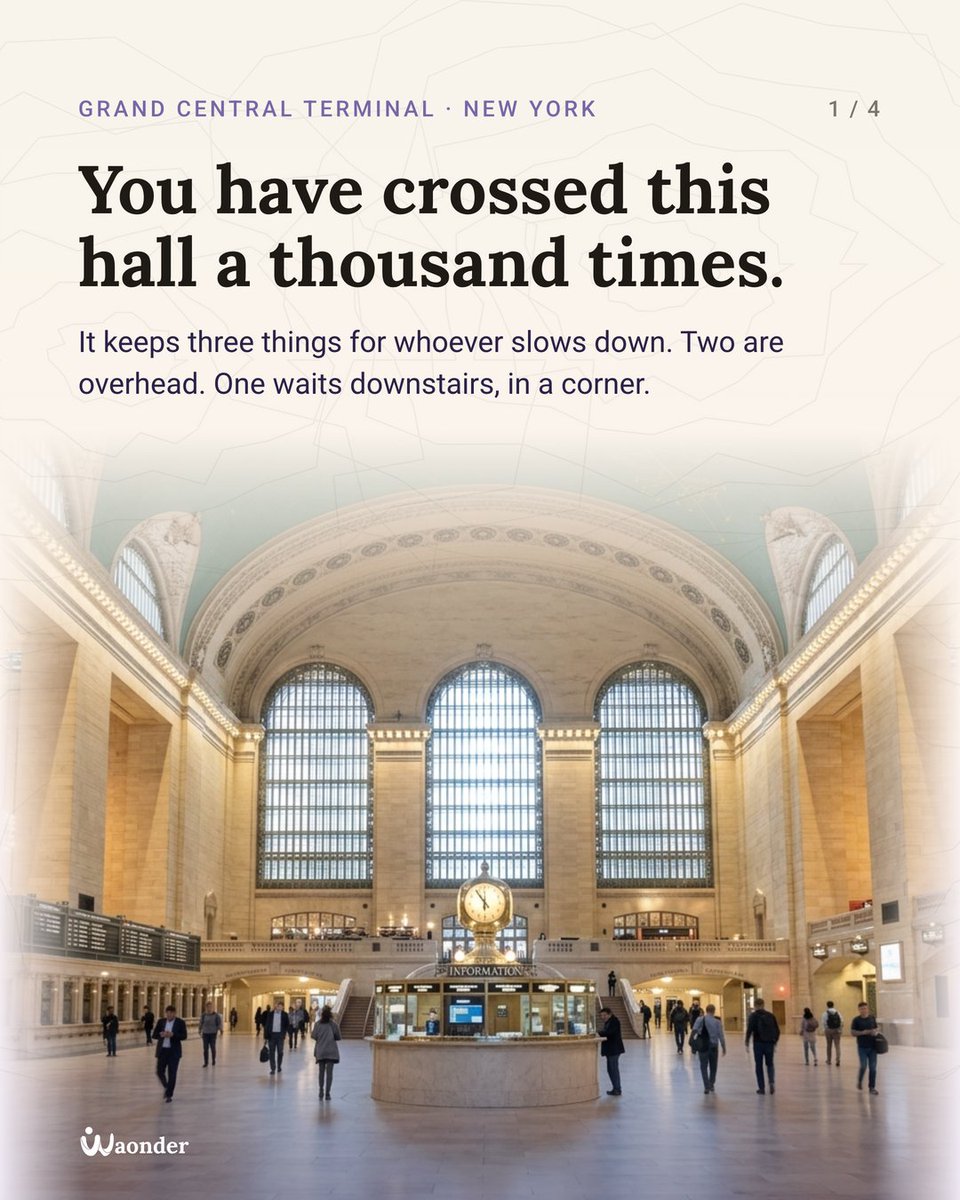
You have crossed Grand Central a thousand times.
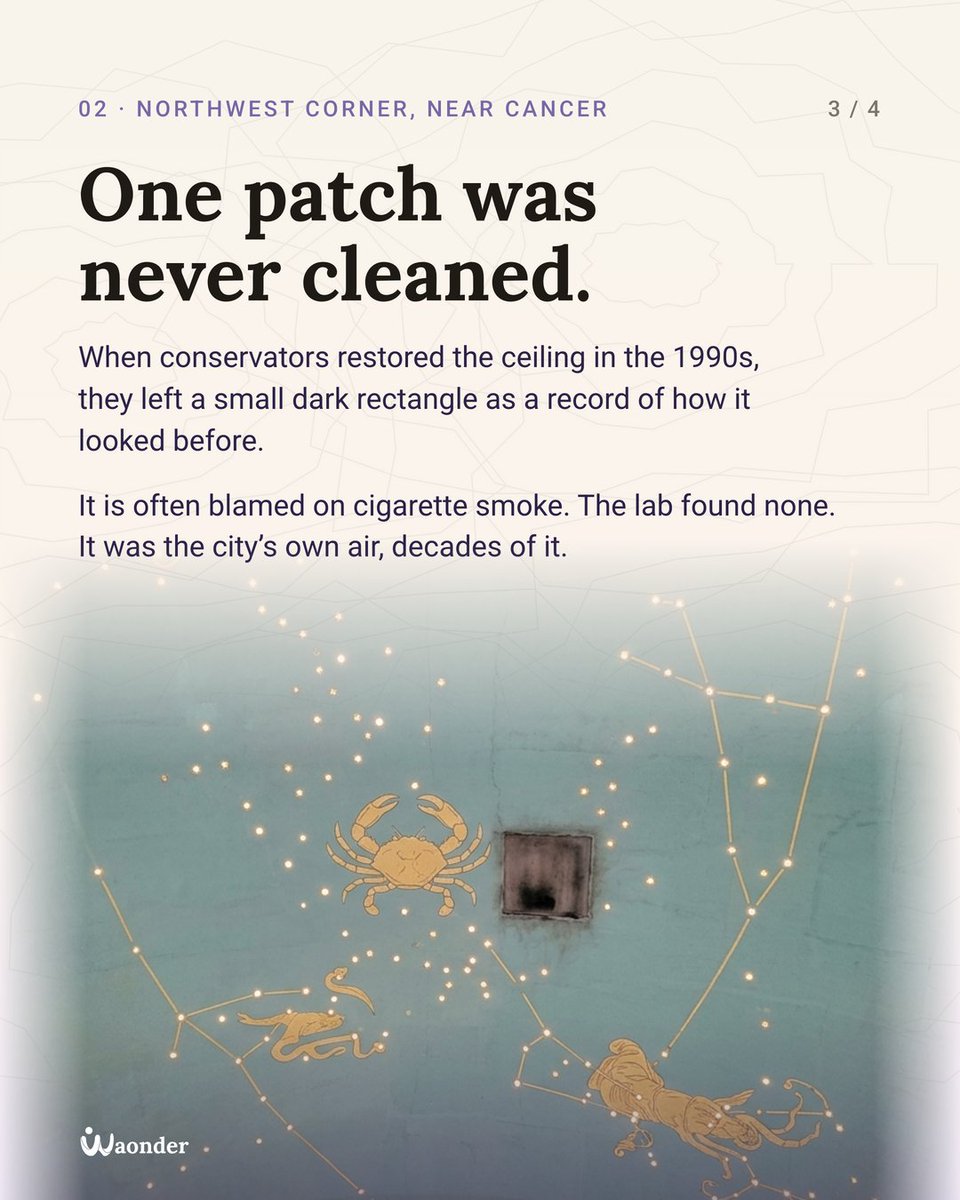
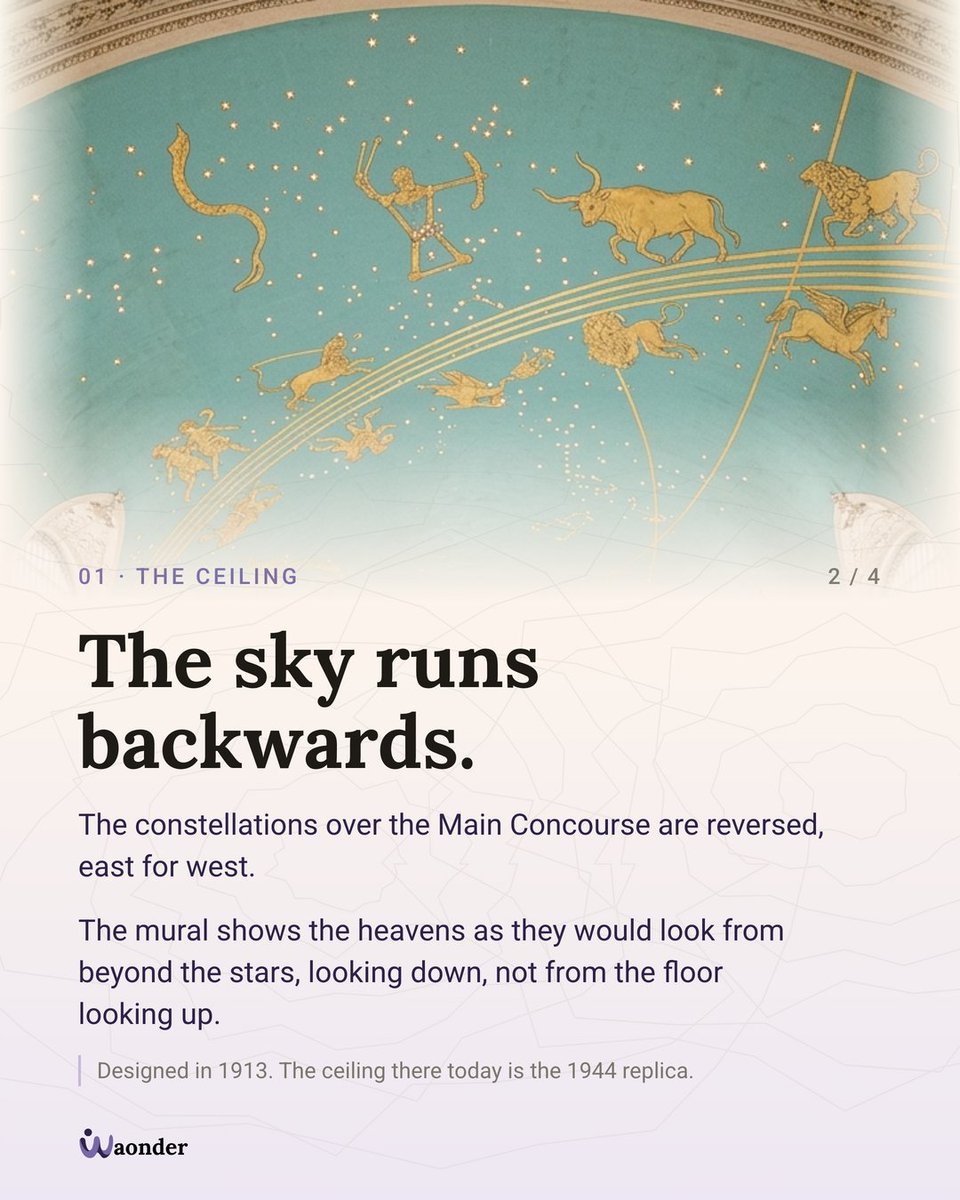
The sky on the ceiling runs backwards. One dark patch was left uncleaned on purpose, and it was never cigarette smoke. Downstairs, the corners by the Oyster Bar carry a whisper across the passage.
The places you pass every day are still speaking.
#GrandCentral #NYC