@WarFrontsWeekly Message I just sent to husband when I subscribed to https://t.co/DaPgMhISEY …
“https://t.co/DaPgMhISEY has been the most informative source for global conflicts. I drop almost anything I’m watching for their content.”
In St. Petersburg, participants are rushing to the opening of the 4-day economic forum, which will be attended by representatives of several countries, and where Putin is also scheduled to speak. They’re probably deciding right now whether to send a body double instead?
The main theme of the forum is "Pragmatic dialogue - the path to a stable future."
Well, they’ll certainly have plenty to discuss.
The truth is that US nuclear deterrence in Europe is less credible with a significantly smaller US conventional footprint in Europe. Nuclear deterrence is more effective when there are more credible options below the nuclear threshold; loss of US deep strike esp concerning.
My article about the Ukrainian middle strike campaign is now public (and it isn't behind a paywall) on the @WarFrontsWeekly website
https://t.co/H2MGPnLmbz
NEW | Islamic Revolutionary Guards Corps (IRGC)-affiliated media reported that Iran has suspended negotiations with the United States, purportedly in response to Israeli operations in Lebanon. This announcement comes days after US President Donald Trump
introduced tougher terms for a US-Iran agreement, which presumably played a role in the Iranian regime’s decision to halt negotiations.
The Israel Defense Forces (IDF) has expanded its ground operations against Hezbollah in southern Lebanon in recent days, including by seizing the operationally significant Beaufort Castle on May 31. Israeli Prime Minister Benjamin Netanyahu has also ordered the IDF to conduct strikes against Hezbollah targets in Beirut’s southern suburbs.
Unspecified sources told Axios that Israel is seeking US approval to conduct “massive strikes” against Hezbollah targets in Beirut.
IRGC-affiliated media claimed that Iran intends to “completely block” the Strait of Hormuz and could activate “other fronts” with the Axis of Resistance, including the Bab el Mandeb Strait, in response to the IDF’s operations in Lebanon.
Iran’s decision to suspend negotiations comes after President Trump requested several amendments to the draft US-Iran memorandum of understanding, particularly related to Iran’s highly enriched uranium and the Strait of Hormuz. A source with knowledge of the negotiations told CBS News that Trump’s amendments are “somewhat significant changes.”
Iran’s decision to suspend negotiations with the United States also comes as Iran and the United States have continued to exchange fire around the Persian Gulf. US forces struck Iranian radar and drone sites over the weekend in response to Iran shooting down a US MQ-1 drone that was operating over international waters.
US forces also shot down two Iranian drones that threatened ships transiting regional waters. Iran has repeatedly used force, including attacks on commercial vessels, to force vessels to comply with Iranian transit protocols and use Iran’s illegal and unrecognized traffic separation scheme.
Iran responded to the US self-defense strikes by launching ballistic missiles at US forces in Kuwait. US forces intercepted the missiles. Iran similarly attacked US forces in Kuwait after the United States intercepted Iranian drones and struck an Iranian drone launch site last week.
My latest!
From the Maghreb to the Sahel, and from the Lake Chad basin, Central Africa and Horn of Africa, jihadist violence is surging across rural and urban areas.
However, despite their growing reach, jihadist groups in Africa have been unable to replicate the kind of territorial consolidation achieved by Hay’at Tahrir al-Sham (HTS) in Syria.
“The local contexts (of African Jihadist groups) are all incredibly different,” says @liam_karr Liam Karr, Africa team lead at Critical Threat Projects. “Group size, group history, the characteristics of the governments they’re fighting and the countries they’re operating in, the local ethnic dimensions,” he tells The Africa Report.
Most African jihadist groups still rely mainly on violence and intimidation to hold territory, expand influence and have been unable to moderate their image. Experts say their affiliations with global jihadist movement contributes to this inability to replicate the success of HTS.
https://t.co/86FGTuqCC4
——Pius Adeleye
“Neutrality as Vulnerability: Russia’s Hybrid Playbook in Moldova”
🇲🇩 Moldova’s neutrality clause is one that Russian hybrid tactics exploit. Yes, writes Thomas Austin Thompson (@georgetownsfs) in this republished @IrregWarfare piece, public opinion for it remains high– but leadership must “expand its definition of neutrality to proportionally address these threats.”
What does that mean? Expand collaboration with democratic partners and further integrate with their defenses.
Read to see how.
#Moldova #russian_propaganda #HybridWarfare #RepublicOfMoldova #Chisinau #Kishinev #SWJxIWI #SWJEssay
https://t.co/GvwbjsEOuM
There's a reason our @WarFrontsWeekly team has been beating the drum on Putin's incentives to escalate.
https://t.co/2hexXdubGl
Here's an extended explanation, with Simon in conversation alongside Ukrainian strategic advisor Illya Sekirin:
https://t.co/Gdrpzk0wj7
Normalization is not in the table, despite president Trump ambitions
There is no greater strategic prize in the Middle East than normalization between Israel and the Arab world. But President Trump’s apparent insistence on pursuing normalization without recognizing that it is politically impossible absent meaningful progress on the Palestinian issue alongside proposals to somehow integrate Iran into a broader regional framework, reflects a deep misunderstanding of the region’s political realities.
Senior officials in Washington need to internalize a basic fact: the Iranian regime will never participate in any regional architecture tied to reconciliation with Israel. Iran’s revolutionary identity and regional strategy are fundamentally built around opposition to Israel’s existence and influence. That is not a tactical position subject to diplomatic flexibility; it is a core ideological pillar of the regime.
At the same time, the remaining Arab states that have not normalized relations with Israel are closely watching Saudi Arabia. And Riyadh has made clear, both publicly and privately, that it cannot seriously return to the normalization track without a significant shift in Israeli policy toward the Palestinians.
The deeper problem, however, goes beyond diplomacy. What increasingly emerges from discussions in Washington is a fundamental misunderstanding of the drivers of the conflict between Israel, the Arab world, and Iran. That misunderstanding risks undermining future efforts to achieve the very normalization the administration seeks.
Normalization does not emerge in a political vacuum. It cannot be manufactured through anti-Iran coalitions alone while bypassing the Palestinian issue altogether. The assumption, dominant in parts of the Israeli government for years, that regional states would permanently set aside the Palestinian question in favor of shared concerns over Iran has now reached its limits.
If Washington genuinely seeks a historic Israeli-Saudi normalization agreement, then addressing the Palestinian issue is not a secondary matter; it is the central prerequisite. There is no realistic alternative route.
And Iran? Tehran will remain outside any regional framework connected to Israeli integration, regardless of who governs in Washington or how attractive the diplomatic incentives may appear.
#IranWar
#iran
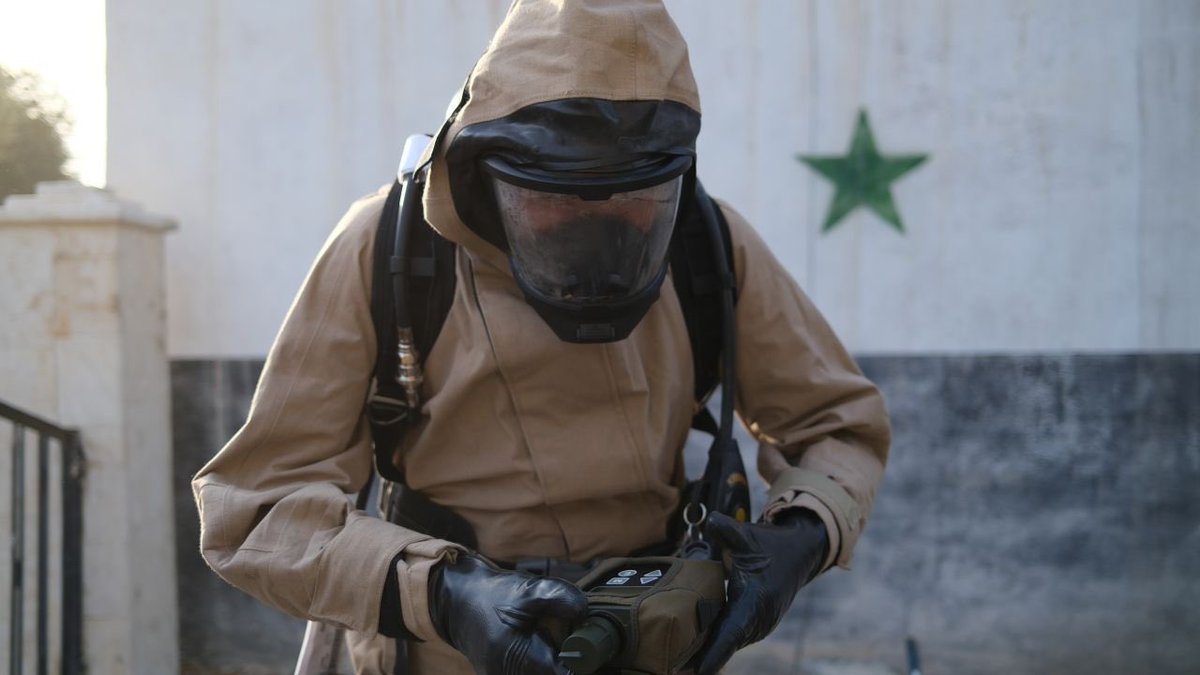
Syria’s transitional government has located remnants of the clandestine chemical weapons program operated under Former Syrian President Bashar al-Assad, including raw materials and munitions similar to those used to carry out deadly gas attacks, killing over a thousand and injuring tens of thousands, during the Syria Civil War, according to Reuters.
Syrian teams, working with inspectors from the Organization for the Prohibition of Chemical Weapons (OPCW), have located more than 70 rockets and aerial bombs, as well as raw ingredients for the production of the nerve agent Sarin. While Syrian authorities have taken into custody 18 suspects for alleged involvement in Assad’s chemical weapons program, including high-level military, political and technical officials previously serving in the Syrian Arab Army.
❗️Reuters reports NATO is forming 3 divisions with 60,000 troops and strengthening rapid deployment systems on its eastern flank. The plan focuses on reinforcing the Baltic region, including Estonia and Latvia, while raising readiness for rapid response to potential threats from Russia. #NATO
Spiegel reports that the U.S. plans to significantly reduce military contributions for NATO allies in a crisis, including fighter jets, warships, mid-air refuelling aircraft, and drones.
The U.S. will only provide half the previous number of strategic bombers, reduce the number of U.S. Air Force fighter jets by a third, make fewer destroyers available and no longer provide any submarines to NATO.
The U.S. also plans to scale back the provision of armed drone models, and force Europe to provide its own reconnaissance drones.
For the Gulf states, 2026 was the wake-up call of a lifetime.
WarFronts lays out the Gulf's roadmap to rearmament, military redesign, and meaningful sovereign deterrence against Iran, Yemen's Houthis, Iraq's militias, and eventually, each other.
https://t.co/Jryi3Rr3W0
My first contribution to @WarFrontsWeekly was released yesterday, it gives an overview on the Malian conflict and its key players, be sure to give it a read!
https://t.co/tretkLQXeq
My latest for @WarFrontsWeekly analyses the depths of what happened over a week ago in Nigeria, where the US and Nigerian forces targeted a key Islamic State operative Mainuki (paywalled).
https://t.co/tGY37yySlB
I would strongly suggest going back and looking at the actual U.S. intelligence assessments, which repeatedly concluded that Iran was not on the verge of acquiring a nuclear weapon.
More importantly, even Israel itself did not publicly claim that Khamenei had made the decision to build a bomb. That is not my argument, it was the assessment of the American intelligence community.
And that is before even getting into the significance of the fatwa and a range of other factors that simply do not align with the claim that Iran was actively rushing toward weaponization.
Since we are already exchanging recommendations and lectures, I would also suggest focusing less on facilities destroyed twenty years ago as the primary basis for determining whether Iran is “close” to a bomb.
Here is an uncomfortable reality: if Iran actually decided to pursue weaponization, many of the facilities currently being monitored by you would likely become irrelevant to the process.
And if I may add one more point, there are limits to the strategic conclusions one can draw solely from satellite imagery. A little humility would go a long way.