warcope is live
2026 africa vs 1939 europe, simulated one day at a time in your browser. free, no account, no install.
pick a scenario and a seed, give orders or let the AI run both sides, then watch ports, shipping and spare parts decide what your take was actually worth. every battle shows its numbers and the sources are right there in the game.
my first baseline run, seed 7: by day 153 europe holds 15% of africa's homeland and there's a massive fight at suez. run yours and post the receipts
building in public: held versus usable
an equipment count is only where a simulation input starts. in the 13 oct research, each record splits into three layers, and each layer keeps its own provenance.
held: the quantity a source reports, with its date and whether we copied it directly or derived it.
available: the share the model treats as serviceable and assigned to this war. that part is our estimate, and it stays labeled as one even when the held count is direct.
effective: what each platform adds in a fight, like role, range, weapon family and tier weight. we authored those in the 14 oct capability rules, and none of them are measured.
one place you can see it: a damaged vehicle that can be repaired stays in the held count but drops out of the usable force until repair work and local spare parts bring it back.
which of the three should the game explain better on screen? reply below
inside the simulation: the trip home still counts
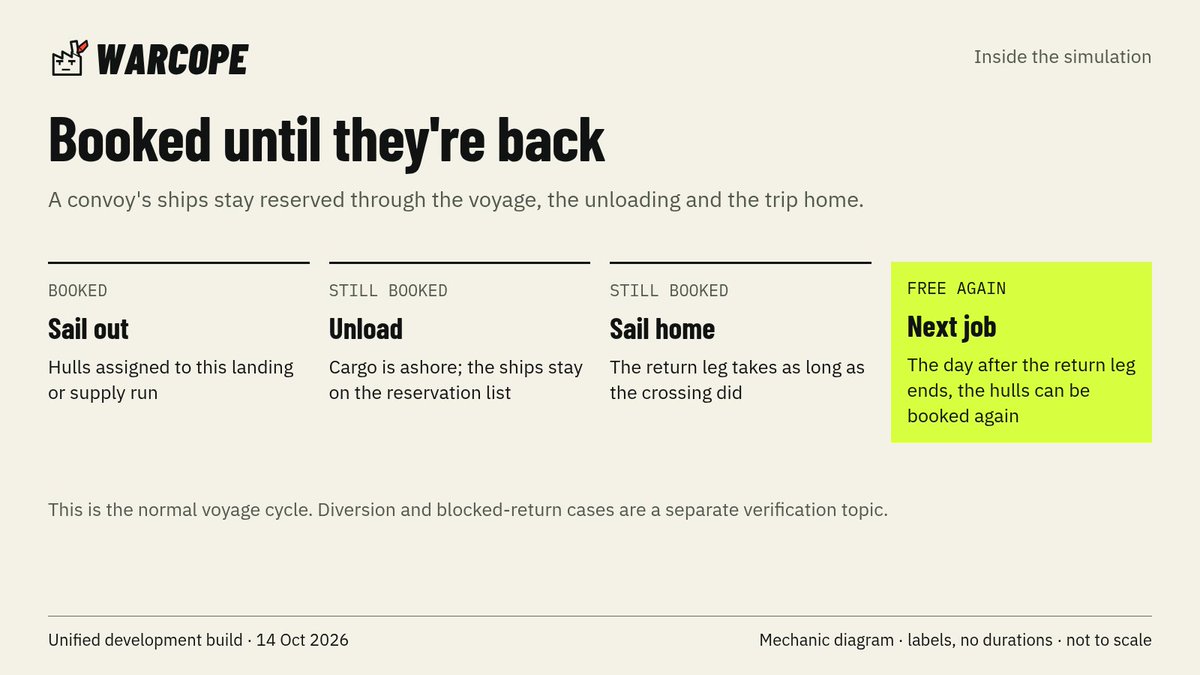
when a convoy unloads, its ships stay booked while they sail home, and the return leg takes as long as the crossing did. the day after it ends, those hulls are free for the next landing or supply run.
troop landings and supply convoys work the same way here, since they draw on the same ships.
what you'll see: right after a big landing, the next formation at that crossing can sit at "awaiting sea lift" even though no ships were lost. they're still on their way back.
the diagram is the normal voyage cycle, labels and no durations. diverted and blocked returns are a separate case we're still checking. rules from the 14 oct development snapshot.
would you hold a landing back to keep ships free for supplies, or send it and let the supplies wait?
@rivo075 the atlantic does most of the work there. 1939 europe would have to ship and supply a whole invasion force across an ocean just to reach brazil's coast
@QuattroMKII@CertifiedOberst fair, and 1939 europe has to pass that check too. germany's synthetic fuel plants covered only part of its oil needs in 1939, the rest was imported. we built a free sim of this matchup at https://t.co/QfIJLyv1Bn if you want to run the check yourself
The casualty total hid the part I needed to inspect.
At day 365, captures made up 77.1% of Europe's combined unavailable total across 100 baseline AI runs.
Look at the lime section. What does your seed's breakdown look like?
building in public: one gap, up close
the 14 oct evidence audit had a lot of empty cells. here's one of them: army trucks and other support vehicles.
we searched for country-by-country counts of military lorries and transport. for 2026 africa we found nothing usable. for 1939 europe we only found unsourced secondary figures for germany that disagree with each other. in the end the support category had records for just two countries on each side.
so we left those holdings marked unknown and switched the rule that ties supply to support vehicles per soldier to neutral for both blocs, with a note in the campaign saying so. for a player, that means truck counts gave neither side a supply edge in those rules, since nobody had a defensible number.
got a dated source for army trucks on either side, with country and scope? drop it below
@Gorchove@AirACE1918@grok rubber is probably the first wall. natural rubber came by ship from malaya, the east indies and places like liberia, and germany's buna synthetic plants were still small in 1939, so tyres and seals get rationed early in a cut-off europe
@Ragki5@martianwyrdlord yeah - https://t.co/QfIJLyv1Bn is a free browser sim of exactly that matchup, 2026 africa vs 1939 europe day by day. suez is usually where the fight jams; feeding armies through that canal decides how much either side can push past the coast.
@RipWinkle31459 africa opens that war already knowing 1939 europe's hqs, airfields and plant locations from the historical record. europe has no matching picture of africa's forces. that intel gap shapes the first months hard.
@FleetOfOceans streaming that debate is brave. free browser sim of the same matchup at https://t.co/QfIJLyv1Bn if you want something concrete to poke at live. open question worth pinning for chat: what counts as a win, holding africa or taking europe?
@danishvaunt made a free browser sim of exactly this matchup, and most of 1939 europe's losses across 100 runs are cut-off armies surrendering in bulk. curious which side your rant lands on, it's at https://t.co/QfIJLyv1Bn
inside the simulation: big formations cross in echelons
when a formation needs more berths than the free ships at a crossing can give, the share that fits can sail first as a forward echelon, with its own id and a parent tag pointing back to the original.
the echelon takes that share of every equipment cohort, plus the same share of stores, ammunition and damage. the rest stays at the port as the original formation, smaller and still able to fight there, with a note saying how many have sailed and how many wait for the ships to return. when the parts meet in one region again, they rejoin.
there's a floor: each part needs at least 1,000 personnel, so a formation too small to split waits until there's room for all of it.
what you'll see: a landing arriving in waves while part of the formation is still on the near shore.
rules from the 14 oct development snapshot. the diagram is the normal voyage cycle, not to scale.
if ships ran short, which formation would you send over first?
@localidiot_REAL fair, the uranium is there. south africa's program needed years of enrichment work before its first device, so a united africa would be holding out for several years of war first
building in public: when a number is missing
to a simulation, a blank cell and a real zero look the same. if a country has no source for its artillery, the lazy move is to read that as no artillery, and then every battle runs against holes nobody chose.
on 14 oct we gave every country/category cell one of five evidence states: observed, confirmed zero, bounded estimate, unknown, not applicable. a zero only goes in when a source confirms it. unknown stays marked unknown, and we don't plug it with a made-up figure.
one place the gap hurt us: the research had no recruitable population for either side, so that blank acted as zero and neither bloc could replace losses after the first months. the next ruleset swapped it for an explicit, labeled educated guess.
know a missing category worth digging into? reply with the country and the category
@51bard we built one of those: https://t.co/QfIJLyv1Bn runs 2026 africa vs 1939 europe day by day in the browser, free. across 100 runs we did, 1939 europe never got past the north african coast