“During spring ball, we were in a scrimmage, and I happen to be standing next to LaVell. So, we started talking and he said, ‘Now, you are Mike’s brother, right?’”
Mike Lewis was Chad’s older brother who had just finished his career at Utah.
“Yeah, I’m Mike’s brother,” Lewis said.
“Jim Fassel, when he got fired (at Utah), told me to look out for you,” Edwards continued. “He said that ‘Mike’s brother was a great athlete. Keep your eye on this kid. I think he’s going to be a great player.’”
Edwards turned and looked at Chad.
“Shows you what a lousy recruiter I am.”
They both laughed.
A couple of months later, Edwards called Lewis into his office and offered him a full scholarship. Lewis vowed to never let him down. He finished his BYU career as an All-American and played nine seasons in the NFL and was named to the Pro Bowl in 2000, 2001 and 2002.
“I went into BYU thinking LaVell was larger than life,” Lewis said. “I left thinking he was even larger.” 👉 https://t.co/YLv3hRYGQ5
On the day of his death, McMahon sought out a final one-on-one exchange with his coach who had always kept his word.
“The day that LaVell was dying, Jim called, and I answered the phone. He said, ‘Pat, I want to tell coach I love him.’ And I said, ‘Tell him yourself’ — and he did,” said Patti. “He said, ‘Coach, I love you and thank you for everything.” Then LaVell said to him, ‘I love you Jim, take care of yourself.’”
When told about that final phone call, former BYU quarterback Steve Young had to fight back his tears, “because I know both of them really well,” he said. “That describes in clarity what I’ve tried to express — it’s that two really different people coming together and having a deep, abiding love for each other. If there’s ever any legacy of who LaVell is, it’s probably that last interchange between he and Jim.” 👉 https://t.co/wXIlhgEugt
Wednesday was supposed to be the day our daughter finally had her posterior spinal fusion, with two rods placed along her spine to correct her scoliosis.
Instead, we found out that she has leukemia.
There are moments in life that completely stop you in your tracks. This was one of them.
What makes this even harder to process is knowing that we were originally scheduled for this surgery six weeks ago. We were forced to postpone it for six weeks, and ultimately, that postponement was for no reason. Had her surgery happened when it was originally scheduled, we would have discovered her leukemia six weeks earlier and been able to begin treatment sooner.
I’ve wrestled with that thought more than I can put into words. There are a lot of emotions that come with that realization. But right now, there is only our girl and the fight in front of her.
And she is incredible.
She has handled this news with a strength, courage, and positivity that I honestly don’t know how to describe. She is scared, of course, but she is also smiling, making jokes, thinking about everyone else, and somehow giving us strength when it should be the other way around.
Her scoliosis surgery is now on hold. Instead, our focus is on fighting this cancer, one day at a time. We will deal with everything else when the time is right.
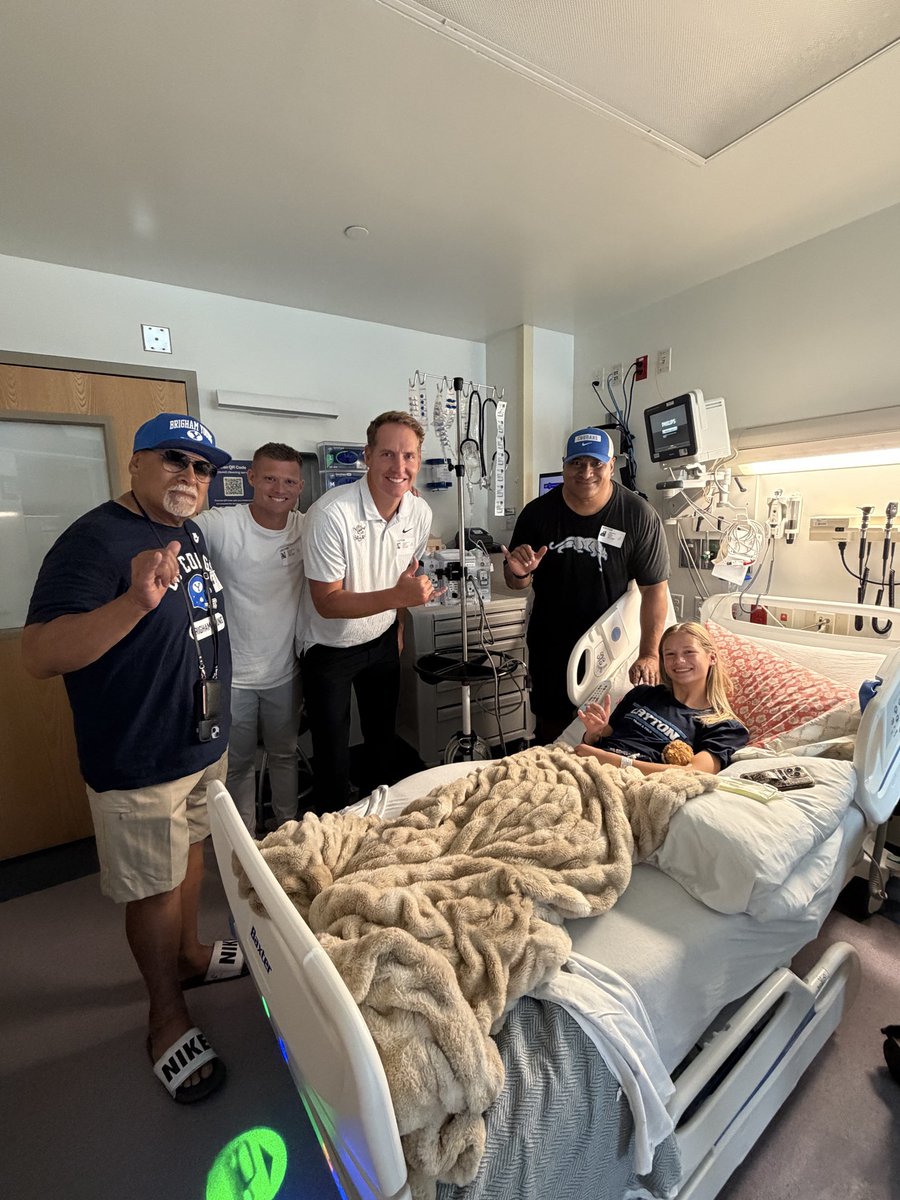
We are also incredibly grateful for the people who have surrounded our daughter with love. The day after we received the diagnosis, Coach Kalani Sitake, Pops, Travis Hansen and Dave George came to visit her. It meant more to our family than they probably realize. Especially right now, in the busiest part of their season, when their time is extremely limited and every hour is accounted for, they still chose to spend part of that rare free time with our daughter. In a moment when our world had yet again been turned upside down, they took the time to show up for a young woman who needed some encouragement.
There are good men in this world. Men who lead, men who care, and men who show up when it matters.
Thank you, Coach Sitake, Pops, Travis and Dave and the BYU Football Family, for being those men for our daughter just like you have been for our son.
And to our sweet girl: keep fighting. Keep smiling. Keep being you.
We are proud of you and love you more than you will ever know. ❤️
#FightLikeAGirl #Leukemia #BYU #CancerSucks #Scoliosis @BYUfootball
On March 5th, 1944, Chuck Yeager was flying a P-51 Mustang he'd named Glamorous Glen, after his girlfriend Glennis back home. He was 21, a farm kid from Hamlin, West Virginia, who had enlisted as an aircraft mechanic because he never expected to be allowed to fly at all. That day, on a mission deep over occupied France near Bordeaux, a German fighter caught him from behind and tore his plane apart. He bailed out with shrapnel in his feet and hands and a hole shot through his plane's canopy inches from his head. He came down in a forest crawling with German patrols who had seen the parachute and were already hunting for him.
He hid, bleeding, until French farmers found him. They passed him to the Resistance, and this is where his luck turned. The Maquis moved him from barn to hayloft to farmhouse, feeding him and keeping him one step ahead of the Germans. Yeager had grown up hunting squirrels and rabbits to put meat on the family table, and he knew guns and fuses and powder cold, so he earned his keep by helping them assemble bombs and detonators. He couldn't speak the language, so he communicated in gestures and drawings, a hillbilly kid suddenly in the middle of a French guerrilla war.
To actually get home, he had to walk out of the country. That meant crossing the Pyrenees on foot into neutral Spain, over snow-covered peaks in the tail end of winter, the same passes that killed plenty of fitter men who tried. He didn't go alone. With him was another shot-down American, a bombardier named Pat Patterson, whose lower leg had been shredded by gunfire and was hanging on by little more than a tendon, frostbitten and turning gangrenous. They climbed for days on almost no food. Partway up the mountain Patterson finally passed out cold from the pain and couldn't go on.
Yeager didn't leave him. He pulled out a knife, finished cutting the ruined leg the rest of the way off, tied the stump shut with a spare shirt to stop the bleeding, then hauled the unconscious man up over his shoulder and kept climbing. Near the top a German patrol opened fire on them and the two of them tumbled down an icy slope, but Yeager dragged them both back up and pushed on over the ridge. On the far side he got Patterson to a spot where he'd be found alive by the Spanish, then staggered down into Spain himself, where the Americans eventually pulled him out through Gibraltar and back to England.
By the rules of the day, that should have been the end of his war. Any pilot who'd been shot down and helped by the Resistance was barred from flying combat again in that theater, the fear being that if he were shot down a second time and captured, the Germans could torture the names of the entire network out of him. Yeager refused to accept it. He and another evader took the fight all the way up the chain to General Eisenhower himself at Supreme Headquarters and argued their case in person. Eisenhower let them go back. Yeager returned to the sky, became an ace, once shot down five German planes in a single day, and downed one of Germany's new jet fighters. And a little over three years after being dragged half dead across a mountain, that same West Virginia kid climbed into a rocket plane and became the first human being ever to fly faster than sound.
@HistoryWJacob I drive by his home every Sunday on my way to church. He and his wife are buried at the state capitol in Nashville.
https://t.co/0kkzZaC6ju
@SharkGoddess Opening for Rod Stewart in Nashville a few years ago. Was singing all the lyrics.... First time seeing Cheap Trick in 1980 in Boulder Colorado, the deserve to be in the RRHoF!
Three hundred and fifty-two. That is how many aircraft Erich Hartmann shot down, more than any fighter pilot in the history of the world, a record that has stood for eighty years and will never be broken.
Hartmann was a slim, boyish German pilot, so young looking his comrades nicknamed him Bubi, the kid. He flew almost entirely on the Eastern Front, and the Soviets came to fear the black tulip painted on the nose of his fighter so much that they put a bounty on his head and would break off and run when they saw it. They called him the Black Devil of the South.
The way he did it was not what you would expect. Hartmann was not a swashbuckling dogfighter. He thought the swirling duels people romanticize were a good way to get killed. His method was cold and patient. Get in as close as he possibly could, so close the enemy aircraft filled his entire windscreen and he could not miss, fire one short devastating burst, then instantly break away and dive out before anyone could react. See, decide, attack, break away. He said eighty percent of the pilots he shot down never even knew he was there. He was forced down many times himself, sometimes by flying debris from planes he had just destroyed at point blank range, and he walked away every time. He flew 1,404 combat missions in about 30 months.
They gave him the Knight's Cross with Oak Leaves, Swords, and Diamonds, the highest German decoration, and he was the most famous fighter pilot in the world at 22.
Then the war ended and his real ordeal began. Handed to the Soviets, who wanted the Black Devil badly, he was convicted on fabricated charges and sentenced to 25 years of hard labor. He spent ten years in the gulag and would not break. He refused to confess to crimes he had not committed, refused to spy, refused to help build a Soviet-controlled German air force, and at one point led a prisoners' protest against the conditions. What kept him alive, he said, was the thought of getting back to Ursula, the girl he had married during the war and barely seen since.
He came home in 1955, one of the last released. He rejoined the West German air force, helped rebuild it, flew jets into the Cold War, and lived a long life. Decades later the Soviet charges against him were formally annulled. The greatest fighter ace who ever lived, and the record dies with him.
This is one of the most famous paintings in America, and most people have no idea what they are actually looking at...
The painting is Christina's World, made by Andrew Wyeth in 1948, and the woman was real: her name was Anna Christina Olson, Wyeth's neighbour in Cushing, Maine. Since childhood a degenerative condition had slowly taken the strength from her legs, until walking was no longer possible. She refused a wheelchair, and for her entire adult life she chose to drag herself across the ground with her arms instead, going wherever she wanted to go under her own power.
Wyeth saw her one afternoon from an upstairs window, alone in that vast field, crawling slowly toward the house on the hill. He said the painting was an attempt to do justice to her extraordinary conquest of a life which most people would consider hopeless. Her world, he said, was limited physically but by no means spiritually.
That is what turns this painting from a portrait of frailty into one of the most triumphant images ever made...
Look at it long enough and it stops being about what her body took from her, and becomes about what she would not stop doing anyway. The field is enormous and she is small and the house is far away, and still she goes, because the alternative, to be carried, to give up, to let the distance win, was something she simply would not accept.
There is one more thing: Christina loved this painting. Pink was her favorite color, and Wyeth had placed her exactly where she most wanted to be, out in the open, in her own field, under her own sky. Late in her life, when she could no longer even crawl out to that field, she said something that holds the whole meaning of art inside it:
"Andy put me where he knew I wanted to be. Now that I can’t be there anymore, all I do is think of that picture, and I’m there."
The echoes of WWI that we continue to see in the war in Ukraine never cease to amaze me. This is a video of Ukrainian pilots in Yak-52 propeller driven planes that are taking down Russian drones with rifles. This is why you should be spending more time learning about WWI. Crazy.
Credit to @prestonstew_ for the heads up on this.
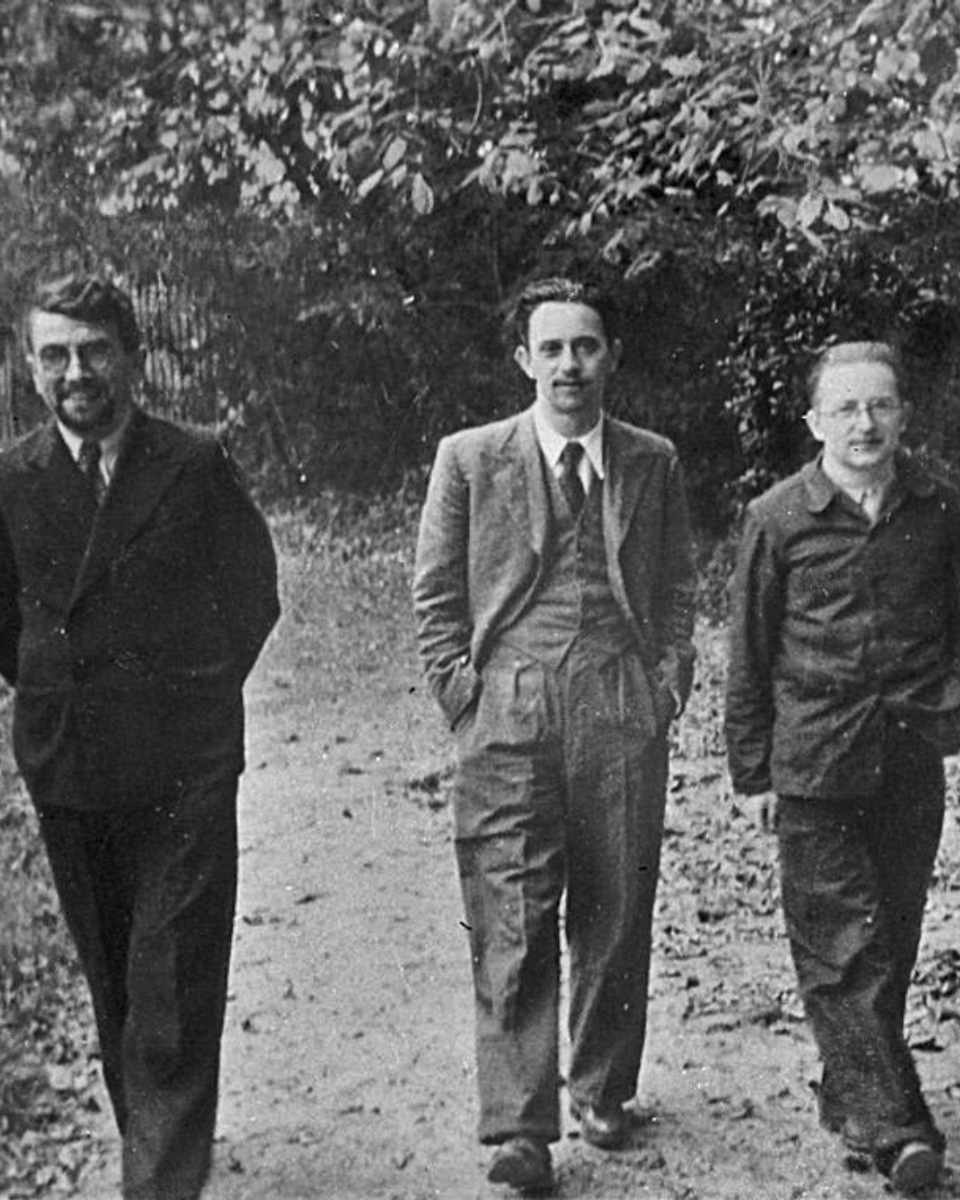
Polish Codebreakers.
The Poles didn't just work out how Enigma operated, they broke it.
Three outstanding mathematicians on the course - Marian Rejewski, Henryk Zygalski and Jerzy Różycki - proved key.
Their knowledge gave the Bletchley Park Codebreakers a crucial head start on breaking Enigma.
In July 1939, under increasing threat of a German invasion, the Poles shared their progress on Enigma with the British and the French at a conference in Pyry forest, near Warsaw.
Celebrate the pioneers of codebreaking at the Polish Codebreaking Festival, 25-26 July at Bletchley Park.
Book tickets: https://t.co/GEkD2jfXve
@PolishEmbassyUK@PLInst_London less
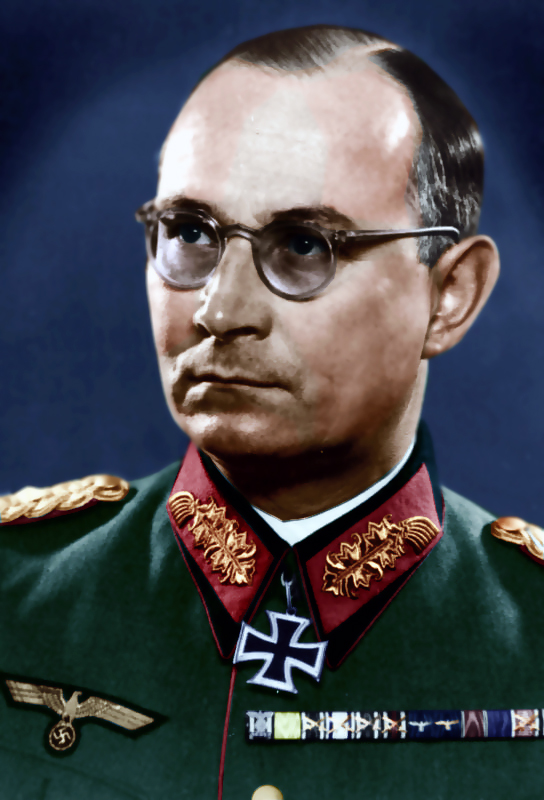
The plot to kill Hitler was built, cleverly, out of Hitler's own emergency plan. The man who quietly turned the regime's security scheme into the tool meant to destroy it was General Friedrich Olbricht.
Valkyrie, on paper, was completely legitimate. It was the official plan for the reserve army inside Germany to take control if there was ever a domestic emergency, a slave labor uprising, a breakdown of order, a collapse. Perfectly loyal. Olbricht, working in the heart of the reserve army headquarters, rewrote it in secret so that the very same orders, once triggered, would send troops to seize the Nazi ministries, arrest the SS, and hand power to the conspirators. He hid the coup inside the state's own paperwork.
That made him indispensable and it put him in the worst seat in the house. Because on July 20, Olbricht was the man in Berlin who actually had to give the order to launch Valkyrie, and he waited. He wanted certainty that Hitler was dead before committing, and in those hours of confusion and contradictory phone calls, the delay let the regime recover its balance. By the time the machinery finally moved, it was too late.
When it all fell apart that night, General Fromm, desperate to hide his own guilt, had Olbricht dragged into the courtyard with Stauffenberg and the others and shot by firing squad in the dark. The man who had built the mechanism was killed by the machine he built, hours after it jammed.
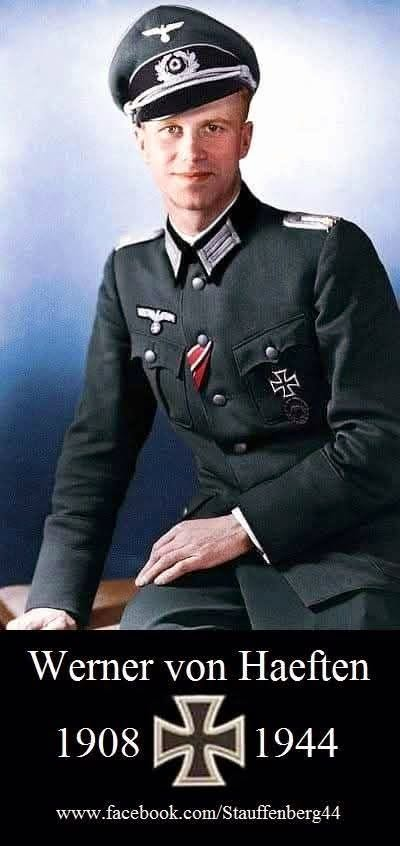
When the firing squad took aim in the courtyard that night, one young officer is said to have thrown his own body across the man beside him to take the bullets first. The man he tried to shield was Stauffenberg. The one who stepped in front was Werner von Haeften.
Haeften was Stauffenberg's aide de camp, 35 years old, a lawyer before the war, from a family that would pay terribly for its part in the resistance. He was not a mastermind or a general. He was the loyal right hand, the man at Stauffenberg's shoulder through the entire day of July 20, and his role was as human as it gets. He helped his half blind, one handed chief arm the bomb. He was the one who carried the second, unused explosive charge, the one they never got the chance to arm, the charge that might have made the difference.
He flew back to Berlin with Stauffenberg, certain they had done it, and threw himself into the failing coup. And at the end, in the Bendlerblock courtyard under the vehicle headlights, when the rifles came up for Stauffenberg, Haeften is remembered as lunging into the line of fire, dying a moment before the man he served.
It did not save Stauffenberg. Nothing could by then. But it is the kind of detail that stays with you, because loyalty like that cannot be ordered or faked. He was 35, and he chose to die a few seconds early rather than watch.
On this day in 1969, the crew of Apollo 11 touched down on the Sea of Tranquility. Later, Neil Armstrong & Buzz Aldrin would become the first men to step foot on the Moon.
16 July 1944: The first troops of #Brazilian Expeditionary Force arrives in Italy. On August 22, 1942 #Brazil declared war on #Germany and Italy. Brazil lost approximately 2,000 people during World War II. #WWII#WW2#History#OTD#ad https://t.co/O7EUykjru4
Erling Haaland has returned to Norway, and it looks like he brought home a $750 Whiskey Raccoon from Wild Bill's Western Store in Dallas, Texas. What an authentic piece of American culture.
@MatthewNichol5@HumbleAnthem I had a Loop T-shirt, a gift from a friend though we lived in Denver at that time. This was popular as well https://t.co/wJVcJy4zus
James K. Polk promised to serve a single term. He kept his word. And that one term destroyed him.
Few presidents ever reshaped the country faster. In four years Polk provoked and won a war with Mexico, took California and the Southwest, settled the Oregon boundary, and pushed the United States all the way to the Pacific. It was the largest expansion of American territory since Jefferson bought Louisiana.
He did it by burning himself to the wick. Polk ran the government almost single-handedly. He refused to delegate, rarely left Washington, and worked ten and twelve hour days for four straight years. By the time he handed the office to Zachary Taylor on March 4, 1849, he was fifty-three years old and physically broken.
He never recovered. One hundred and three days later, on June 15, he was dead, the shortest retirement of any president in history.
Some men leave the White House and get decades. Polk got barely three months.
He poured everything he had into the job, and there was nothing left when he set it down.