Coin flips work when the problem is indecision. They are less likely to work when the problem is Rumination.🚨
The Phenomenology of Thoughts 👇
A 50/50 decision can often be solved by action.
Choose the restaurant. Send the email. Pick the option. Move on …
But rumination is a distinct entity. 🚨
“Rumination may generally be construed as a process of repetitive thoughts.”
“Rumination was described as “fixed ideas” (French: idees fixes) and the “compulsion to repeat” (German: Wiederholungszwang)”
That older language matters because it captures something we still see clinically.
The thought does not simply appear.
It returns.
It intrudes. It repeats. It perseverates.
So the construct has at least two clinically relevant components:
1. Intrusion and repetition : the thought keeps forcing itself back into awareness because it has high salience.
2. Perseveration: the person struggles to shift set, disengage, or move flexibly to another mental frame.
That is why rumination is not the same as ordinary worry or indecision.
Worry is often future-oriented: “What if this happens?”
Indecision is often choice-oriented: “Which option should I pick?”
Rumination is often self-referential and affect-laden:
“What does this say about me?” “What have I done?” “Why do I feel like this?” “How damaged am I?”
And in depression, especially melancholic depression, this can take very specific forms:
1. obsessional guilt 2. financial ruin 3. nihilistic 4. somatic
This is where phenomenology becomes crucial .
In clinical practice a significant proportion of resistant anxiety / OCD / somatisation is rumination misclassified
- also leading to missing melancholic depression
Hence the definition :
“Rumination, a phenomenon that is subserved (i.e., a result of) by brain processes relevant to cognition, is characterized as a cognitive-emotional process whereby individuals repetitively and passively engage in excessive malicious self-referencing and focus on the negative feelings, reasons, consequences and symptoms of their distress instead of engaging in proactive problem-solving (Tang et al., 2021).”
That is the key point.
This is not simply a patient refusing to decide.
It is an all consuming ( almost ) thought (s) .
The psychic equivalent of a repetitive movement.
And if someone has a repetitive motor phenomenon, we do not say:
“Here are two options. Pick one.”
Because the issue is not choice.
The issue is the system being unable to disengage from the loop.
Neurobiologically it is a ‘loss’ of top down control with heightened salience .
That is also why rumination is clinically serious.🚨
It is associated with depressive severity, hopelessness, impaired problem-solving and suicidality.
It’s also transdiagnostic
The question for clinicians in treating ruminations is
“What has made this thought so salient that the mind cannot leave it alone”
*image of thought hierarchy ( conceptual as thought quality may overlap ; obsessions may move to ruminations and have a ruminative quality ( obsessional guilt )
Having some mild cognitive impairment trying to remember dementia patterns on imaging?
Is looking at dementia PET scans one of your PET peeves?
Have short-term memory loss when you read about dementia imaging?
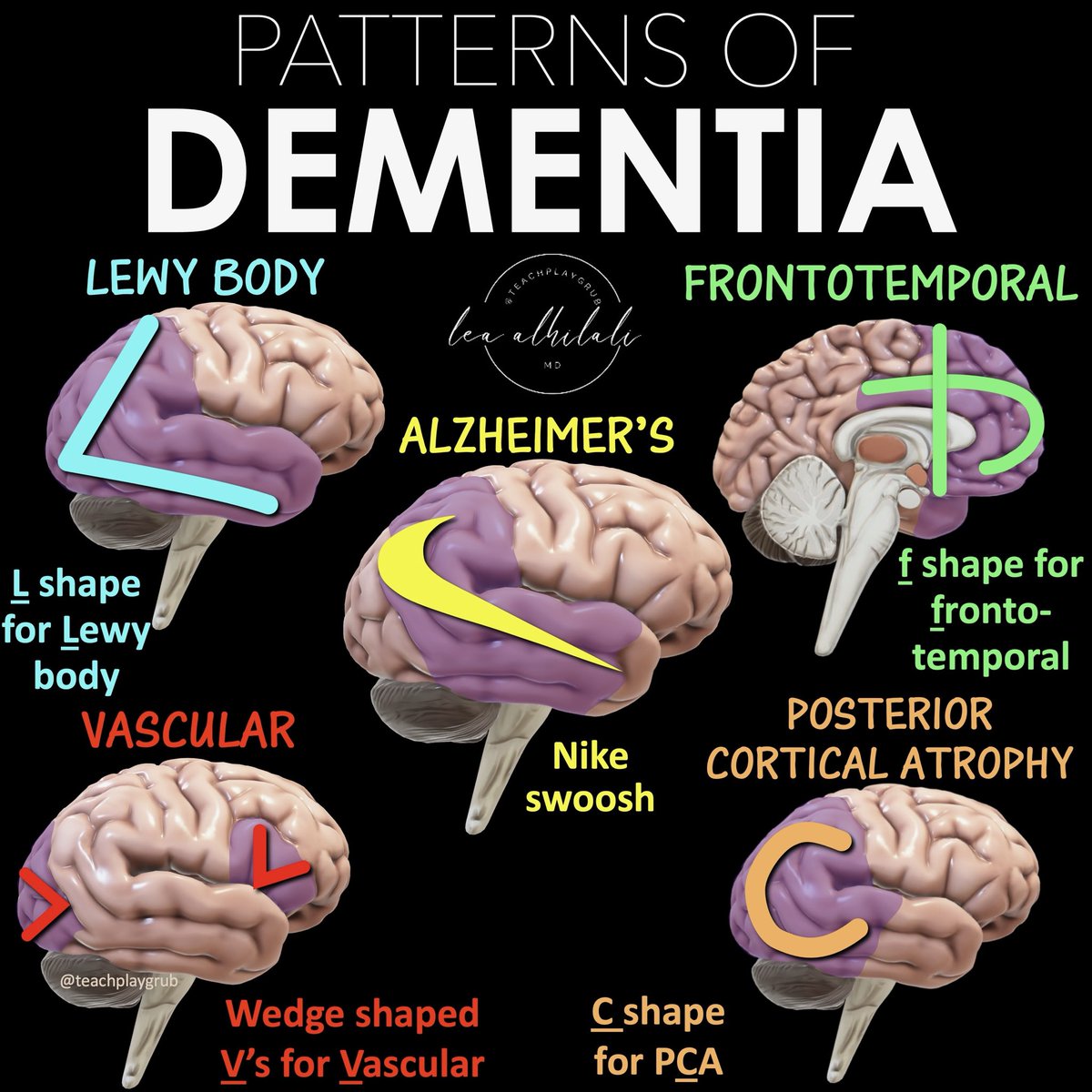
Here’s a way to remember dementia patterns so you will never forget!
Major dementia imaging patterns:
Alzheimer’s disease (AD)
🔸AD has a Nike swoosh pattern—w/decreased metabolism in parietal & temporal regions
🔸Remember if you see a Nike swoosh, just call it!
Dementia w/Lewy Bodies (DLB)
🔸Temporoparietal hypometabolism like AD but also occipital cortex, specific for DLB. DLB also extends farther to the ant. temporal cortex.
🔸Remember, regions of hypometabolism look more like an L. Lewy starts w/an L
Frontotemporal Dementia (FTD)
🔸Frontal & temporal hypometabolism as expected, but extends along anterior cingulate gyrus
🔸Anterior cingulate involvement makes hypometabolism looks like a lowercase letter f—& frontotemporal starts w/f
Posterior cerebral atrophy
🔸Can be from AD or DLB & has hypometabolism in the occipital & post. temporal lobe, sparing ant temporal lobe
🔸Sparing the ant temporal lobe makes the involvement look like a C instead of an L like DLB.
So remember pCa
Vascular dementia
🔸Vascular dementia is variable, depending on the regions infarcted (V is both for Vascular & Variable)
🔸Wedged shaped regions of hypometabolism corresponding to cortical infarcts—looks like an inverted V
This list isn’t all inclusive & there can be variations or even mixed dementias
But hopefully this gives you a starting point you won’t soon forget!
A Harvard psychologist quietly admitted something that destroys the way most people study.
She said it during a routine advising session, and a student posted it in a study group that eventually reached hundreds of thousands of people.
Her name is Jessie Schwab, and she works inside the Harvard College Writing Program.
Here's what she said: "Learners are often bad judges of their own learning. Memorization seems like learning, but we probably haven't deeply processed that information enough to remember it days or even hours later."
That one sentence explains why you can study for three hours and still blank on the exam.
Here's the system she actually teaches Harvard students instead.
Before you read a single word of a new chapter, stop and write down what you already know about the topic and what you expect to learn. This primes your brain to treat new information as an update, not a cold upload.
While you read, take notes about connections to other things you know, not just definitions. The brain doesn't store isolated facts well, but it stores relationships between ideas extremely well.
After you finish, close the material and try to summarize what you learned from memory. The struggle of retrieval is the actual learning. Reading it again is just comfortable, not effective.
The researchers she references call this "desirable difficulties," and the analogy is perfect: reading your notes is like watching someone else lift weights. Testing yourself is actually going to the gym.
The students who use this system at Harvard aren't necessarily smarter. They've just stopped confusing the feeling of familiarity with the fact of retention.
Those are two completely different things, and most people never figure that out.
You’ve been lied to.
Stanford sleep doctor spent 26 years treating insomnia, sleep apnea and recovery.
Dr. Michael Breus exposed 5 lies that you were led to believe since a kid:
1/ You have to sleep at night
AKI guidelines hadn’t been updated since 2012.
The KDIGO 2026 AKI/AKD Public Review Draft just dropped and it changes how we define, diagnose, and follow up after acute kidney injury.
Here’s what every nephrologist, intensivist, and internist needs to know 🧵
⚠️ Public review draft only · Not yet final guidelines
🫀Heart failure in 2026: we are no longer treating symptoms. We are redesigning the disease.
The latest evidence update reminds us of something profound:
Heart failure is no longer a single entity.
It is a spectrum, and now, finally, we are treating it as one.
Several paradigm shifts stand out.
1. SGLT2 inhibitors are no longer “add-on” therapy.
They are foundational across the entire EF spectrum.
From HFrEF to HFpEF, the data are now consistent.
Not just symptom improvement, but hard outcomes.
This may be the most important unifying therapy in modern HF.
2. HFpEF is no longer a therapeutic desert.
For the first time, we have real disease-modifying options:
Finerenone → outcome reduction across EF ranges
GLP-1 / dual incretin therapies → targeting the obesity phenotype
Structural and metabolic mechanisms are finally being addressed
We are moving from “HFpEF frustration” → HFpEF phenotyping.
3. Acute heart failure is no longer about stabilization.
It is about early transformation.
The new paradigm:
Start GDMT in-hospital
Optimize rapidly
Treat beyond congestion
Decongestion is still important, but it is no longer the goal.
Disease modification starts on day 1.
4. Decongestion is becoming precision medicine
Urine sodium-guided therapy
Early escalation of loop diuretics
Sequential nephron blockade
Not just “give furosemide”, but measure, adjust, and target response.
5. Devices are no longer rescue therapy, they are integrated care
TEER expanding from mitral → tricuspid
Pulmonary artery pressure monitoring reducing hospitalizations
Remote hemodynamics shaping outpatient management
The boundary between ICU, ward, and home is dissolving.
6. The biggest problem is no longer evidence.
It is implementation.
We already have:
Quadruple therapy
Proven outcome benefits
Yet many patients never reach target doses.
The gap is no longer science.
It is execution.
🤓Final message
Heart failure care has entered a new era:
Mechanism-based therapy
Early aggressive optimization
Phenotype-driven treatment
And perhaps most importantly:
We are no longer chasing symptoms.
We are altering the trajectory of the disease.
📃Reference
Liori S, et al. Heart failure evidence update 2026. Heart Failure Reviews. 2026. https://t.co/T4MVjK0vGd
#MondayTip
Not all “seizures” are epilepsy.
🧠 #LimbShakingTIA = hypoperfusion from carotid disease
📌 Triggered by standing/exertion
📉 EEG often normal
⚠️ Treat flow, not firing
https://t.co/RTnxAnwQG9
Functional Neurological Disorders #FND “is a ‘software’ issue of the brain, not the ‘hardware’ (as in stroke or MS)“ @jonstoneneuro #psychogenic Great article! https://t.co/cOG3CwBES8