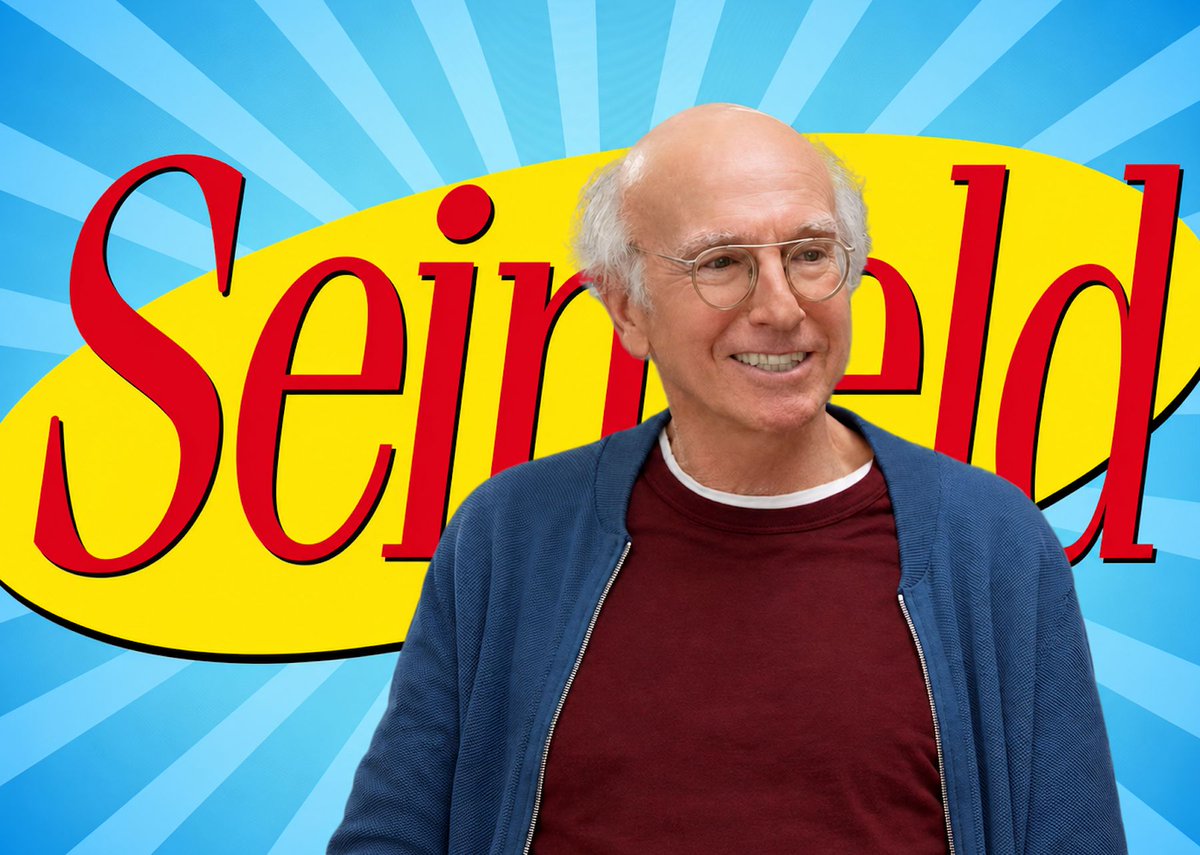
In 1984, Larry David marched up to his SNL producer five minutes before airtime and screamed, “You should be embarrassed. I’m embarrassed. I’m done. I’ve had it. I quit!”
All season, Larry had watched his sketches get cut at the last minute. That night, when another one was chopped, Larry decided, “They’re fooling with the wrong guy.”
So he unleashed on producer Dick Ebersol, who sat frozen, too stunned to speak.
Larry stormed out into the freezing Manhattan night. For a few blocks, he felt invincible.
“Well, that quickly wore off,” he admitted. He had just walked away from enough money to live on for eighteen months.
By the time he reached his building, triumph had turned to dread. His neighbor Kenny Kramer spotted him. “How come you’re not at the show?”
“I lost my temper,” Larry said. “They cut my sketch, I quit.” Then, quieter, “I’m an idiot.”
Kramer suggested, “maybe you can just go back?”
“Go back?”
“Yeah. Pretend like it never happened. You’re an emotional person. People don’t take you seriously!”
On Monday morning, Larry walked into the writers’ meeting and took his usual seat. Every head swiveled toward him. Nobody spoke.
“I’m just sitting there, trying my best to act like nothing’s happened.”
Ebersol began circling the table, collecting pitches, getting closer.
“Larry?”
“Yes.”
A second passed. Then another.
Ebersol only wanted an idea. Larry exhaled and pitched a sketch about a family of trapeze artists. He had un-quit his job.
Four years later, @JerrySeinfeld invited Larry to help create a show for @NBC. When the script needed a neighbor, Larry described his neighbor Kramer who had saved his job, so they wrote him in.
In 1991, Larry wrote an episode called “The Revenge,” where George screams “I quit!” at his boss and hears Jerry repeat Kramer’s advice: “Go back and pretend it never happened. You’re an emotional person. People don’t take you seriously.”
After the table read, @IJasonAlexander, who played George, pulled Larry aside.
“Larry, please help me with this because this would never happen to anybody, but if it did, nobody would react like this.”
Larry replied: “I don’t know what you’re talking about, this happened to me and it’s exactly what I did!”
“And that was when the bell went off in my head,” Alexander recalled. “He’s George.”
By 1995, @SeinfeldTV was the No. 1 show on television. In 1998, 76 million people watched the finale, and decades later @netflix paid more than $500 million to stream the series worldwide. This August, Netflix renewed the deal for five more years, and Nielsen says 72 million Americans watched the show in just the first eight months of this year.
Our most embarrassing moments often hold our best material. Share them with humility, and they may become our greatest asset.
To learn more about the story, check out the Seinfeld episode on @AcquiredFM by Ben Gilbert (@gilbert) and David Rosenthal (@djrosent).
@4thOfJuly365 Body dysmorphia in genderal is already. If my depression hinges on my feeling of ugliness, to the point of $uicidal ideation, why doesn't Medicaid cover facial reconstruction like it does transgender surgeries? What if it would save my life?
Last year, a young man named Harry wrote me a letter about what it’s like to live with a stutter. Tonight, I met him and his family in Milwaukee and shared some techniques I use to overcome mine.
My message to Harry was simple: don’t let anyone tell you what you can or can’t do.