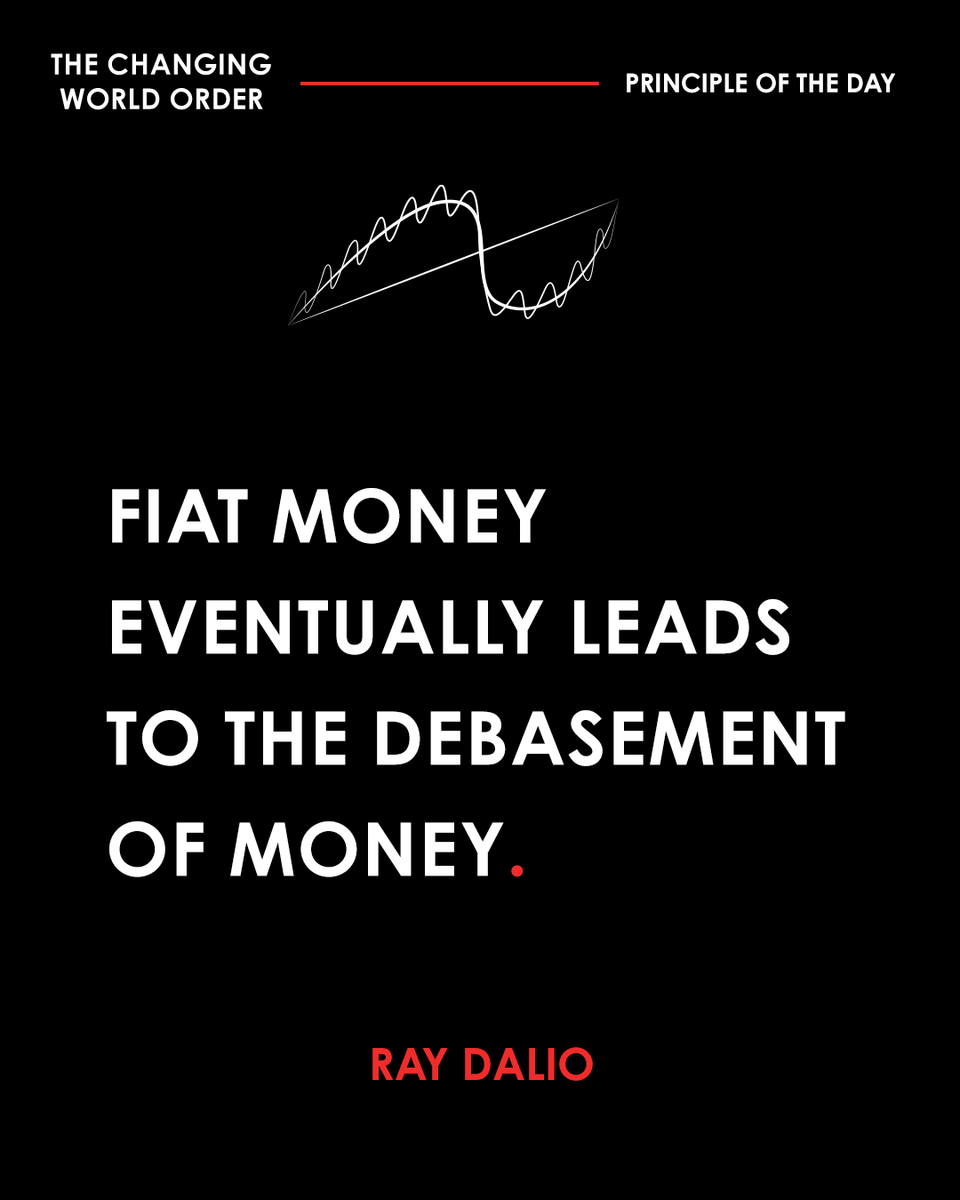
Central banks want to stretch the money and credit cycle to make it last for as long as it can because that is so much better than the alternative. So when the system of hard money and claims on hard money becomes too painfully constrictive, governments typically abandon it in favor of what is called “fiat money.” No hard money is involved in fiat systems; there is just paper money that the central bank can print without restriction. As a result, there is no risk that the central bank will have its stash of hard money drawn down and have to default on its promises to deliver it. Rather, the risk is that, freed from the constraints on the supply of tangible gold, silver, or some other hard asset, the people who control the printing presses (i.e., the central bankers working with the commercial bankers) will create ever more money and debt assets and liabilities in relation to the amount of goods and services being produced until the time comes when those holding the enormous amount of debt will try to turn it in for goods and services, which will have the same effect as a run on a bank and result in either debt defaults or the devaluation of money. #principleoftheday
Airdrop Strategy #59: @initia 🪂
• A network for interwoven optimistic rollups (similar to Avalanche)
• $350M valuation in last funding round
• Token is IMMINENT 👀, more on this in the thread
👇 How to interact for a potential airdrop:
Boxing Day is the day of giving - of both gifts...and yields!
With the 26 December maturity (00:00) upon us soon, here's all that you need to know unbox your hard earned rewards ~
Pendle Maturity Guide🎄👇🏻