Leonardo da Vinci’s self-supporting bridge, designed between 1485 and 1487, is a structural masterpiece that requires no nails, ropes, or glue. It relies entirely on friction, gravity, and geometry to maintain its integrity.
Rick Rule: After grading 100K portfolios, here are the biggest mistakes people make:
1) They get the thesis right but underestimate the required timeframe
2) They do not do the actual work
3) They are not patient enough to let 10-baggers emerge
Avoiding these mistakes will put you ahead of the crowd.
- Almost every one of Rick’s 10-100 baggers took 5-6 years
- Within that timeframe, he experienced a 50% share price decline
You need to build the psychological fortitude to weather these periods.
If you are getting no 10-baggers, your chance of being a successful speculator is 0.
Half of China's auto industry just showed up to one event of Lei Jun's #xiaomi
Wang Chuanfu (#BYD), Li Xiang (#LiAuto), He Xiaopeng (#XPeng) + #Unitree robots
Asia's Hormuz Exposure Scorecard
The region is at the epicenter of the energy security shock and faces potential stagflation, if disruptions persist beyond a month. Thailand, South Korea and India are most exposed @Nomura
https://t.co/0Vjkkybe4z
Professor Jiang Xueqin @xueqinjiang the Beijing-based educator and self-styled “predictive historian,” has gained viral traction in mainstream media and online circles for his supposed geopolitical foresight.
Dubbed “China’s Nostradamus” by some outlets, he’s been celebrated for forecasting Donald Trump’s 2024 election win and the subsequent U.S. escalation into war with Iran - predictions he laid out in a 2024 lecture.
Yet these “prophecies” hardly qualify as strokes of genius.
Trump’s victory was a widely discussed possibility among countless observers (including many on social media who documented their calls early), and the path to Iran conflict was telegraphed by Trump’s first-term actions, like the 2020 assassination of IRGC commander Qasem Soleimani in Iraq, which ratcheted up tensions dramatically.
More concerning are Jiang’s recent takes on the ongoing conflict, which carry a subtle, agenda-driven undertone. He predicts Dubai’s economic allure will collapse amid the chaos, then pivots to suggesting Gulf capital will flee to Singapore, Malaysia, and Hong Kong - nations already awash in inflows but conveniently positioned as “safe” alternatives in his narrative, almost as if nudging stakeholders toward specific destinations.
Even more alarming is his apparent enthusiasm for Iran targeting GCC water desalination plants, framing them as strategic “lifeblood” vulnerabilities. Recent unverified claims from Bahrain of an Iranian drone strike damaging one of its plants (while Iran accuses the U.S. of hitting its own facilities) remain contested - raising questions about whether such incidents are genuine or staged for sympathy and escalation.
Jiang’s rhetoric seems to egg on destructive outcomes rather than analyze them neutrally.
His appearance on @sneako’s livestream further raises red flags, aligning him with fringe, controversial platforms that often amplify provocative or conspiratorial voices.
A TikTok creator recently used AI tools and modeling software to dissect Jiang’s YouTube content, highlighting glaring factual inaccuracies and inconsistencies that undermine his credibility.
Overall, Jiang appears to be transitioning from obscure lecturer to establishment-adjacent influencer - pushing narratives that manipulate perceptions and subtly steer outcomes under the guise of bold prediction.
His theories warrant far more scrutiny, as the line between insight and agenda-driven spin is growing dangerously thin.
Ken Griffin, founder of Citadel, has a $10 plaque behind his desk that reads: "If we're all going to eat, someone has to sell."
Of all the things this man could surround himself with, he chose a cheap plaque with a blunt truth about business.
"You're always selling. You're selling to candidates. You're selling to vendors, you're selling to counterparties, you're selling to customers."
And if you're always selling, you know what you're going to hear a lot of?
"No."
Griffin doesn't sugarcoat it. He tells two stories that illustrate just how brutal rejection can be.
1994 was a rough year, with Citadel losing ~4% of its capital. Griffin flew to Switzerland for a crucial lunch meeting, sat down, and his guest arrived only to say:
"Oh, I thought you were John Griffin from Fen Church. I got to go."
His lunch date got up and left the table.
Later that afternoon, a Swiss banker spent 45 minutes with him in a beautiful office, smoking a cigar, before closing with:
"Such a pity that such a bright young man picked the wrong career."
Two rejections in one day for the founder of one of the most successful hedge funds in history — and his takeaway was simply this:
"You just have to tolerate. You're going to hear no a lot, but you need to become accustomed to having to market your ideas and market what you represent and what you stand for."
Absorbing rejection and continuing anyway is the actual skill, whether you're hiring, raising capital, or winning customers.
Most people avoid selling because they're afraid of no. The ones who build great things have learned to expect it.
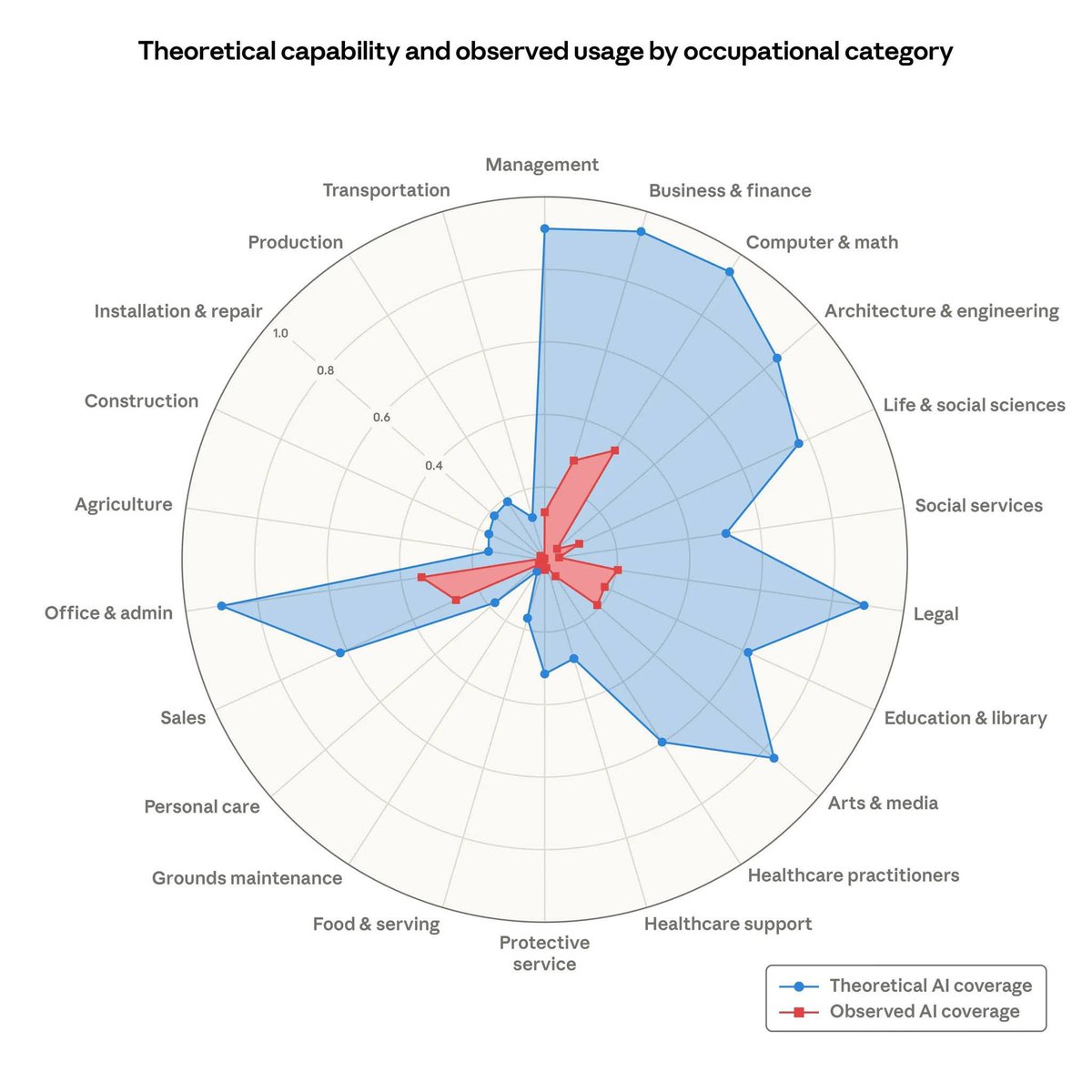
สรุปรายงานของ Anthropic ผลกระทบ AI ต่อตลาดแรงงาน และ 10 กลุ่มอาชีพเสี่ยงถูก AI ทดแทน
Anthropic ผู้พัฒนา Claude AI ได้เผยแพร่รายงาน "Labor market impacts of AI: A new measure and early evidence" ซึ่งนำเสนอแนวทางใหม่ในการวัดผลกระทบของ AI
โดยเน้นไปที่ "ความเสี่ยงที่สังเกตได้จริง" (Observed Exposure) ที่เป็นการนำเอาข้อมูลความสามารถทางทฤษฎีของ AI มาเปรียบเทียบกับข้อมูลการใช้งาน AI จริงในระดับองค์กร (ผ่านดัชนี Anthropic Economic Index)
สาเหตุที่ต้องวัดผลจาก "การใช้งานจริง" เป็นเพราะความสามารถทางทฤษฎีของ AI มักจะสูงกว่าความเป็นจริงมาก เนื่องจากมีข้อจำกัดด้านกฎหมาย, ข้อกำหนดทางซอฟต์แวร์ หรือความจำเป็นที่ต้องใช้มนุษย์ตรวจสอบ
เช่น ในทางทฤษฎี AI สามารถอนุมัติการสั่งจ่ายยาซ้ำได้ แต่ในการทำงานจริง ยังไม่พบการนำ AI มาใช้ในงานลักษณะนี้
โดยเนื้อหาของรายงานฉบับนี้มีหลายประเด็นน่าสนใจ และลงทุนแมนสรุปได้ดังนี้
https://t.co/qJgVp9NqEN
From 1.2T yuan in 2025, China sees its AI industry reaching 10T yuan by 2030. That’s a 53% CAGR over the next five years!
Imagine not owning Chinese AI names.
$BABA $BIDU $TCEHY $KC $GDS https://t.co/FojDExg5MD https://t.co/hnEEzWgCch #Zhipu#Minimax
1/10 $BAK thread. Braskem is down 3.5% today while every near term catalyst is stacking in its favor and nobody is paying attention. Largest polyolefins producer in the Americas, $14B revenue, trading at 85% off its 2021 highs.
🚨 BREAKING: AI can now build trading algorithms like Goldman Sachs' algorithmic trading desk (for free).
Here are 15 insane Claude prompts that replace $500K/year quant strats (Save for later)
This is the most comprehensive breakdown of the silver thesis I've seen. Supply deficit, China export restrictions, warehouse inventory data, mining economics, the paper-to-physical ratio — all in one video. If you're even slightly interested in commodities, this is 28 minutes well spent.