The rise of stablecoins and tokenized finance is creating new opportunities for Web3 talent.
How will banks adapt, and what expertise will they need?
Join the ESSEC Alumni debate on December 3, in Paris or online.
#Web3TalentFair#Web3#Banking#Tokenization
Will stablecoins disrupt traditional banking or create new opportunities for financial institutions?
Instant cross-border payments, tokenized deposits, programmable money and autonomous AI agents are opening a new chapter in the history of finance.
Banks have a choice: risk being disintermediated or become key players in the emerging tokenized economy.
But this transformation requires specialized technological expertise.
At @GoodHive_io, we help banks and financial institutions find the Web3 and blockchain talent they need to navigate this transition and build the next generation of financial infrastructure.
Technology is only part of the equation. Finding the right talent is essential to turning ambition into reality.
On December 3, I will co-moderate an ESSEC Alumni conference with Muriel Faure, bringing together speakers from Banque de France, Circle, Incomlend and De Gaulle Fleurance to discuss the future of money.
Will banks be the winners or the losers of this monetary revolution?
📅 December 3, 2026 | 6:30 PM (Paris time)
📍 Epitech, Paris & online
🎙️ Conference held in French
Register here:
https://t.co/C0vRHnBsLz
#Banking #Stablecoins #Tokenization #Web3 #GoodHive #FutureOfFinance
Et si les Européens finissaient par payer en dollars sans même quitter l'Europe ?
Près de 99 % de la capitalisation mondiale des stablecoins est aujourd'hui libellée en dollars.
Alors que l'Europe multiplie les discours sur sa souveraineté, une nouvelle infrastructure financière mondiale se construit essentiellement autour de la monnaie américaine.
Et ce n'est probablement que le début.
Paiements internationaux, commerce transfrontalier, tokenisation des actifs financiers et, demain, transactions autonomes entre agents d'intelligence artificielle : les stablecoins pourraient devenir une infrastructure essentielle de l'économie mondiale.
Dans quelle monnaie ces transactions seront-elles réalisées ?
Assistons-nous à une dollarisation silencieuse de l'économie numérique européenne ?
L'Europe est-elle en train de perdre une bataille monétaire avant même d'avoir commencé à la livrer ?
Nous en débattrons le 3 décembre lors de notre conférence ESSEC Alumni :
Stablecoins : vers un nouveau système monétaire mondial ? Qui contrôlera la monnaie de demain ?
Avec quatre intervenants aux perspectives complémentaires :
• Audrey Metzger, Banque de France
• Coralie Billmann, Circle
• Morgan Terigi, Incomlend
• Anne Maréchal, De Gaulle Fleurance
J'aurai le plaisir de coanimer ce débat avec Muriel Faure.
📅 Jeudi 3 décembre à 18h30
📍 Epitech, Paris 15e, et en ligne
🥂 Cocktail dînatoire à l'issue de la conférence
Inscription obligatoire :
https://t.co/C0vRHnBsLz
#Stablecoins #Web3 #Finance #AI #Souveraineté
Stablecoins are reshaping global finance. But who will control tomorrow's money?
On December 3, @GoodHive_io and @essecalumni brings together @banquedefrance, @circle, @incomlend and @dgfla_group to debate the future of money.
A must-attend discussion for the Web3 ecosystem.
Et si la prochaine bataille pour la domination monétaire se jouait sur la blockchain ?
Les stablecoins ne sont plus seulement des instruments de l'écosystème crypto. Ils deviennent progressivement des infrastructures de paiement, de financement du commerce international et de circulation des actifs tokenisés.
Mais derrière cette évolution technologique se joue une question bien plus fondamentale : qui contrôlera la monnaie de demain ?
Les banques centrales ? Les banques commerciales ? Les émetteurs privés ? Les protocoles décentralisés ?
Et surtout, les stablecoins vont-ils renforcer la domination du dollar ou offrir une nouvelle chance à l'euro ?
C'est le débat que nous organiserons le 3 décembre à Paris, avec les clubs Digital & Technology et Finance Banque Assurance d'ESSEC Alumni.
Quatre regards complémentaires :
• Audrey Metzger (@banquedefrance) : souveraineté et infrastructures monétaires.
• Coralie Billmann (@circle) : émission et développement des stablecoins.
• @MorganTerigi (@incomlend ) : paiements internationaux et financement du commerce.
• Anne Maréchal (@dgfla_group De Gaulle Fleurance) : réglementation et enjeux juridiques.
Une discussion que j'aurai le plaisir de coanimer avec Muriel Faure (AFG).
📅 3 décembre 2026, 18h30
📍 Epitech, Paris 15e
🥂 Cocktail dînatoire après la conférence
Inscription obligatoire : https://t.co/C0vRHnC0B7
#Stablecoins #Blockchain #Finance #ESSECAlumni
Hong Kong is preparing for a world where banks can settle tokenized money 24/7, without waiting for traditional banking hours.
On November 2, Hong Kong announced a major step toward programmable money.
Through Project Ensemble, 12 banks and 20 industry partners can now support 24/7 interbank settlement of tokenized deposits using tokenized central bank money.
Hong Kong is not alone. Singapore, Switzerland and major US banks are also developing tokenized financial infrastructure.
But Hong Kong's position is particularly strategic: a global financial center, a gateway to China and a potential testing ground for future monetary innovation.
As dollar stablecoins expand globally, banks and central banks are building competing forms of programmable money.
The question is no longer just how money will move, but who will control the infrastructure on which it moves.
On December 3 in Paris, we'll explore these questions with representatives from @banquedefrance, @circle, @dgfla_group and @incomlend.
I'll have the pleasure of co-moderating the debate with Muriel Faure (AFG), on behalf of the ESSEC Alumni Digital & Technology Club, with @GoodHiveLabs supporting the event as a partner.
Join us in Paris or online.
Register here: https://t.co/C0vRHnBsLz
#Stablecoins #Tokenization #Blockchain #DigitalCurrency
What if AI becomes a bigger threat to blockchain security than quantum computing?
On October 7, @VitalikButerin warned about a possibility we rarely discuss: AI accelerating mathematical discoveries that could undermine today's cryptography.
Less than three weeks later, on October 26, OpenAI announced that its models had disproved the Exponential Time Hypothesis, a major conjecture in computational complexity.
Greg Brockman, @gdb, was quick to clarify: “P still probably doesn't equal NP.”
And no, this discovery does not break Bitcoin, Ethereum or zero-knowledge proofs. The result is still undergoing independent scientific review.
But imagine a world where the mathematical problems protecting our digital lives suddenly become much easier to solve.
Digital signatures could be forged. Crypto wallets could be compromised. Banking systems, private communications, medical records and confidential business data could be exposed.
Even our conversations with AI assistants, and the deeply personal context they accumulate about our lives, could become vulnerable if the encryption protecting them were broken.
The consequences would extend far beyond blockchain.
This is not an inevitable future. But cryptography relies on mathematical problems being computationally difficult, not impossible.
And AI is increasingly capable of discovering new mathematics.
The question is no longer just how powerful AI will become, but whether the security of our digital world can keep pace with its discoveries.
That makes cryptographic research, adaptable infrastructure and highly skilled technical talent more important than ever.
#Cryptography #AI #Blockchain #Web3
On nous promet de devenir les managers des IA. Mais pourquoi les IA auraient-elles durablement besoin de nous comme managers ?
Cette question m’est restée après le débat entre @dr_l_alexandre et @FournesMaxime, que j'ai coanimé avec François MARE à Échos de 2050.
Laurent Alexandre présente l’orchestration d’agents IA comme une évolution du travail.
Maxime Fournes en interroge la pérennité : si ces systèmes progressent, pourquoi leur coordination resterait-elle humaine ?
La promesse est séduisante. Nous déléguerions l’exécution pour nous concentrer sur la supervision. Mais superviser suppose aussi de répartir des tâches, comparer des résultats et corriger des erreurs. Des fonctions que l’on cherche précisément à automatiser.
Cela ne signifie pas que tous les managers vont disparaître. Cela signifie que « savoir piloter des agents » ne suffit pas à garantir une place durable.
Pour recruter et former, la question devient plus exigeante : quelle expertise permet de repérer une réponse convaincante mais fausse ? Qui choisit les objectifs et assume les conséquences ?
L’orchestration est-elle un métier d’avenir ou une étape de transition ?
Le débat complet est en commentaire.
#IntelligenceArtificielle #FuturDuTravail #Recrutement
Pour écouter l'échange en intégralité 👉https://t.co/mhH5AGNNY6
Wall Street is going onchain, and Europe isn't standing still.
From DTCC to Spiko and Collaterize, tokenization is creating new opportunities for blockchain developers & financial technology experts.
The next wave of Web3 jobs may come from traditional finance.
#Web3Jobs#RWA
Wall Street is moving blockchain into the heart of financial markets.
On October 28, DTCC announced the launch of its tokenization service, with 20 major financial institutions signed up for access, including JPMorgan, Citi and Morgan Stanley.
This is a significant step. We're moving beyond isolated blockchain experiments toward integrating tokenized securities into existing financial infrastructure.
And Europe isn't standing still.
In France, @Spiko_finance just announced that its SAFO fund reached $2.39 billion in assets, overtaking @BlackRock's BUIDL and @circle's USYC.
But another number caught my attention: 44% of its instant withdrawals happened outside traditional banking hours.
That's a concrete example of what tokenization can bring. Not just digital ownership, but financial services that operate 24/7.
Meanwhile, @collaterizehq is taking a more Web3-native approach, connecting real-world assets with DeFi infrastructure.
Different players, different approaches, but the same underlying shift: tokenization is moving from experimentation to real financial applications.
And there's a talent dimension worth watching.
As traditional finance and Web3 converge, demand for people who understand both worlds is likely to grow.
Follow the infrastructure. Follow the adoption. Follow the talent.
#Tokenization #RWA #Web3 #DigitalAssets
Want to know where the next Web3 jobs will emerge? Follow the recruitment.
@googlecloud's Web3 hiring preceded its latest crypto security initiative.
At Web3TalentFair, we believe hiring signals offer a glimpse into the future of blockchain careers.
#Web3Jobs#Web3TalentFair
Want to know where technology is heading? Follow the recruitment.
A few weeks ago, I spotted a @googlecloud job opening for a senior Web3 architect in Hong Kong.
The required expertise? Multi-Party Computation (MPC), institutional custody, stablecoins, tokenization and digital asset infrastructure.
Now @Google is unveiling its own MPC security solution for financial institutions, with commercial availability expected in early 2027.
I can't say the job opening was directly connected to this product. But the overlap is striking.
This is why I pay close attention to hiring signals.
Companies announce products when they're ready to show them. But they often start recruiting the expertise they need much earlier.
Recruitment can be an early indicator of where an industry is heading.
And as institutional finance increasingly embraces blockchain, the skills companies are looking for can tell us a lot about what comes next.
At @GoodHiveLabs, this is part of how we think about the Web3 talent market.
Don't just follow the announcements. Follow the recruitment.
#Web3 #GoogleCloud #DigitalAssets #GoodHive
AI agents don't need Mastercard to pay. They don't even need x402. So why is Mastercard adopting it?
In March 2026, Binance founder CZ predicted that AI agents would make a million times more payments than humans using crypto.
He may even be underestimating the scale.
Imagine millions of autonomous agents buying data, computing power and API services, generating thousands of micropayments every day.
Technically, we already know how to do this. Give an agent a crypto wallet, let it pay a smart contract, verify the transaction and deliver the service.
No bank. No credit card. No x402 required.
The real challenge isn't payment. It's interoperability.
How does an agent transact with 10,000 independent providers, each potentially using different payment interfaces, authorization systems and delivery mechanisms?
Coinbase introduced x402 in 2025 to standardize machine-to-machine payments through HTTP.
On October 20, Mastercard announced Agent Pay for Machines, building on x402.
A traditional payments giant adopting a Web3-native protocol. That's significant.
But x402 isn't alone.
Stripe and Tempo have MPP. Google has AP2 for authorization. China's Ant ecosystem is developing its own agent-commerce protocols.
Some are complementary. Others compete.
Here's the paradox: crypto removed the need for financial intermediaries, but incompatible payment standards could create a new generation of intermediaries.
Universal gateways, intelligent routing, agent identity, verification, security and automated accounting.
A whole new industry could emerge around making these systems work together.
The next big opportunity may not be inventing another payment protocol, but connecting the entire machine economy.
Will AI agents transact in one open global marketplace, or in fragmented ecosystems?
#Web3 #AIAgents #x402 #Stablecoins #Mastercard
Coinbase fined €3.25M. The real warning for Web3? A shortage of local expertise.
Ireland's central bank sanctioned Coinbase Ireland over failures in safeguarding customer funds and overseeing outsourced operations. Among its findings: insufficient local expertise and excessive reliance on the US parent company.
Coinbase says the issues have been resolved and no customers lost money.
But this raises a much bigger question.
Are we building financial infrastructure faster than we're developing the talent to operate it?
As crypto enters institutional finance, hiring great blockchain developers is no longer enough. Companies also need engineers who understand financial controls, security specialists familiar with operational risk, and technical leaders who can turn regulatory requirements into reliable systems.
You can outsource operations. You cannot outsource accountability.
With MiCA, stablecoins, custody and tokenization reshaping European finance, this combination of technical and regulatory expertise is becoming increasingly important.
That's precisely the challenge we're addressing at GoodHive: connecting Web3 companies with vetted technical talent suited to increasingly complex business and infrastructure requirements.
The next competitive advantage in institutional crypto may not be better technology. It may be better talent.
#Web3 #DigitalAssets #Web3Talent #Coinbase
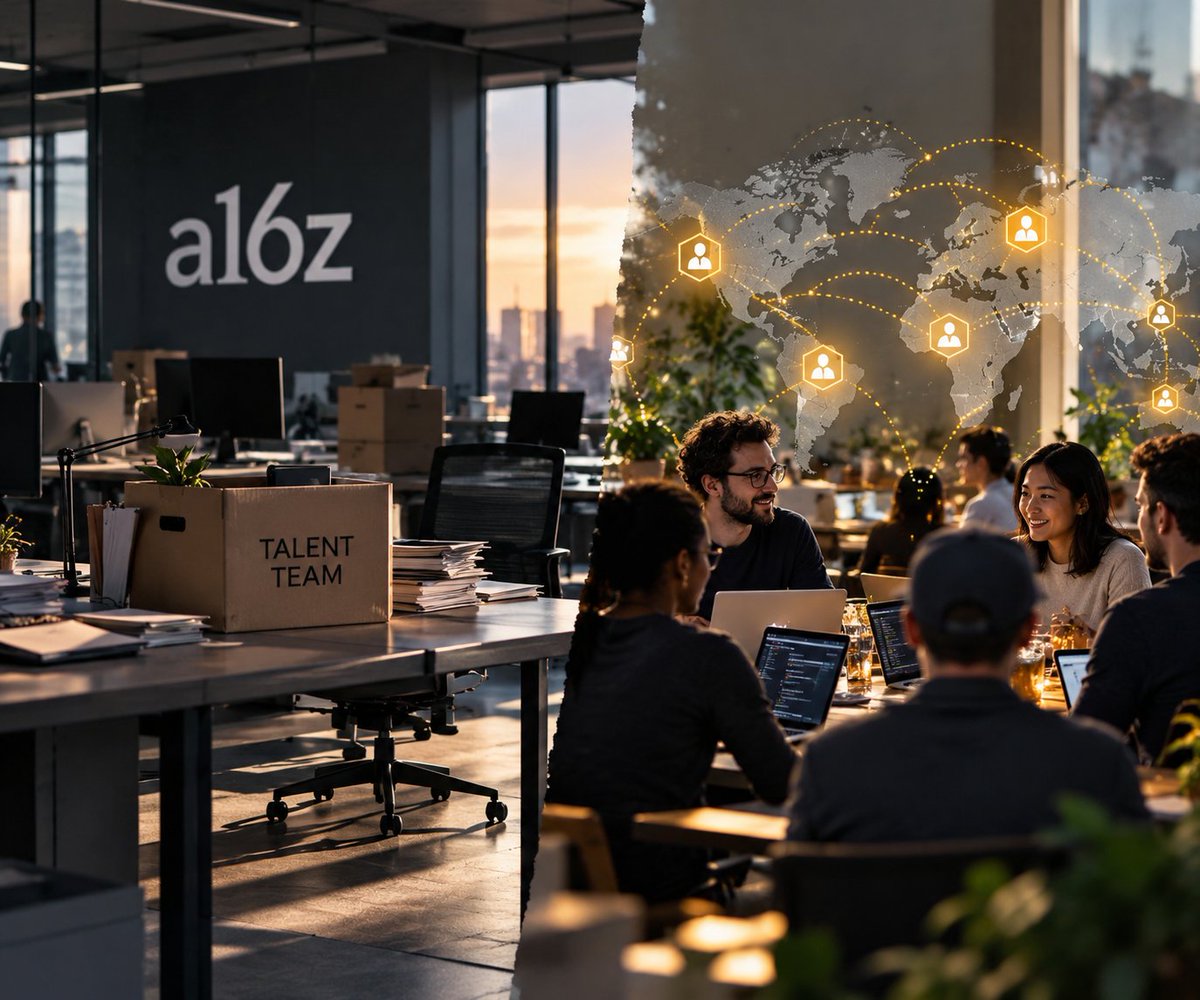
One of Silicon Valley's most influential VC firms just cut most of its recruiting team.
Andreessen Horowitz (@a16z) reportedly laid off the majority of its 34-person talent team, which supported hiring across its portfolio companies.
At a time when exceptional talent has never been more critical to startup success.
But perhaps the real story isn't about layoffs. It's about the economics of recruitment.
For decades, recruiting has relied on centralized teams, proprietary databases and expensive intermediaries. A model built around maintaining permanent capacity, even when hiring demand fluctuates.
What if the competitive advantage is shifting from owning recruiting resources to orchestrating access to the right talent networks?
Imagine a distributed network of trusted professionals who identify, recommend and assess candidates based on their actual expertise, rather than relying exclusively on traditional recruiters.
A network where contributors are rewarded for the value they create, not simply for maintaining an organizational structure.
This is one of the hypotheses we're testing at @GoodHiveLabs, starting with Web3 talent.
But decentralization alone solves nothing.
Trust must be earned. Recommendations must be credible. Quality must be verified. And incentives must align the interests of candidates, companies and contributors.
A distributed recruiting network without these mechanisms is just another database with a community label.
The future may well be hybrid: smaller centralized teams coordinating broader networks of specialized contributors.
Perhaps the next competitive advantage in recruitment won't be the size of your recruiting team, but the quality of the network you can activate.
Can community-driven recruiting outperform traditional models?
Source: Axios, October 14, 2026.
AI makes me feel superhuman. And that's exactly what scares me.
Over a year ago, I used AI to draft complex contracts for @GoodHiveLabs, my collaborative Web3 recruitment platform. Agreements so specific that conventional templates were useless.
Then came prospecting.
Researching a company, understanding its business and crafting genuinely personalized outreach used to take hours per prospect. Scaling that was almost impossible.
AI changed everything.
A few months ago, I was spending three hours a day supervising AI workflows, checking results, testing and correcting errors.
Today? Roughly ten minutes.
I'm automating the supervision itself.
And recently, another revelation: French accounting, taxes and administrative compliance. A bureaucratic nightmare I once thought required an ENA degree just to understand.
Now AI helps me navigate it, ask better questions and understand my obligations.
I've never felt so capable. So autonomous. So augmented.
But here's the paradox.
The more powerful AI makes me, the less human work my business seems to require.
And I'm just one entrepreneur.
Multiply that by millions of companies.
I believe we're approaching a JOB APOCALYPSE.
Call centers, administrative work, accounting and entire categories of traditional jobs could shrink dramatically over the next five years.
Not everyone can reinvent themselves overnight.
What happens to someone who has spent 30 years mastering a profession that AI can suddenly perform in seconds?
We may need to rethink the very meaning of work, how productivity gains are distributed and whether universal basic income becomes a necessity.
Are our political leaders remotely prepared?
The AI revolution won't wait for society to catch up.
#AI #FutureOfWork #JobApocalypse
Web3 doesn't just need more Solidity developers. It needs great engineers.
That's something I've noticed in conversations with founders and CTOs hiring for Web3.
They're not necessarily looking for someone who's spent five years in crypto. They're looking for strong engineering fundamentals, problem-solving skills, code quality and the ability to learn.
And that changes how we should think about the Web3 talent shortage.
Backend engineers, cybersecurity specialists, DevOps experts and distributed systems developers already possess many of the skills this industry needs.
Of course, blockchain introduces specific challenges. Security, decentralization and irreversible transactions require specialized knowledge. For some roles, deep Web3 experience is essential.
But an excellent backend engineer doesn't suddenly become a junior engineer because they're new to blockchain.
At GoodHive, we believe the opportunity goes beyond competing for the same limited pool of experienced Web3 developers. It's also about recognizing transferable expertise and connecting great engineers with companies building decentralized infrastructure.
For founders, that means looking beyond traditional Web3 profiles.
For engineers, it means realizing that the skills they've spent years developing may already be highly valuable in this industry.
The next generation of Web3 engineers may already be out there. They just don't call themselves Web3 developers yet.
#Web3 #Blockchain #Engineering #TechHiring
€3 million sent to Mexico. Six months for the banks to figure out where the money had gone.
Not a crypto hack.
A real cross-border payment involving a CAC 40 company and major international banks.
That story, shared today at @essec, probably says more about the future of blockchain than a thousand discussions about crypto prices.
We gathered Julien Achard (@openbanq), @alixbouxaguet (@krakenfx_FR ), @pablo_veyrat (@merkl_xyz ) and Alexandre Mangin (@Team1FR ), moderated by Hayat Outahar (@GoodHiveLabs), around one question:
What will the financial rails of tomorrow look like?
Three takeaways:
1. Blockchain may not change what finance does. It changes how finance does it.
Atomic settlement, 24/7 markets and smart contracts can remove layers of friction and delay.
2. This increasingly looks like convergence, not a war between TradFi and DeFi.
Pablo made a great point: “DeFi” may actually be a bad name. On-chain finance or open finance better describes where we're heading.
Julien made another provocative prediction:
“By 2035, the RIB could be gone.”
3. The real battle may be about standards, currencies and network effects.
Dollar stablecoins already dominate liquidity. Could decentralized financial rails actually reinforce the dollar’s global dominance rather than weaken it?
The question is no longer simply whether finance will move on-chain.
It’s which rails, standards, currencies and actors will shape it once it does.
Great discussion with @KRYPTOSPHERE_ ESSEC, and proud to have contributed through GoodHive and the ESSEC Alumni Digital & Technology Club.
Next stop: stablecoins and the future of money on December 3 - stay tuned.
@VitalikButerin's experiment raises a fundamental question:
Do we have to choose between an AI that truly knows us and an AI that preserves our privacy?
What if there is another path?
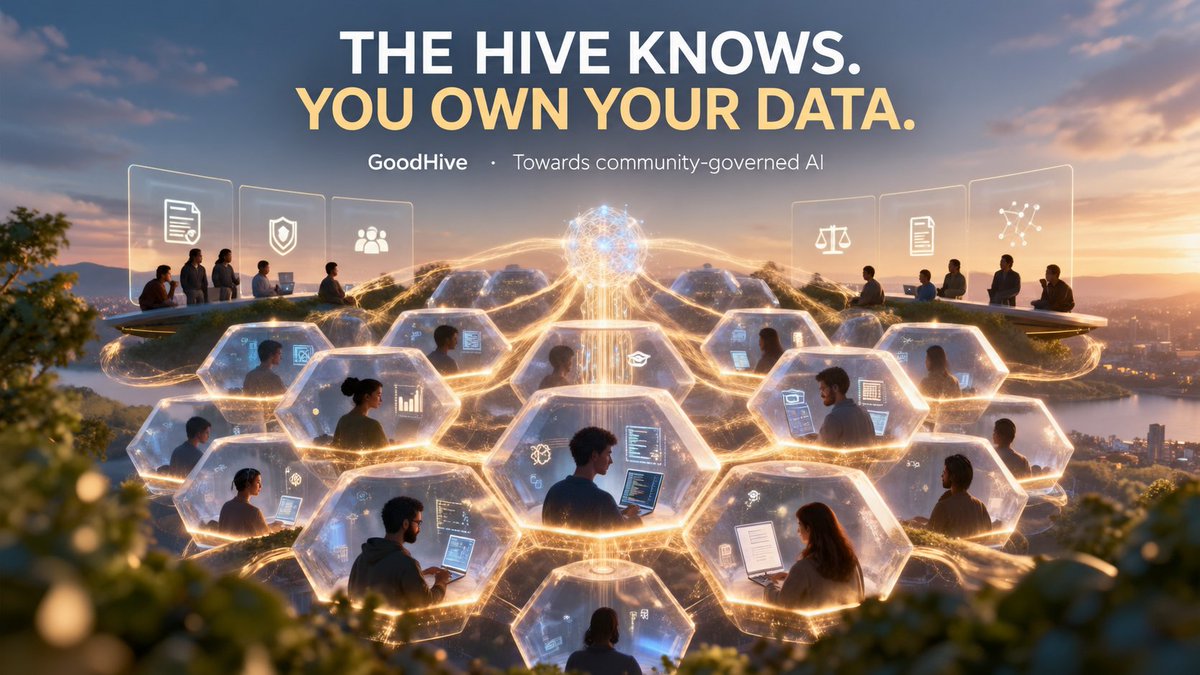
Personal data could remain encrypted and user-controlled. AI computation could happen inside protected environments. The rules governing how AI uses our data could be transparent, auditable and collectively governed.
The user owns the data.
The community governs the rules.
Cryptography helps enforce and verify them.
At @GoodHiveLabs, this becomes particularly interesting around professional identity.
Imagine an AI that knows your skills, experience, reputation, ambitions and peer validation well enough to identify the right opportunities, while recruiters initially see only that you're a strong match.
You decide when your identity and additional information are revealed.
The AI performs the search. The human creates the relationship.
We're exploring this as part of GoodHive's Higher Purpose.
Maybe the next frontier isn't simply smarter AI.
It's AI where trust can increasingly be replaced by verification.
🐝 Want to challenge the idea or help shape it? Join the GoodHive Discord and let's discuss. https://t.co/4oLlGqB6iC
#AI #Privacy #DecentralizedAI #GoodHive
The future of Web3 is built by talent. 🚀
Proud to support @KRYPTOSPHERE_ ESSEC Career Days, bringing students, builders and leading Web3 companies together to explore the future of finance.
See you Oct 7 at ESSEC!
#Web3TalentFair#Web3
What if blockchain doesn’t just improve finance, but gradually decentralizes it?
Financial infrastructure is already digital. Yet it remains fragmented, dependent on multiple intermediaries, legacy systems and market structures designed decades ago.
Blockchain introduces a different set of rails: programmable assets, 24/7 markets, on-chain settlement, DeFi and shared financial infrastructure.
The first transformation is about efficiency.
But the more interesting question comes next:
What happens when traditional financial institutions start adopting decentralized rails?
Does blockchain simply make the existing financial system more efficient? Or does it progressively change the role of banks, exchanges, protocols and market infrastructures themselves?
That’s what we’ll discuss at ESSEC on October 7 with Julien Achard (@openbanq ), @alixbouxaguet (@krakenfx ), @pablo_veyrat (@merkl_xyz) and Alexandre Mangin (@AvaxTeam1), moderated by Hayat Outahar (GoodHive).
📍 ESSEC Cergy
📅 October 7 — 7 PM
🎟️ Career Days registration https://t.co/kUoq8GTjvO
Proud, through @GoodHiveLabs and the ESSEC Alumni Digital & Technology Club, to support @KRYPTOSPHERE_ ESSEC in bringing together the people building the next generation of financial infrastructure.
Better financial rails, or a more decentralized financial system? Probably both.
#Blockchain #DeFi #Tokenization #OnChain #GoodHive
Which skills should you develop to position yourself in Web3?
Introducing @GoodHiveLabs first Web3 Talent Barometer. Each month, we’ll examine technical hiring requirements to help talent make informed learning and career decisions, and give employers a clearer view of the expertise teams need.
Our first expanded research watchlist contains 121 technical roles across 58 companies. We classified 49 as backend or infrastructure, compared with 10 focused on smart contracts and protocol applications.
The interesting part is how skills connect to the products being built.
Among Web3-native teams, Aave’s vaults backend role combines indexing, orchestration, PostgreSQL and GraphQL, with Rust preferred. Stellar pairs C++ and Rust with consensus, peer-to-peer systems and performance. Coinflow connects application-stack knowledge with security engineering in payments.
Institutional teams bring other combinations. Goldman Sachs connects Canton/Daml with EVM interoperability and tokenization. Wells Fargo names Go, consensus engineering, MPC and confidential computing.
And the boundary between these groups is not clean. Crypto-native providers such as Anchorage Digital, Digital Asset and BitGo also build infrastructure serving institutions.
For talent, our first takeaway is to connect your learning to the systems you want to build. DeFi applications, blockchain protocols, payments and custody require different combinations of expertise.
For employers, a useful hiring brief should describe what an engineer must build, secure and operate, alongside the technologies involved.
This first corpus is partial, with mixed signal dates. It is not a representative market sample or evidence of growth.
We’ll progressively strengthen the methodology and coverage. Monthly observations should help us distinguish recurring requirements from genuinely emerging needs.
Follow the series on the GoodHive blog:
https://t.co/lZQQuUrcNn
First observations today. A clearer picture, edition by edition.