@OrangSelangor Quite the opposite. The way I see it, Singapore is destined to become exponential richer than now in foreseen future. Global capital seeking safe haven or investment opportunities will keep flowing in from HK, EU, and SEA.
Today we reduced headcount by 22%. The business is the strongest it's ever been. So I think it's important to be direct about what I'm seeing and why.
First, I made this decision and I own it. I did it because the way to operate at the highest level of productivity is changing, and to win the future, ClickUp needs to change with it.
Second, this wasn't about cutting costs. Most savings from this change will flow directly back into the people who stay. We'll be introducing million-dollar salary bands. If you create outsized impact using AI, you'll be paid outside of traditional bands.
Most importantly, I have the deepest gratitude for those affected. We're doing this from a position of strength specifically so we can take care of people properly. Everyone affected receives a package aimed at honoring their contributions and easing the transition.
I only see two options: wait for this to play out gradually in the market or be honest about what I'm seeing and act proactively.
THE 100X ORGANIZATION
The primary change is that we're restructuring around what I call 100x org. The goal is 100x output. The roles required to build at the highest level are fundamentally different than they were a year ago.
Incremental improvements to existing systems won't get us there. We need new ones. That means creating enough disruption to rebuild rather than iterate on what's already broken.
The common narrative is that AI makes everyone more productive. It doesn't. Many of the workflows of today, if left unchanged, create bottlenecks in AI systems.
These roles will evolve. But waiting for that to happen naturally means falling behind now.
The 100x org is actually heavily dependent on people - infinitely more than today. This is only possible with 10x people that have embraced and adopted new ways of working.
THE BUILDERS, AGENT MANAGERS, AND FRONT-LINERS
— THE BUILDERS: 10X ENGINEERS
I don't think most companies have internalized what's actually happening with AI in engineering. The common narrative is that AI makes all engineers more productive. That may be true in isolation, but at an organization level - that is the farthest thing from reality.
Here's what we've validated recently at ClickUp: the great engineers, the ones who can orchestrate, architect, and review, are becoming 100x engineers. They're not writing code. They're directing agents that write code. The skill is judgment.
AI makes the best engineers wildly more productive, and everyone else using AI slows these engineers down.
Think about it - the bottlenecks are (1) orchestration - telling AI what to do, and (2) reviewing - what AI did. Everything is leapfrogged and no longer needed.
So who do you want orchestrating and reviewing code?
And how do you want your best engineers to spend their time?
If your best engineers are spending time reviewing other people's code, then this is inherently an inefficient bottleneck. These engineers can review their agent's code much faster than reviewing human code.
The new world is about enabling your 10x engineers to become 100x.
The wrong strategy is to push every engineer to use infinite tokens. Companies doing this are celebrating 500% more pull requests. But customer outcomes don't match the volume of code being generated.
I call this the great reckoning of AI coding, and every company will face this soon if not already.
More code is just another bottleneck to the best engineers, and ultimately to your company's impact as well.
— THE BUILDERS: 10X PRODUCT MANAGERS
Product management and design roles are merging.
Designers that have customer focus, become more like product managers.
And product managers that have intuition for UX become more like designers.
The bottleneck of user research is gone. It takes us just one mention of an agent to kickoff research and analyze results.
The bottleneck of product <> design iteration is also gone. The product builder iterates on their own, along with agents and skills that ensure alignment with quality and strategy.
Also controversial today - I believe that the wrong strategy is to have your PMs shipping code - that just introduces another bottleneck that the best engineers will waste their time on.
To be clear, PMs should be coding but they should do this in a playground to iterate, validate, and scope. That code should not go to production.
Everything outside of managing systems, orchestrating AI, and reviewing output becomes a bottleneck.
That's why the other roles that are critical along with these are the systems managers (to reduce bottlenecks) along with a bottleneck you can't replace - customer meeting time.
— THE SYSTEM MANAGERS
Ironically, the people that automate their jobs with AI will always have a job. They become owners of the AI systems - agent managers. We have many examples of these people at ClickUp.
The underlying systems in which we operate are absolutely critical to get right. I think most companies are delusional to think they can iterate on existing systems and compete in this new world.
You must create enough disruption so that old systems are deprecated entirely. If there's any definition for 'AI native' that's what it is.
— THE FRONT-LINERS
In a world that will become saturated with AI communication, the human touch will matter more than anything to customers.
This is a bottleneck that you shouldn't replace - even when agents are high enough quality to do video meetings.
One-on-one meeting time with customers is something that shouldn't be automated. The systems around the meetings should be - so that front-liners spend nearly 100% of their time with customers.
REWARDING 100X IMPACT
In a world where companies are able to do so much more with less, where does that excess money go?
In our case, much of the savings in this new operating model will flow directly back to those that enabled it.
We must reward people that create productivity accordingly. This aligns incentives on both sides. Plus, in a world where your best people create 100x impact, you can't afford to lose them.
You should aim to retain these employees for decades. The context they have and their ability to efficiently orchestrate and review will be nearly impossible to replace.
Compensation bands of today should be thrown out the door. We're introducing $1 million cash/year salary bands with a path available to nearly everyone in the company if they produce 100x impact by creating or managing AI systems.
THE FUTURE
Nearly every company will make changes like these. The ones that do it proactively will define what comes next.
The future is not fewer people. It's different work, new roles, and better rewards for those who embrace it. We're already seeing entirely new roles emerge, like Agent Managers, that didn't exist a year ago.
ClickUp is positioning to lead this shift, not just internally, but for our customers too. I've never been more certain about where we're headed.
I could never say this better, please understand: “Google’s guidance on AI Search is one opinion. It is the opinion of the company with the most to lose from a multi-platform world. Read it. Take what is useful. Apply it where it applies. Don’t mistake it for the truth.”
I mean, you knew I was going to have a thought on Google's AI Search guidance, right?
Google wants SEOs to stay the janitors of the web. Their new AI Search guide is the proof.
The "it's just SEO" crowd is celebrating it like an album release party. They were waiting for permission to keep doing what they were already doing.
Naturally, I have a different position.
Y'all are being naive af.
https://t.co/wvu8ZHQ1cr
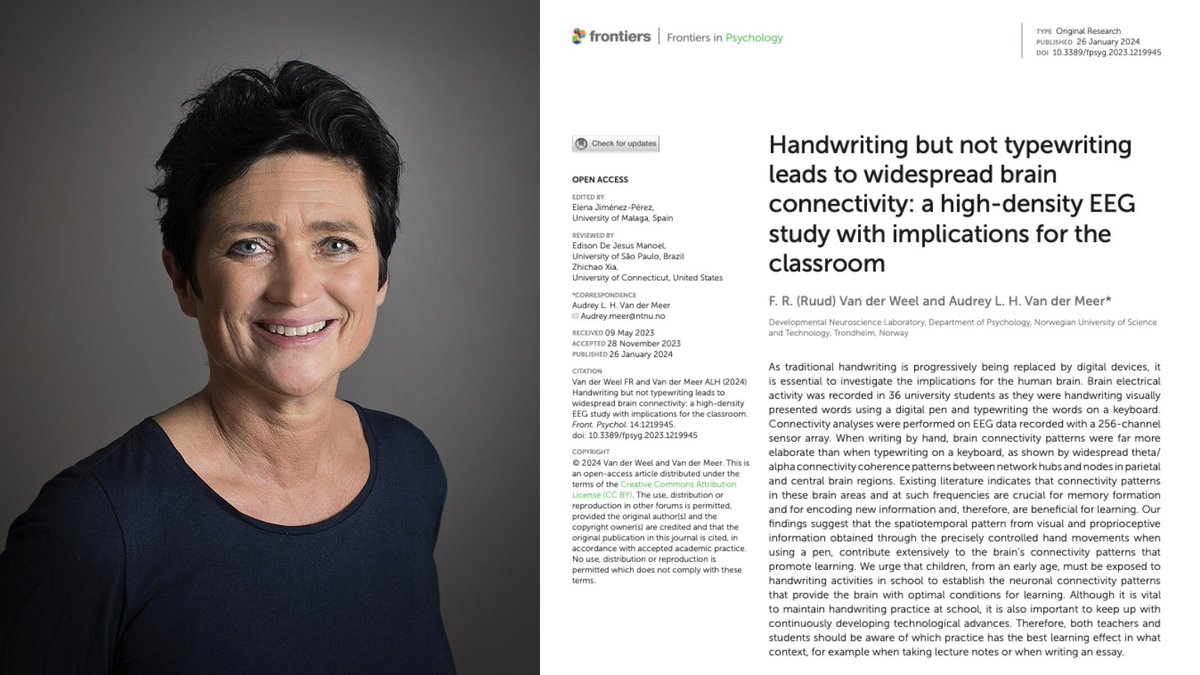
A Norwegian neuroscientist spent 20 years proving that the act of writing by hand changes the human brain in ways typing physically cannot, and almost nobody outside her field has read the paper.
Her name is Audrey van der Meer.
She runs a brain research lab in Trondheim, and the paper that closed the argument was published in 2024 in a journal called Frontiers in Psychology. The finding is brutal enough that it should have changed every classroom on Earth.
The experiment was simple. She recruited 36 university students and put each one in a cap with 256 sensors pressed against their scalp to record brain activity. Words flashed on a screen one at a time.
Sometimes the students wrote the word by hand on a touchscreen using a digital pen, and sometimes they typed the same word on a keyboard. Every neural response was recorded for the full five seconds the word stayed on screen.
Then her team looked at the part of the data most researchers had ignored for years, which is how different parts of the brain were communicating with each other during the task.
When the students wrote by hand, the brain lit up everywhere at once.
The regions responsible for memory, sensory integration, and the encoding of new information were all firing together in a coordinated pattern that spread across the entire cortex. The whole network was awake and connected.
When the same students typed the same word, that pattern collapsed almost completely.
Most of the brain went quiet, and the connections between regions that had been alive seconds earlier were nowhere to be found on the EEG.
Same word, same brain, same person, and two completely different neurological events.
The reason turned out to be something nobody had really paid attention to before her work. Writing by hand is not one motion but a sequence of thousands of tiny micro-movements coordinated with your eyes in real time, where each letter is a different shape that requires the brain to solve a slightly different spatial problem.
Your fingers, wrist, vision, and the parts of your brain that track position in space are all working together to produce one letter, then the next, then the next.
Typing throws all of that away. Every key on a keyboard requires the exact same finger motion regardless of which letter you are pressing, which means the brain has almost nothing to integrate and almost no problem to solve.
Van der Meer said it plainly in her interviews.
Pressing the same key with the same finger over and over does not stimulate the brain in any meaningful way, and she pointed out something that should scare every parent who handed their kid an iPad.
Children who learn to read and write on tablets often cannot tell letters like b and d apart, because they have never physically felt with their bodies what it takes to actually produce those letters on a page.
A decade before her, two researchers at Princeton ran the same fight using a completely different method and ended up at the same answer. Pam Mueller and Daniel Oppenheimer tested 327 students across three experiments, where half took notes on laptops with the internet disabled and half took notes by hand, before testing everyone on what they actually understood from the lectures they had watched.
The handwriting group won by a wide margin on every question that required real understanding rather than surface recall.
The reason was hiding in the transcripts of what the two groups had actually written down.
The laptop students typed almost word for word, capturing more total content but processing almost none of it as they went, while the handwriting students physically could not write fast enough to transcribe a lecture in real time, which forced them to listen carefully, decide what actually mattered, and put it in their own words on the page.
That single act of choosing what to keep was the learning itself, and the keyboard had quietly skipped the choosing and skipped the learning along with it.
Two studies. Two countries. Same answer.
Handwriting makes the brain work. Typing lets it coast.
Every note you have ever typed instead of written went into your brain through a thinner pipe. Every meeting, every book highlight, every idea you captured on your phone instead of on paper was processed at half depth.
You did not forget those things because your memory is bad. You forgot them because typing never woke the part of the brain that would have made them stick.
The fix is the thing your grandmother already knew.
Pick up a pen. Write the thing down. The slower road is the faster one.
Today, a CIA whistleblower sat before my committee and confirmed what I've said for years: government officials, including Dr. Fauci, deliberately misled the American people about the origins of COVID-19. This is not a conspiracy theory. This is sworn testimony. 🧵
After several years of declining search traffic, Condé Nast CEO @rogerlynch has directed all the company's brands to operate as if search traffic to their properties will be zero.
He says the era of turning search and social media traffic into profitable businesses is gone.
And that if you run a media business that doesn't have an authoritative brand, a very strong niche, or a direct audience, you're going to be fighting hostile algo changes all the way down.
He describes a recent board meeting:
"We took a snapshot of search results from seven or eight years ago. And what you saw were a few sponsored links, then the ten blue links."
"Do the same search today, you get an AI overview, then you get rows and rows and rows of commerce links, then you get sponsored stuff."
"Each of the last three years, we would do our budgets, and we'd put forecasts in of search traffic declining. Because we'd seen the pattern of algorithm changes. And generally those algorithm changes were negative."
"Every year, our search traffic was down more than we had forecast. So last year I told our teams, 'Assume there's no search.' You have to have your businesses planned as if search is zero. We don't expect it to be zero, we expect it to be a single-digit percentage of our traffic."
Anthropic's applied AI team just showed how to actually prompt Claude properly.
24 minutes. free. from the people who built it.
watch the workshop. bookmark it.
you've been prompting Claude for months without the 6 elements.
I built a skill that applies them for you. read the guide below.
In 14 minutes, this Anthropic engineer who wrote "Building Effective Agents" will
teach you more about building them right than most developers figure out on their own
in months.
Bookmark this for the weekend. Then read the builder's guide below.
The sun was free. They sold you SPF 50 and a vitamin D deficiency.
Sleep was free. They sold you an app, a pill, and a wearable that tells you your sleep was bad.
Walking was free. They sold you a treadmill, a fitness tracker, and a £180 pair of trainers.
Fasting was free. They sold you meal replacement shakes and the anxiety that skipping breakfast would wreck your metabolism.
Cold water was free. They sold you a £3,000 plunge barrel and a podcast episode about it.
Silence was free. They sold you a meditation app with a premium tier.
Animal fat was cheap. They sold you seed oils, then supplements to replace what the animal fat contained.
Tallow was cheap. They sold you a seventeen-step skincare routine and a clinical trial proving your face needs ceramides.
Meat was cheap. They are currently selling you the idea that you shouldn't eat it.
The 20th century removed access to everything the body needs to function.
The 21st century is selling it back, one subscription at a time.
Your great-grandmother had none of the products.
She had all of the things.
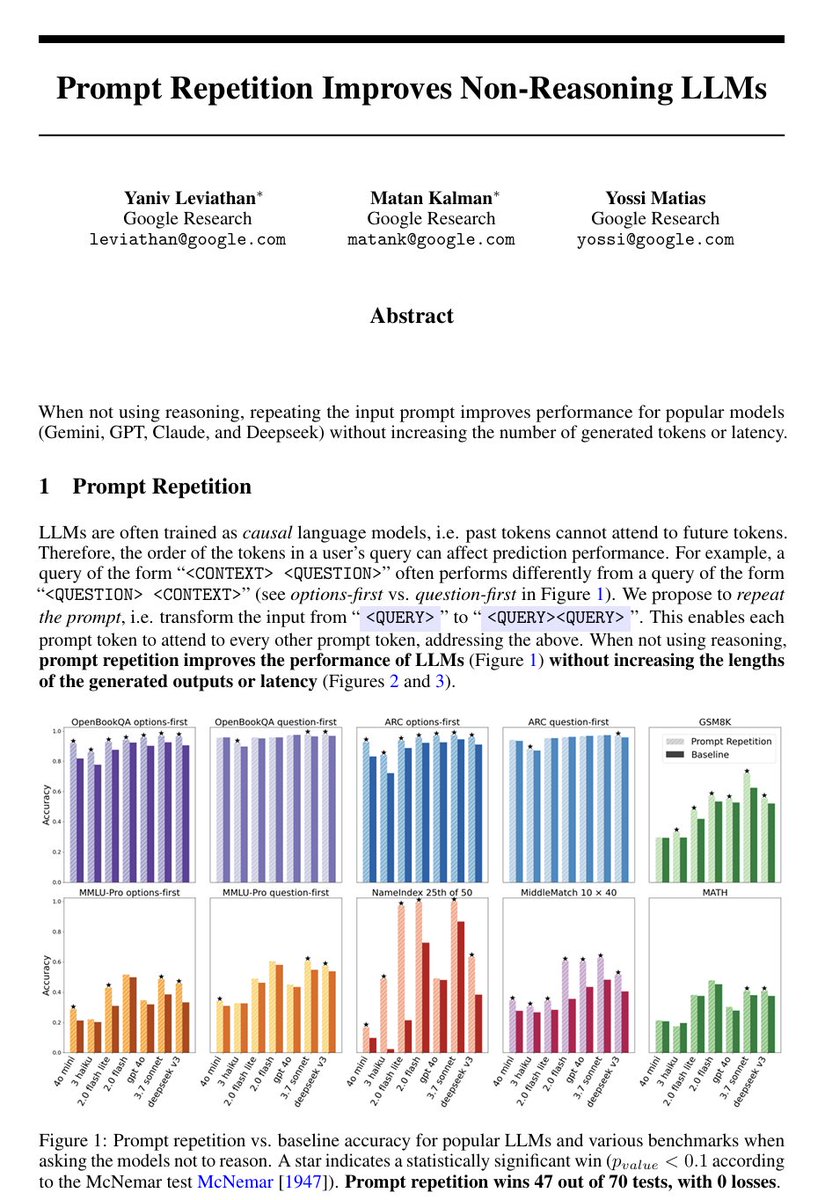
LLMs process text from left to right — each token can only look back at what came before it, never forward. This means that when you write a long prompt with context at the beginning and a question at the end, the model answers the question having "seen" the context, but the context tokens were generated without any awareness of what question was coming. This asymmetry is a basic structural property of how these models work.
The paper asks what happens if you just send the prompt twice in a row, so that every part of the input gets a second pass where it can attend to every other part. The answer is that accuracy goes up across seven different benchmarks and seven different models (from the Gemini, ChatGPT, Claude, and DeepSeek series of LLMs), with no increase in the length of the model's output and no meaningful increase in response time — because processing the input is done in parallel by the hardware anyway.
There are no new losses to compute, no finetuning, no clever prompt engineering beyond the repetition itself.
The gap between this technique and doing nothing is sometimes small, sometimes large (one model went from 21% to 97% on a task involving finding a name in a list). If you are thinking about how to get better results from these models without paying for longer outputs or slower responses, that's a fairly concrete and low-effort finding.
Read with AI tutor: https://t.co/MipHHO6rjX
Get the PDF: https://t.co/XQrqiaGwIO
NEW research: https://t.co/yE1LogIFHO
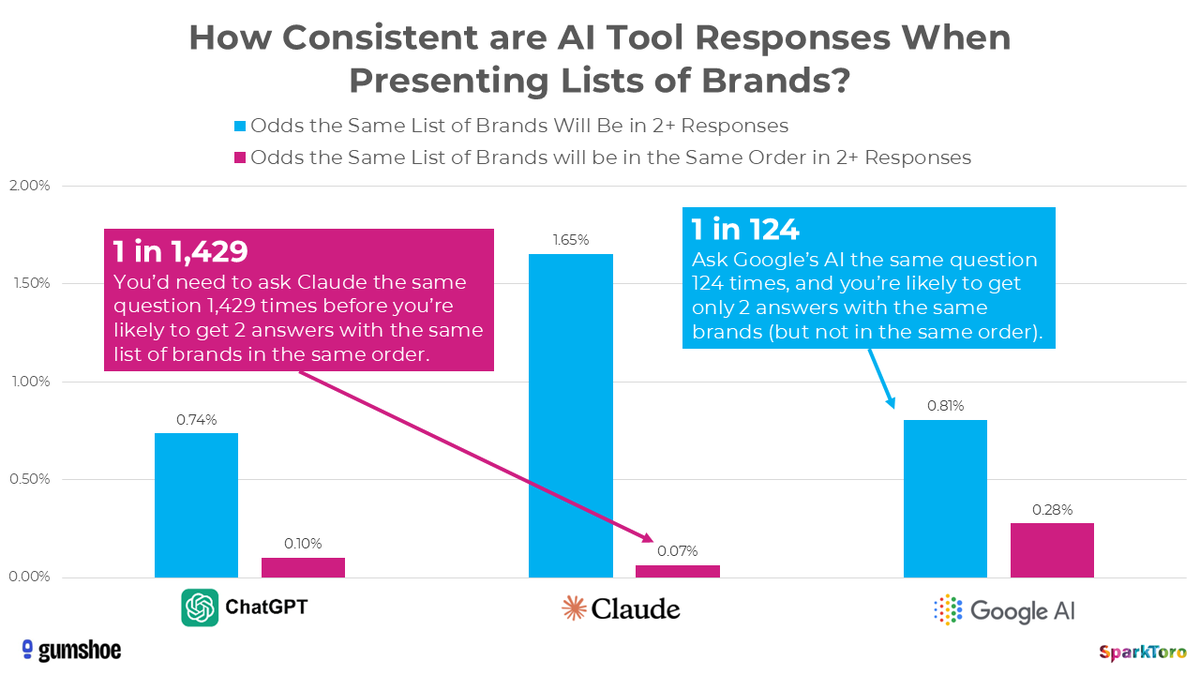
If you give ChatGPT the same request for product recommendations 100X, will you ever get the same list twice?
And what does that answer mean for folks who try to track their brand presence in AI tools?
Finally, some real answers 🧐
I'm a Reserve Manager at a central bank.
My job is buying gold.
297 tons this year.
Quietly.
While we print money.
Loudly.
Gold hit $5,000 an ounce yesterday.
We've been buying since it was $1,800.
That's called "reserve diversification."
Diversification means we don't trust our own currency.
But we can't say that.
So we say "diversification."
The Governor went on television last month.
He said inflation is "anchored."
Anchored means 6%.
Used to mean 2%.
We moved the anchor.
That's monetary policy.
He said the currency is "sound."
Sound means losing 20% of its value.
Per year.
But it sounds sound.
That's what matters.
We bought 45 tons in November.
Poland bought 95 tons.
Brazil bought 43.
China reports 1 ton.
China is lying.
We all know.
Nobody says it.
95% of central banks plan to buy more gold next year.
That's a survey.
We surveyed ourselves.
On whether we trust ourselves.
We don't.
We trust gold.
Citizens ask why prices keep rising.
We say "supply chains."
We say "external factors."
We don't say "we printed 40% of all money in existence since 2020."
That's not external.
That's us.
The Finance Minister asked if gold is a hedge against our own policies.
I said "gold is a strategic reserve asset."
Strategic means yes.
I just can't say yes.
Gold is $5,000 now.
Our currency buys less every day.
Our gold buys more.
That's the strategy.
For us.
Not for you.
You get the currency.
We get the gold.
That's central banking.