$QTC #QuantusNetwork
Fair concern, but the 27% is fully disclosed in the whitepaper. Only 1% of supply was liquid at launch. The investor and team share is locked for a year, then vests over 36 months on-chain. The other 73% can only be mined, with no dev tax. https://t.co/pS5e0Q5EdL
$QTC went from $10 to $186 in 26 days.
$ZEC is worth around $21B.
@QuantusNetwork is only $36M.
Both have a 21M supply cap and use proof of work.
But QTC launched with post-quantum signatures from day one.
Let's understand why Quantus is drawing attention👇
✤ 𝐏𝐨𝐬𝐭-𝐪𝐮𝐚𝐧𝐭𝐮𝐦 𝐬𝐢𝐠𝐧𝐚𝐭𝐮𝐫𝐞𝐬 𝐟𝐫𝐨𝐦 𝐛𝐥𝐨𝐜𝐤 𝐨𝐧𝐞:
Quantus is building a proof-of-work blockchain designed for a future where quantum computers could threaten today's cryptographic signatures.
Bitcoin and most existing blockchains rely on elliptic-curve cryptography. A sufficiently powerful quantum computer could eventually undermine the signatures used to authorize transactions.
Quantus launched on September 9 with post-quantum cryptography built into its base layer.
Its core features include:
• ML-DSA signatures, standardized by NIST
• ML-KEM for peer-to-peer connections
• Proof of work with a 21M maximum supply
• Private balances through wormhole addresses
Mining rewards go to wormhole addresses by default, making it harder to link public mining activity directly to a miner's payout address.
The idea is to combine Bitcoin's familiar monetary model with cryptography designed for the quantum era.
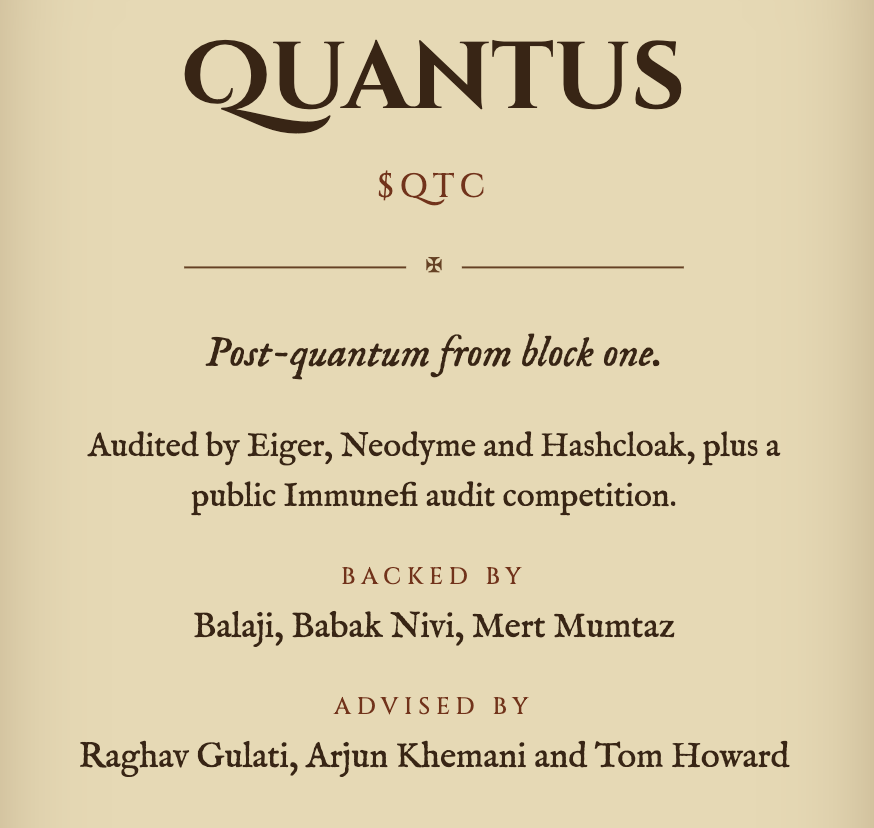
Founders Christopher Smith and Joseph Mattia have raised $2.42M in total, including a $770K round led by Balaji Srinivasan at a reported $100M token valuation.
✤ 𝐀 𝐥𝐢𝐯𝐞 𝐜𝐡𝐚𝐢𝐧 𝐰𝐢𝐭𝐡 𝐜𝐫𝐨𝐬𝐬-𝐜𝐡𝐚𝐢𝐧 𝐚𝐜𝐜𝐞𝐬𝐬:
Quantus mainnet launched on September 9, and GPU mining is live.
The network has reported roughly 41 TH/s of hashrate, with block rewards around 0.31 QTC. Emissions decline smoothly rather than following Bitcoin-style halvings.
On October 6, $QTC became available through NEAR Intents. Users can swap in from 180+ assets across 30+ chains, including BTC, ETH, SOL and ZEC. Swaps are designed to be confidential by default.
The current product stack includes:
• A wallet supporting wormhole and encrypted accounts
• Private-by-default mining payouts
• GPU mining on the live network
• Cross-chain swaps through NEAR Intents
Quantus has also hosted Quantum and Privacy Day with NEAR, bringing more attention to its approach to private, quantum-resistant money.
NEAR Intents gives users a way to access $QTC across chains without relying entirely on centralized exchange listings.
With mining, wallet infrastructure and cross-chain swaps available, the project has several routes through which its ecosystem can grow.
✤ 𝐀 $𝟑𝟔𝐌 𝐜𝐢𝐫𝐜𝐮𝐥𝐚𝐭𝐢𝐧𝐠 𝐦𝐚𝐫𝐤𝐞𝐭 𝐜𝐚𝐩 𝐰𝐢𝐭𝐡 𝐚 𝟐𝟏𝐌 𝐬𝐮𝐩𝐩𝐥𝐲 𝐜𝐚𝐩:
Here are the reported token figures:
• Price: ~$131
• Circulating market cap: ~$36M
• FDV: ~$750M
• Maximum supply: 21M QTC
• Circulating supply: ~272K, roughly 1.3% of the maximum
The supply structure is central to the $QTC thesis.
Around 27% of the supply was minted at genesis, approximately 5.67M QTC. Investor, founder and team allocations account for 23%, while the company allocation is 4%.
The company allocation is locked for one year after mainnet launch, followed by a 36-month release schedule. Most genesis coins remain locked rather than burned.
The remaining 73%, or 15.33M QTC, is reserved for mining. Standard block rewards and fees go entirely to miners, with no developer tax.
Quantus uses a smooth emission curve, with rewards tied to the remaining supply rather than periodic halvings.
With only around 272K QTC circulating, the market is still operating with a very small public float. As mining and circulation expand, the distribution of coins will become an important part of the network's development.
✤ 𝐙𝐜𝐚𝐬𝐡 𝐢𝐬 𝐭𝐡𝐞 𝐩𝐫𝐢𝐯𝐚𝐜𝐲 𝐜𝐨𝐦𝐩𝐚𝐫𝐢𝐬𝐨𝐧. 𝐁𝐢𝐭𝐜𝐨𝐢𝐧 𝐢𝐬 𝐭𝐡𝐞 𝐪𝐮𝐚𝐧𝐭𝐮𝐦 𝐜𝐨𝐦𝐩𝐚𝐫𝐢𝐬𝐨𝐧.:
Zcash ( $ZEC ) is the closest established comparison: proof of work, a 21M supply cap and shielded balances. Its market cap is roughly $21B.
Quantus sits around $36M on a circulating basis.
Zcash demonstrated that there is a market for private digital money. Quantus is attempting to combine that model with post-quantum signatures from genesis.
Bitcoin provides the other side of the thesis. It has the fixed-supply, mineable monetary model, but its current signature system could face a potential quantum threat if sufficiently capable machines become practical.
The timing remains uncertain, and existing networks could migrate to quantum-resistant cryptography. Quantus is positioning itself for that longer-term challenge before it becomes an immediate concern.
Quantus is still small relative to established privacy-focused networks, while its technical design targets both private transactions and post-quantum security.
✤ 𝐖𝐡𝐚𝐭 𝐰𝐨𝐮𝐥𝐝 𝐦𝐚𝐤𝐞 𝐭𝐡𝐞 𝐭𝐡𝐞𝐬𝐢𝐬 𝐰𝐨𝐫𝐤?
Three metrics matter more than another quantum-themed announcement.
• Mining concentration: Kryptex has reportedly produced around 70% of blocks. That is a major concentration point for a young proof-of-work network.
• Supply entering circulation: Most genesis coins remain locked, and scheduled unlocks begin one year after mainnet.
• Actual privacy usage: Watch hashrate, miner distribution, wormhole activity and sustained NEAR Intents volume.
A 21M cap, proof of work, private balances and post-quantum signatures from genesis make Quantus a more coherent proposition than projects that simply attach a quantum narrative to an existing token.
If mining becomes more distributed and wormhole balances see sustained use, Quantus has a credible niche to develop.
Watch the hashrate, pool share and actual privacy usage, not just the quantum narrative.
NFA. DYOR.
RHEA Finance is the liquidity layer of $QTC
@QuantusNetwork quantum secure encrypted money
> L1
> 21M hard cap
> Proof of Work
> Post-quantum signatures (NIST FIPS 204).
> Trade and provide liquidity on RHEA
Now tradable on https://t.co/Zn1mSi4P3n & https://t.co/K5k0Roe6Tw
Post-quantum money, now with a home for liquidity on RHEA
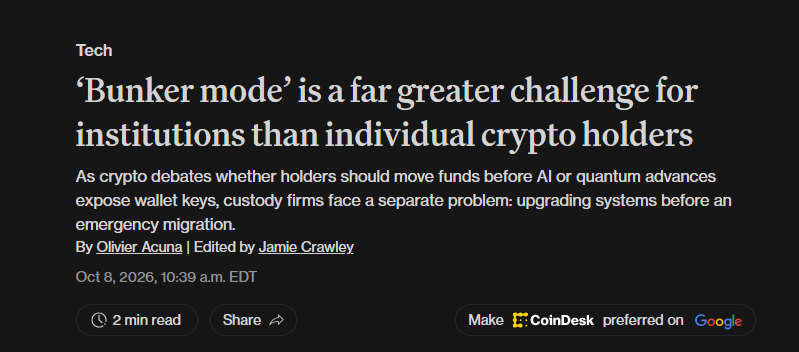
Institutions cannot go into “bunker mode” overnight.
@CoinDesk on how Quantus and @projecteleven are working to bring post-quantum custody to institutions.
makes sense why $QTC is up 60% over the past 2 days
especially after yday when an ethereum researcher told people to prepare for "bunker mode" in case AI finds a way to break ECDSA
One challenge that persisted in crypto is that almost intentional way of communicating complexity publicly.
This among other things what leads to proliferation of scams as it’s easy for non experts to get lost in all the jargon and hard to distinguish what is real innovation.
Same is happening now - cryptographers sharing the possible risks in current schemes publicly without either explaining that other solutions are already in the works or giving historic context that cryptography has been evolving over past 50 years and has advanced every time to get ahead of found issues.
Leaders in the space must uplevel comms to explain things simpler and bring pragmatic solutions to market.
1/ The Numbers:
$QTC is around $166, with ~$47M circulating market cap and ~$1B FDV.
Only ~270K QTC is circulating against a 21M max supply.
24h volume crossed $50M, showing how thin the new market is.
Quantum Bitcoin.
Account followed by Balajis, Cobie, Mert, Naval and more big names.
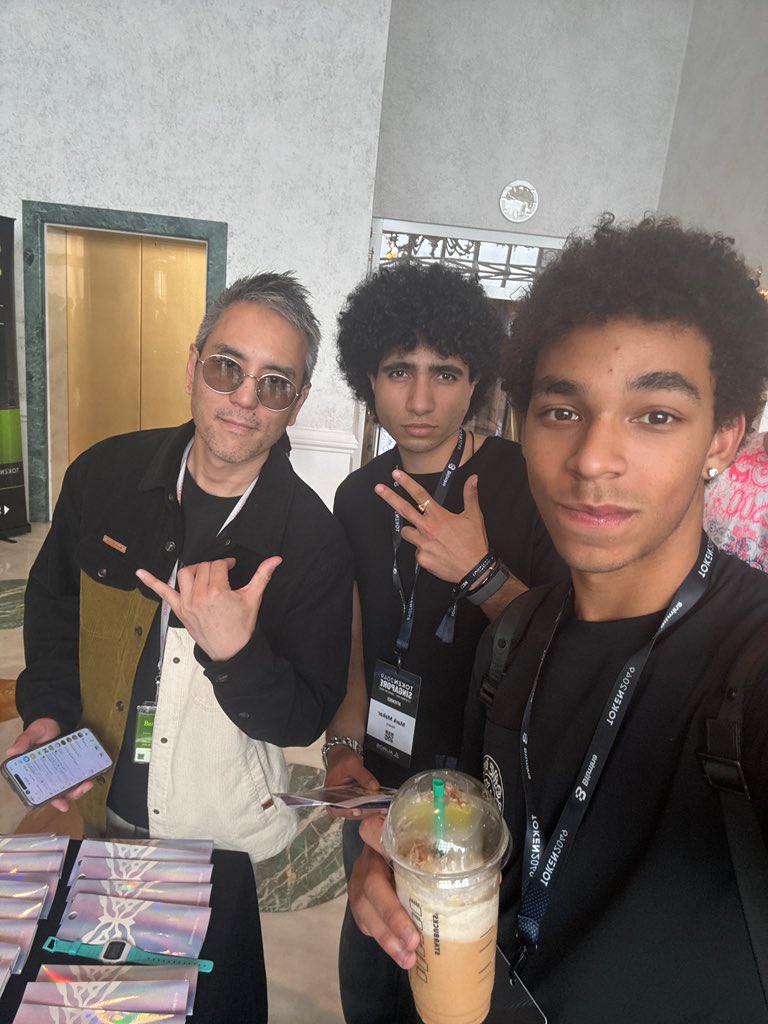
Also NEAR is actively talking about them and gave them a dedicated day during their events.
Circ MC is (approx) under 7M.
Can’t buy on DEX either.
This is the classic example of how to frontrun EVERYONE.
We bidded massive amounts of $QTC early. From $20-60 in @CryptoGoats__
Most people couldn’t even understand what it was, or how to buy it.
Meanwhile, the reality was that there was SO MUCH alpha behind the project, and it’s getting more and more bullish.
A realistic target?
Probably $700-$900.
That’s going to be a clean 20-50X for those who were early.
Privacy needs to survive the journey across chains.
@AlexAuroraDev is now on stage, unpacking the practical privacy work behind @near_intents.
https://t.co/JRCV1Lj63i
Now live: “Keep It Secret, Keep It Safe?”
@azeemk and @SebastienGllmt are exploring the technical foundations of private, post-quantum money, and what it takes to protect user information as cryptographic risks change.
https://t.co/XTJtkZVXAw