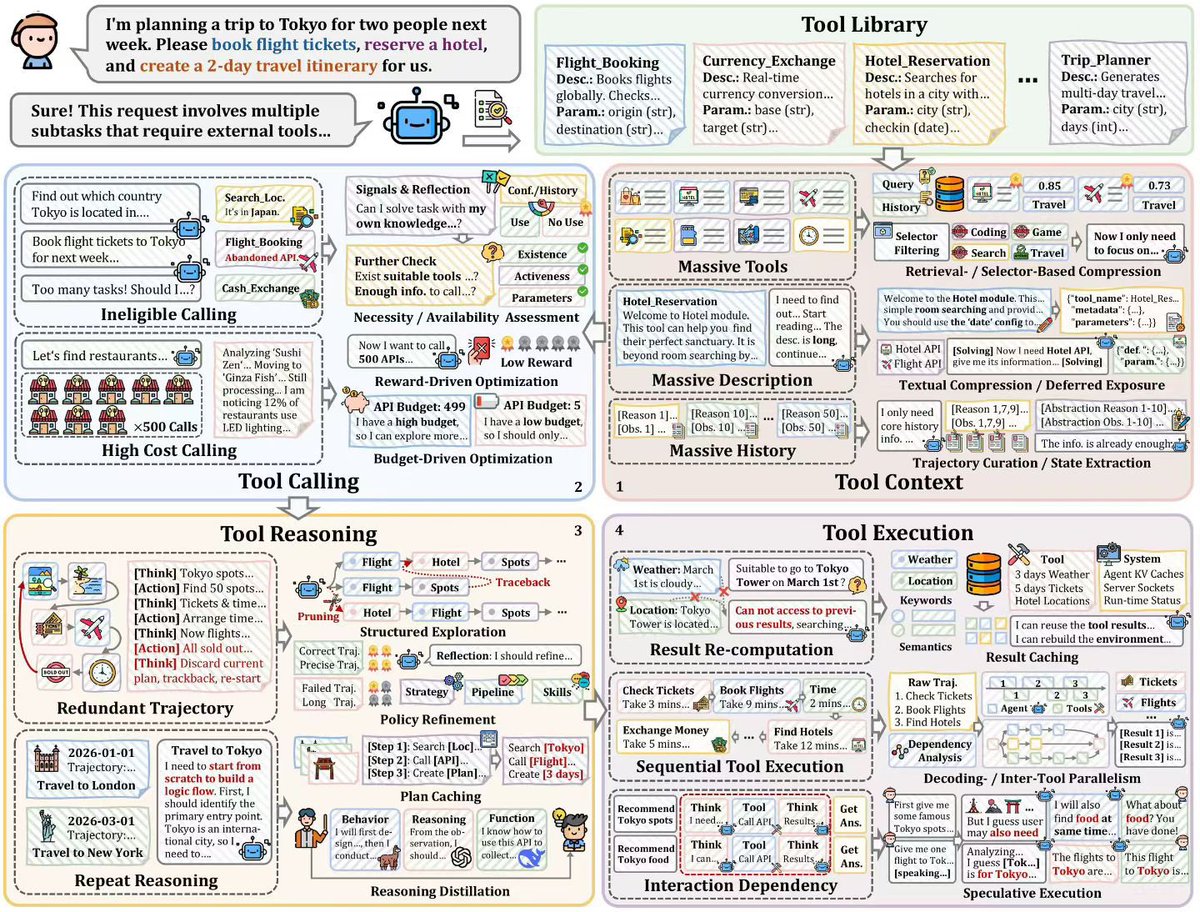
1/5 🎉 Our survey on efficient tool-using agents has been accepted to EACL Findings!
🔧 We review a growing body of work that improves agent efficiency at the harness level.
📄 https://t.co/wy6vdt4qoD
4/5 I worry that suspicion of AI-written surveys can make reviewers skeptical before engaging with the substance. I hope we judge surveys by the insight and clarity they offer.
Excited to share HALO 😇, our benchmark for proactive agents with fine-grained human annotations.
It was an honor to lead this project and collaborate with @2077AI . Big thanks to our coauthors and annotators! 🙌
Proactive agents face a calibration problem: acting correctly is not enough if the intervention itself is poorly timed or unwarranted.
We introduce HALO, a human-grounded benchmark for evaluating proactive agents across everyday environments.
📄 https://t.co/nKcrldJbja
🧵 (1/5)
3/3 Regardless, adversarial architectures like ROSE offer a way to evaluate answers when there is no single valid ground truth. This matters for ambiguous questions in data agents, and the same principle may prove useful beyond text-to-SQL. 💡
1/3 Saw @CapitalOne’s AIR paper at EMNLP. Its Anchor–Adversary design for text-to-SQL ambiguity felt strikingly similar to our ACL paper ROSE’s Prover–Refuter architecture. Yet ROSE is neither cited nor discussed. 🥲
https://t.co/GH3ze5uX4w
2/3 Here’s our ACL paper, ROSE. The tasks differ, but the conceptual overlap in intent-centered adversarial reasoning deserves discussion. Disappointing to see it overlooked when today’s agents can search the literature so well.
https://t.co/MzTXhSqTsC
I’ll be in Budapest for #EMNLP2026, presenting TempCloze, our video temporal reasoning benchmark! 🇭🇺🎉
💬 Let’s chat about data agents, LLM evaluation and multimodal models. Say hi or DM me! 👋
🔍 Also seeking 27Fall PhD opportunities or research internships.