The vast majority of China’s debt is internal (domestic), with external (foreign) debt making up only a small fraction:
⭕️ External debt: Approximately USD 2.33–2.45 trillion (e.g., RMB 17.6 trillion as of March 2025 per SAFE). This equates to roughly 11.9–12.9% of GDP.
China does not need to devalue the RMB/CNY.
With ~88% of its debt being internal (mostly RMB-denominated) + strict capital controls, Beijing faces far less pressure to weaken the currency. This setup gives policymakers more flexibility to maintain stability; or even allow controlled appreciation (which has been happening).
🎯China generates a massive trade surplus of over $1.19 trillion USD annually.
It is clearly in China’s strategic interest to diversify part of this surplus into physical gold; building real, hard assets instead of just accumulating more fiat reserves.
🎯China has mostly internal debt payable in RMB, plus world-class manufacturing and massive domestic coal reserves for its electric power grid.
China can simply grind it out over time. Gold is used to diversify its $1.19T+ annual trade surplus into physical hard assets; not for internal RMB debt servicing.
@Kingkong9888 #Gold #China #RMB
The flaw with the Buffett indicator is that it doesn't take into account that top US companies are global.
Well, here's a modern Buffett indicator that compares global capitalization to global GDP.
By this measure, global stock markets are by far the most overvalued ever.
I start with very informal specifications written by hand. I have an agent convert these into harder specifications that are subdivided into tasks. I review these.
Then I feed those tasks into the specifier agent, which converts each task to Gherkin, prunes the Gherkin, and then hands it off to the coder agent. I spot check the Gherkin.
The coder agent writes acceptance tests directly from the Gherkin. Then writes unit tests. Then writes code. When all those tests pass, the coder agents hands off to the refactorer agent.
The refactorer agent reduces crap to 6 or below, and reduces any duplication. Then it write property tests and gets them to pass. Then it hands off to the architect agent.
The architect agent runs language mutation and covers any uncovered sections, and kills all survivors. Then it runs Gherkin mutation and kills any of those survivors. Then it runs the entire test suite, and when it passes it hands the result off to the specifier, coder, and refactorer.
I spot check the code.
This is an exercise of transformations from the informal to the formal through managed stages, with human interaction decreasing with each stage.
Raw computer power is the limiting factor. Those mutation tests are CPU intensive.
Mark Cuban on why companies desperately need AI implementers, but can't find them:
"I've been through every single technology, you know, event and evolution and this blows them all away."
But the technology itself isn't the real opportunity. As Cuban puts it:
"Now, how you implement it in business is a whole different issue."
To explain why, he goes back to his own beginnings. He recalls walking into companies in his twenties that had never encountered a personal computer:
"Like literally, when I was 24, I was walking into companies who had never seen a PC before in their lives and explaining to them the value and having these guys going, 'Well, son, I got this receptionist right there. I got that secretary. I'm never going to need that s*** ever.'"
His edge back then came from teaching those businesses how to actually put the technology to work.
Cuban sees the same pattern repeating with AI, which is exactly the advice he gives the young people in his life:
"When I'm telling my kids and kids going to school what should I do? What should I do? I'd be like AI research learn all you can about AI but learn more on how to implement them in companies right because to your point companies don't understand how to implement all that right now."
@mcuban points to a shift already underway:
"You got the head of Microsoft saying software is dead cuz everything's going to be customized to your unique utilization."
The question that follows, he argues, is simple:
"Who's going to do it for them? Particularly small to medium-size businesses."
And the scale of that gap is enormous:
"There are 33 million companies in this country. 30 million of them are soloreneurs… There are only, you know, there are millions of companies that have 1, 5, 10, 50, 100, 500 people that aren't going to have AI budgets, aren't going to have AI experts. This is where kids getting hired coming out of college are really going to have a unique opportunity."
Cuban's prescription for students is to spend their free time getting hands-on now — learning to produce video, learning to customize a model, so they can walk into any business and prove their value:
"Let me show you how to benefit you. That is every single job that's going to be available for kids coming out of school because every single company needs that."
"Why does an American need twice as much energy as a European"
For the same reason a European "needs" twice as much energy as a Botswanan 🙌
Energy means prosperity, and Europeans lost the plot.
The AI numbers are starting to look very ugly.
Even under "best case" assumptions, FT's own data shows Microsoft AI ROI at -9%, Google at -15%, Meta at -28%, Oracle at -35%. Only Amazon barely comes out positive.
This is exactly why I keep comparing this to the dot-com era. Incredible technology does not automatically mean sustainable economics. The internet survived. Most internet companies didn't.
Right now hyperscalers are spending trillions hoping future demand catches up to present capex. That's not certainty. That's a leveraged bet.
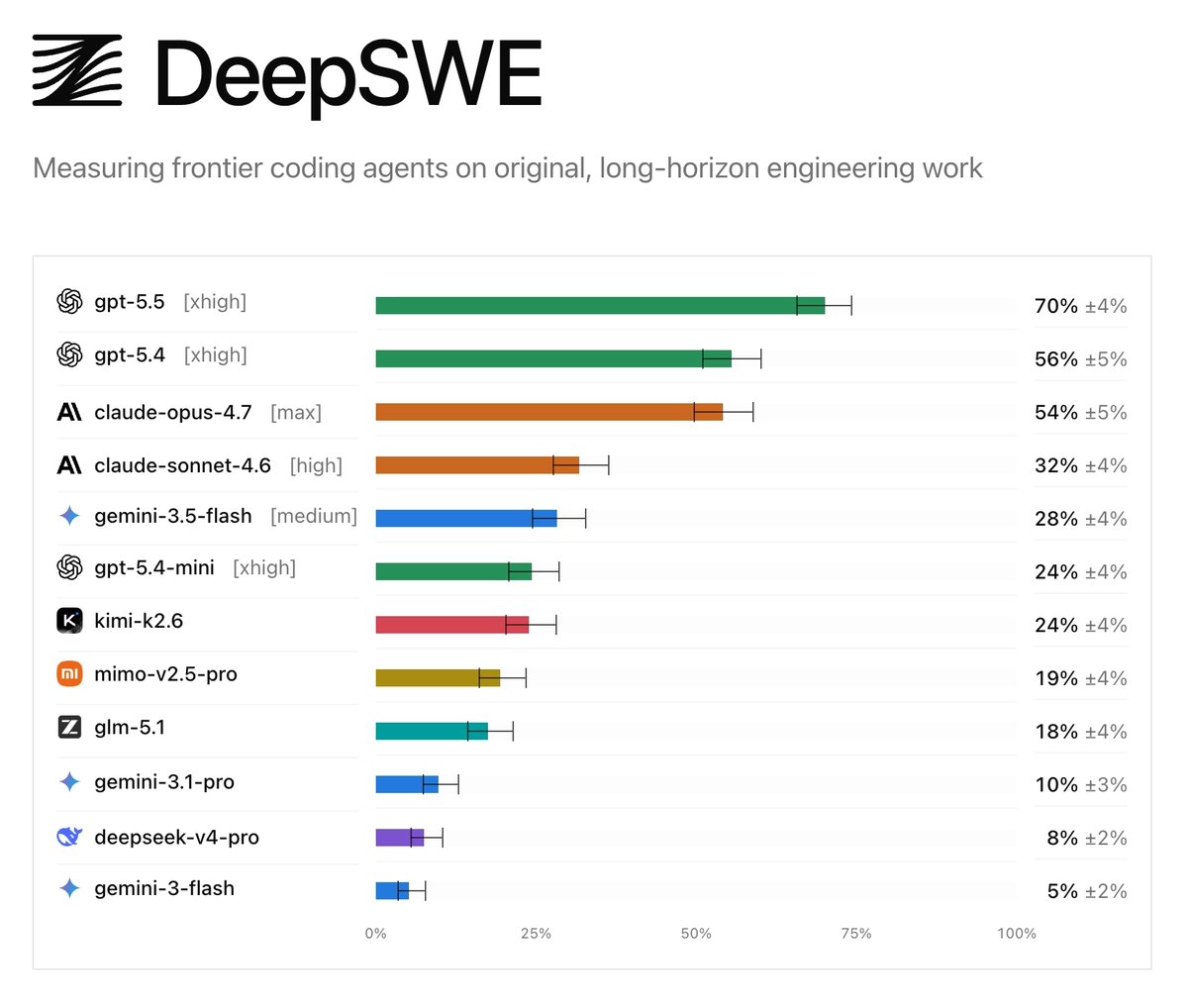
Today we’re releasing DeepSWE, a new standard for agentic coding benchmarks.
On public leaderboards, top models often look relatively close in capability. DeepSWE shows where they actually diverge, reflecting the realistic experience of developers in their day-to-day work.