I told you the top was going to happen.
I told you the EXACT date of when it was going to happen a month ago.
Now, when everyone is panicking, this is when we buy together and make millions.
Wait for my signal. June 15th. And October 10th.
Listen to ME. I MADE you millions. Now I will SAVE you millions. You need to stay careful here.
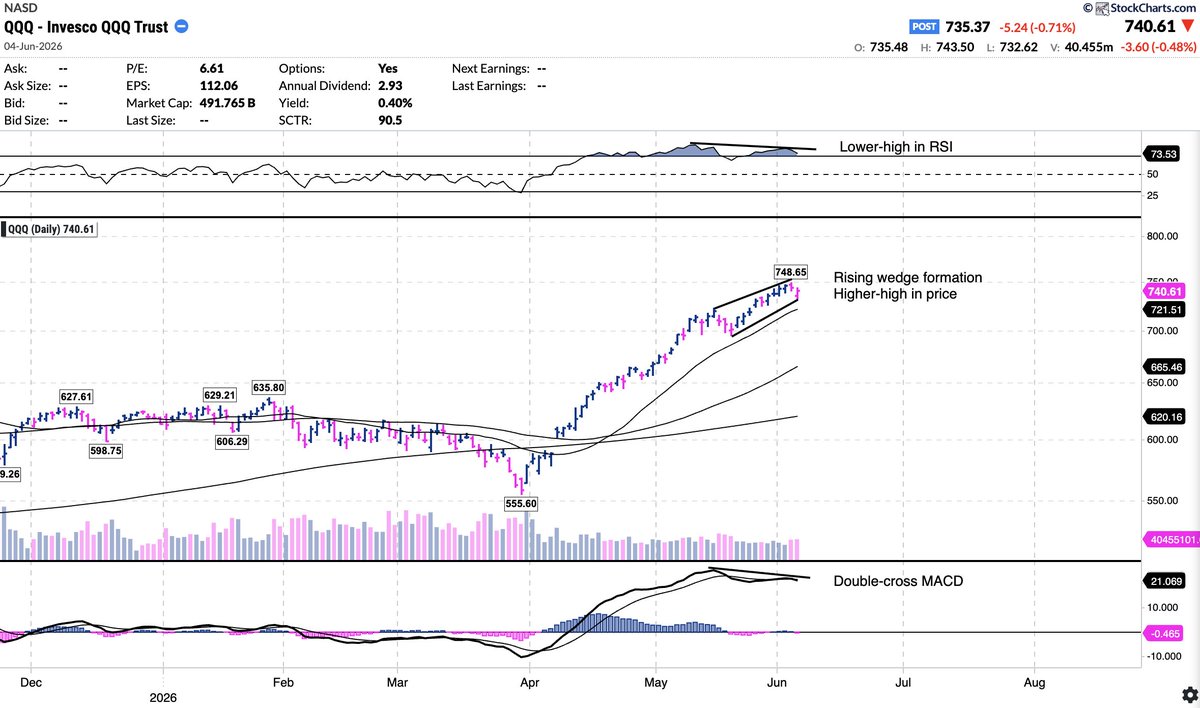
$QQQ and the tech-sector is STARTING to show signs of LATE-cycle movements.
With each new MARGINAL high comes more and more BEARISH-divergence.
Bulls are getting VERY greedy at these levels.
What should you do?
For AI winners like $ARM, $AMD, $NBIS, etc.:
1. HOLD and KEEP
2. But I've TRIMMED my AI winners by 20% to lock-in gains
3. I've also started to HEDGE 15% of my portfolio (3-month puts, inverse ETF, etc.)
4. This helps ABSORB potential volatility
For lagging sectors:
1. We are OVERweight in $XLV and healthcare (doing very well for us)
2. We are OVERweight in bottoming sectors like software $IGV (doing great for us)
3. We are OVERweight in contrarian buys like consumer staples
For defensives:
1. Core positions in defensive sectors can HELP and maybe even OUTPERFORM the next few months
2. Think consumer defensives, utilities, and industrials
Overall, KEEP your AI winners!!!! We are still EARLY in AI.
But make sure you hold your gains by balancing your portfolio for the next 3 months ahead.
I promise you. Follow my EVERY trade, and you'll NEVER miss another bull-run again.
BUY when I buy.
SELL when I sell.
This is all you need to do every day.
The rotation is here. Do NOT miss the next uptrending markets.
$SMCI, $NOW and $IBM are now our top 3 best performers as of this morning.
$SPY top 10 holdings are:
1. $NVDA 7.63%
2. $AAPL 6.64%
3. $MSFT 4.53%
4. $AMZN 4.18%
5. $GOOGL 3.57%
6. $AVGO 2.93%
7. $TSLA 2.39%
8. $META 2.28%
9. $BRK.B 1.53%
10. $MU 1.48%
We are at the decision-zone.
Is it time to pull-back 5% or erase bearish divergence and explode higher?
We are doing so AMAZING, and CONGRATS to all my followers.
But listen to me. You NEED to know this:
1. May 25th to June 5th is the NEXT timing cycle.
2. This means that there is a HIGHER probability of weakness in the markets.
3. It's not 100% certain, but I would stay cautious heading into the next 2 weeks.
For our community, we have a BALANCED portfolio of AI stocks $APLD, $CRWV, etc., traditional defensive names like $KO, $LMT, $LLY, and also 2nd dimension stocks.
Get ready to buy the dip and go ALL-IN soon.
David Ryan won the US Investing Championship 3 years in a row.
No insider edge.
No prediction magic.
Just leaders, timing, pyramiding, and brutal discipline.
Here are 8 lessons from how he traded. 🧵
If you’re new. Listen to this advice.
Dont touch options until you are profitable doing shares for few years.
Trading money should be money you dont need right now
First few years are for paying tuition fees known as losses
You will see everything saying their strategy is best, in the end as long as you can gain a profit out of - its best for you
Listen to everyone online but base your decisions on your own analysis. Your goal is to learn, and be in control
Your stop loss is what stops a $2000 loss to become $20,000
Day trading is hard. Swing trading is a bit easier. Investing is easiest
You should have charting knowledge, drawing support helps you buy stocks at a cheaper price.
Your goal is not to have a 500% year, keep your expectations real. Making 100% doubles your money every year
Before entering a trade, ask yourself three questions
- Am I chasing.
- Do I have a low risk entry
- Am I with or against the trend
- Do not short. 90% of the time market is either in an uptrend or trying to establish a new uptrend.
- Having stop loss is a start but before executing the trade: Accept that loss mentally. Pretend you already lost that money.
The list goes one.
I share things like this every day, if it helps 100 followers per day - that is helping 35,000 every year. And over last 6 years of posting on StockTwits and X it has helped Two hundred thousand people.
The impact we’re making is absolutely incredible.
Video Walkthrough of My Daily Process: How I merge my Finviz screener, TradingView watchlists, and a 'Compression' screener to generate stalk & focused ideas.
Here’s a quick walkthrough of how I generate my stalk/focused ideas—also shared exclusively with my X subscribers through a daily pre-market tweet condensed into a 5-minute reference.
A breakdown of the process;
1. Tradingview as my based charting and watchlist management platform. It is tile next to my finviz web browser.
2. I have 13 preset screeners across both platforms , 9 in finviz (post-market to watchlist), 4 in tradingview (watchlist compression, pre-market gapper of stock & etf, watchlist RVOL sorted). Details of each screener are shared in Chapter 3 of https://t.co/0F5tgGM49z. You can also get direct Shared Screen access from https://t.co/LXC2VSQzZL
3. I copy each screened result from Finviz and paste it into its corresponding TradingView watchlist (e.g., “Hottest Stock” results go into the “Hottest Stock” watchlist). @erikcarell has built a Finviz API workaround that lets you import an entire screen directly into a TradingView watchlist.
https://t.co/SNpaYqObaz
4. Screened results aren’t usually actionable on their own, so I add an extra layer— “compression” screener within TradingView—and run it through each dedicated watchlist. This is what I refer to as a “screen within a screen.” My watchlists are color-coded to show which screener each stock came from—and to highlight when a name appears across multiple screeners (e.g.,🔴= Hottest Stock).
5. I review each name that passes the “compression” screener, evaluating them one by one on the chart to determine whether they qualify for my stalk/focused idea watchlist. The criteria I use are outlined in my “15 Hard Rules” in Chapter 6. https://t.co/0F5tgGM49z.
6. The same process is then applied at the ETF level, since TradingView separates its Stock and ETF screeners into two different sections.
7. On top of that, I manually review over 160 ETFs to track day-by-day price action/RS across industry groups (not shown in the video). The full workflow—including post-market study—takes at least 2 hours per session. The process flows as follows: Screening → Watchlist Management → Focus List Rebuild & Preparation → Qualitative Market Reading for Situational Awareness → Portfolio Stop Management (when needed).
No single screener will ever capture every opportunity.
To stay ahead of the market, you need unwavering dedication, discipline, and consistency. Eventually, the market rewards that effort with the strong, or trending moves. But first, you need a strategy and process that fits your lifestyle and is sustainable over the long term.
I hope you all find this helpful as we navigate this challenging yet financially rewarding journey.
To all my amazing followers. NOBODY teaches you this. But I am right now.
THIS is how you BUY stocks at all-time highs (the right way):
Phase 1
1. The concept is called, "micro-positioning." Instead of lump-summing big and praying markets keep going up, you buy slowly, every single day.
Day 1: $500; Day 2: another $500; Day 3: another $500, etc.
2. This gets rid of the TIMING risk. Rain or shine, you keep building your positions. MUCH better and peace of mind.
3. Having FEW tickers and "conviction" works at LOWS. It does NOT work at all-time highs. Very dangerous to bet your net worth into a few tickers at all-time highs.
Phase 2:
1. Instead of "conviction", you spread your bets across many tickers and stocks. This is NOT diversification. This is, "INTENTION."
2. "Intention" is having 3 categories -> Current winners + laggards + defensives at all-time highs.
3. You will buy across these 3 buckets. Current winners are AI - higher volatility and growth. Laggards are sectors finding a low, like software, healthcare, military defensive. Defensives are consumer defense like utilities and consumer staples.
Phase 3:
1. If the markets keep going up, great. Your AI portfolio and late-stage laggards will outperform the markets.
2. If the markets go DOWN, great. Your portfolio is STABLE with defensive names and you ABSORB the volatility.
Phase 4:
1. Once the markets are at BETTER levels and have dropped, this is when you consolidate into lesser positions and have CONVICTION into fewer names.
2. You start rebalancing by keeping the winners, cutting the losers, and ride the new bull cycle into millions.
Never EVER have "conviction" at all-time highs with bearish divergence and markets stretched 3X standard deviation away from its moving averages. You WILL get humbled.
Let me expand on no 11: "Prepare Mentally For Pullbacks"
One of the most expensive mistakes I made as a trader was not being mentally prepared for pullbacks.
The problem with pullbacks is that they often come out of nowhere.
One day everything looks great. Your stocks are moving higher. Your account is growing. Confidence is high.
Then suddenly the market pulls back.
Maybe it's only one day.
Maybe it's two or three days.
But if you're not mentally prepared for it, emotions can take over very quickly.
In the past, I often reacted instead of following my rules.
Sometimes I sold too many positions.
Sometimes I trimmed positions at exactly the wrong time.
Sometimes I completely abandoned my rules and made decisions based on fear.
Looking back, those mistakes cost me a lot of money.
Many times the market pulled back for a day, scared everybody out, and then continued higher immediately afterwards. The same thing happened with individual stocks. A normal pullback felt like a major problem when in reality it was often just noise inside a larger uptrend.
Today my approach is very different.
When a pullback happens, I try to focus on my rules instead of my emotions.
I ask myself simple questions:
Has a selling rule been triggered?
Has the stock violated a key level?
Do I actually need to take action?
Or am I simply reacting emotionally to red numbers on the screen?
Most of the time the answer is already in the trading plan.
What I see with many traders is that they never prepare for these situations. They spend a lot of time thinking about entries, profits and upside potential. But they spend very little time thinking about what they will do when things become uncomfortable.
Then the pullback arrives.
The market moves lower.
Their stocks turn red.
And suddenly they have no plan.
That's when emotional decisions start taking over.
Today I prepare myself long before the pullback happens.
I look at every position and ask myself what I will do if the stock undercuts the EMA8, the EMA21 or comes back to my break-even point. I already know which actions I will take before the market forces me to make a decision.
I also prepare my mindset.
I remind myself that pullbacks are normal.
I remind myself that strong stocks do not move straight up forever.
I remind myself that discomfort is part of successful trading.
What took me years to learn is that the best time to prepare for a pullback is when everything is going well.
Not when the market is already falling.
When your stocks are moving higher and you feel confident, that's exactly the moment to think through the next correction.
Because once emotions take over, it becomes much harder to make good decisions.
Pullbacks are not the problem.
Being surprised by them is.
The traders who handle pullbacks best are usually not the smartest traders.
They are simply the traders who already know what they are going to do before the pullback arrives.
YOUR AI JUST DID 8 HOURS OF RESEARCH IN 3 MINUTES AND IT COST YOU NOTHING
Hermes connected to NotebookLM means 300 sources per notebook, audio overviews, infographics and n8n workflows all triggered from one Telegram message.
While everyone else is starting from zero every morning, this thing compounds every single day.
You’ll want this saved the day you get tired of explaining yourself to an AI that doesn’t remember you ↓
Quant at Jane Street kills 97 out of every 100 strategies it builds. That body count is the edge.
Not the 3 survivors. The 97 corpses.
The faster you falsify garbage, the faster you reach the one idea that isn't.
Retail runs this backwards - finds one setup, gets emotionally married to it, and rides it down 40% over six months defending it like a religion.
Run the kill-loop yourself with Horizon -> https://t.co/pDDYFGfVga
Type an idea in plain English. Horizon parses it into entry/exit logic, position sizing, risk rules.
Backtests 5 years of tick data in ~12 seconds. Runs Monte Carlo across thousands of simulated paths.
Deflates Sharpe ratio for the number of trials so luck can't sneak through. Spits out a cold verdict: dead or alive.
Kill it. Type the next. 50 ideas before dinner.
That loop cost $25K/year and a quant desk. Now it's a sentence and 12 seconds.
The edge was never having ideas. It was murdering them at scale.
Save this. Test 50. Keep 2. Kill the rest without mercy
You NEED to listen to me right now.
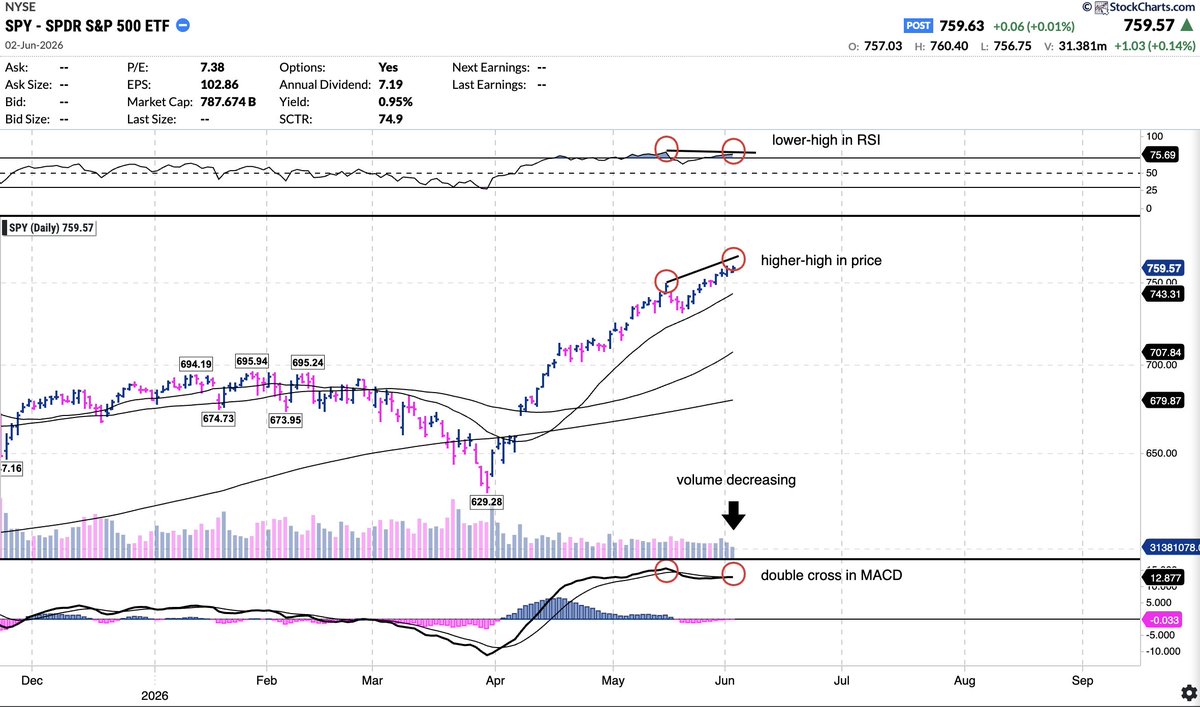
We are in LATE-cycle territory for the overall markets / $SPY.
Bearish divergences are forming with EACH new marginal high.
VOLUME is drying up, candles are getting smaller. This is HESITATION from the bulls.
Momentum is starting to FADE.
Markets will STILL keep going up long-term, but SHORT-TERM, we're in the 8th - 9th inning.
I expect a 5% HEALTHY pull-back.
What should you do?!
1. Keep your AI-winners!!!! Trim 20% to lock-in GAINS, never sell fully. They are WINNERS for a reason
2. Look for CONTRARIAN buys. The stocks that have been LAGGING. They will go down LESS, or even outperform.
3. BALANCE your portfolio with AI leaders + AI laggards + defensives!!!!
All you need to do is SURVIVE, and you will be rewarded with the BIGGEST bull-run in history over the next 5 years.
- Keep companies and consider trimming 20% like $ARM, $NBIS, $MRVL, $MU, etc.
- Slowly positions in companies like $CRWV, etc.
- Build positions in lagging companies like $NOW, $NKE, etc.
- Build defensives like $WMT, etc.
Get ready to buy amazing companies like $AMZN, $GOOGL, and many many others soon.
RAY DALIO JUST SAID HE THINKS THE AI BUBBLE IS GOING TO POP
On Bloomberg, he laid out exactly when, why, and how he sees it happening.
He also compared the current market to two specific years:
"We are right now rising closer to, not at, the same level in 2000 and the same level in 1929, a specific level where you say, oh no, here's the one that we really need to worry about."
On all tech revolutions:
"All great technology changes produce bubbles. And the reason they produce bubbles is because nobody can get it exactly right."
On the mechanism that pops bubbles:
"There's a bubble, and then there's the pricking of the bubble. The pricking of the bubble happens when there's a need for wealth to be sold to get the money."
On the wealth gap that comes with it:
"A very small percentage of the population is going to do unbelievably and a lot of people won't."
On a political solution:
"I'm not optimistic on us working together to solve."
He says the technology is real. The prices and the debt are the problem.
97% probability $SPY crashes at least 10% after June 15.
There's 4 massive reasons $SPY can't avoid it:
1. Large IPOs like $SPCX will trigger sell off.
Major IPOs drain liquidity. The 1999–2000 dot-com IPO wave pulled $100B+ from markets before $SPY crashed 78%.
2. Kevin Warsh hawkish FOMC on June 17
Hawkish Fed surprises trigger immediate selloffs. In June 2022, a surprise 75bps hike sent SPY down 8.4% in 5 days.
3. $MU $ORCL earnings is the peak of market
Semis and enterprise software peak earnings historically signal cycle tops. $MU peaked in June 2018 $SPY followed with a 20% correction by December.
4. Midterm elections for Trump is this year
Midterm years average a 17% $SPY drawdown before Q4 recovery. 2022 saw $SPY drop 25% into October before reversing Trump's 2026 midterms follow the same cycle.
♻️ RESHARE this post and write 1 comment, I'll share with you my $SPY target for the crash.
Most of Leopold Aschenbrenners positions are already up massively since he bought them.
Like $BE $NBIS $SNDK $INTC
But there are also some positions that still have massive upside potential.
Here are 5 of his stocks that can still 10x from here👇