It was an honor to hear Finnish parliamentarian Päivi Räsänen talk at CTSFW today! She was recently convicted of hate speech by the Finnish Supreme Court for a booklet she wrote in 2004 defending biblical marriage. #istandwithpäivi
The beauty of regular and historic ceremonies in Lutheranism. Scripture grounds the historic practices of what we do. Sure you can try out other, newer stuff, but why? You get to enjoy God's word and Christian tradition in practices right at your church https://t.co/mEkSS2mlrP
Hot crust near mid-ocean ridges, matching magnetic patterns on either side, and cold slabs deep in the mantle all point to a seafloor that has spread and been recycled.
Oil deposits that match across the Atlantic provide another clue that today’s continents were once joined.
Dr Timothy Clarey examines six lines of empirical evidence and argues that rapid plate movement during the Flood best explains them.
Open the link to explore the evidence for catastrophic plate tectonics and its role in the Flood: https://t.co/6k30EiIBgy
A population can adapt in obvious ways and still suffer genetic decline.
It's just like how fitting new windscreen wipers doesn’t stop an old car from rusting.
Dr John Sanford argues that rare beneficial mutations and short-term adaptations don’t settle the crucial question.
The question?
Can they outweigh the many slightly harmful mutations that natural selection may fail to remove?
Read his point-by-point response to the criticisms of genetic entropy: https://t.co/A3bDzedOZH
@TheDonStein With all fairness to Ken Ham...he and the folks with Answers in Genesis have been saying this is not Noah's Ark for a while. One of the geologists involved with AiG argued against it back in 1992 https://t.co/cYK8kUA0LP https://t.co/mJWMI16o7T
Is Creation Science Really Science?
Critics often dismiss creation science as “pseudoscience.” But what exactly makes something science in the first place?
This thought-provoking article explores the scientific method, testability, paradigms, presuppositions, and the role of historical evidence—and asks whether a biblical starting point automatically disqualifies scientific research. Learn more here: https://t.co/ULdqhFJgfW
https://t.co/ULdqhFJgfW
Fluid trapped in Permian salt pointed to extremely acidic water, with a pH below one.
This goes against the alkaline conditions that researchers had assumed, and surprised them quite a bit.
Did they think that maybe their assumptions of alkaline soda lakes were wrong?
No.
Instead, the finding led to a new idea, imagining highly acidic lakes across some 200,000 km².
It's a pretty wild point that what we observe in the rocks and the stories people speculate around them are not quite the same thing.
To see why paleoenvironmental deductions should be tested within the unique conditions of the biblical Flood, read the full article here: https://t.co/jAXEPxT984
Lark Quarry’s famous dinosaur “stampede” wasn’t a terrified flight from a meat-eater after all.
A 3D analysis identified the supposed predator as a plant-eating dinosaur, while many smaller tracks appear to be claw marks left by dinosaurs swimming in a current.
Rapidly changing water depths and sediment-laden flows fit naturally with the article’s model of briefly exposed sediments during the Genesis Flood.
Read the article to discover how watery catastrophe makes sense of these remarkable tracks: https://t.co/7y20yMxFKh
@VanDigglerUSA@potamopotos@bonifacegroup Delete this post, if you have any sense of decency and dignity. You are an embarrassment to America. If you had done ANY research you would know that's not what's going on here. Adding personal attacks to grief is inhuman.
What if the history of our world isn’t billions of years old?
Thousands… Not Billions explores the evidence and arguments behind a biblical, young-earth view of Earth’s history—challenging conventional assumptions and inviting you to examine the evidence for yourself below:
https://t.co/Jm5nrXGDUT
https://t.co/Jm5nrXGDUT
Have I betrayed my puritan ancestors by becoming Lutheran? Did they betray their Anglican ancestors? Did they betray their Roman Catholic ancestors? Did they betray their pagan ancestors?
The truth is, all before me betrayed their ancestors, Adam and Eve, who were Lutheran.
Congregations grow when they:
1. have a pastor who works hard
2. have a pastor who is a solid preacher
3. are in growing areas
4. have a history of being stable and normal
In Lutheran Land, people are still repeating this decades old line that the way to bring people into your congregation is through "relevant" forms of worship. But you can look at the statistics of our biggest congregations that are the most dedicated to the whole Praise Band Pastor Blue Jeans thing and the vast majority of them are waaaaay down in attendance over the past 10 years.
The exceptions that I know of are congregations with pastors who, despite the evangelical style trappings, are pretty solid gospel preachers.
And I see this in my own circles. I know of liturgical congregations that have grown and ones that have withered despite facing similar demographic landscapes. The difference is that those that have grown had pastors who worked hard and preached faithfully and the people were friendly and inviting and the ones that withered were served by lazy guys with Correct Theology and/or who sometimes had congregations that would chase off anybody he might bring in right away.
The moral of the story is that "young people want the liturgy" and "young people want praise bands" are both somewhat false narratives.
Doing my best to keep Jake on the topic of Hitler hating Christ instead of the US being founded by "antichrist worshipping freemasonic kabbalah wizards"
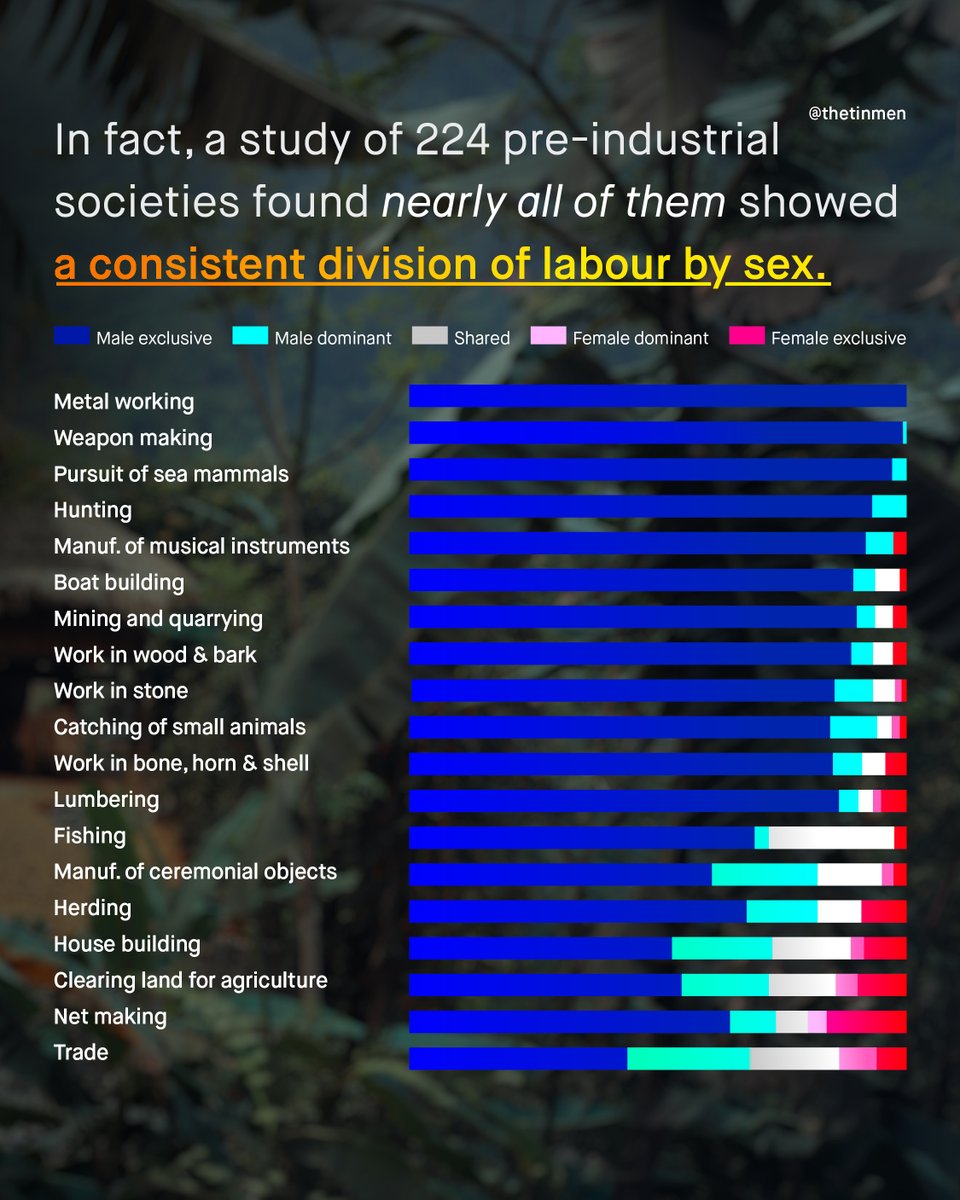
A global study of 224 pre-industrial societies found nearly all of them had the same sex-based division of labour.
So either
a) men and women have different interests/skills,
or b) 'the patriarchy' is oppressing all these disparate, disconnected societies in the exact same way.
A pub cellar might seem an unlikely place to challenge millions of years.
But funny enough, that’s exactly what makes the Anchor Inn so interesting.
Its spectacular stalactites grew within a building whose history can be traced back only a few centuries.
That historical check exposes the danger of assuming that slow rates observed today have always been the same.
Click through to read the full article: https://t.co/eAuExWv4pF
@JoshuaW4145 Martin Chemnitz's "Examination of the Council of Trent" is the most incisive critique of Roman Catholicism I've ever read. Also, Johann Gerhard and Charles Porterfield Krauth are some of the most brilliant theologians I've ever read.