What will it take to keep pace as AI reshapes the future of work?
Increasingly, it may come down to our ability to learn, adapt and apply new knowledge. https://t.co/m4wGVSDLr2
Their conversation is the latest in our "What I've Learned" series, featuring interviews with @Wharton faculty who've made a lasting impact in their fields.
They also explore Shropshire’s unconventional path to academia and lessons learned along the way: https://t.co/psm646fIaJ
As valuations for sports franchises like the Lakers soar, @Wharton professor Kenneth Shropshire explains to dean @ErikaHJames why teams have evolved into an increasingly attractive asset class, and how sophisticated management and technology are creating opportunities for growth.
How will the Sixers build a cohesive team with so many high-usage players?
The full @WMoneyball podcast interview with @DeanO_Lytics covers why predicting whether stars will fit together remains one of basketball analytics’ hardest challenges. https://t.co/c622T0z2Tf
The Sixers' acquisitions of Jaylen Brown and LeBron James have made headlines this offseason.
How does basketball analytics pioneer & @ESPN data scientist @DeanO_Lytics feel about the moves, including the perception of Brown's value?
He joined @WMoneyball to share his thoughts.
We are proud to have received HigherEd PodCon's Outstanding Institutional Podcast Network award at its 2026 conference.
Thanks to all who've helped build the @Wharton Podcast Network, especially the faculty and staff bringing industry-leading insights to feeds every week.
Many assume the fastest path to expertise is to narrow your focus as early as possible.
@DavidEpstein, author of the new book, "Inside the Box: How Constraints Make Us Better," argues on the latest @WMoneyball podcast that the opposite may often be true when it comes to sports.
Last year, Americans wagered more than $160 billion on sports, a 23% jump from the year before and a figure that has ballooned 30-fold since the 2018 Supreme Court ruling that struck down a federal sports betting ban and let the apps flood in.
Prof. @MichaelLouisPl1, Director of the Wharton Neuroscience Initiative (@WhartonBrain), spoke with @WhartonKnows about the biological basis of gambling amid the proliferation of online gambling sites: https://t.co/YdwMPIhNEg
Testosterone, in particular, acts as a biological amplifier for risk-taking, especially in males. This hormonal effect “directly influences real-world behavior, making men more likely to desire luxury goods and take ‘wild gambles,’” says Prof. Platt.
Time pressures and exhaustion can push it even further, a fact that isn’t lost on modern online gambling platforms.
“What we’re seeing,” he adds, “is these platforms acting as hyper-stimulating substitutes for healthier, real-world interactions.”
Whose work most influenced you?
Professor at the Wharton School at the University of Pennsylvania, @katy_milkman answers this question on a special episode of the Social Science Bites podcast.
Hear from today’s leading social and behavioral scientists: https://t.co/knNBLK5hTk
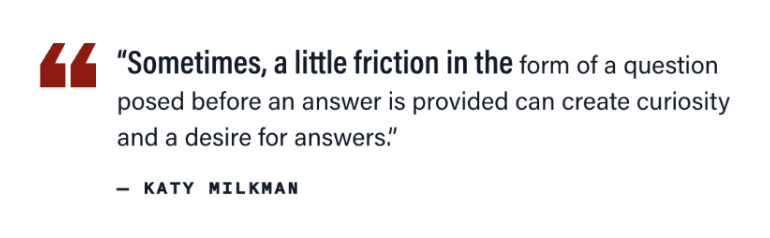
When might adding friction be a positive?
Posing a question before sharing the answer can spark curiosity and boost engagement with health information.
BCFG-supported work on this topic–led by Team Scientist @erika_kirgios featured in @whartonknows: https://t.co/Ve7tShOKoA
@Wharton@kwerb@lynnwu02@ebradlow What have been the most transformative innovations in marketing over the United States' 250-year history?
We asked @Wharton faculty to share their thoughts as part of our “American Business Innovation” series.
Head to our YouTube channel for all 12 interviews 🎥
🤔 Which would make your list?
We asked 12 @Wharton faculty members across fields to offer their responses as #America250 approaches.
Stay tuned to the Knowledge at Wharton YouTube channel every Monday for the rest of June as we launch our American Business Innovation series.
@Wharton@kwerb@lynnwu02@ebradlow What have been the most transformative innovations in management and operations over the United States' 250-year history?
We asked @Wharton faculty to share their thoughts as part of our “American Business Innovation” series.
If your goal is to get someone interested in learning more, what's the better approach? (A) Lead with information. (B) Lead with a question and then provide the same information as the answer.
New research led by Prof. @erika_kirgios suggests that simply putting a question before an answer can significantly increase people's desire to keep learning more even after you've sated their initial curiosity.
In a series of field experiments with @Susan_Athey, @angeladuckw, @deankarlan, Mike Luca, and Molly Offer-Westort, we found that presenting information in a Q&A format can boost people's requests for more, related information.
Our findings were recently published in Management Science and are featured in a new Knowledge at Wharton article:
📄 Management Science Paper: https://t.co/xr6qZaoANO
📄 Knowledge at Wharton (@whartonknows) Summary: https://t.co/vxJMgB4LRZ
What question can you pose when you next have information to share?
This perspective was one of several insights shared during a discussion on how sports can act as a local growth engine, moderated by @Wharton finance professor Kevin Kaiser and also featuring @VisitPhilly's Angela Val and @discoverPHL's Larry Needle. https://t.co/WwupEFocaW
The @FWC26Philly starts this week, but for sports executives, the real opportunity extends far beyond the month of matches.
At a recent @WhartonSABI event, @PhilaUnion president Tim McDermott explained how the club is approaching the tournament as a long-term growth opportunity.
On the full episode, @R_Thaler & @Benj_Robinson (@GrindingMocks) join the @WMoneyball team – Massey, @EBradlow, Shane Jensen & @AdiWyner – to discuss behavioral bias, pick valuation, and how emerging models are changing the way teams prep for draft day. https://t.co/Mf8fWIEt18
Even with more data, more scouting, and better tools, NFL teams still struggle to predict which college players will perform best as pros. #NFLDraft
On @WMoneyball, @R_Thaler explains the striking "better than the next guy" stat uncovered in research with @Wharton's @BCMassey.