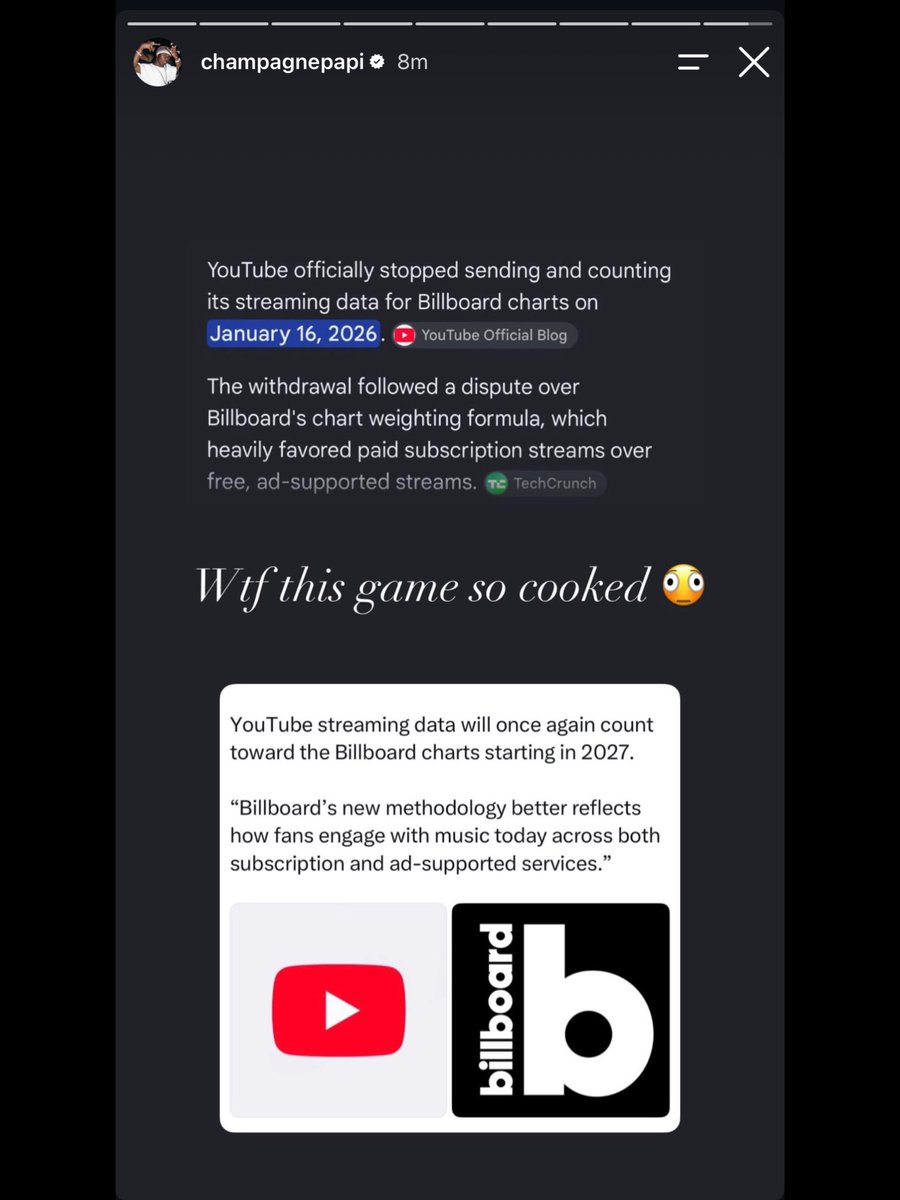
Drake calls out billboard for rigging the game and removing YouTube views during the year he released ICEMAN
Roughly 413,000 equivalent album units from Drake’s estimated uncounted U.S. YouTube streams this year, if they had been converted under the new 2027 rules (and none of them were actually counted).
An open offer to Tesla: We fully support putting Cybercab first, and we’d be glad to take the Cybertruck line off your hands.
We’d fund it with a consortium of investors and run it at no cost to Tesla’s floor space, headcount, or focus. All of that goes to Cybercab. Cybercab gets first call on battery cells too. We’ll wait our turn.
Tesla gains incremental profit: a license fee, plus FSD and Robotaxi network revenues on every vehicle built.
We’d build the Cybertruck, a three-row CyberSUV, and an unmanned CyberCargo hauler. More autonomous miles, across every surface of this planet and beyond.
Worth a conversation?
If you're a Cybertruck owner, welcome to the 0.7% club!
With over 10.2 million Tesla vehicles produced, you're in a rarified group of about 70,000 owners.
Our numbers are small, but we are mighty!
Long live the 📐!
People will deadass look you in the eyes and say that Darius Acuff Jr. but none of what he’s doing seems fake
In fact, it’s even more impressive that he’s able to achieve this with the roadblocks he’s facing in Sacramento roster construction wise
Imagine you and your friends run a lemonade stand.
The city says, “We’re going to charge a bigger tax on kids who make a lot of money from their lemonade stands.” That’s the rule—the kids who earn the most have to pay more money to the city. Those kids are the ones the law says have to pay.
But here’s what actually happens:
To still make enough money to keep running the stand (and buy more lemons and sugar), the kids raise the price of a cup of lemonade from 50 cents to 75 cents.
Now everyone who buys lemonade—including kids who don’t make much money and just wanted a cold drink—has to pay more. The tax was aimed at the successful lemonade sellers, but part of the cost got passed on to the customers through higher prices.
Over time it gets even clearer. Some kids decide it’s not worth the extra work to keep the stand open as much, so there are fewer lemonade stands around. With fewer stands, the ones that stay open can keep the price higher. Regular kids who just want lemonade end up paying more, even though they weren’t the ones the tax was supposed to hit.
The successful lemonade sellers still feel some of the tax (they don’t get to keep as much money as before), and the customers feel some of it too (they pay higher prices). Nobody escapes it completely, and the people buying the lemonade notice it in their pockets.
That’s basically how it works with grown-up taxes on business owners too. The tax is written so richer business owners pay more, but part of that cost often shows up later as higher prices on the stuff everyone buys.