@Terry1629425@MorEdge_Insight Your reply doesn't make what I stated less true. One sided narratives do not lower the intensity of the hatred. As is demonstrated by comments naming Christianity in negative context.
🚨 UPDATE: In a SHOCKING incident, a young Iranian-American tells MI Senate candidate Abdul El-Sayed that his family was hunted and k*lled by the Islamists in Iran — and asks Abdul to CONDEMN the IRGC...
...Abdul refused IN HIS FACE.
"WE'RE DYING."
"You said you didn't want to comment on Ayatollah Khamenei's death...that silence left a GAPING HOLE IN OUR COMMUNITY. Do you renounce the people that held vigils that supported this TERRORIST? Do you stand against the Islamic Republic of Iran that killed 50,000 protestors? Please!"
ABDUL: My worry is when one decides we go in and take out the leadership of foreign government... *word salad against Trump's Iran intervention*
STUDENT: YOU STILL HAVEN'T SAID IT. WE'RE DYING.
ABDUL: I want to be careful.
WHAT IS WRONG WITH THIS GUY?!
Abdul is an Islamist...he is MORE WORRIED about upsetting radical Islamic voters so he can win the election than standing with the civilians.
You know why? Because he knows that it nets him more votes.
If he tries to stand with the Iranian civilians, the Left would paint him as sympathizing with Trump. THAT'S WHAT THIS IS ABOUT.
He hates Trump so much he's willing to stand with the IRGC. Vote for Mike Rogers!
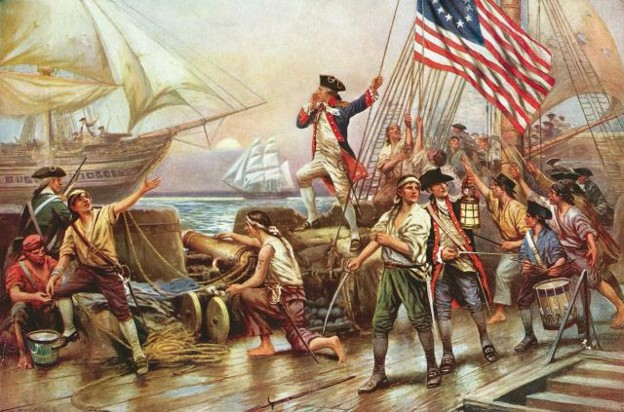
On this day in 1779, an American captain stood on the deck of a ship that was literally sinking under his feet, on fire, riddled with holes, half his crew dead or wounded, and when the enemy shouted across the water asking if he surrendered, he roared back a line that the United States Navy has never forgotten: "I have not yet begun to fight!" His name was John Paul Jones, and what he did that night made him the founding legend of the American navy.
Understand how insane the setting was. Jones was not defending American waters. He had taken the fight to the enemy's home, cruising in a small squadron right off the coast of England itself, terrorizing British shipping in their own front yard. His flagship was an old, worn-out French merchant vessel he had converted into a warship and renamed the Bonhomme Richard, in honor of Benjamin Franklin's "Poor Richard." It was slow, tired, and outgunned.
Off Flamborough Head, Jones ran into a British convoy escorted by a brand-new, faster, more powerful Royal Navy frigate called the Serapis. By every rational measure, Jones should have run. The Serapis was a better ship with heavier guns. Instead, Jones attacked.
The battle that followed, fought into the night under a rising moon, was one of the most savage ship-to-ship duels of the entire age of sail. Early on, disaster struck the Americans: two of the Bonhomme Richard's big old cannon burst when fired, blowing apart their own gun crews and leaving Jones dangerously short of firepower. The Serapis hammered the Richard mercilessly, its heavier guns tearing the American ship to splinters, opening holes below the waterline, setting fires. The Richard was being destroyed.
So Jones did the only thing that could save him. If he could not win a gunnery duel, he would not fight one. He drove his ship straight into the Serapis and lashed the two vessels together, hull against hull, muzzle to muzzle, so close the gun crews were practically fighting through each other's ports. Now it was not a naval battle so much as a brawl, and Jones's American and French sailors and marines could rake the enemy's decks with musket fire and grenades from the rigging.
It was in the middle of this hell, with his ship clearly sinking and afire, that the British captain called over, reasonably, to ask if the Americans had had enough and wished to strike their colors. And Jones, standing on a doomed deck, gave the answer that became immortal: he had not yet begun to fight. And he meant it.
The turning point came from above. One of Jones's men climbed out on a yardarm over the enemy ship and dropped a grenade down through an open hatch into the Serapis, where it touched off a chain of gunpowder charges. The explosion ripped through the British gun deck, killing and maiming dozens of men in an instant. The fight went out of the Serapis. Its captain, his own ship now wrecked and burning, finally surrendered.
And here is the almost unbelievable ending. John Paul Jones had won, but his own ship was beyond saving. The Bonhomme Richard was so shattered that it slowly sank over the next day, and Jones had to move his victorious crew onto the captured Serapis and sail away in the enemy's ship, because his own had gone to the bottom. He won the battle and lost his vessel, all at once.
The victory made him a hero on both sides of the Atlantic, a symbol that the infant United States could carry the war to the mightiest navy on earth and win. To this day, the Navy calls John Paul Jones its father, and it teaches new sailors his answer from that burning deck. Remember September 23, 1779, and the man who was sinking, and on fire, and outgunned, and answered a demand for his surrender by saying he had not yet begun to fight, and then proved it.
@StephenMil48 Yes, there is no place for law that does not comform to the constitution and is not enacted by our two houses of congress and sighed by the president.
Here’s why beef is so expensive in America, says Joel Salatin, co-owner of Polyface Farms.
He said:
“The biggest enemy right now keeping beef prices high … is the subsidies to the corn and soybean farmers.”
“Half the soybeans America produces are exported. We don’t even use them. Almost half the corn goes into ethanol.”
“A huge percentage of American agriculture is not in the food business.”
“The average soybean farmer lost $100 an acre last year…Instead of having to face the reality that the world doesn’t need soybeans.”
His alternative: take 1,000 acres of Nebraska soybeans, convert them to grass, and begin grazing cows.
“My hypothetical 1,000 acres,” Joel says, “costs $300,000 to convert from soybeans to grass… That’s exactly what it costs annually to grow soybeans.”
Joel says that either “It’s going to cost me $300,000 of annual expense to put that crop in and harvest it,” or “I can do a once in a century $300,000 investment and return it to perennial prairie polyculture.”
“Today’s farmer only gets 5.8 cents of the retail dollar.”
“Today, we have four companies controlling 85% of the meat market.”
“It’s not free enterprise…It’s capital cronyism.”
@JoelSalatin
@Mel_Gibson042 A- If you can't put other religious symbols in public square or pray in front of abortion clinics, if other religious practices are restricted in any way in the public then so should islamic religious expressions if they intrude in others peace.