Minimum wage just got a 5.97% increase for the lowest rate, which sounds good on paper.
Working a standard 38hrs week: you’ll see ~$56.60 extra in your pay packet each week. But here’s the catch: roughly $18–19 of that (~32–33%) goes straight back to the taxman via income tax + Medicare.
Over a year, you keep only about ~$2,000 of the ~$2,944 gross rise. Cost of living is crushing people, yet the government takes a big bite before you even see the money.
We should lift the tax-free threshold to $52,000.
Let low and middle income workers actually keep what they earn instead of handing a third straight back in tax.
@rationalaussie@keithmarlowau WA Labor government does exactly the same. They’ve become notorious for it over this term and the one immediately before.
"RECORTEN LOS BENEFICIOS a los migrantes y se DEPORTARÁN a sí mismos."
Esta joven australiana tiene TODA LA RAZÓN y es una solución simple para un problema de largo plazo.
A British biologist looked at 200,000 years of human history and found that the entire reason humans broke out of poverty was not intelligence, not language, not even agriculture, but one mechanism so simple a 6-year-old could explain it.
His name is Matt Ridley.
He is a zoologist by training, an evolutionary biologist by career, and in 2010 he wrote a book called The Rational Optimist that quietly argued the most important fact about human progress had been hiding in plain sight for the entire history of economics.
Naval Ravikant has been telling people to read everything Ridley has ever written for the last 15 years. The reason is the argument inside this one book.
For 200,000 years, anatomically modern humans walked around with the same brain you have right now. Same skull size. Same neural architecture. Same raw capacity for language, planning, and abstract thought.
For roughly 190,000 of those years, almost nothing happened. Generation after generation lived and died inside the same Stone Age toolkit their great-great-grandparents had used. Then somewhere around 50,000 years ago, the line on the chart of human progress started to tick upward. Then it bent. Then it exploded.
The question Ridley spent years on was the only question that mattered. What changed.
It was not the brain. The brain had been the same for 190,000 years. It was not language, which had existed long before the takeoff. It was not even agriculture, which arrived only 10,000 years ago and was actually preceded by the upward bend, not the cause of it.
What changed was that humans started trading with strangers.
This sounds too small to be the answer. Ridley argues that it is the answer to almost everything. The moment one human exchanged a useful object with another human from a different group, something happened that no other species on earth had ever done.
Two ideas that had developed in isolation came into contact. The flint knapper learned what the spear maker had figured out. The fisherman from the coast learned what the hunter from the forest had figured out. The two pieces of knowledge fused into something neither side could have produced alone.
Ridley calls this ideas having sex. The phrase sounds frivolous and it is meant to. The point is that ideas, like genes, get better when they combine with other ideas from different lineages.
An idea sitting inside one head, no matter how brilliant the head, eventually hits a ceiling. The same idea exposed to ten thousand other ideas does something genes do under sexual reproduction. It mixes. It recombines. It produces offspring nobody planned.
The cleanest proof of this argument is the most uncomfortable case study in the book. Tasmania.
Around 10,000 years ago, rising sea levels cut Tasmania off from mainland Australia. A population of roughly 4,000 humans was now isolated on an island, with no possibility of contact with the rest of humanity. They had the same brains. The same language. The same starting toolkit as their cousins 150 kilometers north. The natural experiment was now running.
What happened next is something no economist or geneticist had ever predicted.
The mainland Australians kept inventing. Boomerangs. Spear-throwers. Fishing nets. Bone needles for sewing fitted clothes. Watercraft with paddles. Their technology compounded slowly across the centuries.
The Tasmanians went the other way. They did not just fail to invent the new tools their cousins were developing. They started losing the tools they already had. Fishing was abandoned within a few thousand years. Bone tools disappeared. Fitted clothing disappeared. They forgot how to make fire from scratch and started carrying lit firebrands from camp to camp instead, relighting their fires from a neighbor's whenever their own went out.
By the time European explorers arrived in the 17th century, the Tasmanians had the simplest toolkit of any human society ever recorded. Their material culture had gone backward for 8,000 years.
The archaeologist Rhys Jones called it a slow strangulation of the mind.
Joseph Henrich at Harvard later proved with formal mathematical models that there was nothing wrong with Tasmanian brains. There was something wrong with their network. A toolkit requires a critical mass of people exchanging skills to maintain itself.
The act of teaching a skill is imperfect. Every generation loses a small percentage of what the last generation knew. If your population is large enough and trading widely enough, those losses get caught and corrected by someone else who still remembers.
If your population shrinks below a certain threshold and stops mixing with outsiders, the small losses compound until entire technologies disappear.
This is the part that should haunt anyone reading this in 2026.
Intelligence is not a property of the individual brain. Intelligence is a property of the network the brain is connected to. A genius in isolation will produce less than a mediocre thinker inside a dense exchange of other mediocre thinkers.
The thing your ancestors needed in order to break out of 190,000 years of stagnation was not better brains. It was better connections between brains they already had.
The implication for any individual is direct and uncomfortable. If you are smart and isolated, you will be outproduced by people half as smart who are connected.
The most successful people in any field are almost never the smartest people in it. They are the ones positioned at the intersection of the most idea flows. They are reading more authors than their competitors. They are talking to more people from more disciplines. They are in the rooms where ideas from different lineages bump into each other.
Ridley ends the book on the line that sounds optimistic but is actually a warning its this "The future will be invented by people who connect ideas, not by people who guard them."
This post is deadly accurate:
“This is what feminism actually accomplished.
The destruction of womanhood from the inside. Everything feminine, the relationships, the mothering, the holding-together of a community, labelled as low status, and the hole filled with a masculine dream she was told would set her free.
Feminism is the spiritual and philosophical r@pe of what it means to be a woman.”
The Only Real Existential Risk: the female problem
https://t.co/CQ1mVR82jX
I saw this video the other day and I can’t stop thinking about it.
A young woman celebrating that 52 percent of women aged 20 to 39 are now childless, that she is finally “part of the majority” and “the men are gonna crash out about this because they are so worried about the birth rate, and let me make this clear, I don't care".
It is true that this is the best indicator of feminism’s success but the girl, as most women celebrating this, is not the enemy. The real problem is the mismatch between women and the modern world.
Women evolved in environments where social exclusion meant death. You cannot hunt pregnant or fight nursing, so a single woman's survival depended on the tribe's acceptance, and a few hundred thousand years of that programmed her to see consensus as safety. It is the same trait that made women the thing that makes families work, what makes them a good mother and a good wife. It’s not that they are better or worse than men, they just evolved differently.
Which is why women do not really know what they want. Not because they are stupid but because of how they evolved. What a woman says she wants is mostly what she thinks the group wants. For two hundred thousand years the group was right and disagreeing meant death. The problem is what the group is now.
The group that decides what a woman wants is the average of millions of strangers an algorithm pulled together because they got a reaction out of them, tuned for outrage and sadness because that is what is engaging and sells ads. The wanting still feels like hers because the group wants it, but it’s the feed's.
We built a global consensus engine, pointed it at the half of the species that sees consensus as survival, and hoped for the best. Add to the algorithms a world that never existed before 50 years ago, the new career ladder, the adversarial institution, the hyper-individualism, built by men for men and then imposed on women as liberation.
Two transitions destroyed the family. The first was the decade between 1960 and 1973: the pill, no-fault divorce, Roe, and the beginning of adult daycare. IQ tests for hiring basically became illegal, college became the proxy, and college plus “career progression” became the norm eating away the entire fertile decade. In just 13 years, sex decoupled from reproduction, reproduction from commitment, commitment from permanence, and hiring from intelligence.
The second transition was in 2012, when smartphones with social media and dating apps went into every teenager’s pocket. Family was first destroyed, and then women were told they never wanted one to begin with, and if they *really* wanted one they should have waited.
They took her most fertile decade, the one stretch of biology that does not come back, and filled it with an extended adolescence. Eighteen to twenty-eight first in a classroom and then an office, children labeled burdens, the thing you get to later once you are established and it is responsible. Later arrives and the good men are gone (so are the eggs). She did not waste those years. They were taken from her by the people who were supposed to care for her.
This is what feminism actually accomplished.
The destruction of womanhood from the inside. Everything feminine, the relationships, the mothering, the holding-together of a community, labelled as low status, and the hole filled with a masculine dream she was told would set her free.
Feminism is the spiritual and philosophical rape of what it means to be a woman.
Women have been getting sadder for forty years while every objective measure of their lives improved, and the women who still report the most meaning are married mothers (shocked_pikachu_face.jpeg). Incredibly, the life they were told to run away from is the one that works.
And that’s why elections are going how they are going.
The same empathy that makes a woman a good mother is programmed to answer to the suffering it can see, the face in front of it, never the abstraction behind it. And that is what the whole political machine exploits. You take the most sympathetic case, give it a face, and let that face carry the entire policy without reason behind it. The raped woman becomes the proxy for every abortion, so the rare horror and the change of mind become the same thing, healthcare, and the child that is murdered never counts, because a fetus has no face and the woman in the ad does. She is not lying when she refuses to call it killing her own child. For women, an abstract victim never registers as a victim.
The child in a war zone becomes the proxy for every migrant, so one photograph carries a policy about millions of grown men, and the country that has to hold them is too abstract to weigh against the kid. Every time, the visible sufferer now beats the invisible one later. Run that instinct at the scale of a whole country and the conclusions are fairly obvious, the more a society allows women to be politically involved, the lower the fertility rate goes (this is truer for single women than for married ones).
The parallel problem is that men first allowed this, then were removed from the conversation, and now they ran. After allowing this to happen, a feminized society told them that masculinity was toxic, a lot of them obeyed and checked out into porn and games, built nothing worth joining, and the ones who refused got punished for it. Either way the supply of men worth marrying collapsed. "I can't find a good man" is true and self-inflicted at once.
So this is the female problem of our generation.
It was never that women were the problem. It is that female nature, the consensus-reading, the empathy, their radar for the room, the good stuff that built every family that ever held together, is the part most unfit for the modern world.
You cannot fix a nature. You can only build a world that works with it instead of against it. We built the one that works against it.
And this is the only existential risk that actually counts.
If we can’t fix the female problem, fertility will remain below replacement, which means extinction, no matter what. AGI or automation or any other possible existential risk does not matter if there is no one left to use it. Abundance in an empty room is just an empty room.
The woman in the video will get her wish, she will be the majority, she’ll cherish her childless life and realize her mistake when it’s too late. But the problem is that being the majority of a generation that does not continue is not a win. She cannot get out of this alone. Her nature is not the thing that can move first. Unless men start doing something and become worth choosing again and rebuild the thing worth joining, it only gets worse from here.
@Novarcharesk3 Yes truly, parenthood is the most humbling and challenging, yet incomparably best thing I have ever done in my entire life.
It really is the calling worth following 🙂❤️
The profound sense of meaning and purpose I receive from being a wife and mother is incomprehensible to this miserable, self-deluded ideologue.
These partisan leftists think white women are cattle to be herded through gates. After years of being brow-beaten with virtue signalling and moralising, white women are starting to say no.
Queer Indian SBS leftist tells gay man, Tom Ballard that they need to remind white women “where their allegiances lie” and that white women effectively face a binary choice between the left and being a trad wife.
@rationalaussie Have you seen the raid on the socialist party in Spain? I keep thinking, imagine the corruption just waiting to be discovered here in Australia.
The profound sense of meaning and purpose I receive from being a wife and mother is incomprehensible to this miserable, self-deluded ideologue.
These partisan leftists think white women are cattle to be herded through gates. After years of being brow-beaten with virtue signalling and moralising, white women are starting to say no.
Anonyme :
J’ai42 ans et je viens de passer les vingts dernières années de ma vie à me mentir.
J’ai été la féministe typique : celle qui hurlait que tous les hommes étaient des toxiques en puissance, que le mariage était une prison, que les enfants c’étaient du fardeau et que je n’avais besoin de personne. J’ai craché sur les mecs bien, j’ai traité de faibles les femmes qui voulaient juste être aimées et protégées. J’ai défilé, j’ai liké, j’ai partagé, j’ai insulté. J’étais fière. Tellement fière.
Et aujourd’hui ? Je suis seule.
J’ai vu mes copines qui ont suivi le même chemin : à 36-38 ans, elles sont épuisées, amères, et elles pleurent le soir parce qu’aucun homme ne veut plus d’elles. On leur a vendu que leur valeur augmentait avec l’âge et la carrière. On leur a menti. La vérité, c’est que plus on devient exigeante, indépendante et agressive, moins les hommes ont envie de nous. Point.
J’ai passé des années à humilier mon ex parce qu’il voulait payer l’addition ou m’ouvrir la porte. Je l’ai traité de macho alors qu’il voulait juste bien faire. Aujourd’hui il est marié avec une fille douce qui le regarde avec admiration. Moi je suis sur les applis, à swiper des mecs qui ne veulent plus que du sexe parce qu’on leur a répété pendant dix ans qu’on était “fortes et indépendantes”.
Le féminisme m’a volé ma féminité. Il m’a rendue dure, soupçonneuse, en colère en permanence. Il m’a appris à voir l’homme comme un ennemi plutôt que comme un partenaire. Et le pire ? Je vois plein de jeunes filles de 20 ans qui sont en train de tomber dans le même piège. Elles sont persuadées qu’être aimée = être soumise. Alors elles préfèrent être “reines célibataires” avec leur chat et leur prêt immobilier.
Les hommes, vous n’êtes pas tous innocents non plus. Beaucoup se sont réfugiés dans la facilité, la pornographie et l’irresponsabilité. Mais on ne peut pas nier que notre discours les a poussés à ça.
Je regrette. Profondément. J’aurais aimé qu’on me dise plus tôt que vouloir être chérie, protégée et aimée par un homme n’était pas une honte. Que ma force, ce n’était pas de ressembler à un homme, mais d’assumer ce que je suis vraiment.
Si t’es une femme et que tu te reconnais… réveille-toi avant qu’il soit trop tard. Et si t’es un homme qui lit ça… sache qu’il y en a de plus en plus qui regrettent. On est juste trop fières pour le dire à voix haute.
Voilà. J’ai tout perdu à cause d’une idéologie qui m’a promis la lune et qui m’a laissée vide. »
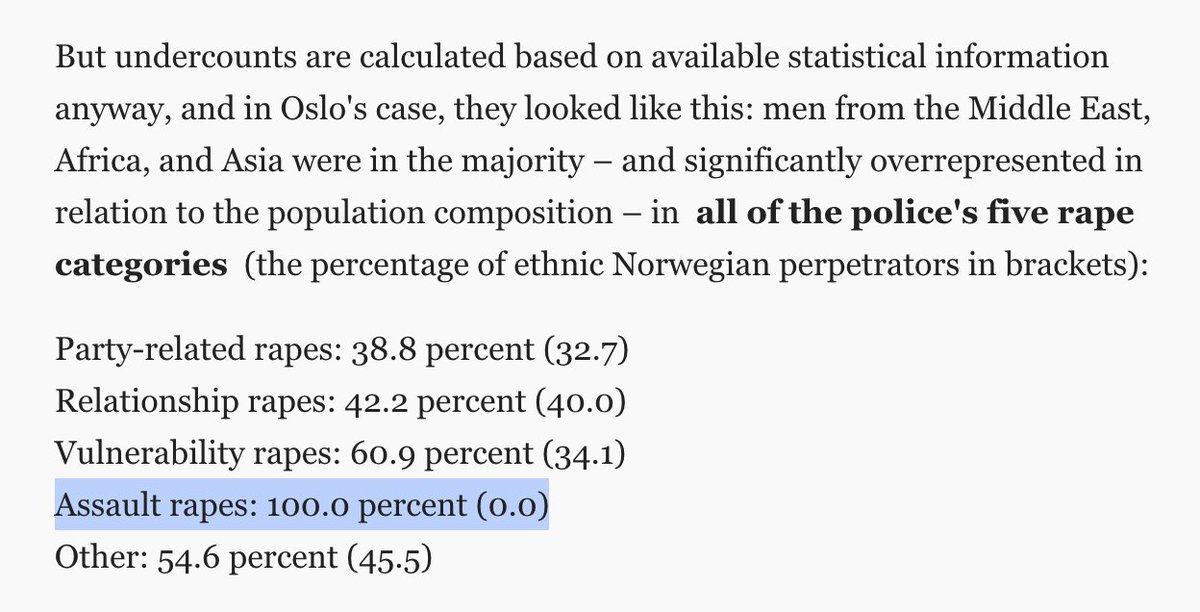
Here is an important thing to understand about rape and women feeling safe:
There are different types of rape. For many rape victims, the perpetrator is their partner. If we are looking at what especially makes it unsafe for women to be outside in public, the most important rape type is assault rape.
This is important with regards to Muslim and African immigration. If we look at total rapes, there is a significant overrepresentation of perpetrators with immigrant background, often in the range 2.5x to 5x. This is already very bad. But nonetheless, if we look only at assault rapes, the overrepresentation would likely be far, far higher.
Unfortunately, no country in Europe systematically tracks this statistic by immigrant / native status. Even though it is among the most important things for the safety of women.
It has been tracked officially one time that I know of, in Oslo. And here they found that *100 percent* of the assault rapes were by perpetrators with immigrant background.
Mass immigration is the most anti-women policy.
@IanBatchelor11 Each of the states and territories operate quite independently anyway.
I am also biased being from WA, with our perennial secessionist streak.
Australians only really have two paths left.
The first is to do what we’ve always done when the state forgets who it serves: reject its authority outright and build something better ourselves — our own parallel systems, communications, and communities that don’t ask for their permission.
The second path is violence, which most Australians want nothing to do with.
The managerial state is pouring hundreds of millions of dollars into spying on its own citizens. Not because they’re terrified of terrorism — but because they’re terrified of ordinary Australians waking up and taking their country back.
They understand our history. They know there’s a rebellious streak baked into the Australian character. We tolerate a lot. We whinge, we take the piss, we go along with it… until we don’t.
And when Australians finally say “enough”, we don’t write letters or hold polite protests. We simply withdraw our consent and start building our own way.
That spirit is still alive in our DNA.
The Australian identity and culture is upstream of their law — and there’s nothing they can do to stop it.
Big opportunities for these super ladies in Australia;
“Ortiz-Wines is part of a new generation of women advocating for nuclear energy, even though surveys show most women are skeptics. Call them the Nuclear Power Rangers. Engineers, community organizers, influencers, even models, they have atomic levels of gumption and are helping move the dial on our most misunderstood energy source. And that’s not an easy mission: there are a lot of villains to blast into oblivion.”
Ortiz-Wines is part of a new generation of women advocating for nuclear energy, even though surveys show most women are skeptics.
Science unequivocally proves that nuclear power is super safe and super clean. But, as Oliver Stone argues in his eye-opening documentary Nuclear Now, it’s been demonized.
Article | https://t.co/di4aF3lLEP